When Jesus Said Literally Not to Take Him Literally

Jesus often used literary devices to convey nuanced, spiritual meaning.


As an English Literature major in college, I have always been interested in literary devices. Symbolism, hyperbole, allegory, imagery, metaphor, analogy, and simile are some common literary devices, and we can add parable to the list.

Jesus often spoke in parables, but he also used other literary devices. The statement that it’s easier for a camel to go through the eye of a needle than for a rich man to enter the kingdom of God is both figurative and hyperbole.

According to the Oxford Dictionary online, “figurative” means “departing from a literal use of words; metaphorical.” Many literary devices are figurative, including all the ones I listed in the opening paragraph. Literary devices make our communication more interesting, and they communicate truth in a way that is more nuanced, robust, and multi-dimensional than literal statements.

Jesus often used literary devices to convey nuanced, spiritual meaning. For instance, in the Sermon on the Mount, Jesus encouraged a more nuanced (spiritual) understanding of sin when he said:

“You have heard that it was said, ‘You shall not commit adultery.’ [Literal] But I tell you that anyone who looks at a woman lustfully has already committed adultery with her in his heart.” [Figurative]

Matthew 5:27-28

In fact, Jesus used figurative language often. To some people, he spoke only figuratively! (Matthew 13:34) (in parables) He even spoke figuratively to his disciples, and he seems to express frustration when they didn’t get it:

“When the disciples went to the other side, they forgot to take bread. ‘Watch out,’ Jesus said to them, ‘beware of the yeast of the Pharisees and Sadducees.’ So they began to discuss this among themselves, saying, ‘It is because we brought no bread. When Jesus learned of this, he said, ”You who have such little faith! Why are you arguing among yourselves about having no bread? Do you still not understand? Don’t you remember the five loaves for the five thousand, and how many baskets you took up? Or the seven loaves for the four thousand and how many baskets you took up? How could you not understand that I was not speaking to you about bread? But beware of the yeast of the Pharisees and Sadducees!’ Then they understood that he had not told them to be on guard against the yeast in bread, but against the teaching of the Pharisees and Sadducees.” [emphasis added]

Matthew‬ ‭16:5‭-‬12‬ ‭NET‬

The “yeast of the Pharisees and Sadducees” is a figurative statement. Jesus wasn’t talking about bread (literally). When the disciples didn’t get what he was talking about, Jesus told them literally not to take him literally! He also seems to suggest that seeing the figurative meaning is a matter of faith. (Not the other way around.)

Jesus was talking figuratively about the influence of the Pharisees and Sadducees in the community, their thinking, their teaching, their attitudes, their assumptions, their hypocrisy, and…. Truth be told, I am not exactly sure exactly what all he meant by their “yeast”.

That’s the thing with figurative speech. It isn’t as precise. It doesn’t carry with it a detailed explanation. Figurative speech can be more profound than more literal speech, and it can carry fuller and deeper meaning. Often, however, it requires explanation for us to understand it, and we don’t always get all the explanation we want.

Jesus provides some explanation to the disciples in this case (telling them that he wasn’t making a point about bread at all), but he doesn’t really explain exactly when he meant by their “yeast”. What is it about the Pharisees and Sadducees that Jesus was talking about? He doesn’t really say!

People we often call “fundamentalists” have developed the idea that we do not take the Bible seriously if we do not take it literally. The ministry of Jesus is replete with examples that run completely counter to that idea, but it’s easy to understand why people might want to read the Bible literally. It’s easier! We don’t have to wonder what is meant if we simply take it literally, but we clearly run the risk of missing the whole point if we insist on reading everything literally.

Continue reading “When Jesus Said Literally Not to Take Him Literally”

Does God Throw Wildflowers into a Furnace?

The title to this piece seems like a silly question, right? But Jesus said,

“Consider how the wildflowers grow: They don’t labor or spin thread. Yet I tell you, not even Solomon in all his splendor was adorned like one of these. If that’s how God clothes the grass, which is in the field today and is thrown into the furnace tomorrow, how much more will he do for you — you of little faith?”
 
Luke 12:27‭-‬28 CSB

So, we need to ask again, “Does God throw wildflowers into a furnace?” I think it’s pretty safe to say that He doesn’t, right? Jesus is speaking allegorically here.

Jesus is saying in flowery terms that flowers are here today and gone tomorrow. They are beautiful, but only for a short time. No one reads this passage to mean that has a furnace where He throws all the wildflowers in the world. A wildflower furnace.

In the context of this little parable, Jesus is saying that wildflowers are magnificent in their splendor, though they last only a short time. The fact that God makes such temporary things as wildflowers beautiful in splendor is meant to give us hope and faith that He has much more splendor in store for us, the creatures He made in His own image!

These words give us great hope when life seems to be taking us down. No one interprets what Jesus says here as a lesson in the way God disposes of wildflowers. It’s a lesson about putting our faith in God.

Continue reading “Does God Throw Wildflowers into a Furnace?”

Meaning in the Metaphor in the Bible

God intertwines metaphor and fact as only the very writer of history can do


Imagine hearing these words in the First Century:

Truly, truly, I say to you, whoever believes has eternal life.  Your fathers ate the manna in the wilderness, and they died.  This is the bread that comes down from heaven, so that one may eat of it and not die.  I am the living bread that came down from heaven. If anyone eats of this bread, he will live forever. And the bread that I will give for the life of the world is my flesh.”  The Jews then disputed among themselves, saying, “How can this man give us his flesh to eat?” So Jesus said to them, “Truly, truly, I say to you, unless you eat the flesh of the Son of Man and drink his blood, you have no life in youWhoever feeds on my flesh and drinks my blood has eternal life, and I will raise him up on the last day.  Whoever feeds on my flesh and drinks my blood abides in me, and I in him.  As the living Father sent me, and I live because of the Father, so whoever feeds on me, he also will live because of me.  This is the bread that came down from heaven, not like the bread the fathers ate, and died. Whoever feeds on this bread will live forever.”
(John 6:47‭, ‬49‭-‬54‭, ‬56‭-‬58 ESV) (emphasis added)

The crowd asked, “How can this man give us his flesh to eat?”… and they were probably thinking, “Why would we want to it? That’s disgusting!”

They took him literally, but we understand that he was speaking figuratively. In fact, Jesus spoke figuratively all the time. In fact, Mark says that Jesus spoke in parables everywhere. (Mark 4:34).

To Jesus, the physical world was like one big figure of speech. He spoke about bread, and light, and salt, and a lamp, and a vine, and a mustard seed, and on and on and on. In this way, Jesus was continually challenging the people listening to him to think beyond the physical world they knew to consider spiritual truths that transcend it.

Many, like the Jews who asked how Jesus could give them his flesh to eat, had a hard time with the way Jesus spoke. Even the disciples, themselves, found these words the comparison of Jesus as living bread for people to eat hard to swallow (pun intended). (John 6:66)

Continue reading “Meaning in the Metaphor in the Bible”

Back to an Early Church View of Genesis

We make a critical mistake when we think that Adam and Eve and Eden were perfect. Only God is perfect.


I have much enjoyed reading Joel Edmund Anderson’s blog, resurrecting orthodoxy. So much that I am reblogging his latest post which is part of a walk through Genesis: Making Sense of Genesis 3 (Part 1): The Big Picture, Nakedness, and Two Trees. Knowing history allows us to avoid the mistakes of those who came before us, but not knowing history makes it likely that we will repeat those mistakes.

So it seems that some have made the mistake in this modern day and age of reading Genesis too literally. Just suggesting that triggers a slight shudder as I can imagine someone taking umbrage with the suggestion that we shouldn’t take the Bible literally.

I maintain that we should take the Bible seriously, which means that we should let the Bible inform us when we should read it literally, when we should read it figuratively, and when it has both literal and figurative meanings. (Should we take the Bible Literally? Or Seriously?)

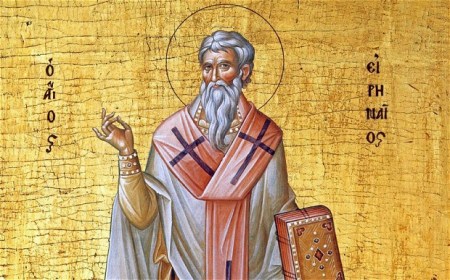
Anderson reminds us that this is how some of the most influential early church fathers viewed Scripture. For authority, he cites all the way back to Irenaeus, the disciple of Polycarp who was a direct disciple of John –  the disciple of Jesus and writer of the Gospel, epistles and Revelations. Irenaeus is just one spiritual generation removed from Jesus.

I realize that people might want simple formulas for Bible interpretation, but there is nothing simple about the universe we live in, reality or (most of all) God.

His ways are higher than our ways. We shouldn’t lean on our own understanding. Jesus left the Holy Spirit to guide us into all truth, and Jesus said we must learn to worship God in spirit and truth.

I am  not talking about New Age spiritualism or secret Gnostic knowledge. The Living God spoke to Abraham and David and took on human form in the body of Jesus, lived obediently to His own purpose as a man to the point of dying on a cross for our sins and rising from the dead in that same body to give us hope. This is the uncreated Word of God who was with God in the beginning, and was God, and through whom all that was created was made – the seen from the unseen.

Anderson says in his latest article:

“Genesis 3 was not claiming that God had created a ‘perfect’ world, because God alone is perfect. In fact, Irenaeus called the teaching that Adam and Eve were originally ‘perfect’ a gnostic heresy. Irenaeus was emphatic: God didn’t create Adam and Eve as ‘perfect’ beings.”

God called the world He made “good” (not perfect). It was good for His intended purpose, and it still is.

He certainly knew humanity would fall and fail. That was inevitable because we are not perfect; we are not God. God knew we would fail because He can see the end from the beginning, and everything in between. When He hit the “start” button on the creation, He saw how His purpose would unfold before the foundations of the earth. And, He saw that it was good.

Through our experience we learn good and evil, and the value of embracing good and rejecting evil. In this way, our experience is intended to lead us to God who alone is perfect. Through our experience, we learn to rely not on ourselves, but on God. Through our experience we learn to embrace God and His purpose. As we yield ourselves to Him, God works in us what we could never do in ourselves – perfecting us in Him.

We make a critical mistake when we think that Adam and Eve and Eden were perfect. Only God is perfect.

I’ve heard people say that there was no pain or death before the fall. Why, then, does God tell Eve that her pain in childbirth will increase (multiply)? (“To the woman He said: “I will sharply increase your pain in childbirth; in pain you will bring forth children. Your desire will be for your husband, and he will rule over you.” (Genesis 3:16)(Berean Study Bible))

We need to be careful not to let the agendas and theological constructs of others inform us rather than the Word, itself. The Word of God is living and active, sharper than a double edged sword, and is able to discern the thoughts and intents of the heart. (Hebrews 4:12-13) We need to let God’s Word inform us through the guidance of His Holy Spirit.

The danger of systematic theologies and secret formulae is that we don’t know how much of the system or the formula is our own invention. We need to be guided by the Word of the Living God, the Bread of Life.

All Scripture is God-breathed and “useful for teaching, rebuking, correcting and training in righteousness, so that the servant of God may be thoroughly equipped for every good work.” (2 Timothy 3:16-17)

The idea that Genesis should be taken absolutely literally and historically is more of a modern construct than a biblical one. (See Is Young-Earth Creationism Another Gospel?) That doesn’t mean Scripture isn’t God-breathed and we shouldn’t take it seriously.

From the beginning the followers of Jesus read Scripture as the word of God. They took it so seriously they were willing to die for it – not for it alone, but for the God it revealed. And though they clung to the Scripture, for in it was revealed the Messiah, Jesus, who they followed, they didn’t read Genesis as literal, historical record.

~~~~~~~~~~~~~~~~~~~~~~

Postscript:

Irenaeus was born in Smyrna (now Turkey) to a Christian family in 130 AD, just a generation after John the apostle died. He stood against heresy, being one of the first theologians to use apostolic succession to protect the integrity of the Gospel. His close connection to Jesus, Himself, through Polycarp who was mentored by John the apostle, was his authority.

“Irenaeus’ point when refuting the Gnostics was that all of the Apostolic churches had preserved the same traditions and teachings in many independent streams. It was the unanimous agreement between these many independent streams of transmission that proved the orthodox Faith, current in those churches, to be true.” Irenaeus is credited with arguing that all four Gospels (Matthew, Mark, Luke & John), and only those four Gospels, were Scriptural. (See Wikipedia)

He preached the rule of faith, one of the earliest church creeds, as a standard for orthodoxy:

…this faith: in one God, the Father Almighty, who made the heaven and the earth and the seas and all the things that are in them; and in one Christ Jesus, the Son of God, who was made flesh for our salvation; and in the Holy Spirit, who made known through the prophets the plan of salvation, and the coming, and the birth from a virgin, and the passion, and the resurrection from the dead, and the bodily ascension into heaven of the beloved Christ Jesus, our Lord, and his future appearing from heaven in the glory of the Father to sum up all things and to raise anew all flesh of the whole human race…

We might credit Irenaeus for solidifying and defending the idea of the Trinity, being one God in three persons. “Irenaeus used creation to distinguish the Father, Son, and Holy Spirit from that which is created, to identify the Three as the one Creator God, and to secure their distinction. In so doing Irenaeus became the first to support his belief in the Three as God with an account of God as three.” (See Iranaeus: the Creation and the Father’s Two Hands)

Sam Harris Podcast with Bart Ehrman – Part 2 – Wooden Fundamentalism

A rigid and wooden fundamentalism is an all or nothing way of looking at scripture that cements secondary things into the primary framework of our belief system.


This is a continuation of observations in regard to a podcast interview of self-described agnostic, New Testament scholar, Bart Ehrman, by the atheist, Sam Harris.  In the first installment, I focused on Ehrman’s personal story about “losing his faith” as he transitioned from high school to Moody Bible Institute to Wheaton College to Princeton Theological Seminary. Along the way, he went from fundamentalist to agnostic. In many ways, though, he never left his fundamentalist view of the Bible.

Ehrman says that he began to shed his fundamentalist views as he learned the original languages and began to read scripture in those original languages. He describes how his rigid, nonintellectual reading of the scriptures began to crumble as he discovered issues with the Bible that didn’t allow such a strict interpretation of a text considered to be inerrant.

As the interview progresses, Erhman relates that he used to believe in a literal rapture, alluding to the Book of Revelations read in light of 1st Thessalonians (being caught up in the air).[1]  Erhman comments, “I not only believed in the rapture, I knew it was going to happen in the late 80’s” (followed by a hearty guffaw).  He goes on to describe that his loss of faith was a long process, but the “rapture was one of the first things to go”.

This was Ehrman’s fundamentalism, but “the rapture” is hardly a point of “doctrine” on which even fundamentalists agree, let alone the rest of the believing world. The verses in the Bible from which the idea of a rapture has been formulated are few, and they are wrought with difficulty in the interpretation, like the visions in Revelations and other apocalyptic writings. Many speculations have been suggested[2], but the whole idea is quite ancillary to the central tenets of the faith.

A person certainly doesn’t have to believe in the rapture or in any particular formulation of the rapture to believe in God or to have faith in Jesus Christ.

We often get the peripheral things inextricably intertwined with the essential things in our minds, and it’s hard to untangle them. This is the danger of placing too much importance on peripheral things, especially peripheral things with as little biblical support as the rapture: when the peripheral things begin to unravel, they are likely to begin to unwind the essential things if we have bundled them too tightly.

Rigid and wooden fundamentalism is brittle for that very reason. It’s an all or nothing way of looking at Scripture that cements secondary things into the primary framework of our belief system. We have to hold on tightly to the whole thing to keep the faith. When we allow any part of it to come unraveled, it’s likely to unravel the whole thing. The issue isn’t with Scripture, however; the issue is with the approach.

Continue reading “Sam Harris Podcast with Bart Ehrman – Part 2 – Wooden Fundamentalism”