Are We Alien and Strange Enough in Our World?

Are you looking for a heavenly country?


Aliens and strangers in our world: that is an apt definition of Christians. We are made for more than the present heavens and present earth that we live in. Though we are born of perishable seed, we have been born again of imperishable seed, and we look forward to the day when we, like the acorn, will die so that we may rise again.

I say these things as I think about the chaos, or law and order, of our times, depending upon your perspective. I see it as chaos from the perspective of the immigrants who have come to the United States for a better life. It is just law and order from the perspective of the person who defends the current immigration laws of our country.

Of course, it isn’t that simple. Slavery was once legal in our country. Is it really just law and order? Or is it something else?

Our ancestors came here for a better life. Unless, of course, our ancestors are Native American. My father’s ancestors came here in 1846. they entered a commercial port in New York City before Ellis Island existed and before there was any process in place to receive immigrants. My mother’s ancestors came here long before that.

When I was young, we celebrated the pilgrims and other sojourners who came here for a better life. Seeking a better life for ourselves and our families, our children and our children’s children was the American way. We were proud of the pioneer spirit brought people to our shores.

It’s also a bit more complicated for Christians, as we believe this world is not all there is, as I often say. Followers of Christ know that a place has been prepared for each one of us. We know that storing up treasures on this earth is a futile and fruitless endeavor at the end of our days. The only thing that ultimately matters are the treasures we store in heaven – if, indeed, we are actually people of faith.

We store our treasures in heaven by following the narrow path, by taking up our crosses and following Jesus. We do this by laying down the desires of our own flesh, and living for the love of God and the love of our neighbor.

To those of us who are clinging to the rock of this country, who are trying to defend the law and order that protects our comfort, our future, and our way of life, I say, you are clinging to the wrong thing. In fact, it really isn’t really a rock at all.

A nation is actually shifting sand. Like the sands of the great civilization of Babylon that lies today in deserted ruins, on a wind-swept dessert expanse without inhabitant. A nation is an empty and parched hope that turns to dust. People, however, have eternal value.

As I look at the way the present administration of this country is carrying out the agenda of President Donald Trump, I am saddened all the way around. I am not unpatriotic. I am not empty of all nationalistic pride, but the older I get and the more deeply I commit to Jesus, the more I identify as an alien and stranger in our world. My citizenship is not ultimately in the United States of America – or in any worldly nation. My citizenship is in heaven.

And as I turn down another stretch in this journey of my life, I am learning to be more focused on life after life, which is the life that Jesus urges us to focus on. The kingdom of God, which is not a kingdom of this world, is a foretaste of the next. That is the aim of people of faith.

By faith Abraham made his home in the promised land like a stranger in a foreign country. Isaac and Jacob did the same. They were waiting for “the city with foundations, whose architect and builder is God.” (Hebrews 11: 9-10) All the people offered to us as examples of faith in Hebrews 11 welcomed the promises of God from a distance as “welcomed them from a distance, admitting that they were “foreigners and strangers on earth” (Heb. 11:13) because they were longing for a “heavenly country” (Heb. 11:16) – not an earthly country.

So, as Christians on either side of the modern immigration issues, we cannot lose sight of our heavenly home, of that city whose architect and maker is the Lord. We longingly wait for the new heavens and the new earth that will come down and that day when the Lord, Himself, will dwell among us. That is our destiny and that is our destination.

Nations come and go. The grand monuments to our national identities will become like the Babylonian ruins, the heavens and earth will fade away, but a person who is born of imperishable seed lives forever. What, then, is a nation? Nations do not last.

We live by faith in the hope of the new Jerusalem where people from every tribe and nation and tongue will gather before the throne of the Lamb, crying, “Holy! Holy! Holy! Lord, God Almighty!” No human eye has seen nor mind conceived what is the greatness of the world that lies in store for us.

Why cling to the comforts and the privileges and the things that we can accumulate in this life when we are promised a life we cannot even imagine? Perhaps it is because we have a hard time imagining it. Yet, that is the substance of true faith – the certainty of things hoped for.

We should ask ourselves as we look at the great examples of faith God chose to parade before us in Hebrews 11 whether we would be honored to be counted among them? Or whether we think they were foolish to be tortured, jeered at, flogged and imprisoned for such a hope? They are commended for their faith in the promises of God they didn’t receive in this life.

Perhaps, the immigration issue separates sheep from goats. The laws and order of this country that wall out a field that is ripe unto harvest for the imperishable seed of the gospel are of illusory value to the person of faith. Are we willing to gain our country at the loss of our citizenship in heaven?

That is a question we all must ask ourselves. Even if we do not ask that question, though, we are all deciding which side of the wall we are on in the decisions we make daily. Are we aliens and strangers in our world? Or have we chosen the world as our portion?


Christmas: The Triumph of the Almighty God Is Not Exactly As We Might Have Imagined It

The hope we reflect on in wonderment at this time of year

The words of the ancient prophet, Isaiah, are spoken often this time of year:

“For to us a child is born, to us a son is given, and the government will be on his shoulders. And he will be called Wonderful Counselor, Mighty God, Everlasting Father, Prince of Peace. Of the greatness of his government and peace there will be no end. He will reign on David’s throne and over his kingdom, establishing and upholding it with justice and righteousness from that time on and forever. The zeal of the Lord Almighty will accomplish this.”

Isaiah 9:6-7 NIV

These words were spoken many centuries before one, Jesus of Nazareth, was born in Bethlehem while his parents were in town for a census. This passage is full of triumph: “Mighty God”, an “Everlasting Father”, and “Prince of Peace”. “The government will be on his shoulders,” and he will “reign on David’s throne” – the “Lord Almighty!”

These words foretell of a mighty, conquering, benevolent God. (Benevolent after the conquering bit, of course). Human beings have always venerated and celebrated strength, and what could be more compelling to us than a conquering king (provided he is benevolent also!)

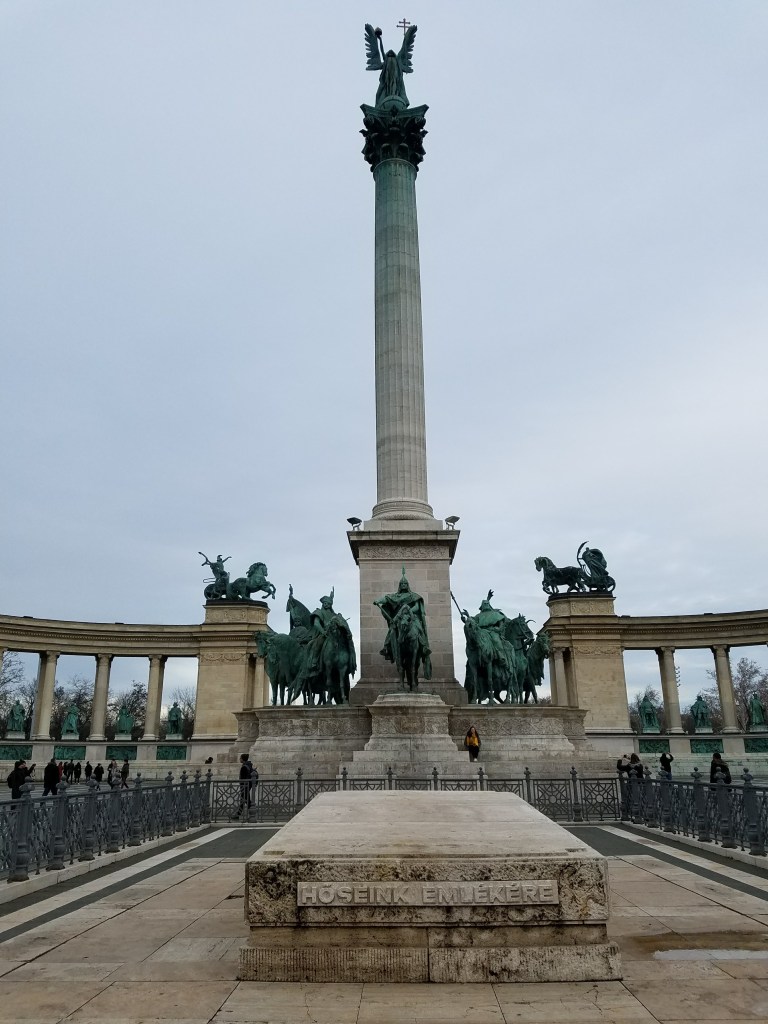
This is the way people view God and the world. This view of God inspired the crusades. It inspired many kings and nobleman through the ages like Stephen I, Szent István király. Born in 975, Stephen took the throne on December 25, 1000, and he became the last “grand prince of the Hungarians”, and he is the first King of Hungary.


I took the photos I have reproduced here when I was visiting my daughter in Hungary this time of year 6 years ago. The prominence of Steven and other kings in Hungarian lore is evident in the statuary around Budapest and in the stately basilica named after him that lies near the Danube in the center of the City.


Stephen succeeded his father as a grand prince of the Hungarians, but he had to fight for the throne against his own extended family. He fought many wars against surrounding tribes and chieftains, including his own uncle. He “converted his uncle’s ‘country to the Christian faith by force’ after its conquest,” and he “encouraged” the spread of Christianity “by meting out severe punishments for ignoring Christian customs.” (See Wikipedia)

Many modern minded people with sensibilities trained over the last generation likely squirm (or fume) over stories like Stephen’s, as children are taught in grammar school to recoil at the “imperialism” of our Western/Christian forebears. The so-called “Christian nationalists” among us likely count Stephen a hero of the faith.

Indeed, Hungarians today proudly celebrate Saint Stephen as a national hero, but this celebration seems more focused on nationalistic pride than the spread of Christian faith – if faith can be commandeered by force. Stephen is hailed for unifying the tribal regions around him under his kingship, giving birth to the nation of Hungary.

That the nation was unified under a Christian flag seems to be more of a national identity than a statement of faith. While I was visiting, I observed that Hungarians did not appear, as a whole, to be a people of devout faith.

A 2017 poll reveals that Hungarians, indeed, are not very religious. While about 76% of Hungarians self-identified as “Christian”, only about 8% of Hungarians attended church services on a weekly basis, “placing Hungary among the countries with the lowest church attendance in Europe” (according to my very cursory research using Chat GPT).

While the notion of a king conquering in the name of Christ may be a source of national pride for some, it makes other people feel uneasy. It makes me uneasy.

We celebrate at Christmastime the triumphal prophecies foretold by Isaiah of the Lord Almighty taking the government on his shoulders with zeal and reigning on David’s throne. Yet, this imagery contrasts with the images of the story of the birth of Jesus, born of a humble virgin in a lowly manger because they had no influence to make room for themselves anywhere else.

As this story goes, God incarnate was born in poverty, on the edge of the Roman empire, in the humblest of circumstances, to parents who were not even married. God came into the world as an infant, weak and vulnerable.

God is human form became a refugee when his parents fled to Egypt to avoid King Herod’s decree to kill the male babies in the region of Galilee. They returned after Herod’s death but moved to the more remote and neglected area of Nazareth where Jesus grew up in almost total anonymity apart from the small community of people who knew him.

These realities stand in stark contrast to the conquering and reigning king imagery of Isaiah and the images of kingly might we celebrate in people like Saint Stephen. We consider these paradoxical images this Christmas day, December 25, 2024, as we recall the birth of our Savior and Lord, Jesus, and what it all means for us.

Continue reading “Christmas: The Triumph of the Almighty God Is Not Exactly As We Might Have Imagined It”

Keeping it Real On the Path to Wherever I am Going

The sense of loss and the emptiness of having traveled so far just to get to this place can be overwhelming.


I have been writing now for about twelve years on this blog. I started it because I am a professional writer (of sorts), and I wanted to use the talents God gave me for something bigger than me.

I became a Christian in college, and that conversion diverted me from any career path I might have wandered down. I should emphasize the wandering, because I wasn’t very career-minded to begin with. I was a truth seeker, and I still am.

I thought I would go into “ministry”. That’s all I really wanted to do, but I wasn’t on a track for ministry. It was a very secular college with very traditionally secular guidance to provide. I was a crazy Christian convert who was reading the Bible and believing it.

I became a student leader of the campus InterVarsity group. We had virtually no oversight. That group of fledgling college students, like myself, was my discipleship group

I was certain about one thing: that God existed, and He had changed me. I didn’t know much of anything else.

I gravitated toward a local independent, Charismatic church about 40 minutes away. I would go to church there many Sundays, but I was a college student preoccupied with the things college students did. I mentored with the head pastor for a short time, but not long enough to make much of a difference.

I didn’t trust my college advisors because they didn’t believe the Bible like I did. I should have gone to seminary, but I didn’t because the apostles who stood up on the day of Pentecost and preached powerfully and eloquently in various tongues to the crowds in Jerusalem were unlearned men. I wanted to be like them.

These words Paul spoke to the Corinthians heavily influenced me: The Gospel is foolishness to those who are perishing (1 Corinthians 1:18); and God makes foolishness the wisdom of the age. (1 Cor. 1:20-21) I thought I didn’t need a seminary. In truth, I was afraid that a seminary would try to conform me by the wisdom of the age.

I should have paid more attention to what Paul said to the Corinthians: Greeks look for (worldly wisdom), but the Jews demand signs. (I Cor. 1:22) I wanted signs. It turns out that Paul was right. Worldly wisdom and demanding signs are both misguided paths.

I went off to the East Coast chasing after a church, the legend of which I heard from the man who become my best friend in college. Maybe the best friend I have ever had. A true brother in the Lord, Jesus.

We encouraged each other in that season of our lives. We both had become Christians after leading wild, existentially-angst-filled lives in our youth. We came to the kingdom of God with baggage (who doesn’t?), but we knew that Jesus had the words of life, and we were all in.

I packed my bags for a summer counseling job in a Christian camp on the south side of Like Winnipesaukee like Abraham leaving behind his homeland for the promised land. I didn’t believe I was ever coming back. Only God knew my intentions at the time.

After camp ended and I helped to close it up for the next camping season, I moved a half hour north into the last communal house left over from the Jesus People movement that swept this tourist area in the late 60’s and early 70’s. That movement of the Holy Spirit caught a bunch of migrant hippies in its current and deposited them downstream from wherever they thought they were wandering into Christian communal living.

Those communes were a legend I only heard snippets about when I arrived, but the communal spirit was still in the air. I loved it. I embraced that communal spirit for the next 40 months, and I plugged into the life of that church.

I grew up as person and as a young Christian during that time in many ways. The church was edgy. It was brash. It tried to be authentic. It dared to think big, and I ate it up. But, it wouldn’t last. (It disintegrated and splintered into many fragments not long after we left it.)

I still wanted to be in ministry, though I had no vision. I thought it would just happen. I had heard that a man’s gift makes room for itself. (I think that is in a Proverb somewhere.) But it wasn’t happening for me. I was also young and impatient and impetuous.

I had always longed for love and intimacy. I was a romantic dreamer. I was heavily influenced by Disney stories of life lived happily ever after, but I knew nothing of the promise those stories offered. I still don’t.

I married on a whim, encouraged by “a word spoken over me” that I didn’t understand, but I acted anyway. That determination to act was pivotal.

Just over 40 years have past. I have been married, now, for 39 years. It would be 40 years in November, but my wife left me almost two years ago, and I don’t think we are going to make it to 40.

I am not sure exactly where I am going here today, other than the need I feel to keep things real. I don’t usually focus so much on myself, but I have gotten used to writing to work out the thoughts in my head, and today those thoughts involve trying to make some sense of my life.

Continue reading “Keeping it Real On the Path to Wherever I am Going”

What The Bible Has to Say about Grumbling and How to Overcome It

The pressures we face and how we react to them determines our character.

The Bible has a something to say about “grumbling”. Have you ever noticed that? What’s the deal with grumbling? What IS grumbling, anyway? I was realized recently that maybe I should not assume I know, so I spent a little time digging into it. My writing today is inspired by James:

Don’t grumble against one another, brothers and sisters, or you will be judged. The Judge is standing at the door! Brothers and sisters, as an example of patience in the face of suffering, take the prophets who spoke in the name of the Lord. As you know, we count as blessed those who have persevered. You have heard of Job’s perseverance and have seen what the Lord finally brought about. The Lord is full of compassion and mercy.

James 5:9-11 NIV

James tackles grumbling against others, and says that people who grumble against others judge them. (While our own Judge is at the door!) James also contrasts grumbling to perseverance, grumbling against others seems to be a failure to persevere.

If anyone had a legitimate opportunity to grumble it was Job, who was afflicted though he was a man who was considered blameless, full of integrity and pure in his desire to worship God. When he was afflicted, his wife urged him to grumble against the Lord. His wife said to him,

“Are you still maintaining your integrity? Curse God and die!” He replied, “You are talking like a foolish woman. Shall we accept good from God, and not trouble?” In all this, Job did not sin in what he said.

Job 2:9-10 NIV

Thus, grumbling is something we do against God also. Grumbling is something we encourage each other to do at times, perhaps, because “misery loves company”. Job was goaded by his wife to grumble against God, but he refused. Job is held up by James as a model for us to follow: a man who persevered patiently in difficult circumstances without grumbling.

The word translated “grumbling” in James 5:9 is the Greek word, στενάζω (stenazó), which means literally “to groan (within oneself)”. It can be used as an expression of grief, anger, or even desire.

The word, stenázō, comes from the root word, stenós, which means “compressed, constricted”. The idea is that one who groans is doing so “because of pressure being exerted forward (like the forward pressure of childbirth)”. Figuratively, it means “to feel pressure from what is coming on – which can be intensely pleasant or anguishing (depending on the context)”. (See Biblehub)

Stenós, then, seems to be the internal pressure that causes us to groan inwardly, and stenázō seems to be an outward negative response to that inward pressure – to grumble. The word is also translated complain, murmur, and grudge.

As I think about these things, I realize that we do not control the pressures that bear down on us from within (and without), but we do control how we react to those pressures. Grumbling, complaining, and murmuring against others and against God is a negative reaction to the pressures we face.

James calls us to react differently to the pressures we face. He calls us to bear up with patience and perseverance. If we give in to grumbling and complaining against each other, we become judges of each other, forgetting that we have a Judge who stands at the door. When we grumble against God, we judge our Judge!

This passage also suggests that, while we may groan inwardly, we do not have to groan (grumble and complain) outwardly – though we may strongly desire to! We have a choice in the matter, and the better choice is to be patient and persevere.

That observation, perhaps, begs the question: why is it better to persevere with patience rather than grumble?

Continue reading “What The Bible Has to Say about Grumbling and How to Overcome It”

The Importance of Building Your Ark as God Instructs

We do not walk alone; we walk with God and with each other. Perhaps, my experience will be helpful as I have been helped by others who have had similar experiences.


I was praying one morning recently for God’s help to guide me away from the paths of thought and actions that take me down. I had been wrestling lately with old sin and losing the battle.

I do not often get so personal on this blog, but God knows all. He knows my heart, my thoughts, my actions – everything. He knows the words I speak before I even say them (or write them as the case may be). Nothing is hidden from Him.

I do have people who are close to me who I confide in and help me sort through these things. Still, being so personal is hard.

To get to the point, I have been married for 38 years as of November, but my wife informed me last June that she hasn’t been happy in a long time, and she moved out. I have been sad and depressed since she left.

Her leaving, and the present silence and emptiness in my life without her have filled my thoughts and haunted my waking hours since then. I have spent most of my life working to support my family. Our kids are out on their own now, and I was beginning to let myself think about retirement for us.

Now, everything has changed. At the age of 63, I am adrift. My future is uncertain. I am sad for her, and I am sad for me and I fear the future will not be easy for either of us.

I doubt she will not be happier now. I have often said and believe that the grass isn’t always greener….. But, she doesn’t seem to see it that way. Perhaps, she is willing to trade one kind of unhappiness for another.

Maybe I haven’t been happy myself for a long time, but I don’t really think about it. I have come to believe that happiness is fleeting. I can live with unhappiness. I would rather search for a joy that lasts forever than settle for mere happiness that is here today and gone tomorrow.

Maybe that attitude doesn’t make for a good marriage. I don’t know. I do know that I am no hero in this story. I have failed in many ways, and my failures hang like a dark cloud over me. They threaten to crush me.

I have not written much since June because of these things. I haven’t had the inspiration or the energy to write. Yet, I feel God called me to write, so I am trying to plod on.

I don’t want to dwell on these thoughts, but this is where I was when I approached God one recent morning. My failures, disappointments, regret and other negative emotions are ever before me, and they threaten to undo me.

Not the least of which is the gravitational pull to give in to old ways of thinking and to succumb to old habits. I have at various times lost the will to overcome and fallen back, and I have despaired in my falling back.

As I asked God to help me, to rescue me from my thoughts that threaten to take me down, a verse I read in my daily Bible reading that morning seeped back into my conscious thoughts, and I engaged with it:


“And Noah and his sons and his wife and his sons’ wives entered the ark to escape the waters of the flood.” 

Genesis 7:7 NIV


Noah, who was said to be “blameless in his generation”, was saved from the judgment of God by building an ark. That ark was the vessel that lifted Noah and his family above the waters and carried them on to safety.

Continue reading “The Importance of Building Your Ark as God Instructs”