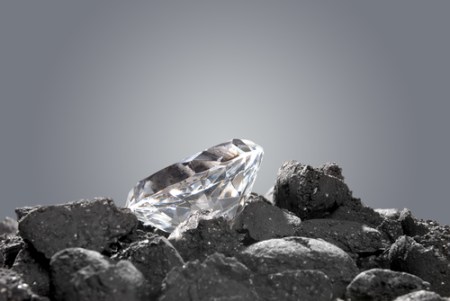
Diamonds and coal are made from the same substance, carbon.[1] They are both formed by heat and pressure, but the results are very, very different. We can learn some very poignant things from diamonds and coal that I will explore in this piece.
The properties of the two substances are interesting, and very different, though they form from the same substance. Coal is relatively soft. Coal burns and provides a source of energy, but it is not a very clean source of energy because coal is full of impurities.
Diamonds, on the other hand, are relatively hard – one of the hardest substance that exist. Diamonds have few impurities, and diamonds won’t burn. Diamonds can be used for cutting hard metals and similar uses because they are so hard and immutable.
Coal is readily available. It is soft and combustible. Coal is dirty and rubs off everywhere. Coal is really only useful for burning. Appropriately, a coal in the stocking has become cliché for an unwanted “gift”.
Diamonds are clean, translucent, rare and beautiful. Diamonds are highly valued for their own sake. So much, that we wear them on our fingers and around our necks as adornment for special occasions. They are also highly useful in all kinds of industrial applications.
Interestingly, diamonds and coal are both formed by heat and pressure. The difference is only in degree and location.
Coal is formed relatively near to the surface of the Earth, while diamonds are formed deep within the Earth. Diamonds are formed under tremendous heat and pressure over a long period of time. Coal forms relatively quickly under less heat and less pressure.
The result is that coal is full of impurities. Coal is still combustible, though it is formed under heat. Diamonds, on the other hand, undergo so much heat and so much pressure, that they are no longer combustible. All the impurities have been burned away.
I have heard that diamonds form from coal, but they don’t. Though diamonds and coal do form from the same substance – carbon – one doesn’t form from the other.
Carbon can be formed into diamonds, or it can be formed into coal. It’s one or the other. Coal never forms into diamonds, and diamonds never form into coal. The paths for the two elements are completely different, and the difference in the process under which they form results in two completely different elements – though they form from the same basic substance.
These facts that I have taken some time to gather in relation to diamonds and coal prompt some very poignant thoughts, beginning with the question: Would you rather be a diamond or a lump of coal? How do the processes of the formation of diamonds and coal, and nature of diamonds and coal, instruct us?
Continue reading “Diamonds and Coal and the Pressures of Life that Shape Us by Our Reactions to Them”


 Navigating by Faith