I did not decide to vote until I approached the turn off to head to my home from my office. I wasn’t excited about voting this time, and I put off the decision to vote until the last second. A sense of obligation convinced me to make the short detour to my local polling place.
Even so, I punted on my vote for a president. I couldn’t pull the switch for red or blue. I just didn’t have it in me.
I know I am not alone in the way I felt this election season. A Relevant Magazine article published October 8, 2024, reported on survey results indicating that 41 million Christians did not plan to vote in this election. They are my tribe, and I was one of those 41 million.
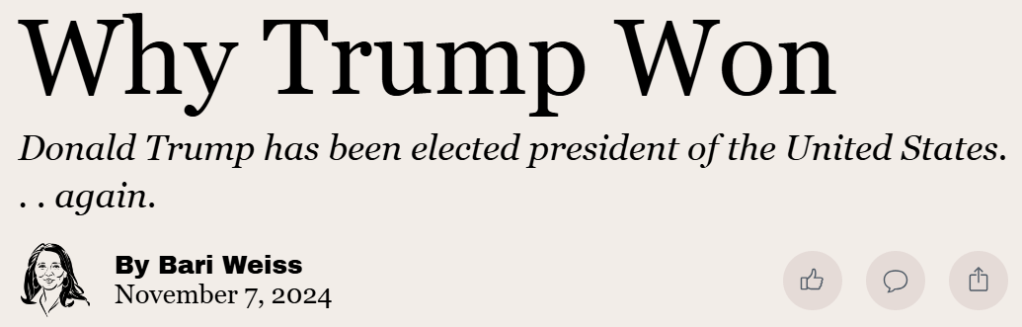
A dialogue with a long time friend (who probably doesn’t see the world as I do) about why the election results turned out as they did inspired me to do some post-mortem review of the election. I chose a trusted source for that analysis: Bari Weiss, a former NY Times reporter who has established her own news outlet, the Free Press.
I spent some time today listening to the latest podcast episode on Honestly, with Bari Weiss, Why Trump Won. Bari Weiss is lesbian and liberal. Her panel of experts included a transgender woman, Brianna Wu, and her conservative representative was Batya Ungar-Sargon. Senior Editor of the Free Press, David Svadnik rounded out the panel.
I like to say, “Truth is truth”, and I appreciate people who are able to put aside their agendas and biases and speak to truth. We all have them (agendas and biases), but there is something highly valuable about the effort to cut through those personal values that motivate us and be honest about the way things really are.
Bari Weiss started the discussion with statistics from CNN exit polls that show Trump won about 13% of black voters in 2024 (up from 8% in 2020), and Trump won 45% of Latino voters (up from 32% in 2020.) She noted that Trump improved on his 2020 votes almost everywhere.
This seems to be at the center of the story of this election. Weiss says, “It’s indicative of a massive countrywide political realignment.” It was a “Republican landslide”, and the question we should be asking is, “Why?”
I recently heard Tim Alberta say that some modern evangelicals have picked up a sword, and that sword is Donald Trump. Such a sword is needed for success in a culture war, and a culture war mentality drives the politics of many, if not most, of evangelicals today.
Many evangelicals are concerned, if not fearful, of current cultural trends. People are pulling away from and rejecting traditional Christian values in the US. The change has been rapid (as far as cultural trends go). American society is going the way of Europe and Canada in letting go (and outright rejecting) Christian labels, overtly Christian thinking, and church attendance.
Perhaps, nothing demonstrates the cultural movement away from Christianity in the United States like the book, The Nones: Where They Came From, Who They Are, and Where They Are Going, by Ryan P. Burge. The author says that only five percent (5%) of Americans claimed “no religion” in a 1972 poll. That number rose to over twenty three percent (23%) by 2018. This made “nones” as numerous as Catholics or evangelicals in the US in 2018.
Nones are predominantly young Americans, but this trend does not just affect the nation’s youth, and it has picked up momentum since COVID. Robb Redman reports from various sources on community trends and culture for worshipleader.com, including the following:
70% of Americans were church members in 1999 (Gallup);
Less than 50% of Americans were church members in 2023 (Id.);
45 million Americans have stopped going to church in that time;
41% of Americans 39-57 went to church regularly in 2020 (Barna);
28% of Americans 39-57 went to church regularly in 2023 (Id.).
Ryan Burge partnered with Jim Davis and Michael Graham to explore the reasons for this precipitous decline in church membership and attendance and the rise in self-described nones in their recent book, The Great Dechurching. This book has become the topic of much conversation in the short time since it was published. I haven’t read the book yet, so I posed the question, “What are the top five reasons people have stopped going to church, listed from most common to least common”, to two different AI platforms. The results from Bing Co-Pilot are as follows:
Judgmental attitudes (87%)
Distrust of organized religion (74%)
Too focused on Money (70%)
Busy schedules (67%)
Loss of Habit (58%)
The Co-Pilot response summarized studies done by the Pew Research Center, Gallup Polls, the Barna Group, the Public Religion Research Institute and various academic studies to generate this list. I note that the first three reasons people have given for not attending church are issues with the Church I am referring to the Church (capital C) because I don’t know how this breaks down among denominations. The other two main reasons are unrelated to the Church; they reflect personal and societal lifestyle issues.
Chat GPT reported different results, citing some of the same sources (Pew and Barna) and some different sources (General Social Survey and books and articles, generally, including Sociology of Religion by Diana Butler Bass, an academic book). The Chat GPT list is not as straight forward:
“A growing disconnection with church teachings or religious beliefs” (about 60%-70%);
“Negative experiences, such as feeling judged or encountering hypocrisy” (about 30%-40%);
“A perceived irrelevance of church” and disconnectedness of the church to modern issues (about 25%-35%);
Busyness, lifestyle, time constraints, and changing priorities (about 20%-30%); and
Exploring alternative spirituality and religious practices (about 15%-25%).
Again, the first three (3) (and the most prominent) reasons for not attending church deal with the Church, itself. Worldviews are shifting away from the views held by the Church (which seems to indicate we are losing this “culture war”). The Church is perceived as disconnected from modern life and the modern world and not relevant to it, and the Church is perceived as overly negative and hypocritical.
The one area of overlap is the high percentage of people who list judgmental attitudes, including negative experiences and hypocrisy) as major reasons of not attending church. This is obviously a key issue (ranking 1st and 2nd respectively).
I find this to be highly problematic for the Church because the Paul plainly said the Church should not be (presently) judging the world (according to Paul (See What Business Do We Have Judging the World?)) And, Jesus said we should be known by the love we have for each other.
It seems pretty obvious to me in my own anecdotal experience that the American Church, generally, has some significant issues in this regard. We are not following Paul’s instruction not to judge the world, and we are failing to love each other well.
I recently watched a Gavin Ortlund critique of fundamentalism in the Church today that focuses on these issues. He says it well when he describes a segment of the Church that is focused more on what followers of Christ should against, rather than than what we should be for. When our focus is on the negative, our positive message is likely to be eclipsed and obscured and it lost in the noise.
I realize, of course, that this “indictment” of the Church generally, is a very broad brush. The church I attend does not fit this mold. Most of the Christians I have close relationships with do not fit this mold. We don’t have to look very far or deep on social media, however, to see evidence of judgmental attitudes, hypocrisy, and negativity.
It’s interesting to me that resources Co-Pilot pulled from identify more negatives (distrust of organized religion and too focused on money) in the top three reasons for not going to church, while the Chat GPT sources identified “growing disconnection with church teachings or religious beliefs” and perceived irrelevance of church” and disconnectedness of the church with modern issues. Distrust and money-focused have nothing to do with message, but disconnection with church teachings and a perceived irrelevance with modern issues has everything to do with message (theology).
Exploring alternative spirituality and religious practices (the 5th reason noted by the Chapt GPT response is related to the disconnection responses. I don’t know whether these things are causal or just symptomatic. If people were finding what they were looking for in church, they wouldn’t disconnect and look elsewhere. If their church experience wasn’t negative, they might still be connected.
On the other hand, both sources identify other things that are going on. Busyness, lifestyle, time constraints, and changing priorities are “neutral” pressures that are affecting not just churches, but service organizations, fraternal organizations, and other traditional ways people have gathered together.
We see a spike in this trend of disconnection from Church membership and attendance after COVID (pun intended). COVID seemed to supercharge changes that were already in the works in many areas of life. People were already disconnecting from face-to-face contact with other people with the proliferation of hand-held devices and social media going back at least to 2012. COVID isolated people even further.
Sociologist, Jean Twenge, finds sharp changes in teen behavior and mental health starting in 2012, which she attributes to teen use of smartphones and other hand-held devices. Her findings about the changes in the behavior of teens is a yardstick to measure the pulse of society.
A published interview with Twenge as Time Magazine’s Person of the Week, reports that “Gen Z is in the grips of a historic mental health crisis, with teenagers struggling with record levels of depression, anxiety, and loneliness.” Twenge, who has studied many generations of teens, discovered “big and sudden” changes in Gen Z starting around 2012, when hand-held devices became normalized among teens.
Those changes included, among other things, a doubling in the diagnosis of clinical depression among 12-17 year-olds from 2011 to 2019. At the same time, teens reported significantly less face time with other people corresponding significantly with more screen time. I have heard her say that teen pregnancy is down (which seems to be a good thing) because teens spend more time on their phones in their bedrooms alone than spending time with each other (which is problematic).
So, what does this have to do with Donald Trump and Christians fighting a culture war to try to preserve their power and influence in a society that seems to be pulling away from us? I seem to have wandered far afield, but now I am going to pull it in and get to the point.
It seems our culture needs Jesus more than ever. At the same time, people are do not see the benefits of knowing Jesus. At the very time when people need the grace and love of Christ most, people are being pushed away by judgmental attitudes and negative experiences. As people are struggling with isolation, polarization, and mental health issues, the Church is becoming more irrelevant, disconnected, and inaccessible to them.
Ironically, it seems to me, we are not only losing this culture war, the culture war seems to be the very thing that is pushing people away and isolating them from us. As we are circling our wagons defending ourselves against these “outsiders”, and attacking them from behind our theological walls, we have lost sight of the fact that Jesus sent us out into the world to bring the Gospel to the lost.
“You must not blaspheme God or curse the ruler of your people.”
Exodus 22:28 NET
These words from Moses were quoted by Paul when he was accused of insulting the high priest, Ananias. (See Acts 23:12-35) Paul had been hauled in front of the high priest when a mob of Asian Jews saw Paul in Jerusalem and sought to kill him for the things he was saying.
The Roman authorities had to employ an army of soldiers to save Paul from the mob, and the Romans gave him his day in court with the Jewish council and high priest. When Paul got a chance to speak, he said, “Brothers, I have lived my life with a clear conscience before God to this day.”
Paul barely spoke the words of introduction before the high priest ordered Paul to be struck on the mouth. Paul responded, saying, “God is going to strike you, you whitewashed wall! Do you sit there judging me according to law, and in violation of the law you order me to be struck?”
That is when the mob accused him of insulting “God’s high priest”, and Paul acknowledged, “You must not speak evil about a ruler of your people.”
Some commentators have suggested that Paul really didn’t know he was in front of the high priest. When he found out, he apologized immediately.
Other speculate that Paul’s remarks were sarcastic. Maybe this was a backhanded compliment, false deference, a subtle challenge to the high priest’s authority, suggesting that he was not really God’s ruler.
In the Greek, the word translated “know” can also mean appreciate. So perhaps, Paul was saying he didn’t appreciate the fact that he was in front of the high priest when he said what he said. Perhaps, his outburst was a momentary lapse, and his response was an apology.
Whatever the actual nuance of the situation was, I take Paul at his word that he respected the words of Moses about respecting authority and God’s sovereignty that allowed rulers to rule. Paul would later write:
“Let everyone be subject to the governing authorities, for there is no authority except that which God has established. The authorities that exist have been established by God.”
Romans 13:1
This is all by way of introduction to the things I want to write about today: the politics of the Church and of people who call themselves by the name of Christ. The disrespectful and polarizing political rhetoric of our times is understandable, given the tensions, emotions and level of disagreement in our country, but I maintain that the rhetoric of the Church and the people of God should be different.
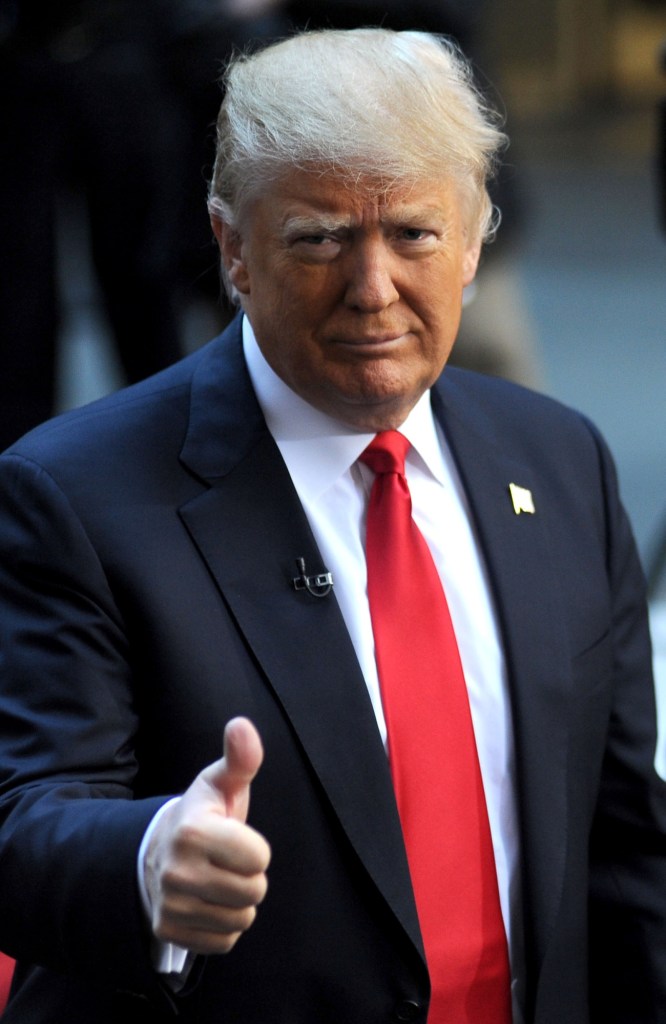
This morning I watched two different videos about Donald Trump in the aftermath of the assassination attempt that came within millimeters of ending his life. Such an experience would sober the hardest of self-made men. Trump experienced the proof of the reality of personal mortality and the razor line between alternate fates.
The first video I might have ignored, but for the source. Capturing Christianity is a YouTuber who manages a thoughtful and circumspect apologetic presence online. He interviews good people and engages in civil conversation with people who disagree with him. I am attracted to people like that.
The video purported to be about a prophecy predicting the assassination attempt on Donald Trump. I don’t run after so-called prophecies. I am immediately skeptical when I see anyone claiming to be a prophet or to have some message from God.
With that said, I do not completely dismiss the idea that God could speak to or through anyone. If we believe anything in the Bible, we have to accept that God has spoken to and through people in the past. I also don’t see anything in the Bible that indicates God can no longer do that if He chooses to speak to or through people in the present.
I believe that skepticism is the right posture from which to consider any claimed prophecy, but I believe we also have to acknowledge and respect Paul’s admonition:
“Do not quench the Spirit. Do not despise prophecies, but test everything; hold fast to what is good.”
1 Thessalonians 5:19-22 (ESV)
The title of the video is, Viral Trump Prophet Now Admits THIS. I don’t like clickbait headlines either, though I admit to being persuaded to click on them sometimes. When I do, my Spidey senses are always tingling, expecting to be disappointed by another bait and switch or overblown story that has little to no factual support, is (likely) full of misinformation and disinformation, and (maybe) even outright misleading information. I have seen it too many times.
I respected the source, however, so I clicked.
The 15-minute video walks through a purported prophecy published by one, Brandon Biggs, four days before the assassination attempt. Mr. Biggs seems very sincere and forthright, but many people can be sincerely and forthrightly wrong. I will let you discern for yourself:
The gist of the Capturing Christianity take is that Biggs got some things wrong, though he accurately predicted the assassination attempt.
Of course, anyone could predict an assassination attempt. I have personally heard people speculate that such an attempt might be made, given the current, polarized and tensely emotional political climate.
The video commentary includes clips of what Mr. Biggs claims he saw in a vision and his interpretation of it. Some of what he saw and reported days before the incident are generally accurate to the events that occurred. In particular, he saw a bullet whiz past Trump’s right ear. He saw blood coming from Trump’s right ear, and he saw Trump down on his knees.
As the commentary points out, anyone might predict an assassination attempt, but the details of this vision are remarkably close to what actually happened. The bullet didn’t whiz past the left ear. It didn’t whiz past the top of the head, or chin, or cheeks, or neck or chest. It whizzed past Trump’s right ear.
Biggs added that Trump’s eardrum was ruptured and that he was “radically born again”. This is where the reality differs. Donald Trump’s eardrum was not ruptured. We also have no way of knowing what happened in Donald Trump’s mind or heart.
The central point of the commentary focused on Mr. Biggs’s “admission” that he added to what he saw in the vision. Biggs says that he didn’t see the bullet pierce Trump’s ear, but he saw the blood coming from the ear. He also mentioned seeing sonic waves behind the bullet, as in the movie, Matrix.
(I am reminded in this comment that prophets are people who perceive things in the context of their culture, experience, and understanding. Food for thought as we read the Old Testament prophets – not that Brandon Biggs should be compared to an Old Testament prophet.)
Briggs admits that he assumed the bullet somehow caused Trump’s eardrum to burst. He added that part, because it seemed like be a logical conclusion to him from what he believed he saw. What he saw, and what he assumed are two different things.
I believe Biggs was sincere and forthright, as I said above, and he was humble in explaining these things. He wasn’t defensive. He didn’t seem intent on defending himself. In fact, he was apologetic and called himself “immature” in not recognizing the difference between what he saw and what he assumed.
So much for these basic facts. They aren’t what I want to focus on here.
As I stated just three days ago, the original prophecy about Trump being President (in 2011) and the miraculous escape from death this week (even if we admit God’s hand in the prophecies and the saving of Trump’s life) do not mean that Trump is God’s man and that Christians should uncritically support him in whatever he says and does.
Paul said we need to “test everything” (1 Thess. 5), so I think that is exactly what we should do. Some people may say that I am vacillating, but I am not. I am keeping an open mind in taking a closer look.
The world is chattering about the Trump assassination attempt. Some people are gnashing their teeth, and others are thumping their chests and pumping their fists. I don’t want to rush to conclusions about anything. There is far too much of rushing to conclusions in our world – or reflexively doubling down on the conclusions we reached long ago.
The assassination attempt, however warrants some kind of response. No one is without some thoughts on the matter. My goal, though, is to be circumspect and seek perspective
As I write this, I recognize that Trump may likely become the next President of the United States – an unlikely two-time President. I also recognize the prophecies about the first Trump presidency and the prophecies predicting a second Trump presidency that did not come to fruition four years ago. They appear (to me) about to be vindicated in 2024.
If Donald Trump is elected for a second time, we must admit that these prophecies came true. The test of a true prophet and of a prophecy from God is whether the events predicted happen.
That isn’t the end of the story, however. Paul exhorts us to test everything and hold onto only what is good. (1 Thess. 5:21) The context in which these words were spoke is prophecies, among other things:
Do not quench the Spirit. Do not despise prophecies, but test everything; hold fast what is good. Abstain from every form of evil.
1 Thessalonians 5:19-22
What do we hold on to here? What is God saying, and what is God doing in these times
Does a second Trump presidency as prophesied mean that Trump is God’s anointed? Like David? Or Like Saul? Does it mean that the American church must put its uncritical allegiance behind Donald Trump, including all that he says, all that he does, every position he takes, and all that he stands for?
These questions are ways of asking, “What God is doing in our times?” And, maybe more importantly, “What should we be doing in these times?”
We need to be careful – to test everything. God has a way of doing things that we don’t expect and don’t understand. If we don’t believe that, we are not reading our Bible closely enough.








 Navigating by Faith