I want to focus on the following statements Paul made in his letter to the Romans:
“[T]he mind set on the flesh is hostile toward God; for it does not subject[i]itself to the law of God, for it is not even able to do so….
Romans 8:7
“[C]reation was subjected[ii]to futility[iii], not willingly, but because of Him who subjected it, in hope that the creation itself also will be set free ….”
Romans 8: 20-21
Life and death, the universe and all the “stuff” that is, ever was and ever will be are “in God’s hands”. That is another way of saying that God created everything. God is timeless and immaterial and has created all that is material out of nothing, including us.
But the material world, the world as we know it, is passing away (1 John 2:17), even from the moment it was created! That’s what science (the second law of thermodynamics) tells us also. The world has been has been “winding down” since the “Big Bang”.
Paul’s statement about the “futility” to which the world has been subjected suggests that futility is part of God’s ultimate plan, because it was done “in hope”.
If that doesn’t add up for you, I don’t think you are alone. I have been puzzling on it for awhile. What possibly could be the plan?
The trite response that “God’s ways are not our ways” falls short. We want to know, though perhaps it’s true that we may never completely understand. Still, I have some ideas that are informed by Scripture that I will try to lay out in this article.
I listened to an episode of the Unbelievable! podcast from 2011 that was rebroadcast recently. Stephen C. Meyer was on with Keith R. FoxMA, MPhil, PhD, professor of Biochemistry, Principal Investigator (Nucleic Acids) at University of Southampton in the UK and Associate Director of the Faraday Institute for Science and Religion, Cambridge. The topic was Meyer’s groundbreaking book, Signature in the Cell, and the origin of life.
Keith Fox and Stephen Meyer are both professing Christians. Fox holds dogmatically to the evolutionary paradigm and does not believe intelligent design is an appropriate framework for scientific inquiry. Meyer maintains that intelligent design is a better explanation and is warranted by the science.
I will not attempt to explain everything they discussed, as I would require much more space than a blog article and more time than my schedule might allow at the moment. I encourage you to listen to the whole discussion if this article piques your interest. (You could also read the book.)
I want to focus on one point Steven Fox made about the intelligent design argument: that intelligent design is a “science stopper”.
He explained that he believes the promotion of intelligent design as an explanation for the origin of life would stop further scientific inquiry and frustrate science. It will effectively inhibit further inquiry as to how the origin of life occurred, says Fox. If we conclude that “intelligence did it” (a kind of God of the gaps argument), science would grind to a halt.
Meyer didn’t address the point immediately or directly. The discussion went off in a different direction, but I found myself unwilling to let it go.
“Why would intelligent design be a science stopper?” The statement begs for a response.
Fox claims that invoking the intelligent design explanation stops the process of asking questions, but he didn’t explain why. I have heard the statement before, but the statement is conclusory, and does it really follow?
I understand the anecdotal evidence of certain people who have advocated a kind of blind faith approach to the Bible and science issues, but that’s only a segment of the population of people who call themselves Christians. It’s not the majority, and they don’t have any influence over people who do science (Christian or non-Christian).
Implicit in that response is, perhaps, the thinking that we have done biological science very well on the evolutionary paradigm for about 150 years. It works. Let’s not mess it up.
I can appreciate that.
A person might also observe, correctly, that the focus of science, narrowed many years ago, focuses on purely natural processes. Science is not concerned with the supernatural. Let theologians think about God, but the scientists should focus on the natural world (the “non-overlapping magisterium” approach).
I understand that science is limited to the study of nature and natural processes. Science has nothing to do with theology (though theology was once considered the Queen of the sciences). Science has nothing to do with philosophy (though many scientists don’t appear to know the difference between science and philosophy, and that is a problem).
I am only speculating that these kinds of thoughts are behind the resistance against considering intelligent design as a competing paradigm to evolution. I understand them, but I would like to push back.
The objection to intelligent design seems to be an extension of the “God of the gaps” argument.
It incorporates the same assumption – that belief in God stifles and stymies science, but I don’t believe it’s a good assumption, and I don’t believe that the evidence warrants that conclusion.
Will the world know you by your family, your ancestors and the legacy that comes after you?
Will the world know you by your wealth, your fiscal responsibility and ability to turn a profit?
Will the world know you by your great intellect, by the diplomas on your wall, the articles you have written? and the collection of books on your shelf you have read?
Will the world know you by your creativity, your command of a color palette, graceful and unique strokes of the brush and eye for design?
Will the world know you by your fame, by the number of people who know your name?
Will the world know you by your physical prowess, your ability to come through in the clutch, and your wins?
Will the world know you by your command of the English language, your artful turn of a phrase and your ability to move people with the written word?
Will the world know you by the instrument you play, the finesse of notes and rhythms, and the virtuosity with which you play your instrument?
Will the world know you by your professionalism, by your reputation for excellence in your field, and the accomplishments you have achieved?
Will the world know you by your stunning good looks, your impeccable fashion taste, and the company of beautiful people you keep?
Will the world know you by your eloquence, the depth and richness of your voice and your ability to command the attention of a crowd?
Will the world know you by your scientific mind, your understanding of technical details, and ability to apply scientific method and sound logic?
Will the world know you by your leadership, the number of people who follow you and your influence?
Will the world know you by the music you compose, the divine harmonies and intricate melodies you weave together in symphonic wonder?
Will the world know you by your politics, the platforms you have championed, and the dedication to your party allegiances?
Will the world know you by the roles you have played, the tears you have coaxed from fawning audiences, and the adoring fans you have?
Will the world know you by your architecture, by your complex end subtle designs, by the magnificence of the structures created from your drawings?
Will the world know you by your dedication, reliability and number of sick days you did not take?
How will the world know you?
In the end, we all go down to the grave, and the world is passing away. When an Ode to a Grecian Urn fades from collective memory, Jesus said we will be known as his disciples simply by our love for each other.
“Love one another. As I have loved you, so you must love one another. By this everyone will know that you are my disciples, if you love one another.”
John 13:34-35
“We know that we have passed from death to life, because we love each other. Anyone who does not love remains in death.”
1 John 3:14
“Be devoted to one another in brotherly love. Outdo yourselves in honoring one another.”
Romans 12:10
“Love never fails. But where there are prophecies, they will cease; where there are tongues, they will be stilled; where there is knowledge, it will pass away….” And now these three remain: faith, hope and love. But the greatest of these is love. “
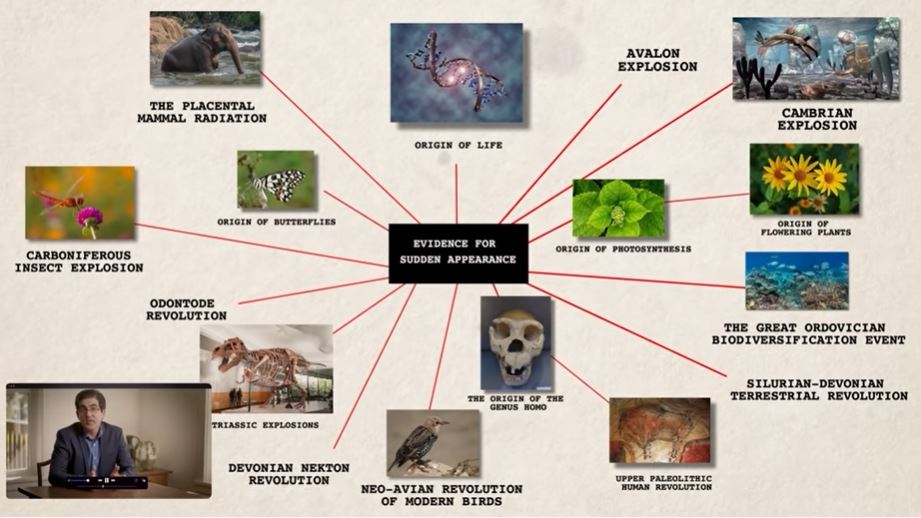
Alright, I admit the title of this short article is a bit provocative, but I got your attention. I would actually say the Darwinian paradigm is going through something more like an evolution. The explosions are not in the paradigm, but in the facts that have been slowly uncovered in the fossil record since Darwin championed the evolutionary paradigm.
The short video at the end of this article produced by Science Uprising alludes to a number of “explosions” that elude a Darwinian explanation. Paleontologist Günter Bechly, summarizes,
“The phenomenon of sudden appearances in the fossil record is not just an exceptional case, but actually is a pattern that is found everywhere.”
The obvious example is the Cambrian explosion in which most of the phyla that exist today appeared in the blink of geological time, in a mere five to ten million year window. Charles Darwin, himself, acknowledged the problem the Cambrian Explosion posed for evolutionary theory, but he expressed confidence that future fossil discoveries would fill in the gaps and provide evidence of the precursors to the Cambrian life forms.
the Avalon Explosion (see Wikipedia (“The Avalon explosion appears similar to the Cambrian explosion in the rapid increase in diversity of morphologies in a relatively small time frame”)),
the Great Ordovician Biodiversification Event (GOBE), (see Wikipedia (characterized by “taxonomic diversity explosions”))
the carboniferous insect explosion (See Insects of the Oxygeniferous (“The number of insect families increased from 1 or 2 to more than 100 during the Carboniferous, and many of the insects were huge, and no one has been able to say exactly why.”)),
the Triassic explosion,
the origin of flowering plants See The origins of flowering plants and pollinators (addressing the “abominable mystery” of “the surprisingly rapid rise and early diversity of flowering plants”)),
the Upper Paleolithic Revolution (See What Was The Upper Paleolithic Revolution? (describing the “significant behavioral changes” in the development of modern humans over the 40,000-year flash in a pan time period in the Late Stone Age)).
Technical scholarship is replete with the recognition of explosions (radiations or revolutions) of insects, fish, birds, dinosaurs, mammals, and the “big bang theory of human evolution” with no credible transitions in the fossil record. Many scientists, though continue to look for the precursors and clues to plug in the evolutionary gaps.
It seems that the evolutionary paradigm, which arose abruptly and transformed science overnight, is very slow in adapting to new information as it is uncovered. Not that we should be overly critical of the painstakingly slow progress. Science is slow and methodical with intention.
Explosions, though, such as the relatively sudden rise of Darwinian theory, may give way to equally sudden corrections, kind of like the mass extinction events that give way to new “radiations” or “revolutions'” in life forms. For more on the “time crunch” facing evolution, watch the short video that follows.
In two previous articles attempting to make an “unapologetic” argument for God, I have just been ramping up to make the argument. I still haven’t gotten there yet, and I am still just getting started.
That’s right. I am still working on getting to the starting line. Maybe I will still get there.
I say, “unapologetic”, rather loosely, in case you are wondering. I am not being apologetic in the sense of apologizing for anything. Apologetics has nothing to do with being sorry, of course. It means to provide a defense, and it specifically describes the effort of providing a defense for Christianity.
The word, apologetics, derives from the Greek word, apologia, which means “a speech in defense” or a “verbal defense” or a “well-reasoned reply”. The world is used in Peter 3:15 as follows:
“Always be prepared to give an answer [apologia] to everyone who asks you to give the reason [logos] for the hope that you have.”
I am using “unapologetic” as a kind of play on words. I am not giving a typical apologetic argument for the existence of God, and I am not being apologetic about doing that.
I previously made the observation that we all start with axioms, premises on which we support our positions for and against God, but we are incapable of proving those axioms. We consider them “self-evident”, but that is, frankly, just another way of saying that we can’t prove our starting premises” we have to assume they are true, and we go from there.
We take our fundamental premises on faith, essentially. This includes everyone, even in science.
As an example, consider the scientist, like a few I have heard, who says that science is the only way to know truth and all truths can be revealed by science. That premise cannot be scientifically proven. Therefore, you just must take it on faith.
Ironically, that statement is also self-contradictory. If science is the only way to know truth, and the statement itself cannot be proven by science, then even if it is right, it is wrong! (Echoing John Lennox here.)
I recently heard the astrophysicist, Michael Guillen, say similarly that science does not prove anything absolutely. As an example, he says we could posit that ravens are always black. Every raven the modern world has ever encountered and documented may be black, but that doesn’t mean that every raven that ever existed and every raven that will ever exist is always black.
To make the claim that all ravens are black is to go beyond science. We can only verify the blackness of all the ravens we can find and the ravens that other people have documented, but we can’t verify the blackness of the ravens that were never documented or the ravens that have not yet existed.
William Lane Craig talks about the philosophy of logical positivism championed by people like AJ Ayer in the 1940’s and 50’s. Logical positivism, or “verificationism”, as Craig calls it, was claimed that consideration of the existence of God is meaningless because it is not verifiable by the five senses. The book, Language, Proof and Logic, was a kind of “manifesto” of this view, says Craig,
Verificationsim was used by Ayer to nix anything metaphysical. According to this view, a statement is only meaningful if it is capable of being empirically verified. Since metaphysical statements are beyond the reach of empirical science, they cannot be verified. Metaphysical statements were, therefore, dismissed out of hand. According to Craig,
“Ayer was very explicit about the theological implications of this verificationism. Since God is a metaphysical object, the possibility of knowledge was ‘ruled out’ by our treatment of metaphysics. Thus, there can be no knowledge of God.”
Do you see the problem with this view? One only need ask, “Is that statement capable of being empirically verified?”
Ayer’s view was built on an axiom he could not prove, and which could not be proven by the methods he arbitrarily limited according to the premise he assumed. His view could not even stand up to itself!
Craig says the collapse of verificationism was “the most philosophical event of the twentieth century”. The verification principal was not only unscientific; it was self-refuting. “The statement, ‘You should only believe what can be scientifically proven cannot, itself, be scientifically proven.’”
In the previous “unapologetic” articles, I claim that we all have to take certain things on faith, especially our starting premises, which are the tools by which we view and explore the world, but not all of those starting premises are created equal. Some of them cannot even stand up to themselves!
But, enough of that. I need to get to the point of this article.
It seems axiomatic that, if one wants to determine whether God exists, and if one is sincere in making that determination, one will not start with a premise that will inevitably result in the logic that God does not exist.










 Navigating by Faith