Moderns have issues with miracles, but ancients did not. Many ancient histories reference miracles, and we do not discount them as histories for that fact. The miraculous element of the accounts of Jesus, however, are a basis on which many contemporary thinkers reject the claims of Jesus and claims about Jesus a priori.
Miracles are consistent with and flow from the nature and character of who Jesus claimed to be and who his followers claimed he was. If Jesus was God in the flesh, miracles are to be expected. The apostle John says that Jesus was the Word; he was with God in the beginning; He was God; and all things that were made were made through Jesus, the Word. (John 1:1-3) If the universe was made by and through Jesus, miracles are no big deal, and the resurrection is more than just possible.
This was thrust of the Gospels. The authority of Jesus resonated in his message and was attested by the miracles. Many moderns reject the message largely on the basis of the miracle claims because miracles are not allowed in a naturalistic worldview that dominates academia today. We can’t accurately judge what Jesus said, though, without being willing to suspend that disbelief, even if only to reach some understanding.
Have you ever felt like nobody gets you? Have you ever felt that no one understands who you really are? Not even your family or your closest friends?
First of all, congratulations, because you are being honest. It’s uncomfortable to be that honest.
I could be wrong. Maybe it’s only me, but I think many of us would rather pretend people know us better than they really do. We connect on the surface. We connect the best we can, but there are parts of us few people know or understand… if we are honest.
I sometimes feel as if everyone else “gets it” (this thing we philosophically call life) but me. Perhaps, everyone else is connected in a way that I am not. Nothing feels more isolating or lonely than feeling disconnected and alone.
I don’t think I am alone in feeling this way, though. This is the human condition. If we are being brutally honest about it. This is reality.
If this is the reality, what do we do with it? How do we live with the brutal honesty of it? We yearn for connection deep down, but many of us feel utterly disconnected and isolated from others at the core of our being.
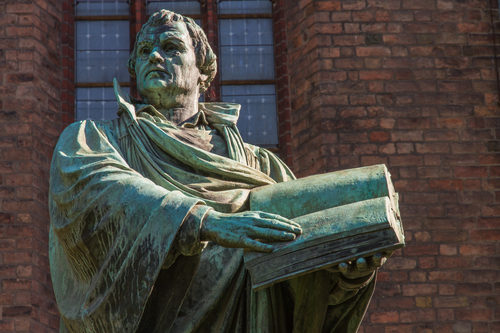
Today us Reformation day. I don’t really care about Halloween, so I figure I should say something about the Reformation.
You might call me a reformed Catholic. I grew up in the Catholic Church. When I encountered Jesus Christ, the living Son of God, who shed His glory to become a man, walked in obedience to His own purposes, died on the cross for our sins, and rose again from the dead, my life changed.
When I accepted Jesus Christ as my Lord and Savior, I left the Catholic Church for greener pastures. I have been involved with and visited many churches since then, and I am still looking for greener pastures. Along the way, I have learned that Catholics haven’t cornered the market on rigid structures and white-washed tombs.
The Christian response to the age old problem lies in the story of Adam and Eve. Created in God’s own image, they were given a choice but were forbidden from exercising it. Anyone with a modicum of understanding about human nature knows that forbidden fruit is a temptation that is hard to ignore. It should come as no surprise to us (or God) that Adam and Eve gave into the temptation and ate of the fruit.
God surely must have known that they would exercise that forbidden choice! Yet, he banished them from the idyllic “garden” He created for them and cursed the world, subjecting it to difficulty, pain, suffering and death. We are looking for a clue to the question that screams from our guts, “Why?!”
This indeed is the harsh reality in which we live. There can be no denying it. Recognition of this harsh reality is not uniquely Christian. It is a universal truth. The explanation of it is what differs. The atheist might simply say that we all die and “then worms will eat our bodies”. That’s just the way it is. The Hindu might say we suffer because of karma, and we all die, and die again, and again, and again, and again. The Buddhist might say we suffer only because we haven’t reached enlightenment because pain and suffering are just a figment of the unenlightened imagination. All worldviews must contend with the fact that we live in a less than idyllic world.
The Christian says we suffer pain and death because Adam sinned. “And we’ve been attending funerals ever since,” Clay Jones says; and “Only one thing is going to prevent you from watching absolutely every person you know die from murder, accident, or disease, and that will be your own death from murder, accident, or disease.” What a harsh sentence!
If the Bible is an accurate reflection of God and of reality, why in the world would God have cursed the ground and subjected His creation to futility?
The Apostle Paul tells us in his letter to the Romans that God subjected the world to futility “in hope that the creation itself will be set free from its bondage to corruption….” (Romans 8:20) This suggests that the choice that led man to corruption and the cursing of the world to futility was part of the plan all along. In this second half of “the story” we try to make some sense of it.
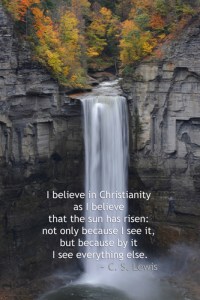
CS Lewis wrote eloquently on the “myth” of modern scientific cosmology and the reality of Christian thought in an interesting and thought-provoking twist on dreaming and waking. Ever the poet, Lewis takes poetic license to invert our common thinking on these subjects.
In the reblogged post below, we trace those poetic steps through the scenery of Lewis’s imaginative mind and come out into the clearing of a spectacular vista from which Lewis sees and makes sense of the world. Science, he says can’t do that. Science can’t even ultimately account for science.
Whether you might agree or disagree, you will find his thinking to be worth the trip through the underbrush.
I am a great fan of C.S. Lewis. Not that I agree with everything he has written, I love his genius and insight that is marked by a truly Renaissance journey through all of the great classical literature, philosophy and rational, scientific discourse. He approaches Christianity from the opposite shore and provides a view that most churchgoers would never otherwise get.
I recently read his short essay (Is Theology Poetry?) that is published with the Weight of Glory and other addresses by Harper One. In classic Lewis style, he starts off with a very obscure, nuanced question (that few, if anyone, would even think to explore) and, from the seeming pedantry and narrow beginning, he opens up the discourse about half way through into a sweeping view of an eternal truth that is absolutely breathtaking.