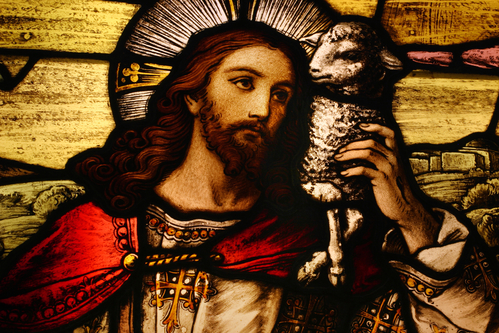
Is the Story of Jesus a Story of Divine Vengeance or Love?

Many people interpret the story of Jesus as if God was looking for someone on whom to take out his vengeance, and His son got in the way – so that somehow makes it right.


NT Wright made a statement on Justin Brierley’s new podcast recently, Ask NT Wright Anything, that is worth repeating. He says that people read John 3:16 (“That God so loved the world that he gave his only begotten son….”) this way: “that God so hated the world that he killed his only son.”

People, especially today, view God as an angry bully. They interpret the story of Jesus, Wright says, “as if God was looking for someone on whom to take out his vengeance, and His son got in the way – so that somehow makes it right”. The people who interpret the story in this way don’t think it is right. They recoil from God as from a cosmic bully.

Of course, many people who moralize about God are simply refusing to acknowledge God as God. They sit in judgment of God. At least they sit in judgment of “the God of the Bible” as they perceive Him.

Many who hold these views also don’t believe God exists, so they are really sitting in judgment of God as they perceive God to be who other people believe in. (Nevermind that this cosmic bully god is not the god other people actually believe in.)

Skeptics aside, I think believers may also view God as more of a cosmic bully than a loving Father, sometimes. It isn’t just skeptics; sometimes believers wrestle with a muddled view of God.

Continue reading “Is the Story of Jesus a Story of Divine Vengeance or Love?”

Homosexuality and the Church

What we need is for the church to have the conversation on homosexuality better.


I am a big fan of Justin Brierley’s podcast, Unbelievable! on Premiere Christian Radio in the UK. The theme of the podcast is to interview persons with different viewpoints on a variety of subjects that usually focus on some aspect of faith. Often the interviewees include a person of faith and a person of no faith. Sometimes, the interviewees are people of different faiths. The podcast that aired on November 24, 2018, included two Christians on different sides of the debate about homosexuality: How should gay Christians express their sexuality?

David Bennett “grew up in an agnostic/atheist home” but became a “conservative” Christian, while Justin Lee represents the mirror image of David’s experience. Justin grew up in “a very devoutly Christian home”.

Justin relates that he understood that being a Christian meant “taking a loving but principled stand against homosexuality” and that “being gay is a sinful choice”. He felt it was his obligation as a Christian to speak out and encourage people not to be gay. He believed that God would “lead people out of homosexuality”. He believed that homosexuality was a choice, which is what his Southern Baptist church taught.

But then, Justin came to realize that he was same sex attracted himself. In spite of praying and believing that God would change him, his feelings didn’t change. He struggled with that realization until he came to believe that same sex attraction is not a sin. Though Justin is still single, he now engages in ministry to the gay and lesbian community who he says have been left adrift by the greater Christian community.

These two men, both same sex attracted, have come from opposite shores, crossed in between, and take different positions in respect to homosexuality and faith. They engage in a very thoughtful, honest and thought-provoking conversation with Justin Brierley in the podcast.

You can hear the whole thing by clicking on the link in the first paragraph above. Meanwhile, I will summarize their divergent experiences that cross over from opposite shores below.

Continue reading “Homosexuality and the Church”

Yearning for Perfection in an Imperfect World


Have you ever felt like all you do is spin your wheels, but you don’t get anywhere? I have days and weeks like that. Sometimes, it seems my life is like that.

Imagine a people like that….

Isaiah said this of the nation of Israel (Isaiah 26:17-18 NASB):

As the pregnant woman approaches the time to give birth,
She writhes and cries out in her labor pains,
Thus were we before You, O Lord.
We were pregnant, we writhed in labor,
We gave birth, as it seems, only to wind.
We could not accomplish deliverance for the earth….

As a lawyer, I have spent a lot of time in court. I have represented many people, and I have seen our system of justice at work. I can tell you from experience that it’s far from perfect. That is being kind really.

The truth is that not just our legal system is imperfect; our lives are far from perfect. We all desire perfection, but our attempts at achieving perfection are like giving birth to the wind. Though we strive to make the world a better place, for ourselves, our loved ones and others, we haven’t been able to accomplish deliverance from the imperfections that have been the blight of human existence since time immemorial.

What are we to do?

Continue reading “Yearning for Perfection in an Imperfect World”

Seeking God and Finding Him

It isn’t a matter of God responding to us. It’s a matter of us responding to God.


As I was praying for my children this morning, I was reminded that no one comes to the Father except through Jesus (John 10:6), and no one comes to Jesus unless he or she is drawn by the Father (John 6:44). As I prayed for my children who have not acknowledged Jesus as Lord and Savior and have not professed faith in Jesus, I am also reminded that God gives us free will.

God won’t violate the free will He has given us. How, then, should I pray?

I wish there was another way! I wish that God could just make them believe! If I only I were a Calvinist!

I am only half joking. Maybe not even half joking!

I had a conversation with my youngest about a year and half ago in which she told me that she thought she was an atheist. She said all of her friends are atheists. (I doubt that is true, but whatever.) She told me that she asked God for something (I don’t remember what), and He didn’t respond.

That conversation has stuck with me ever since. I was taken aback. She was only about 16 or 17 at the time. I was painfully aware as we spoke, as I am now, that I can’t make her believe. I was thankful that she felt comfortable enough with me to be open and honest, and I told her so. But that doesn’t make the pain of it any less.

I don’t remember exactly what she said she asked God, but she seemed convinced, at least as we talked at that point, that God must not be real if he didn’t respond to her. I didn’t want to preach. I wanted her to know that she always has an open door to talk to me so I didn’t press the issue with her.

I also know that God is faithful. God drew me out of my darkness, and I believe He can draw her too. After all, no one can come to Jesus except the Father draws her. But will He? Can He?

Continue reading “Seeking God and Finding Him”

An Ancient Near East View of Israel

Gehenna (Hinnom) Valley near the Old City in Jerusalem

I am grateful for the religion classes I had in college. I wasn’t a religion major, but I took all the classes to be one, including the thesis class. I took them because I was hungry for the truth that was contained in the ancient scriptures. That hunger began as a hunger for truth, and I searched for it in history, literature, art, philosophy and wherever I could find it, including religion.

I searched for whatever truth I could find in the various religions of the world, but the religion classes at Cornell College where I did my undergraduate work were largely the Judeo-Christian scriptures. There I got a solid academic foundation in the Old Testament and New Testament, with an emphasis on the Pentateuch (Books of Moses), writings and the Prophets, because one of the two religion professors was Jewish.

I appreciate the sense of the sweep of biblical history that this education gave me. I wasn’t taught in the context of a particular Christian denomination, but from a Jewish perspective. So, I appreciate what James Michael Smith is doing in his ministry, the DiscipleDojo, who presents an authentic Ancient Near East perspective of Deuteronomy in the podcast that is embedded below. I encourage you to listen to the whole thing (and listen to the other installments if your interest is piqued).

To get an accurate and nuanced understanding of God’s interaction in history with His covenant people that became the backdrop and springboard for His plan of universal redemption, it helps to understand the Ancient Near East that formed the historical context for this interaction. The Abrahamic people were very much people of the Ancient Near East. God’s interaction connects with them where they were in the cultural understandings that informed them.

It’s amazing to me to think about how this very intimate and familiar interaction in an Ancient Near East culture (Bronze Age people as skeptics like to point out) has become a timeless, ongoing and ever relevant message for us through the Scripture that was inspired and written down in the process. How could such a Bronze Age perspective carry forward such a universal and timeless message?

Continue reading “An Ancient Near East View of Israel”