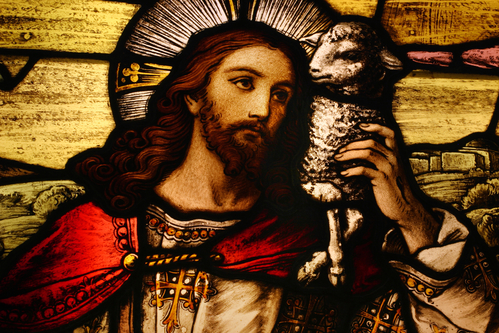
Who Was Jesus?


Who was Jesus? A friend recently asked, “Jesus was a Jew preaching Judaism. Right?” He explained his thought that the people who came after Jesus created a new religion using him as the central figure in spite of who he really was – just a Jewish man preaching Judaism.

This is a popular Internet characterization of Christianity. I am not a scholar on the subject, but I did minor in religion in college. I took all the courses for a religion major, including the thesis course, and I even did the research and wrote the thesis. I would have had a religion major if I had turned in my thesis. I didn’t do it because I didn’t need the major. I took the classes because I was interested in them. I didn’t hand in the thesis paper because I didn’t feel good about it.

A religion major at a small liberal arts school meant majoring in “religion” generally. There were no flavors available for particular study. We looked at all religions, though we focused most heavily on Judaism and Christianity. That is because there was one “Christian” professor and one “Jewish” professor.

The Christian professor took the position that “all roads lead to the top of the same mountain”. Of the Christian road, he was very fond of Liberation Theology that took the position that the God has been changing, progressing and more or less learning to be God throughout time. Liberation Theology was born in South America among the people who were oppressed by the corrupt government and military forces in the 1970’s, and the Catholic priests who espoused this theology believed in taking arms in counter-insurgence against the oppressive political and military regimes.

My “Christian” experience included some very progressive literature. We were encouraged to sit in on lectures given by people like Hare Krishnas and a European Muslim – both lectures that I attended, among others. The Jewish professor was very much the modern, reformed variety – not conservative or Hasidic. This was my introduction to religion and to the Bible.

I did read the Bible from cover to cover in college, not only as an academic exercise as part of my course of study, but because I was drawn to it. In the midst of the all-roads-lead-to-the-same-mountaintop atmosphere in which I studied, I began to be taken by Jesus, who said, “I am the way, and the truth and the life, and no one comes to the Father but by me.” (John 14:6) This is because Jesus stood head and shoulders above all the other religious personalities that I read about. There was something transcendentally different about him.

As I have been thinking about the (largely rhetorical) question my friend posed about Jesus, I think of the sweep of the Bible – Old Testament to New Testament, beginning to end. Having been intimate with it for well over 30 years, having read it many times over, and recounting my own journey of discovery, I feel compelled to tackle the question, but the scope of the answer is daunting.

Continue reading “Who Was Jesus?”

Christmas Thoughts: God Redeems the Line of Judah through Tamar

Originally posted on Navigating by Faith:
(c) Can Stock Photo / halfpoint Amazingly, the genealogy of Jesus in Matthew lists five women. In a patriarchal society governed by paternal lineage, that fact should jump out at us and cause us to take notice. What is God saying? What was He doing? How should we view…


Families and Christmas can be messy. The vast majority of us do not live in a Hallmark world. The fact that Christmas season always sees an uptick in the incidence of suicide is testament to the fact that the gap between Holiday cheer and reality can be a big on

But there is hope! Christmas is the remembrance of God stepping into world like a light shining in the darkness.

Last year at this time, I began a series of blogs on the women listed in the genealogical lineage of Jesus in the Gospel of Luke. That a total of five women are even listed in his genealogy is kind of mind blowing. Genealogies, especially in the First Century patriarchal world, are dominated by men. What are these women doing there?

It occurs to me that maybe God is saying something particularly important by including five women in the genealogy of Jesus.

For starters, God’s view of women, I believe, has always been higher than patriarchal history gives them credit. After all, God made us, male and female, in His image. Men are only half the image of God if you do the math.

But something else is going on as well. When you dig into the stories of the people in the lineage of Jesus, the Messiah, the Savior, surprises are plentiful. His lineage isn’t particularly saintly. It’s “complicated”.

Jesus came not only as a light in the darkness of the world; he came as a light in the darkness of his own lineage. The story of Tamar is just one such example. She is the first woman listed in that lineage.

kevingdrendel's avatarNavigating by Faith

 (c) Can Stock Photo / halfpoint(c) Can Stock Photo / halfpoint

Amazingly, the genealogy of Jesus in Matthew lists five women. In a patriarchal society governed by paternal lineage, that fact should jump out at us and cause us to take notice. What is God saying? What was He doing? How should we view that today?

We can gain insights by looking at the women who are listed. The first woman listed is Tamar. Her story is found in Genesis 38, and it is a wild one for people of polite sensibilities.

Tamar was the wife of Judah’s oldest son, Er. Judah was the fourth son of Jacob (son of Isaac, son of Abraham). It might seem odd that Judah, the fourth son, is the one from whom Jesus (the Messiah) descends, but that is only a minor oddity compared to the rest.

View original post 1,702 more words

Is the Story of Jesus a Story of Divine Vengeance or Love?

Many people interpret the story of Jesus as if God was looking for someone on whom to take out his vengeance, and His son got in the way – so that somehow makes it right.


NT Wright made a statement on Justin Brierley’s new podcast recently, Ask NT Wright Anything, that is worth repeating. He says that people read John 3:16 (“That God so loved the world that he gave his only begotten son….”) this way: “that God so hated the world that he killed his only son.”

People, especially today, view God as an angry bully. They interpret the story of Jesus, Wright says, “as if God was looking for someone on whom to take out his vengeance, and His son got in the way – so that somehow makes it right”. The people who interpret the story in this way don’t think it is right. They recoil from God as from a cosmic bully.

Of course, many people who moralize about God are simply refusing to acknowledge God as God. They sit in judgment of God. At least they sit in judgment of “the God of the Bible” as they perceive Him.

Many who hold these views also don’t believe God exists, so they are really sitting in judgment of God as they perceive God to be who other people believe in. (Nevermind that this cosmic bully god is not the god other people actually believe in.)

Skeptics aside, I think believers may also view God as more of a cosmic bully than a loving Father, sometimes. It isn’t just skeptics; sometimes believers wrestle with a muddled view of God.

Continue reading “Is the Story of Jesus a Story of Divine Vengeance or Love?”

Homosexuality and the Church

What we need is for the church to have the conversation on homosexuality better.


I am a big fan of Justin Brierley’s podcast, Unbelievable! on Premiere Christian Radio in the UK. The theme of the podcast is to interview persons with different viewpoints on a variety of subjects that usually focus on some aspect of faith. Often the interviewees include a person of faith and a person of no faith. Sometimes, the interviewees are people of different faiths. The podcast that aired on November 24, 2018, included two Christians on different sides of the debate about homosexuality: How should gay Christians express their sexuality?

David Bennett “grew up in an agnostic/atheist home” but became a “conservative” Christian, while Justin Lee represents the mirror image of David’s experience. Justin grew up in “a very devoutly Christian home”.

Justin relates that he understood that being a Christian meant “taking a loving but principled stand against homosexuality” and that “being gay is a sinful choice”. He felt it was his obligation as a Christian to speak out and encourage people not to be gay. He believed that God would “lead people out of homosexuality”. He believed that homosexuality was a choice, which is what his Southern Baptist church taught.

But then, Justin came to realize that he was same sex attracted himself. In spite of praying and believing that God would change him, his feelings didn’t change. He struggled with that realization until he came to believe that same sex attraction is not a sin. Though Justin is still single, he now engages in ministry to the gay and lesbian community who he says have been left adrift by the greater Christian community.

These two men, both same sex attracted, have come from opposite shores, crossed in between, and take different positions in respect to homosexuality and faith. They engage in a very thoughtful, honest and thought-provoking conversation with Justin Brierley in the podcast.

You can hear the whole thing by clicking on the link in the first paragraph above. Meanwhile, I will summarize their divergent experiences that cross over from opposite shores below.

Continue reading “Homosexuality and the Church”

Yearning for Perfection in an Imperfect World


Have you ever felt like all you do is spin your wheels, but you don’t get anywhere? I have days and weeks like that. Sometimes, it seems my life is like that.

Imagine a people like that….

Isaiah said this of the nation of Israel (Isaiah 26:17-18 NASB):

As the pregnant woman approaches the time to give birth,
She writhes and cries out in her labor pains,
Thus were we before You, O Lord.
We were pregnant, we writhed in labor,
We gave birth, as it seems, only to wind.
We could not accomplish deliverance for the earth….

As a lawyer, I have spent a lot of time in court. I have represented many people, and I have seen our system of justice at work. I can tell you from experience that it’s far from perfect. That is being kind really.

The truth is that not just our legal system is imperfect; our lives are far from perfect. We all desire perfection, but our attempts at achieving perfection are like giving birth to the wind. Though we strive to make the world a better place, for ourselves, our loved ones and others, we haven’t been able to accomplish deliverance from the imperfections that have been the blight of human existence since time immemorial.

What are we to do?

Continue reading “Yearning for Perfection in an Imperfect World”