Contemplating the Influence of Power and Wealth on The Church

It is “a supreme paradox” that ‘the church in freeing itself from the secular itself became a state”, says Tom Holland.

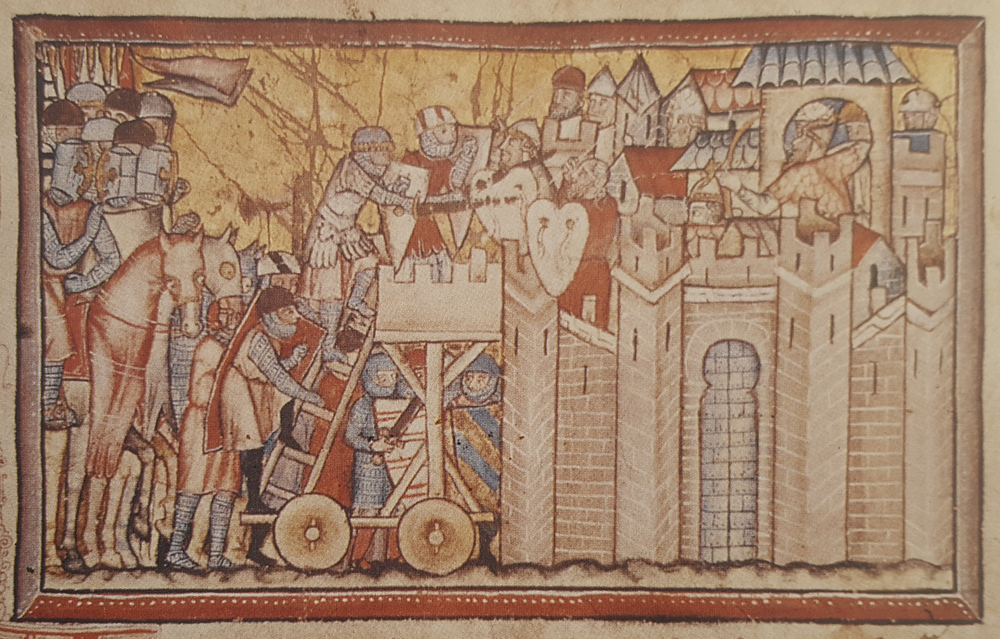
Miniature showing siege scene of conquest of Jerusalem, 1099. Nunez de Balboa House-Museum, Jerez de los Caballeros, Spain

I am working my way through Tom Holland’s book, Dominion: The Making of the Western Mind. I have just finished the segment on Pope Gregory VII and Pope Urban II at the turn of the first millennium since the birth of Jesus Christ.

Since Jesus first told an antagonistic group of religious leaders that people should “render unto Caesar that which is Caesar’s, and render unto God that which is God’s”, and for centuries afterward, the church was at the mercy of the state. Not even a generation after Jesus died, the Roman government, which controlled Judea where Jesus lived and his following sprung up, ransacked Jerusalem, scattering Jews and Christians into the countryside and beyond.

Through the first three centuries, the best the followers of Jesus could hope for was an indifferent Caesar or provincial ruler. At various times, they suffered at the hands of a Nero or more local prefects of local Roman rule in places like Lyons, Vienne or Carthage. The powerful Roman government was to be suffered and obeyed.

Christianity was illegal until Constantine decreed the prohibition lifted. Within a generation or two, Christianity was not just legal in the Roman Empire; it became the favored religion. Christian rulers became part of the governing structure of Rome, serving by the appointment and the pleasure of ruling authorities from mid-way through the 4th Century on.  

Over the centuries, the Roman Church became a player in the ebbs and flows of power and influence in western and central Europe. When Gregory VII was made Pope by acclamation of the people, however, he hid himself, not having been chosen through the usual protocols. When he was affirmed, nevertheless – his affirmation having as much to do with popular will as with political protocols, it marked the beginning of a change.

Gregory and Henry IV, the Roman Emperor, had a fitful relationship. Gregory excommunicated him three times, each time undoing it, the last time on his death bed in a remote outpost to which he been banished by the powers that be. Henry IV, for his part, declared antipopes in opposition to the papacy of Gregory, but his antipopes never rose to the position of acceptance by the people. The tide was turning.  

When Pope Urban II gathered and commissioned a vast army in the sacred duty of marching on Jerusalem to reclaim it from the Saracens who had overrun it a couple centuries earlier, the victory they attained in 1099 AD (the First Crusade) marked the completion of a transition. Carrying forward the efforts of Pope Gregory to divorce the church from the state, the goal was accomplished by the military victories won for Christendom – not by any Caesar or secular emperor, but by people marching under the banner of The Church.

Holland described the irony that, in obtaining freedom from the state, the church became a state. Holland calls it is “a supreme paradox” that ‘the church in freeing itself from the secular itself became a state”.

Continue reading “Contemplating the Influence of Power and Wealth on The Church”

Tracing the Origin of Natural Law & Equal Rights in Western Thought

The law of loving your neighbor as yourself written on the tablet of the heart by God

In Chapter 9 of Tom Holland’s book, Dominion: the Making of the Western Mind, he traces the idea of natural law back to 1150 AD when a lawyer named Gratian compiled the first canon of law in the west. His work (the Decretum Gratiani, as it came to be called) was derived from Scripture and the writings of the early church fathers. It was an attempt at harmonize those two sources into a comprehensive whole.

The original notion of natural law came from the Stoics: “The Stoics believed that the fundamental moral principles that underlie all the legal systems of different nations were reducible to the dictates of natural law.” Gratian syncretized the Stoic notion of natural law (the law of nature) by attributing it to divine origins. This law, which God desires to write on men’s hearts, can be summarized as the law of loving your neighbor as yourself.

Holland observed that for a millennia Christianity existed without “what Muslim lawyers had long taken for granted – a comprehensive body of written rulings supposedly deriving from God Himself”. Holland is struck by the contrast of the Christian notion that God “wrote His rulings on the human heart”.

Holland first picks up that theme in his book with Saint Augustine of Hippo in Chapter 5. Hollands description of Augustine’s words – that “God writes His laws on the heart,” and, therefore, “Love, and do what you like” – is a theme Holland traces as he finds it in the history of western thought.

Thus, Holland observes that Gratian opened his Decretum Gratiani with the statement that all law can be summed up in a single command: love your neighbor as yourself. Gratian called this idea “natural law”, summarized by the statement, “all souls are equal in the sight of God”. Gratian further identified this principal as the foundation stone of true justice.

Holland mistakenly attributes these ideas to Paul (“Paul’s authority on this score was definitive…. [e]choing the Stoics”). but the important point is that Gratian’s syncretism of the law was a decisive departure from earlier ages:

“Much flowed from this compilation that earlier ages would have struggled to comprehend. Age old presumptions were being decisively overturned – that custom was the ultimate authority, that the great were owed a different justice from the humble, that inequality was something natural and to be taken for granted.”

This is the central theme of Holland’s book – “How the Christian Revolution Remade the World” (its alternate title). His book is an attempt to trace back the roots of modern notions, such as the idea that people have “equal rights” stemming from natural law (“inalienable rights”) that fundamentally inform modern, western thought.  

Holland notes that these ideas do not flow out of Greek or Roman philosophy or law. They were are much foreign to the world of classic Greco-Roman thought. They are definitively Christian – Judeo-Christian – in their origins.

Holland, of course, is an atheist. He comes to these conclusions through his study of western civilization. He is an “outsider” to Christianity, which perspective makes his observations so interesting – the that he picks up on the novelty of these ideas as being a distinctively Christian departure from classical Greco-Roman thought.

He also wrote Dominion coming off the heels of writing a similar work on the history of Islam. The contrast was striking for him. Whereas Islamic scholars attempted to proscribe laws for every detail of human life, including things like how to brush your teeth and dog ownership, Christians distilled law down to a single phrase – love your neighbor as yourself – and rested in the confidence that God writes His laws on people’s hearts (“not in ink” as Augustine said). The influence of Holland’s awareness of that contrast is striking.

It shouldn’t be surprising, coming from his perspective, that Holland doesn’t get things exactly right. When Augustine focused on love, he wasn’t championing anything new, and Paul was not the source of the notion that the law can be summed up in the phrase, love your neighbor as yourself or the belief that God writes His laws on human hearts. While he might attribute these things to Paul and Augustine, the history is much older and deeper than that.

Continue reading “Tracing the Origin of Natural Law & Equal Rights in Western Thought”

Who Are the Righteous and the Wicked? Part III

Abraham’s faith was more than naked belief; it was belief that prompted him to act in trust in God.

“All Scripture is breathed out (inspired) by God and profitable for teaching, for reproof, for correction, and for training in righteousness….” (2 Tim. 3:16)

I was prompted in reading Psalm 1 to focus on the distinction between “the righteous” and “the wicked” in Who are the Righteous and the Wicked? Part I. As I began to dig into it, I observed that only God is righteous, and our righteousness depends wholly on our relationship to God. If we believe (trust) Him, he credits His righteousness to us. (See Part II) Abraham is our example: when he believed God, His faith in God was credited to him as righteousness. (Gen. 15:6 & rom. 4:3)

This is all very fundamental to Christianity. It might prompt us to make the assumption that people who merely believe God, believe the Bible (and go to church) are righteous. There is a fly in that ointment, however; and James identifies it in his letter.

James acknowledges that Abraham believed God, and his belief was counted to him as righteousness (James 2:23), but James digs a little deeper into what “the righteousness that comes by faith” (Rom. 3:22) really looks like. After all, even demons believe in God (James 2:19), but they aren’t righteous! The difference between the righteous and the wicked, therefore, involves something more than merely believing in God

We explored the idea that righteousness is something that flows from God, out of His very Being. It is not something God decreed, but something that God is in His very nature. Righteousness is not an abstract ideal that God lives up to; God is righteous. We don’t describe God in respect to righteousness; we know righteousness by knowing God.

It helps, perhaps, to take morality out of the equation and to look at it through a more scientific lens. Just as gravity is what it is and operates the way it operates (because that is how God created the universe), righteousness is simply what it is. Righteousness, however, isn’t something God created, like gravity; righteousness flows from the very nature and character of God.

To put it very simply: God defines righteousness by who He is, and righteousness is defined in relation to God.

Thus, we can only know righteousness in relation to God. We can’t be righteous, because only God is righteous. God credits His righteousness to us who believe (trust) in Him, but that is only the beginning.

Christians might call this being born again. We believe God; God counts us righteous; and, thus, He welcomes us into relationship with Him. A birth, however, is only the beginning.

When we dig deeper, as James did, we see a specific characteristic to the belief that Abraham by which God credited it to him as righteousness. That characteristic is something more than bare belief. Demons, who also believe, don’t have that characteristic (otherwise their belief would be credited to them as righteousness too). This characteristic is what James is getting at when he says that “faith apart from works is dead”. (James 2:26)

Abraham’s faith prompted him to action. James says that Abraham’s “faith was active along with his works”, and his “faith was completed by his works”. (James 2:22) Thus, Abraham’s faith was more than naked belief; it was belief that prompted him to act in trust in God.

Having some understanding of what makes a righteous person righteous, and what doesn’t, is essential to our relationship with God.

Faith that doesn’t prompt a person to action is not the kind of faith Abraham had; it is not the kind of faith that is credited to a person as righteousness. Faith that only prompts feelings is not the kind of faith that leads to righteousness. (James 1:19) The faith that leads to righteousness is faith that prompts a person to be a doer of God’s word. (James 1:22-25) It is faith that prompts love for God and love for neighbor, and that love is active! (James 1:26-27)

Faith that doesn’t result in a change from the core of a person’s being that emanates out into a change of heart and change in action is not the kind of faith that can be described as being born again. It is not saving faith, and it is not the kind of faith that God attributes as righteousness to people. 

On Working to Establish a Biblical Orientation on Issues of Race

Christianity transcends all the natural barriers to human relationships.

Although the dust has settled (somewhat) on racial tensions since the maelstrom that was kicked up in the wake of the George Floyd killing in Minnesota, no one should think that the issue has been settled or will go away without some resolution. The country, including the church community, is divided on the facts, and issues, and measures that should be employed to resolve the racial tension. Even people of good will are uncertain on how to move forward.

A predominant worldview has emerged in academia that is filtering down into local communities that frames the issue and potential resolution in terms of oppression. This worldview divides the world into the oppressed and their oppressors. The people who hold to that narrative are aggressively pushing for change.

They push the people they are define as the oppressors in the racial tension. The people defined as the oppressors are white and predominantly “Christian” in name (at least). As with the laws of nature, so with the laws of natural human tendencies: when someone pushes, people being pushed naturally push back.

So it is today that the predominantly white, Evangelical Church in the United States is feeling the pressure of the desire and demand for change to address the racial disparities and tensions in our world, and we are tempted to reflexively push back against that pressure.

But how should we respond?

I have written on the differences between Critical Race Theory and biblical justice. We should recognize that the worldview based on the CRT framework is not biblical, though many of our brethren of color and more progressive white Christians have embraced it.

I submit, though, that CRT has come to prominence in the African American churches and among progressive white churches because the Church, generally, has left a vacuum, and “nature abhors a vacuum”. We have failed to recognize and address in a biblical way the deep and lasting pain of racism that continues to exist in a society that only recognized equal rights for African Americans in my lifetime.

The failure of the Church to address racial issues left room for a completely secular and unbiblical approach to sweep in. So, other than acknowledge our failure, what do we do now?

Continue reading “On Working to Establish a Biblical Orientation on Issues of Race”

God Will Not Be Mocked; His Purpose Will Be Accomplished Among Us

I have no doubt God is accomplishing His purpose, but what role we play may surprise us

21 February 2016: Republican Presidential candidate Donald Trump speaks to several thousand supporters at a rally in Atlanta, Georgia.

The Washington Examiner reported that Republican senator, Ben Sasse, said in a “campaign telephone town hall call that went to about 17,000 Nebraskans”, among other things, that President Donald Trump trash-talks evangelicals behind their backs”. After briefly citing some points of agreement with Trump, Sasse “began to unload” on the President.

Sasse identified a litany of issues he has with Trump – careening “from curb to curb” on COVID (first ignoring it, then going “into full economic shutdown mode”), selling out allies, “the way he treats women”, spending “like a drunken sailor” and flirting with white supremacists – but the issue I want to focus on is the charge that Trump “mocks evangelicals behind closed doors”.

Sasse commented, “I think the overwhelming reason that President Trump won in 2016 was simply because Hillary Clinton was literally the most unpopular candidate in the history of polling.” It’s true, and most evangelicals I know said they were voting “only” for Trump as “the lesser of two evils”. They couldn’t stomach another Clinton presidency, perpetuating that inbred political machine in Washington that is openly hostile to concerns of evangelicals.

So, where along the timeline did Donald Trump become our champion? When did he stop being an evil? (Albeit an “lesser” one)

A little googling reveals (for those who’s memory is short) that “long before” Donald Trump ran for President of the United States, he was a Democrat. Donald was registered as a Democrat from 2001-2009. Have we forgotten the criticism leveled against The Donald by Jeb Bush? “He was a Democrat longer than he was a Republican. He’s given more money to Democrats [including Hillary Clinton] than he has to Republicans.”

To be completely accurate, Donald Trump changed his party affiliation at least five times since 1987, when he registered as a Republican. He changed to Independent in 1999, to Democrat in 2001, to Republican in 2009, to Independent in 2011, to Republican again in 2012. (See Political positions of Donald Trump at Wikipedia) But should that give Republicans comfort?

On the issue that has been historically most influential on the Evangelical vote, abortion, Donald Trump has been described as shifting “from pro-choice to pro-life only as he planned a presidential run”. Robb Ryerse, a pastor at Vintage Fellowship in Fayetteville, AR, said earlier this year, “I personally believe that the President is cynically using pro-life voters for his own electoral purposes and doesn’t actually care about protecting innocent life at all.”

The LA Times was less skeptical in its description of Trump’s turnabout recently, calling him “a late convert” to the pro-life cause. Noting Trump’s position in 1999 (“pro-choice in every respect”), Trump told the March For Life crowd in Washington this year that “every life is worth protecting”.

The Times added: “Trump is counting on the support of his base of conservative activists to help bring him across the finish line.” While I don’t share the Times’ anti-pro-life stance, that’s what concerns me – that Trump is saying simply what a large block of his constituents want to hear. (To be fair, my skepticism runs deep with all politicians, especially when they are in campaign mode.)

After all, politicians seem to think that moderates are not tolerated by voters anymore. Both political parties have “taken harder-line positions for and against abortion rights”. Trump had to choose sides. As former White House Press Secretary, Ari Fleischer, said recently, “There used to be a middle”, but now candidates must choose sides in an increasingly polarizing political environment.

Digging deeper, Trump’s political views have shifted from moderate populist (2003) to liberal-leaning populist to moderate populist (2003-2011) to moderate populist conservative (2011-12), to Libertarian leaning conservative (2012-15) to “hard-core conservative” just before the 2016 election. Interestingly, he back-stepped to Libertarian-leaning conservative, then moderate conservative after the election, but he may (again) be described as “hard-core conservative” … now that he campaigns for re-election. (See Political positions of Donald Trump ibid.)

I can’t help noticing that his hard-core conservativism seems to be timed with election campaigning, and that’s one of the things that troubles me about him. So, I began wondering today: what are his long-standing convictions? From my reading, I would say populism, authoritarianism, and nationalism, so let’s take a closer look at those threads of Donald Trump’s political life.

Continue reading “God Will Not Be Mocked; His Purpose Will Be Accomplished Among Us”