The Evil We Must Guard Against

The truth is that we can take every possible measure to protect ourselves and protect our families and still be vulnerable.

© Can Stock Photo Inc. / aaronamat

Immigration continues to be in the news with Donald Trump calling for a ban on all Muslims who want to immigrate to the United Stated. In the wake of widespread criticism, Trump is holding his ground on barring Muslims and tracking the Muslims who already live here until we can determine “where this hatred comes from and why”:

Until we are able to determine and understand this problem and the dangerous threat it poses, our country cannot be the victims of horrendous attacks by people that believe only in jihad, and have no sense of reason or respect for human life,” Mr. Trump said.

Meanwhile, Loretta Lynch, the highest prosecutor in the land, pledged she will take aggressive action against anyone who uses “anti-Muslim rhetoric” that “edges toward violence.”  She has since toned down her own rhetoric following backlash on the grounds of freedom of speech, but she stuck to her guns on the pledge to protect Muslims against violent actions that might be inspired by “hateful speech”:

We always have a concern when we see the rhetoric rising against any particular group in America, that it might inspire others to violent action — and that violent action is what we would have to deal with,” Lynch said on Monday.

These heated words on opposite ends of the spectrum follow on the heels of the mass killing in San Bernardino, which the FBI now says was planned out by a couple who had been “radicalized ‘for quite some time’”. We barely had caught our breath from the mass killing in Paris by another group of radicalized Muslims who may or may not have had direct ties to ISIS.

Continue reading “The Evil We Must Guard Against”

Not by the Will of Man

Becoming a child of God has more do to with God than us.

Sun Thru the Woods


But as many as received Him, to them He gave the right to become children of God, even to those who believe in His name, who were born, not of blood nor of the will of the flesh nor of the will of man, but of God. (John 1:12-13)

Although we have the choice to receive God, those who receive God do not grasp on to something that they have uniquely divined. We cannot boast in receiving God. Gaining knowledge of God and becoming a child of God has more do to with God than us.

When people claim that Christians are exclusive and boast of a righteousness and holiness that is exclusive, bigoted and intolerant (to put it in modern terms), they do not understand what they are saying. God presents Himself to us, and we either receive Him or not. It is not our choice (not by the will of the flesh or of the will of man).

The righteousness does not come from us. God extends the right to us to become His children.

If by “child of God” we mean Christian, there is no such thing as a Christian who was born into it. Being a child of God is not something that passed on to us by natural birth; it is not passed down in our genes. People do not become children of God because of birth, but because of second birth[1].

Nor do people choose to become children of God. No one chooses to become a child of God any more than we chose to become children of our natural parents. The event of natural birth is entirely initiated by forces outside our control, and the second birth, without which no one may become a child of God, is also initiated by forces outside or our control – by God Himself.

God does the initiating, and we do the receiving. When we are born physically, we are born through the agents of our parents. When we are born again (born from above), we are born directly through the agency of the Holy Spirit, who is offered to us and who we must receive.

In this process, we are not unwilling vessels. We must receive the offer of new life, but we are not the author of it. We are not the initiators of this new life. We are entirely dependent on God who extends Himself to us.

Children of God are born not by the will of man but by God’s will. God gave His son to the world[2] and desires that no one would be perish, but that all would have everlasting life. Everlasting life comes from God, by being born from above, and becoming children of God. This is what God offers; we only need to receive it.

When we receive what God has offered, we are changed (born again). The proof is in the change.[3] We do not make the change; God makes the change occur within us by His spirit that we receive when we are born from above. All true children of God know this change comes from God, not from within us. The change takes place within us, but it does not originate from ourselves. The Father of this change is God, and we simply receive it and yield to it.

~~~~~~~~~~~~~~~~~~~~~~

[1] “Truly, truly, I say to you, unless one is born again he cannot see the kingdom of God.” Nicodemus said to him, “How can a man be born when he is old? Can he enter a second time into his mother’s womb and be born?” Jesus answered, “Truly, truly, I say to you, unless one is born of water and the Spirit, he cannot enter the kingdom of God. That which is born of the flesh is flesh, and that which is born of the Spirit is spirit. (John 3:3-6)

[2] “For God so loved the world, that he gave his only Son, that whoever believes in him should not perish but have eternal life. For God did not send his Son into the world to condemn the world, but in order that the world might be saved through him. Whoever believes in him is not condemned, but whoever does not believe is condemned already, because he has not believed in the name of the only Son of God. (John 3:16-18)

[3] Therefore I urge you, brethren, by the mercies of God, to present your bodies a living and holy sacrifice, acceptable to God, which is your spiritual service of worship. And do not be conformed to this world, but be transformed by the renewing of your mind, so that you may [d]prove what the will of God is, that which is good and [e]acceptable and perfect.

Dating the Gospels and the Resurrection Story

© Can Stock Photo Inc. / CWMGary

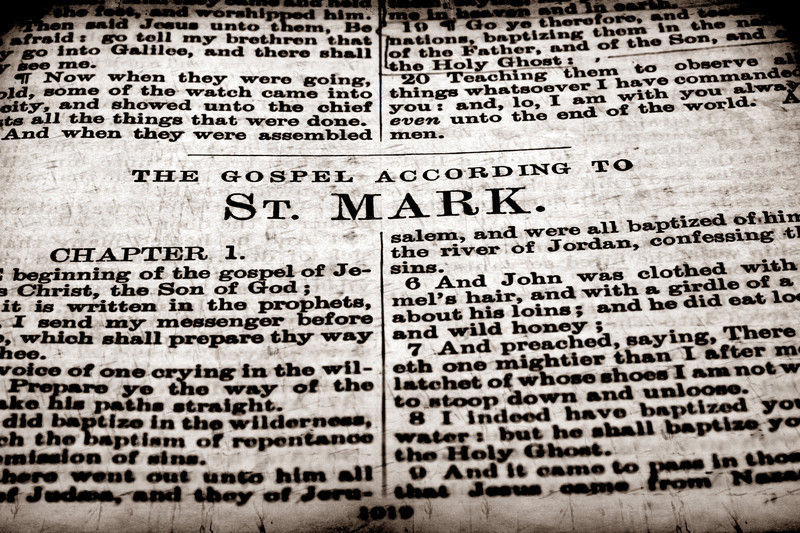
When were the Gospels written? This is an important question.

Most scholars date the Gospels between 40 and 65 years from the death of Christ as follows: Mark 70 AD, Matthew 80 AD, Luke 85 AD and John 95 AD. The scholarly position is stated concisely in the narrative on Dating the Gospels linked here.  Other scholars date them much earlier than that, but Gary Habermas, adopts the majority scholarly view in making his argument for the historical resurrection. (Gary Habermas Explains The Earliest Source Of Resurrection Facts.)

Virtually no one disagrees that Paul’s letters (the ones scholars concede) were written in the 50’s AD. James, Peter and Paul all died in the 60’s AD during the persecution of Christians by Rome. Another key date is the destruction of the Temple in Jerusalem in 70 AD. The scholarly consensus is that “the deaths of these important figures likely encouraged the writing down of the narratives about Jesus”.

Some scholars maintain the narratives were written down well before that time, the reasons for which I will explore in this article. Incidentally, that was the the common view until about the 19th Century, when scholars from the Tubingen school in Germany began to posit the idea that the Gospels were written much later, even as late as the 2nd Century. They also began to question that the Gospels were written by the people attributed to them.

That view of the Gospels is what I learned in college in the late 1970’s, but modern scholars have backed off that view and concede that the Gospels were written within a generation of the death of Jesus. Most scholars agree that Mark was the first Gospel to be written, and that Mark was written around the year 70 AD. Most scholars believe the Gospels of Matthew and Luke were composed in the 80’s, using Mark as source material and a “collection of Jesus’s sayings” (oral tradition). The Gospel of John was believed to derive from different sources (like the Apostle John, himself) and was written toward the end of the 1st Century..

While there is some disagreement on how early the Gospels were written, the work of Gary Habermas has convinced many (most?) scholars, even skeptical ones, that the message of the Gospel – that Jesus, lived, died and rose from the dead, appearing to his followers – goes back many years before the Gospels are believed to have been written. 

In fact, it seems fairly clear that this message (of the resurrection) goes back virtually to the beginning. It goes back, at least, to the time when Paul says he “received” the message at his conversion, but it goes back further than that because he corroborated the message he received with the apostles in Jerusalem who were sharing the same message before Paul did. That message was also at the heart of all the creeds found in Paul’s writings, which were arguably before the Gospels were written.

Continue reading “Dating the Gospels and the Resurrection Story”

Let Your Light Shine Before Men without Practicing Your Own Righteousness

In the Sermon on the Mount Jesus said “Let your light shine”, but don’t practice your righteousness before men. How do we do tell the difference?

by Heather Russell
by Heather Russell

In the Sermon on the Mount (where Jesus spoke to His disciples, not the crowds that also followed Him) a couple of the subjects that Jesus addressed seem contradictory at first blush. They both relate on the surface to the way we act in public, before other people. He said, on the one hand:

You are the light[1] of the world…. Let your light shine before men in such a way that they may see[2] your good[3] works, and glorify your Father who is in heaven. (Matthew 5:14, 16)

Jesus, on the other hand, gave the following negative instruction:

Beware of practicing your righteousness before men to be noticed by them; otherwise you have no reward with your Father who is in heaven. (Matthew 6:1)

Jesus went on to provide the following examples:

“So when you give to the poor, do not sound a trumpet before you, as the hypocrites do in the synagogues and in the streets, so that they may be honored by men. Truly I say to you, they have their reward in full. But when you give to the poor, do not let your left hand know what your right hand is doing, so that your giving will be in secret; and your Father who sees what is done in secret will reward you. When you pray, you are not to be like the hypocrites; for they love to stand and pray in the synagogues and on the street corners so that they may be seen by men. Truly I say to you, they have their reward in full. But you, when you pray, go into your inner room, close your door and pray to your Father who is in secret, and your Father who sees what is done in secret will reward you.” (Matthew 6:2-6)

How do we let our light shine before men without practicing our righteousness before men?

Continue reading “Let Your Light Shine Before Men without Practicing Your Own Righteousness”

Let Your Light Shine

by Nicholas Drendel
by Nicholas Drendel

When Jesus saw the crowds, he went up on a mountain. The disciples followed and gathered around Him when He sat down. So began the Sermon on the Mount.

Though the text does not clearly say, I believe it was just Jesus and the disciples on the mountain. Jesus was sitting, and the disciples were around Him. there was no room for the crowds to gather, and they could not hear Him as He sat with the disciples around Him.

The Sermon on the Mount, therefore, was not for the crowds, but for the followers of Jesus.

Continue reading “Let Your Light Shine”