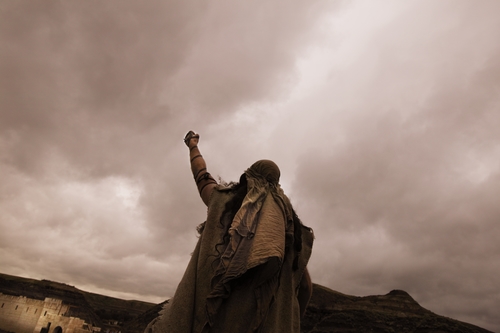
The Resurrection from the Point of View of Mary Magdalene

In the resurrected Christ, there is neither Jew nor Gentile, male nor female. We are all one.

Mary Magdalene, Mary, & Salom walking up to the bright empty tomb of Jesus Christ early Sunday morning

Three days and two nights ago, Mary’s entire world came crashing down. The earth opened up and swallowed Jesus, whom Mary loved, into the abyss. Mary’s world was thrown into darkness and confusion, leaving only soul crushing grief, bewilderment, and emptiness.

She barely had enough time to get him down from that tree on which he had died. A very generous leader risked his life and reputation to help her with the body and prepare the body properly for burial before Sabbath began. (John 19:42) It was the least they could do.

The shock of his arrest and the whirlwind of everything that followed came upon her in a rushing torrent so quickly that she was completely overwhelmed, reeling, barely able to breath. The that unbelievable, astonishing, implausible whirlwind of events ended with his death. It’s all too unreal.

When the devotion of last minute burial preparation ended and the tomb was sealed, tornadic activity gave way to the silent weight of reality. The yawning emptiness and overwhelming grief descended on Mary as she labored to get home in the darkness.

All the men abandoned Jesus as their world began to unravel. The petty squabbling at dinner the night before left Mary confused about what Jesus had been saying. Jesus was trying to tell them something important, but she could only remember bits and pieces….

Something about a cup… and pouring out his blood and…. It was all so surreal and confusing. So impossible to accept.

Igt seemed clear to her in retrospect that Jesus seemed to know what was going to happen. She remembered seeing it in his eyes. He was resigned to it, but she didn’t understand. How could she have understood?

All the mysterious things Jesus said during the exciting and hopeful years they traveled with him played in her mind like a long, beautiful symphony suddenly ending in a grand, discordant cacophony that would not resolve before it faded into a whimper. The mystery seemed so poignant, but no less momentous and ominously empty. Through the looming darkness, a slight flame of hope sputtered as she recalled these things like a lone survivor clinging to whatever is close hand in the receding waters of a tsunami .

As she reached her destination for the night, she recalled that Jesus wouldn’t let anyone try to defend him. “He just gave himself up!” she thought. He utterly gave himself over to them. It was so painful to watch.

But even in his weakness he was noble. He was so beautiful. He seemed like everything they thought he was. Even in the end. Even as he resigned himself to death…. She wept and the torrent of her tears broke through the dam of the brave front she put on through all of it.

“Those men!” she thought, “They didn’t do anything. The torrent took an angry turn. “They were always arguing about who was the greatest.” Her thoughts tumbled like rocks that could not withstand the current. “They couldn’t even stay awake with him! Jesus needed them!”

She let out a long, mournful gasp as she recognized the dark cloud threatening her and swallowed her anger.

“They could have, at least, gone with him! But, they left him,” she mourned. “They saw it happening, but they pretended not to know!” her thoughts raced again. “They didn’t lift a finger. When Jesus needed them most, they abandoned him. Peter even claimed he didn’t know Jesus! Peter!” She stopped as the dark cloud threatened again.

Mary and the other women would not leave him. They saw the whole, unimaginable thing … and John. “At least, John was there…. Not that he did anything, either,” Mary recounted.

She realized, “If it wasn’t for Joseph, who knows where his body would have ended up.” Mary was grateful that Joseph owned a tomb nearby and even more grateful that Joseph and the people with him helped with the body. (Luke 23:50-53). Even so, Mary couldn’t help but wonder, “Where they were earlier – when Jesus needed someone. Anyone!”

Even as she felt her heart constrict in anger and frustration, the realization came in like the gentle lapping of the waves on the shore, “They could not have stopped what happened.” There were powerful forces at work that Mary did not understand. She softened, and she wept.

They didn’t have time to prepare him properly. It was the Sabbath, and night was upon them. The hours labored by through the night. The force of things undone kept slept at bay. Everything weighed so heavily on Mary’s heart. She needed to get to him as soon as she could, as soon as the doaw broke and Sabbath was over.

Mary was up before the dawn. Sleep was not an option anyway. She hurried to the tomb, where she met Joseph and Nicodemus who came through with the spices and ointments for Mary to prepare the body in the soft light of the morning. (Luke 23:56)

The hopeful sounds of birds gently singing in the still of the early morning might have lifted her heart on any other day. She was drowning in sadness, as tears came in waves. She could hardly see at times.

Tears she could not manage to wipe way with the back of her hands fell from her cheeks into the mixture of ointment and spices. She recalled the day she wiped her own tears from his feet with her hair in repentant gratitude and joy, knowing her sins were forgiven, and her life was forever changed.

The dam of whatever shame might have remained was swept away. Her tears turned to waves of uncontrollable sobs. She could not resist them. She gave herself over to them in a gush of new gratitude for all Jesus had done, and she could not continue until the waves of emotion passed.

Mary could not adequately express the depth of gratitude for Jesus for rescuing her from the demons that haunted and tormented her from her youth. She tried. It wasn’t enough. She didn’t care what anyone thought, but it still wasn’t enough.

Nothing had been more precious to her than the ointments she collected… until Jesus set her free. None of those precious ointments mattered anymore. They were all she had, and they weren’t enough. She would have spent her entire life pouring her very self out for him.

The grief returned, and she desperately longed to wind back time. The impossibility of it all was maddening; it seemed so impossible, yet it was so formidably real. Those demons lurked again in the back of her mind. She caught herself again, shuddered, and and devoted her weary mind to the ointment and spices and the body of her precious love, Jesus, lying lifeless at her side.

Continue reading “The Resurrection from the Point of View of Mary Magdalene”

The Upside of Deconstruction

Deconstruction might not be the evil that some Christians may believe it is


Like many people, I suppose, I have been thinking about the phenomenon known as “deconstruction” since it has become popular to tell deconstruction stories in recent years. A deconstruction story is an “anti-testimony”; it’s a testimony of a journey from belief in the God of the Bible to non-belief in the God of the Bible.

Last summer, a high profile Christian worship leader and the guy who wrote the book urging Christians not to date (that created a generation of non-dating Christians) “deconstructed”. They walked away from their faith and publicly announced it, blogged about it, were interviewed about it and became celebrities of the walk away from faith movement.

Other notables come to mind as well, but I am not going to name them. That isn’t the point. I only recount these stories to demonstrate that “it’s a thing”, as my kids say.

Old timey religious folks used to call it “backsliding”. By that, they meant turning back to a sinful lifestyle, lured away by the temptation of sin. I remember people calling it “falling away”. By that we meant, losing faith, not being able to hold on to it.

Deconstruction seems to be a much more noble and honorable thing to do than backsliding or falling away. (I say that not without my tongue in cheek.) Deconstruction suggests that you had a hand in it. You didn’t backslide against your better judgment or let faith slip through your fingers; you rolled up your sleeves and dismantled your faith, and you found that it didn’t fit back together again.

It’s scientific, right? So it must be a good thing.

Deconstruction is popular, I believe, because skepticism is gaining in popularity. Scientists, like Neil de Grasse Tyson and pseudo-scientists, like Bill Nye, “the Science Guy”, have ridden that wave of popularity scaling away religious (and philosophical) ideas and replacing them with science, because (they say) science has all the answers.

Deconstruction is science, right?

I don’t buy it for a second that science and religion are incompatible, and neither do many scientists. I participated in a Zoom conference just this morning with a biochemist who is a believer. On the other hand, deconstruction might not be the evil that some Christians may believe it is. In fact, I think, deconstruction can be a good thing.

Continue reading “The Upside of Deconstruction”

Some Consolation in the Biblical Illiteracy of Modern American Christians


This piece I post not without some trepidation. I throw it out into the blogosphere nevertheless. For what it is worth.

I was listening to a podcast this morning by an atheist, turned Christian apologist, who commented that an “overwhelming number” of American Christians do not know what scripture says about key issues, including salvation. The comment stood out to me, so I googled it.

I found a Lifeway article that doesn’t focus on Christians, per se, but on Americans generally[1]. (We’re supposedly a Christian nation, right?) The article focused not on the content, but on how much of the Bible people have read. While the article didn’t focus on people who call themselves Christians, it began to paint the picture.

A whopping 53% of the people polled had read no more than “several passages” or “a few stories”. Twenty three percent (23%) had read no more than “only a few sentences”, and ten percent (10%) of the people polled hadn’t read a single word of the Bible.

I am not completely surprised, though I would love to see the percentage of those people who have a strong opinion about what the Bible says.

About fifteen percent (15%) of the people polled said they had read “at least half” of the Bible. Another twelve percent (12%) said they had read “almost all of it. Only twenty percent (20%) of the people polled said they had read all of the Bible, but only nine percent (9%) had read all of it more than once.

Clearly, we are not very Bible literate as a nation, though we have strong opinions on what we think the Bible says. That goes for people who have strong positive opinions and strong negative opinions.

Interestingly, I found an article written by a well-known atheist that suggests most Christians don’t understand the fundamentals of their faith.[2] He concludes, “This survey shows that a lot of people take on a particular religious label, not because they have a full understanding of what that faith believes, but for other more superficial reasons. Maybe their parents raised them in it. Maybe they were led to that religion by a friend. Maybe they attended a service and found it welcoming and inspiring.” Anecdotally, I see some truth in that statement.

It’s not just atheists making that observation. An article by the Barna Group, a Christian organization, finds that most churchgoers have “never heard of” the Great Commission.[3] Another article commenting on a similar survey concludes that most Americans are heretics and claims the results show that even “those who wear Christianity on their sleeve” … “Christmas-treed the survey, espousing all kinds of unorthodox views”.[4]

I found many articles by Christian leaders expressing concern about Bible illiteracy among people who consider themselves Christians (calling it a big problem[5], a scandal[6] a crisis[7] and an epidemic[8]), so it seems there truly are an “overwhelming number” of American Christians who do not know what scripture says about key issues – to circle back to where I started. And, where do I get off this feedback loop?

Continue reading “Some Consolation in the Biblical Illiteracy of Modern American Christians”

Justice from a Human Perspective


Every human being has a sense of justice that develops at a very early age. If I show a cookie to a 15-month old, and don’t give it to her, she will cry. She might not be able to articulate what she is thinking, but she reacts because “it isn’t fair”. I shouldn’t show her a cookie I’m not going to give her!

Is this a primitive form of the sense of justice that we all have? Maybe.

Scientists used to believe that a sense of justice didn’t develop until age 6 or 7, but recent studies suggest our sense of justice forms much earlier than that (before we even reach the age of two).[1] The study shows that toddlers not only have a sense of justice; they are already developing nuance in their sense of justice to distinguish between lesser and greater injustices.

That sense of justice matures as we grow older. Studies show that children as young as 3 to 5 years old can already identify injustice done to others, not just themselves.[2] I think our common experience demonstrates that our sensitivity to injustice grows, develops and becomes more refined as we mature as people. We develop a sensitivity to injustices done to others, not just ourselves and the people we know.

Still, that sense of injustice is never provoked so much as when we are on the receiving end. We are never more incensed at injustice as when the injustice is done to us, our family or people with which we identify. Our sensitivity to injustice tends to get softer and less urgent when the injustice is done to people we don’t know, especially if they are people with whom we don’t easily identify.

Don’t think so? When someone from “the other party” rants about a particular injustice done to “their side”, do you feel empathetic?

We can train ourselves to be more sensitive to other people, including other people with whom we have little or nothing in common, maybe even people with whom we disagree, but it’s a lot of work!

Let’s be honest here: it’s much easier to spot the injustice done to ourselves and people with whom we identify; we are much quicker to jump to our own defense and to the defense of people with whom we identify; we don’t naturally have the same feelings for others, especially those with whom we have little or nothing in common.

These observations suggest that a person’s sense of justice is affected by his or her perspective. As we grow older, our perspective broadens and widens, and we can learn to take other people into account as our sense of justice develops, but even as mature adults our sense of justice is driven by our personal perspectives.  Continue reading “Justice from a Human Perspective”

Change of Perspective: From the God of Moses to Jesus

Our perspective of God changes dramatically in the New Testament because God came to us in different form.


I can’t how many times I have been reminded and drawn to the words Paul penned in his letter to the Philippians about Jesus (Phil: 2:6-8):

Though he was God,
he did not think of equality with God
as something to cling to.
Instead, he gave up his divine privileges;
he took the humble position of a slave
and was born as a human being.
When he appeared in human form,
    he humbled himself in obedience to God
and died a criminal’s death on a cross.

Scholars tell us these words were an early creed. The creed that Paul recited to the people in Philippi was probably familiar to them, as it was intended to be recited. That is the nature of creeds: they are meant to be repeated.

Thus, I suppose, the fact that I find myself drawn over and over again to the Philippian creed is apt. It carries significant and timeworn meaning to me, as it certainly must have done for Paul and and the early followers of Jesus to be considered so worth repeating.

I found myself thinking again about these words today as I wrapped up another blog post (Lessons Learned from the Edge of the Wilderness). As often is the case when meditating on Scripture, meanings deepen, grow and broaden. The Philippian creed takes on new meaning for me in light of the exercise of comparing and harmonizing the “God of the Old Testament” with Jesus (another theme I have focused on in the past).

In Lessons Learned from the Edge of the Wilderness, I was thinking about the fact that Moses and the people of Israel were distanced from God – such is the fate of all people in our natural and sinful state. In this piece, I want to explore what that means (and why it is the case), and I want to explore why our perception of God changes in the revelation of Jesus.

Continue reading “Change of Perspective: From the God of Moses to Jesus”