A Complex World Suggests a Robust God

As powerful as our telescopes are, we cannot see the end of our ever-expanding universe. Neither can we even see the beginning.


It seems that many people have this idea that God and spiritual things should be simple. They react skeptically to “complicated” responses to hard questions. When I look at the universe, though, I wonder why people think like that.

Some truths about the universe are simple. We don’t have to be rocket scientists to understand gravity. We know it when we feel it and see it. On the other hand, the computations and deeper understanding of gravity and its interrelationship with other cosmological constants is anything but simple.

Some truths about God are simple too. For instance, that God is love seems simple enough. That God created the universe is pretty simple to grasp also. Now ask, “Why is there evil in the world?”

If we take the universe as an example, however, it should be evident to us that a God who might have created the universe would be far from simple. We should not expect (or demand), therefore, that the resolution of hard questions to be simple. God must be, at least, more robust than the world created by such a God.

Continue reading “A Complex World Suggests a Robust God”

Christians On Social Media


Peter said, “but in your hearts honor Christ the Lord as holy, always being prepared to make a defense [apologia; apologetics] to anyone who asks you for a reason for the hope that is in you; yet do it with gentleness and respect.” (1 Peter 3:15)

This is the tenor and main point of the article, CHRISTIANS ARGUING WITH CHRISTIANS ON SOCIAL MEDIA: A REAL INTEREST IN THE SALVATION OF THE LOST?…. I encourage you to read it. I put it here so people would read it, and so I would be reminded of it and read it again myself.

It’s far too easy to say things on social media that we wouldn’t think of saying face to face in conversation with someone. If we don’t respond to people with gentleness and respect, as Peter urges us, we are not responding in love. We might as well not respond at all.

We live in a reactionary world like never before, exasperated by social media that gives us the instant gratification of an immediate response for every thought that crosses our minds. Don’t do it!

Social media is designed for instant gratification. The algorithms are purposely designed to evoke an immediate response. Social media marketing is aimed at stirring up your emotions to get you to respond, good or bad (they don’t care). Our knee-jerk reactions, especially to contentious comments and posts, are often unkind, judgmental, harsh or worse.

We need to be more self controlled than that. We need to be more self-sacrificial, resisting that desire for immediate gratification for the good of the Gospel. We can pick up our crosses and follow Jesus in this social media age by dying to that desire for the instant response.

We need to be salt and light. Salt accentuates the taste of food, but it does that subtly. Too much salt overwhelms and destroys the flavor of the food. Just the right amount accents and brings out the flavor. People are much more apt to take notice of what we say and take it to heart if we say it with gentleness and respect, as Peter admonishes us.

Light illuminates. Too often we demonstrate heat without a great deal of light. It isn’t our job to convict people of their sin or even to convince them of the rightness of our positions. The Holy Spirit is well-equipped to do the convicting in peoples’ hearts. We just need to be faithful to speak the truth, but we need to do it in love – always in love.

God’s word does not go out and come back void, but our idea of how people should respond and what it means that God’s word does not come back void may not be accurate. We may want every post to be a mic-drop moment, but God doesn’t always work that way.

When Isaiah was given the commission to speak God’s word to the people, he was told they wouldn’t listen. It wasn’t Isaiah’s responsibility to make sure they listened. It was his responsibility simply to speak and to let God do His work. If nobody listened, still Isaiah was being faithful in what God called him to do.

Are we always speaking God’s word? We are finite beings. We might not always have it right. We should have the humility to realize that.

Our love for other people, on the other hand, is always “true”. How we treat people will always shine through and have an impact. Our greatest apologetic is the love of God. Love covers a multitude of sins.

“If I speak in the tongues of men and of angels, but have not love, I am a noisy gong or a clanging cymbal. And if I have prophetic powers, and understand all mysteries and all knowledge, and if I have all faith, so as to remove mountains, but have not love, I am nothing. If I give away all I have, and if I deliver up my body to be burned, but have not love, I gain nothing.” 1 Corinthians 13:1-3

The Hole In the God of the Gaps Argument

All people, including scientists, fill in the gaps in their knowledge with a model of reality they believe best fills those gaps in light of the knowledge they have. 


Most people who have entertained the question, whether God exists, are familiar with the “God of the Gaps argument” that is made against the existence of God. It goes something like this: In the past, people couldn’t explain natural phenomenon, like rain, thunder, earthquakes, etc. so they attributed those things to the activities of the gods. People use the gods (or God) to fill gaps in their knowledge and understanding of how the world works out of ignorance.

From that observation (which is factually true as a simplistic statement), they add in the equally true observation that the progression of science over the centuries has been filling in the gaps in human knowledge and understanding of the natural world. We have found natural explanations for most phenomenon without having to resort to the conclusion that “God did it”. Thus, the argument goes, we should stop invoking divine explanations.

Many people take that even further and conclude that we should stop believing in God altogether. We don’t need God to do science; thus, we don’t need God at all, they say.

Thinkers realized during the Enlightenment period that they didn’t need to invoke divine explanations at all to be able to study the natural world. From that realization, a scholarly consensus the thinking has developed that divine explanations are not only not necessary; they are not appropriate.

Divine explanations are viewed today by most scholars as anti-scientific. Some people who are concerned with the purity of science would even deem divine explanations “heretical” to the current scientific orthodoxy.

The God of the gaps argument (as an argument to prove the nonexistence of God), however, is pretty weak. The fact that we can do science (which is, by definition, the study of the natural world) without appealing to a supernatural being or explanation isn’t surprising. It also can’t tell us what caused the natural world, as any cause of the natural world would have to be independent of it.

Just as the study of a painting can never introduce us to the painter, study of the natural world could never hope to introduce us to the creator of the natural world. At best, it might tell us something about the painter/creator. In both cases, we must be willing to look elsewhere to find the painter/creator.

Frankly, the order we see in the natural world is more surprising on a naturalistic worldview that assumes no intelligence behind the universe. We see intricate design in the universe, from the micro to the macro levels. How do unguided co-locations of molecules and matter acting randomly on each other produce the exquisite fine tuning we see?

The order to the natural world that we can study and know doesn’t preclude the existence of a supernatural (other than natural) Being behind it all. The order of the natural world is actually more difficult to explain without God.

The order of the world, by itself, is not proof that God exists, but the design we see is best explained by a grand Mind. This is not a gap-filling argument. It is an argument based on the best explanation we have – that all design we see in our experience is created by a being with agency who thought of it, designed it, and created it. This is the best explanation that we have.

If we resign ourselves to nothing but the study of the natural world, how do we expect to know anything about the possibility of reality beyond it? If we limit ourselves to naturalistic explanations, we foreclose any other possibility.

Thus, refusing to allow for the possibility of a God that might fill the gaps in our knowledge is just as arbitrary and closed-minded as filling every gap with God (and refusing further inquiry).

We all fill gaps in our knowledge, and we do it on the basis of what we know and believe about what we know. Our gap fillers are our basic assumptions. The theists assumes a Creator exists. An atheist assumes that no creative mind is behind the universe.

Frankly, there is a big gap between the fact that the natural world has order that we can study and the question whether anything beyond the natural world exists. I can turn the argument around and accuse the naturalist of filling the gap with the conclusion that no God exists.

But all of this really misses the important point. Hugh Ross addresses the God of the gaps argument in a recent interview with Kahldoun Sweis. He says,

“In science, there are always gaps. We will never learn everything. We are limited human beings.”

However, when we “push back the frontiers of science”, we have to ask ourselves whether the gaps in our knowledge are getting bigger and more problematic? Or are they getting smaller and less problematic?”

Continue reading “The Hole In the God of the Gaps Argument”

Questioning the Skepticism about Some of Paul’s Letters

A little skepticism of the skeptics might be in order in questioning the rejection of the authorship of some of the “questionable” Pauline epistles.

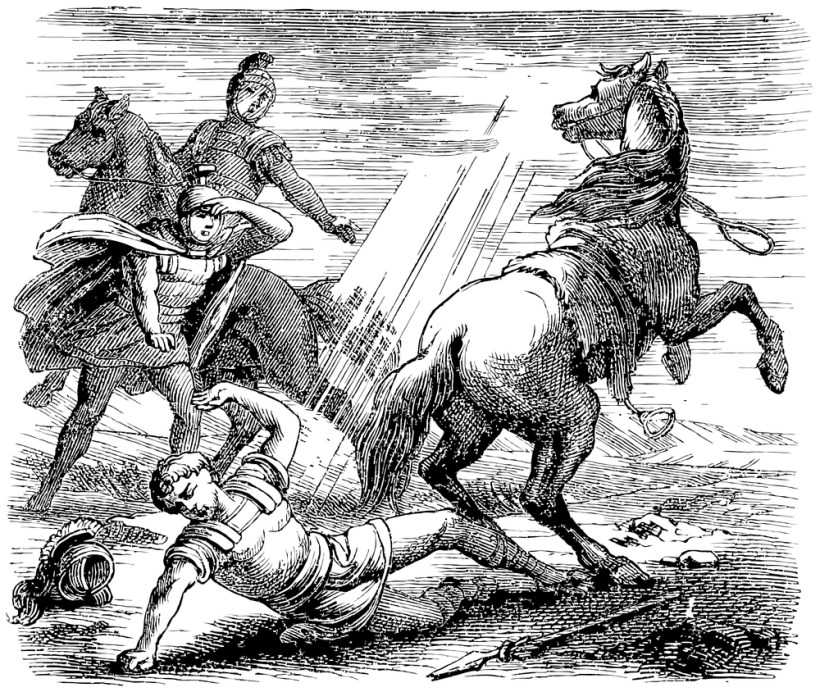
Old Engraving of the Conversion of Paul

I first learned that some of the “Pauline epistles” were not written by Paul in my religion courses in college. That was the scholarly consensus then, as it is now, among the elite New Testament scholars in colleges and universities around the world. This consensus grows out of the “school of higher criticism” that began in the 19th Century in Tubingen, Germany.

The so-called “school of higher criticism” is textual criticism with a heavy emphasis on the text. (I will explain that comment below.) Not that textual criticism, itself, should be suspect. Textual criticism is “a branch of textual scholarship, philology, and of literary criticism that is concerned with the identification of textual variants, or different versions, of either manuscripts or of printed books…. The objective of the textual critic’s work is to provide a better understanding of the creation and historical transmission of the text and its variants.” (Wikipedia)

And by the way, there are differences among the New Testament manuscripts. Many differences. That fact shouldn’t come as a shock to anyone in this information rich age. If you aren’t aware of that fact, you would do well to consider the work of Daniel Wallace on the subject. I have addressed this issue before (Can We Trust the Bible?). But, I digress….

I have no issue with textual criticism applied to the Scriptures. We have learned much about the Bible from the method of study called textual criticism. “Criticism” here doesn’t mean, necessarily, rejection or doubt, but is more of a method of study that recognizes textual differences between manuscripts and attempts to identify the text that is most true to the original text, among other things.

Because we have so many manuscripts, well over 25,000 of them in various languages, there are variants that need to be addressed and understood. Textual criticism helps us with this understanding. (I should add that we have such a high degree of certainty about what the original text says precisely because we have so many manuscripts. If you want to dig in to the topic of textual criticism as applied to the Bible, I recommend The Basics of New Testament Textual Criticism.)

Some people take the fact that there are many differences among the manuscripts as a reason to reject the New Testament as Scripture, believing it to be inherently unreliable, questing whether we even know what the original authors wrote. This is an extreme view, in my opinion, though one that skeptical intellectuals seem to like. Perhaps, their fondness of this view is that it eliminates the need to take Scripture seriously or to apply it to their lives (to apply a little skepticism to the skeptics).

The fact is that we have such a wealth of New Testament manuscripts (5800 Greek, 10,000 Latin and 9800 Syriac, Coptic, etc.) that we can know with a very high degree of accuracy precisely what the original text was (like 98.5% per Dr. Wallace). Even if we didn’t have a single manuscript left, there are some 36,000 quotations of New Testament text by the early church leaders. Wallace observes that we could assemble the entire New Testament from those quotations alone, without the need for a single manuscript of the text.

But, I digress. Only a little. The point is that we should be as skeptical of the skeptics as they are skeptical of the text. In fact, Skepticism is the hallmark of the higher school of criticism. Skepticism is their starting place. They assume a skeptical approach. They don’t just wipe the slate clean, and start from neutral; they assume that the plain meaning of the text, the authenticity of the text and the reliability of the text has the burden of proof. And for this reason, we have good reason to be skeptical.

This form of skepticism is the flip side of what some might call blind faith. There is a danger in being skeptical that will not admit a positive result. There is a commitment to skepticism that is counterfactual. We can be as “committed” to skepticism as we are to belief to the exclusion of the facts and reality. I believe this is the case with the Pauline epistles that scholars reject.

Continue reading “Questioning the Skepticism about Some of Paul’s Letters”

Significance in the Way Christianity Spreads

Islam rivals Christianity in its “travel” around the world. But the spread of Islam looked different than the spread of Christianity.

Os Guinness talks about differences between Christianity and other religions in an interview with Justin Brierley a few years ago. He made a statement that Christianity is the only “traveling religion”.

He observed that Hinduism began in India and remains primarily in India. Buddhism began in India and remains primarily in India and Eastern Asia. Islam began in the Middle East and remains primarily in the Middle East. Christianity, however, began in the Middle East. Then it moved to Europe; and then it moved to North America; and now Christianity is growing fastest in Africa and Latin America and Asia.

While I think Guinness overstates the case little bit, he got me thinking about the how the major world religions have spread. For instance, Islam, which rivals Christianity in numbers, grew very rapidly during the life and immediately after the death of Muhammad. It spread throughout the centuries into Europe and down into Africa and more recently across Southern Asia.

Islam rivals Christianity in its “travel” around the world, but the spread of Islam happened very differently than the spread of Christianity. This is the significant fact, in my opinion – not so much that Christianity has traveled through all the world like no other religion. (Though it has.)

Continue reading “Significance in the Way Christianity Spreads”