Doubts About the Viability of Darwinian Theory Increase

sad chimpanzee


I am reblogging this post as I have the distinct impression that most of the world, including most of the academic world, don’t realize that the Theory of Evolution, which seems to be accepted more like a fact in modern society, is still not completely settled. While the official face of the scientific world continues to bow in homage to Darwinian Theory, doubts of its ultimate viability and explanatory scope are increasing.

This is not to say that doubts about evolution, generically, are increasing. Evolution can mean any number of things, including the adaption of species over long periods of time. Garden variety evolution is not seriously in question (to put a layman’s spin on it).

Rather, evolution as an explanation of the origin of life and which defines the entirety of the biological process, from beginning to end, is still in some flux. If you don’t believe me, listen to Stephen Meyer and Perry Marshall debrief the Royal Society meeting of eminent biologists last November. (See Unbelievable? What happened to evolution at the Royal Society? Stephen Meyer & Perry Marshall)

Their report (as well as others) reveals a Neo-Darwinian theory in crisis. Many scientists are finding it increasingly difficult to maintain the old paradigm, even with a face lift, in light of ongoing research and discovery. The old model is straining under the pressure.

It isn’t any wonder, then, I suppose, that the number of scientists willing to sign a petition expressing skepticism about the contemporary theory of Darwinian evolution has risen ten times since 2001.

Skepticism About Darwinian Evolution Grows as Over 1000 Scientists From Around the World Declare Their Doubts About Darwinism WASHINGTON, Feb. 5, 2019 /PRNewswire/ — Over 1000 doctoral scientists from around the world have signed a statement publicly expressing their skepticism about the contemporary theory of Darwinian evolution, according to Discovery Institute. The statement, located online at http://www.dissentfromdarwin.org, reads: “We are […]

via Doubting Darwin — God does not believe in atheists

Commitment to a Worldview

The commitment to atheism can be as dogmatic as any other belief.

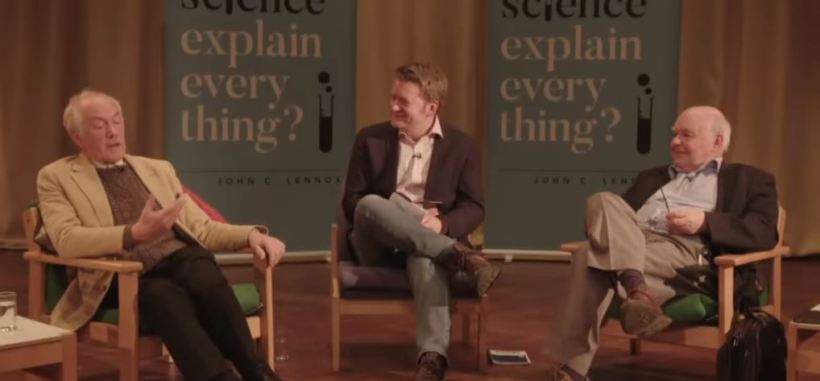
From the Unbelievable! discussion involving John Lennox vs Peter Atkins – Can science explain everything?

In a recent discussion on theism and atheism with the Oxford professors, John Lennox and Peter Atkins representing both ends of the spectrum, the dialogue stopped, and a time of questions and answers began. One person, a scientist, wrote in saying that he is an atheist, but his commitment as a scientist to follow the evidence suggested to him that God does exist. For him, the issue isn’t the evidence, but his own feelings, instincts and emotions.

When this question was put to the two guests to respond, the answers were very intriguing. John Lennox, the Christian, suggested that the man should continue to question and research and to test the position (that God exists) personally, not from afar. The response of the atheist, Peter Atkins, was simple: stick to your “commitment to rationality” (which to him presupposes atheism).


Think about it. Would you suppose the answer, to stick to your commitment, would more likely come from the Christian or the atheist? I would. I think most people would expect that answer to come from the Christian, but it doesn’t in this case. It’s the atheist sticking dogmatically to a presupposition.

Continue reading “Commitment to a Worldview”

The Plurality of One God


I have undertaken to explore the question, Is Jesus God?, by looking first at the claims Jesus made about himself. After all, if Jesus didn’t really claim he was God, we would have to wonder about others making that claim. The religious authorities, at least, understood what Jesus was saying, and they condemned him precisely because he was making claims of equivalence with God.

I also explored what people in the time of Jesus said about him. Some people claim that the early followers of Jesus didn’t really think he was God, that the God-claim arose generations later in the way of a legend. Unless the Gospels and letters collected in the New Testament were written generations later, clearly, his early followers, and even people opposed to him, believed that he was God or, at least, that he claimed to be God.

One puzzle that remains, though, is how the claims made by Jesus and his Jewish followers fit into an ancient Judaic theology built on the foundation of one true God. Jesus, himself, quoted the sacred text handed down from Moses: “You shall worship the Lord your God and serve him only.” (Luke 4:8, quoting Moses Deut. 6:13) So how do we square that statement with his evident claims that put him on a par with God?

There is no dearth of resources addressing the idea of the Trinity, but I turn to a former Muslim for help. Muslims have a robust view of God (Allah) as one. Allah is not a father and does not beget sons. He is single, undivided, and purely one God.

Nabeel Qureshi is my source for an explanation of the Trinity. Nabeel was a devout Muslim turned Christian after his college years, and he went on to become a Christian apologist.

Nabeel recalls that one of the most recited passages of the Qur’an is Surat-al-Ikhlaas, 112:2 – “God is not a Father, and He is not a Son.” This “doctrine above all doctrines” in Islam is known as Tawhid – God is absolutely one and cannot be father or son.

The question that troubled Nabeel when he was comparing the two religions was this: How can the Trinity be harmonious with a monotheistic doctrine?

Continue reading “The Plurality of One God”

Is Jesus God? Part 1

Is Jesus God? What did he actually say about himself? And what did the people closest to him say?


Over 800 churches in the Chicago area are working through a series of big questions together all at the same time. (See exploreGod) The big question two weeks ago, for instance, was: Why Does God Allow Pain and Suffering? I have addressed the problem of pain before. Not that I have addressed the issue once and for all. I certainly haven’t. Gaining knowledge and understanding is an ongoing process. In that vein, I tackle the question for this week: Is Jesus God?

Not that I (nor anyone) can prove Jesus is God. I don’t suggest that I can, and it isn’t my goal to offer that proof here. Rather, I intend to go through the exercise of following the claims that Jesus and others made about who Jesus was. After all, why would it even be a question whether Jesus is God if neither Jesus nor any of his close associates made that claim?

Before launching into a review of what Jesus and others said about his deity, we should note what he didn’t say. To be perfectly frank, Jesus didn’t not say, “I am God in the flesh” in those exact words or other words directly and expressly making such a claim.

At the same time, Jesus never said, “I am not God”. He never says, “Don’t worship me.”

Jesus is known for the questions he asked. Perhaps, the most significant question he asked is this: “Who do you say that I am?” This series of blog posts is an introduction to that question by looking, first, at the claims Jesus made about himself and then looking at what others said about him.

Continue reading “Is Jesus God? Part 1”

Is Jesus God? Part 2

Recounting what Jesus said about himself, what do you think? Was Jesus claiming to be God?


Over 800 churches in the Chicago area are taking on seven big questions in a series of discussions over the course of seven weeks. (See exploreGod) The big question this week – Is Jesus God? – is the subject of this piece. I introduced the question in a preliminary blog post (Is Jesus God? Part 1). I will get into the specifics of what Jesus said about himself in this piece followed by what others in his time said about him. (Is Jesus God? Part 3)

There are people who say that Jesus didn’t, in fact, claim to be God. One friend of mine, asked recently, “Jesus was a Jew, right? Didn’t he preach Judaism?” He was suggesting that people took what Jesus said out of context and ran with it, creating a new religion that Jesus didn’t even intend.

I believe my friend is partially right – that Jesus was a Jew, and he came first to the Jews, but that wasn’t his end goal. (See John 1:11-12; John 10:16; see also Got Questions) If we understand the sweep of the Bible, Old Testament through the New Testament, we see that the Jews and Judaism were the platform and the stage on which God could engage with His creation and demonstrate to the world who He is, but the climactic event in that drama was the life, death and resurrection of Jesus for the salvation of all the world.

Of course, Christians believe Jesus was God in the flesh, but, I am getting ahead of myself. The only goal of this piece is to explore the what Jesus claimed about himself, and what other people in his time claimed about him?

Continue reading “Is Jesus God? Part 2”