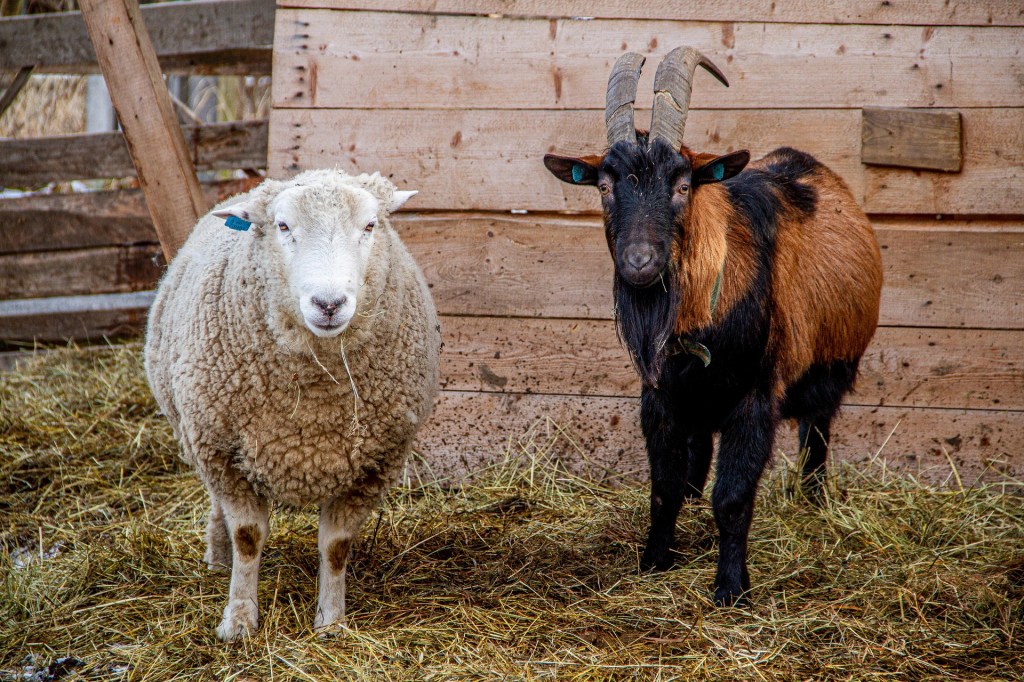
Have you ever noticed the odd qualification in the key statement of the Parable of the Sheep and the Goats: [W]hatever you did for one of the least of these brothers and sisters of mine, you did for me.” (Matthew 25:40)(NIV) Why did Jesus qualify “the least of these” with the phrase, “brothers and sisters of mine?”
I came at the same topic from a different angle in Who are Christians to love? I raised the question, then, whether “brothers and sisters of mine” limits the people we are to care for – limiting them to brothers and sisters of Jesus. What does that phrase mean in the context of the parable of the Sheep and the Goats?
Elsewhere, Jesus tells his disciples that the world will know they are his followers by the love they have for one another. (John 13:35) When Jesus learns from someone in a crowd that his mother and brothers are looking for him, Jesus says, “[W]hoever does the will of my Father in heaven is my brother and sister and mother.” (Matthew 12:50)
These verses in other contexts have prompted some scholars to conclude that we are only called to love fellow believers. They conclude that only the care we show for fellow believers who are hungry, thirsty, naked, a stranger, or a prisoner is showing care for Jesus in the Parable of the Sheep and the Goats. Some even narrow the focus further, taking the position that Jesus was only referring to his disciples (with whom he shared the parable).
This, however, is a minority view. Most of the early church fathers and theologians do not hold that view because of the many Bible passages that instruct us to love our neighbors and even our enemies. The Parable of the Good Samaritan makes this point rather clearly, as I show in the blog article linked in the opening paragraph.
In another article, I tackled the question, Why does Jesus repeatedly prioritize Christians loving one another? It seems that Jesus does prioritize our love for fellow believers. Paul also prioritizes Christian love for fellow believers when he says, “[A]s we have opportunity, let us do good to everyone, and especially to those who are of the household of faith.” (Galatians 6:10)
I note in the previous article that Jesus emphasized loving each other as he was preparing his disciples for the imminent reality of his death. In that context, he was encouraging them to stick together and to love each other. The context matters.
In other contexts, Jesus told his followers to love their neighbors and their enemies. Thus, Christian love is not exclusive to loving Christians.
Yet, Jesus does seem to prioritize love for fellow followers of Christ at some points.
Perhaps, Jesus was letting his followers (and us) know that we need to love each other, first, before we can love our neighbors (and then our enemies). If we cannot even love those who love us and think like us, how can we love our neighbors – and how in the world can we love our enemies?
I encourage you to read the previous two blog articles if you want a more compete analysis on the subject. In this blog article, I want to explore the majority way of reading “whatever you did for one of the least of these brothers and sisters of mine, you did for me.” (Matthew 25:40)
The disciples were likely encouraged to know that people treating them badly is equivalent to treating Jesus badly (and treating them well is equivalent to treating Jesus well). The Parable of the Sheep and Goats, though. doesn’t read as an encouragement to the disciples in the way people treat them.
Consider how Jesus instructed the 72 disciples to announce the coming of the kingdom of God: “Whoever listens to you listens to me; whoever rejects you rejects me; but whoever rejects me rejects him who sent me.” (Luke 10:16) If Jesus wanted to encourage his disciples in their representative capacity, he would have phrased the statement similarly in the Parable of the Sheep and the Goats.
Instead, the Parable reads like a lesson applied to his disciples. Jesus said, “Truly I tell you, whatever you did for one of the least of these brothers and sisters of mine, you did for me.”
Jesus was not talking about what others do or do not do to the disciples, like he did when he sent out the 72. Jesus is talking about what they (his disciples) are to do. The lesson of the Parable is directed to his audience (the disciples), saying that whatever you (his disciples) do for “the least of these brothers and sisters of mine,” you (his disciples) do for me.

As was shown clearly (I hope) in the previous two blog articles, Jesus commands his followers to love all people, including their neighbors and even their enemies without distinction. Just as Jesus so loved the whole world that he came and died for all, he sends his followers out to the whole world as an extension of his love to spread the gospel and make disciples.
As noted in the previous blog, we cannot love the world unless we start with loving each other. We cannot love our neighbors and our enemies unless we love the people in the family of God first. Jesus emphasizes loving each other as a priority but not as a matter of exclusivity.
Thus, I think we need to pay attention to the way the lesson about caring for the hungry, thirsty, naked, stranger, sick and imprisoned is phrased: it is a lesson given to the disciples (his audience) and not for them. It is not meant to be like the encouragement Jesus gave to the 72: to consider the rejection they experience as ambassadors of Jesus a rejection of Jesus (and not them). Because the phrasing is different, I think we need to read “the least of these brothers and sisters of mine” differently.
Some scholars, like N.T. Wright and Scot McKnight, take the view that application of “the least of these” to the disciples, or more broadly to followers of Jesus, has strong support, but it isn’t an either/or proposition. Scripture is full of commands to love other people without that distinction. For instance, Jesus expresses care for the poor and needy without distinction in The Sermon on the Mount (Matthew 5-7), beginning with the Beatitudes:
“Blessed are the poor in spirit,
Matthew 5:3-10
for theirs is the kingdom of heaven.
Blessed are those who mourn,
for they will be comforted.
Blessed are the meek,
for they will inherit the earth.
Blessed are those who hunger and thirst for righteousness,
for they will be filled.
Blessed are the merciful,
for they will be shown mercy.
Blessed are the pure in heart,
for they will see God.
Blessed are the peacemakers,
for they will be called children of God.
Blessed are those who are persecuted because of righteousness,
for theirs is the kingdom of heaven.”
In the same discourse, Jesus tells his audience not only to love their neighbors, but to love their enemies, and to pray for those who persecute them (vv.43-44) “that you may be children of your Father in heaven…. [Who] causes his sun to rise on the evil and the good, and sends rain on the righteous and the unrighteous.” (v. 45) Jesus also assumes that his followers are “practicing righteousness” by giving to the needy when he tells them to give in secret. (Matt. 6:1-4)
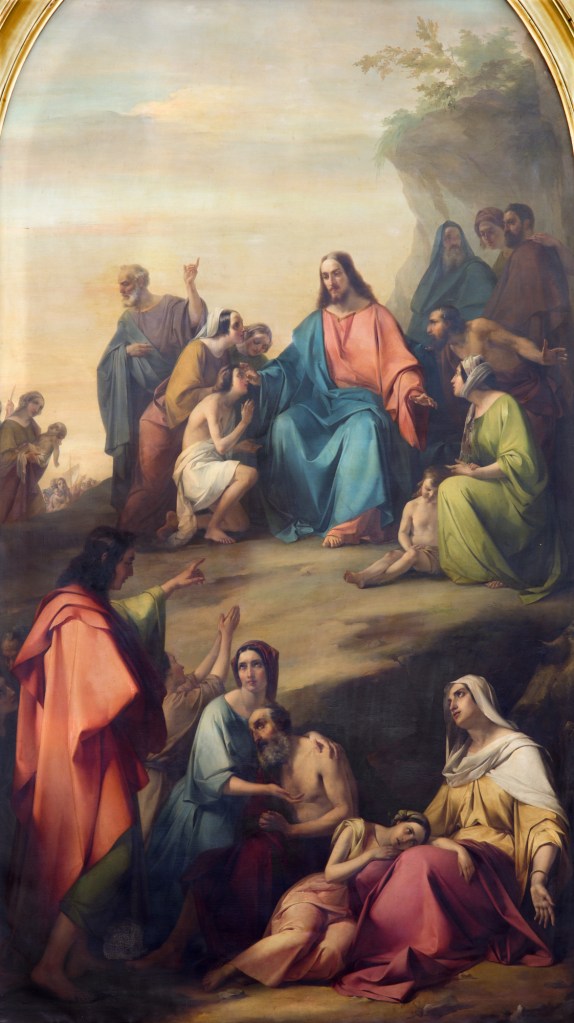
God’s attitude toward the poor and vulnerable isn’t confined to Matthew or the New Testament. It is a theme that runs through Scripture. God “secures justice for the poor and upholds the cause of the needy,” without distinction. (Psalm 140:12) “He defends the cause of the fatherless and the widow, and [he] loves the foreigner residing among you….” (Deuteronomy 10:18) In this and many other places in the Old Testament, foreigners are included – people not counted among the “brothers and sisters” of Israel.
Scripture reveals that God’s heart is inclined toward the poor: “When the poor and needy seek water, and there is none, and their tongue is parched with thirst, I the Lord will answer them; I the God of Israel will not forsake them.” (Isaiah 41:17) When the poor cry out, God hears them. (Ps. 34:6) God is vigilant on behalf of the poor and oppressed, holding people accountable who mistreat, oppress, and exploit the poor. (Proverbs 14:31; 22:22-23) All of these statements are without distinction.
God instructs us to have the same heart and to act accordingly:
- “Defend the weak and the fatherless; uphold the cause of the poor and the oppressed. Rescue the weak and the needy; deliver them from the hand of the wicked.” (Ps. 82-3-4)
- “Is not this the kind of fasting I have chosen: to loose the chains of injustice and untie the cords of the yoke, to set the oppressed free… Is it not to share your food with the hungry and to provide the poor wanderer with shelter—when you see the naked, to clothe them, and not to turn away from your own flesh and blood?” (Is. 58:6-7)
- “Religion that God our Father accepts as pure and faultless is this: to look after orphans and widows in their distress and to keep oneself from being polluted by the world.” (James 1:27)
None of these passages add any qualification on God’s affection and concern for the poor. None of these passages qualify the poor people God commands us to defend, rescue, set free, feed, provide for, and look after. None of these passages limit our compassion to “people of God.”
Interestingly, I found echoes of the words Jesus used in the Parable of the Sheep and the Goats in other Old Testament passages. For instance, “Whoever is kind to the poor lends to the Lord, and he will reward them for what they have done” (Prov. 19:17); and “Whoever oppresses the poor shows contempt for their Maker, but whoever is kind to the needy honors God.” (Prov. 14:31)
These passages do not qualify the statements, as Jesus seems to qualify them in the Parable. They do not limit their application to those in the Nation of Israel or the House of David.
Perhaps, then, the phrase, “the least of these brothers and sisters of mine” is not a qualification, but simply an expression of the favor God shows to the poor and needy – regardless of who they are. By calling them “brothers and sisters of mine”, he is showing how much God values them and, by extension, how much we should value and care for them.
Perhaps, Jesus is encouraging his disciples to see anyone who is hungry, thirsty, naked, a stranger, sick, or imprisoned as a brother or sister of Jesus. Perhaps, he is prioritizing love for vulnerable and needy people similar to the way he emphasizes the command for his followers to love one another.
God is the Maker of all mankind and of every person everywhere. Every man, woman, and child is made in the image of God. Thus, “Whoever oppresses the poor shows contempt for their Maker, but whoever is kind to the needy honors God”; and “whoever is kind to the poor lends to the Lord….”
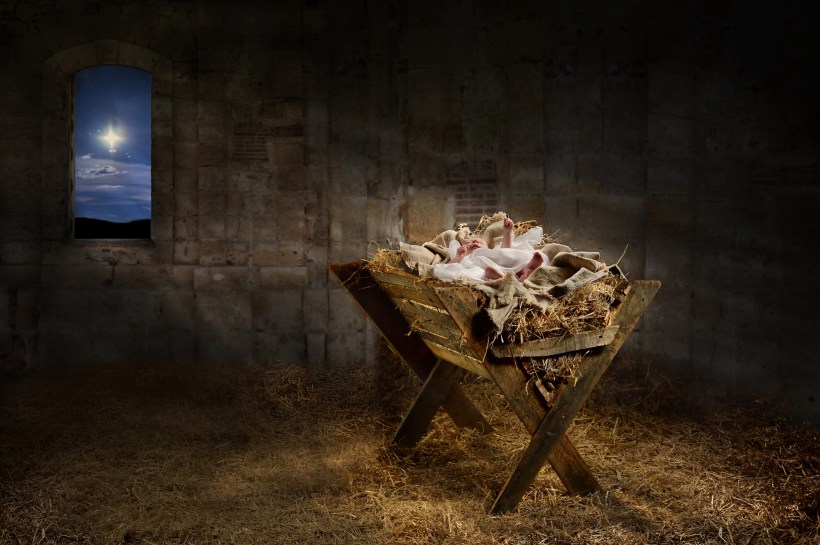
More than that, Jesus is God who took on human flesh. He could have come as king or at least as the son of a king. Instead, he came as a vulnerable infant.
He was born into a poor and vulnerable family at time when they were sojourning without a place to stay. He became a refugee with his parents when they fled from the decree of Herod to kill the male infants in their hometown.
Jesus experienced poverty and vulnerability. He knew what it meant, and he knew how it felt. Thus, when he calls the least of these “brothers and sisters of mine,” Jesus may have been conveying a sense of empathy, understanding, and fellowship with the poor and vulnerable because he experienced being poor and vulnerable.
This is consistent with the way in which God encouraged the Israelites to empathize and identify with strangers in order to love them:
“When a foreigner resides among you in your land, do not mistreat them. The foreigner residing among you must be treated as your native-born. Love them as yourself, for you were foreigners in Egypt.”
Leviticus 19:33-34
God encouraged His people to identity with the strangers in their midst and to treat them as they would want to be treated because His people knew what it was like to be mistreated as strangers in Egypt. Jesus called “the least of these” his “brothers and sisters” because he knew what it was like to be treated as the least.
In John, Jesus encourages his followers to be one with Jesus as he is one with the Father. Jesus encourages us to love as He loves. He encourages us to love our neighbors, our enemies, and the world because he loves them and gave his life for them. As one who sacrificed his life for them, he identifies with them and encourages us to identify with them – caring for and loving them as we care for and love ourselves. John says, “[W]hoever does not love their brother and sister, whom they have seen, cannot love God, whom they have not seen.” (1 John 4:20)
Thus, I believe the admonition in the Parable of the Sheep and the Goats is not just to care for the disciples of Jesus, or missionaries, or Christians generally. It is to care for all people who are vulnerable and needy as if they were brothers and sisters of Jesus.
~~~~~~~~~~~~
The following discussion focuses on the same topic with some additional insights:

 Navigating by Faith