
I recall today the Flying Fickle Finger of Fate award from Rowan and Martin’s Laugh In back in 1968. When I was 8 years old, Laugh In was a hip variety show of biting political humor that was mostly lost on my young mind. The award was a dubious honor ceremoniously presented each week to public figures, corporations, and government agencies for ridiculous “achievements”.
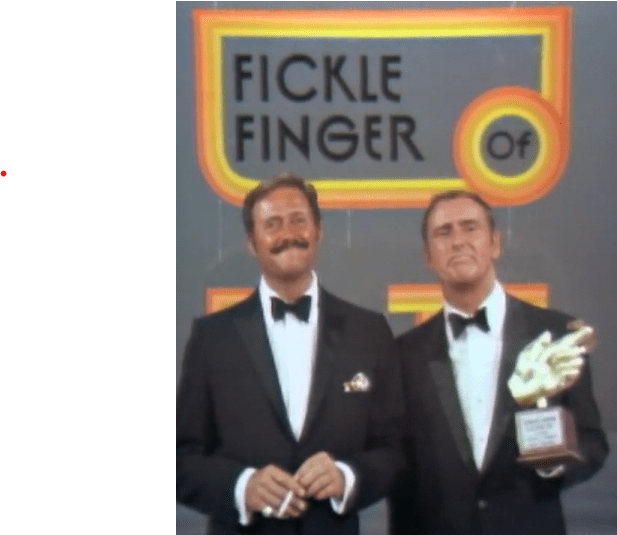
The Fickle Finger of Fate suggests the unpredictable and arbitrary nature of luck or destiny. As finite human beings, we don’t control our fates, and we cannot know the twists and turns that await us in the future.
The award has an ironic backstory. Star Trek was moved from the coveted 7:00 PM spot to the dreaded 10:00 PM “death slot” by NBC to make room for Laugh In. The hip, comedic variety show, however, was popular only for a relatively a short stint from 1968 to 1973 and has largely been forgotten by all but impressionable young minds.
Star Trek, on the other hand, went on to become an iconic science fiction series. It was ahead of its time, and it became a hit in off-network syndication, inspiring sequels and movies for almost 50 years.
Fate is certainly a fickle thing. Driven by polls and ratings to attract the largest audience, NBC obviously did not foresee the lasting success of the Star Trek brand. They also did not expect the short-lived lifespan of their cutting edge variety show that replaced Star Trek.
As Christians, we don’t believe in fate, of course. We don’t believe in random chance. We believe in God who designed and ordered the universe and established our place in it.
The future, however, is equally unknowable to us. As the writer of Ecclesiastes said thousands of years ago, “God set eternity in the heart of man, but not so that he can know the end from the beginning.” (Ecc. 3:11). The Prophet Isaiah said it this way,
“’For my thoughts are not your thoughts,
Isaiah 58:8-6
neither are your ways my ways,’
declares the Lord.
‘As the heavens are higher than the earth,
so are my ways higher than your ways
and my thoughts than your thoughts.'”
God famously, but lovingly, rebuked Job for insisting on understanding things he could not fathom. As with Job, we are invited to have faith and to trust God, but we have more reason for hope and trust than Job, because we know our redeemer lives. He rose from the dead!
We understand that God can be trusted because of His willing demonstration of love for us in emptying Himself to become a man and laying down His life for us. We have no option but to trust Him, but we know we can trust him because of His love for us that He demonstrated on the cross.
Still, we easily are easily swayed and influenced by external pressures. We may think that we understand the times when we are only blowing in the shifting winds of “fate” (powers and principalities that want to blow us off course).

Paul says these powers and principalities are operative in the world. They are “spirits of the age” that play us like instruments if we are not grounded in the Word of God and led by His Holy Spirit.
Jesus used the phrase, reed blowing in the wind, when he addressed a crowd that went into the wilderness to see John the Baptist: “Did you you go to see a “reed swayed in the wind?” (Matt. 11:7-18)
John the Baptist was not just a curiosity. He was not a fleeting personality (like Rowan & Martin) with no lasting importance or purpose. He was the messenger of the Messiah, foretold by the prophets preparing the way for Jesus, the suffering servant who would take away the sins of the world. John was an agent in God’s eternal plan, and Jesus was (and is) the key figure in that plan.
Though he was foretold by the Prophets, no one knew exactly how things would unfold – not even God’s own people. In fact, they didn’t recognize God’s Messiah or receive him when he came. (John 1:11). Crowd of common people were drawn to Jesus, but smarter and more prestigious religious leaders were not.
Many have come, and many have gone. Many have claimed to be the harbingers of promise and special knowledge in their times, but many have proven wrong in their predictions.
The reality is that we do not know what we do not know. We must ever remain open to letting God’s Word shape us and direct us, and we must ever remain attentive to allow the Holy Spirit to guide us in applying His Word in our times.
Even now, smart people – including learned, religious people – believe and act as if they know the times. It is the same in every age and every generation, but we are easily swayed and blown by the winds of fate and human influence that seek to drive the course of history not always in ways that are aligned with God’s plan and purposes. To that generation, and to ours, Jesus said:
“They are like children sitting in the marketplaces and calling out to others:
Matt. 11:16-17
‘We played the pipe for you,
and you did not dance;
we sang a dirge,
and you did not mourn.’”
Human tendency is to trust ourselves. The smarter we are, the more we trust in our own ability to figure it out. Perhaps, this explains why so many scientists and PhD’s are atheists. Perhaps, this is why so many of the religious leaders in the time of Jesus were blind leaders of the blind. Perhaps, we are susceptible to the same error.
We don’t know the end from the beginning. We don’t know God’s thoughts unless He reveals them. God doesn’t dance to the tunes we play. Our tunes are often just riffs on the spirits of our age changing as those spirits change their tunes that we follow.

I reflect on these things as I think through changes in the winds influencing the evangelical church in my lifetime.. We need to be grounded in the Word of God and in tune with the Spirit of God. (See Hearing the Voice of God for Today) if we are not, we become reeds blowing in the wind.
A few weeks ago, I created a short list of issues on which Evangelicals (my tribe) have swayed in the political winds during my lifetime. I have done some research to confirm and correct my intuitions, and that exercise has confirmed my suspicions that we have, indeed, been reeds blowing in the political winds over the last 60 years. Following are just a few examples.
Abortion
I was born in 1959. At that time, abortion was considered a “Catholic issue”. (See “The Real Origins of the Religious Right” by Randall Balmer, May 27, 2014) Prior to 1971, the Southern Baptist Convention stance would be considered pro-choice today. (See Was the Southern Baptist Convention Ever ‘Pro-Choice’? by Monty Self, June 27, 2022) “Messengers to the [1971] convention affirmed the sanctity of human life, including that of a fetus, but they also called upon Southern Baptists to protect a woman’s right to an abortion.”
When Roe v. Wade was decided in 1973, W. A. Criswell, former president of the Southern Baptist Convention said: “I have always felt that it was only after a child was born and had a life separate from its mother that it became an individual person, and it has always, therefore, seemed to me that what is best for the mother and for the future should be allowed.” This idea, of course, was the key principal of the Roe v. Wade decision.
When Roe was handed down, some Evangelicals (as reflected in Christianity Today) were “mildly critical”. Baptists, however, were vocally supportive as a measure to keep church and state separate. “Religious liberty, human equality and justice are advanced by the Supreme Court abortion decision,” wrote W. Barry Garrett of Baptist Press. (The Real Origins of the Religious Right)
The issue that rallied some conservative Christians politically at that time was desegregation. The Brown v. Bd. of Education decision in 1954 prompted the establishment of Christian schools so parents could avoid sending their children to desegregated schools. The impetus for many Christians to get involved in politics at that time was the denial of tax-exempt status to segregated schools by the courts.
The church was diverse politically at that time. Intellectual Evangelicals distanced themselves from their fundamentalist brethren, but Bible believing Christians in both camps spanned the spectrum from left to right.
Paul Weyrich, co-founder of the Heritage Foundation, sought to find a strategy that would unite evangelicals and their more fundamentalist cousins politically. His strategy was aimed at taking control of the nation:
“’The new political philosophy must be defined by us in moral terms, packaged in non-religious language, and propagated throughout the country by our new coalition,’ Weyrich wrote in the mid-1970s. ‘When political power is achieved, the moral majority will have the opportunity to re-create this great nation.’ Weyrich believed that the political possibilities of such a coalition were unlimited. ‘The leadership, moral philosophy, and workable vehicle are at hand just waiting to be blended and activated,’ he wrote. ‘If the moral majority acts, results could well exceed our wildest dreams.’”
The Real Origins of the Religious Right
Weyrich tried pornography, prayer in schools, the proposed Equal Rights Amendment to the Constitution, and “even abortion” to rally Christians. The unifying cause that galvanized his “moral majority” turned out to be abortion, of course, and it changed the landscape and course of politics from the late 1970’s to the present time.
Abortion became the litmus test and rallying cry of that Moral Majority, and it continues to define the Religious Right to this day. It has entrenched generations of conservative Christians into the Republican camp, many of whom (including myself) voted Republican for one reason, and one reason only: to stop the proliferation of abortion.
Conservative Christians, however, were not always so unified on the issue of abortion. Those winds changed in my lifetime. Prior to the mid to late 1970’s, many Bible-believing Christians had more of a moderately pro-choice stance on abortion. Southern Baptists lauded the Roe v. Wade decision.
Since that time, the direction of the wind shifted dramatically. Abortion became the one issue uniting conservative Christians, and it caused many of us to cling to the Republican platform regardless of changes in the Republican platform on other issues as we shall see.
Immigration
Immigration policy before the 1990’s was not sharply divided along political, ideological lines. Republicans under President Reagan, with a consensus from Democrats, passed the 1986 amnesty bill to legalize undocumented immigrants at that time:
“The legalization provisions in this act will go far to improve the lives of a class of individuals who now must hide in the shadows, without access to many of the benefits of a free and open society. Very soon many of these men and women will be able to step into the sunlight and, ultimately, if they choose, they may become Americans.”

In 1990, the first President Bush tried to create a consensus on another bill to increase the number of immigrants allowed in the US, but it failed. (See Immigration Act of 1990, Wikipedia) By 1996, Republicans in Congress were turning anti-immigration. President Clinton was elected, in part, because he campaigned on toughening up immigration law.
Clinton approved the immigration reform bill passed by a Republican controlled Congress in 1996 “that overhauled immigration enforcement in the US and laid the groundwork for the massive deportation machine that exists today.” (See The disastrous, forgotten 1996 law that created today’s immigration problem, by Dara Lind for Vox, April 28, 2016) “[T]he ‘96 law essentially invented immigration enforcement as we know it today — where deportation is a constant and plausible threat to millions of immigrants.”
Since 2016, conservative Christians have rallied around Trump’s hardline views to restrict immigration even further, and they have used Clinton’s immigration law to do it. Liberals over the past 20 years have shifted to favor more open immigration policies and sanctuary laws, while Republicans, and especially the Trump Administration, have blown hard in the opposite direction. It’s hard to imagine the Republican party of the Trump era resonating with these words spoken by Ronald Regan:
“I’ve spoken of the shining city all my political life, but I don’t know if I ever quite communicated what I saw when I said it. But in my mind it was a tall, proud city built on rocks stronger than oceans, wind-swept, God-blessed, and teeming with people of all kinds living in harmony and peace; a city with free ports that hummed with commerce and creativity. And if there had to be city walls, the walls had doors and the doors were open to anyone with the will and the heart to get here.”
Farewell Address to the Nation, Ronald Reagan, January 11, 1989
Conservative Christians have swayed like reeds with the changing winds on immigration. Before the 1990’s, “evangelicals actively endorsed and participated in a large-scale legalization effort for undocumented immigrants”, citing biblical commands to welcome strangers, among other things. (See Evangelicals and Immigration: A Conflicted History, by Ulrike Elisabeth Stockhausen, March 18, 2019) According to the author’s research, “[N]ot a single article in a major evangelical publication alluded to their legal status in a negative way” as late as the 1980’s.
All that has changed. “Following a pattern established both by the Republican Party and the mass media in the 1990s, evangelicals now incorporate the distinction between ‘legal’ and ‘illegal’ immigrants into their thinking on immigration – and many [have] little patience with so-called ‘law-breakers.’” By 2019, a majority of white evangelicals were hardliners on immigration, becoming the only religious group demanding a ban on refugees.
A February 2005 Lifeway study shows those winds may be changing again. “While nine-out-of-ten evangelicals support immigration legislation that would ‘ensure secure national borders,’ the exact same share say that potential legislation addressing illegal immigration should ‘protect the unity of the immediate family’ and ‘respect the God-given dignity of each person.’”
Seven in ten evangelicals now believe the US has a moral responsibility to take in refugees, but many vocal, conservative Christians also now support the extreme and aggressive measures exhibited by the Trump Administration to restrict immigration and deport immigrants. Conservative Christians are currently very divided on the issue of immigration.
Christians have blown with the changing winds on immigration. I suspect that the conservative Christian attachment to the abortion issue may explain the embrace of the policy changes by the Republican party on immigration. Either way, Christians have been reeds blowing in the winds on immigration.
Freedom Speech
Freedom of speech has been embedded in the US Constitution from the beginning and has long been considered the bedrock of a free society. The right of people to exercise freedom of speech is often challenged, nevertheless. I can attest (as an attorney) that the challenges are legion!
I remember the tumultuous 1960’s when flag burning, black bands worn in school to protest the Vietnam war, and other expressions of political dissension were challenged by conservatives in power. Liberals in the 1960’s were the champions of free speech, and conservatives often were the ones attempting to quiet their voices in the courts, which largely (and wisely) ruled in favor of freedom of speech.

Today, the political winds have shifted completely, and freedom of speech now seems to be a conservative position. Liberals have taken over higher education, and the shoe is on the other foot. Liberals have been the ones attempting to cancel contrary voices on college campuses in recent years, including an effort to criminalize speech (by calling it “hate”).
In the 1960s–70s, freedom speech was a liberal cause, associated with antiwar protests, civil rights activism, and opposition to censorship. In recent times, conservatives have been the champions of free speech in opposition to “cancel culture,” speech codes, and a forced liberal orthodoxy in academia and the media.
Now however, the winds are shifting again. The Trump administration is arresting protestors, limiting White House access to journalists who are critical of the administration, fining universities millions of dollars and cutting off federal grants for scientific research because of views they express or allow on campus.
Political and cultural winds are always shifting and changing, but God never changes. If we are driven by political and cultural influences, we will blow this way and that with the blowing winds unless we are focused on God’s Word and tuned into His Holy Spirit.
Trust in Government Power
Liberals were skeptical of government power in the 1960’s and 1970’s, especially in response to the Vietnam War, Watergate, COINTELPRO, and police violence. Government control was viewed as an oppressive force limiting human freedom. Conservatives were on the side of governmental authority.
Conservative Christians in that era, however, were concerned with the separation of the church and state – not to protect the state, but to protect the church. The conservative political winds shifted in the 1980’s with Ronald Regan, who was skeptical of big government, and Christians largely embraced that skepticism.
But, the crosswinds were blowing in those days. The Moral Majority was gaining steam with an unlikely cohort of fundamentalist, Pentecostal and Charismatic forces seeking to exert control over local, state, and national government. We viewed government as powers controlled by “this world” that needed to be overtaken by prayer and action.
That conservative skepticism of government carried forward, but only when conservatives were not in control. Christians remained largely skeptical of government largess, public health mandates, and governmental overreach, while liberals supported strong federal action on issues like public health, climate change, civil rights enforcement, etc.
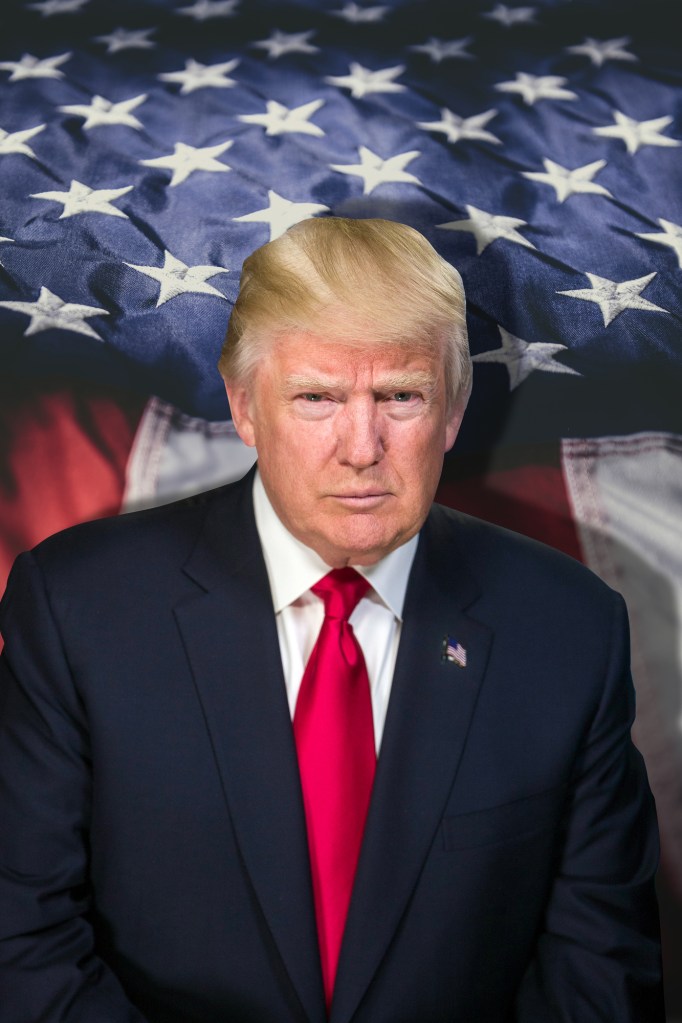
The shoe has changed to the other foot recently, and many Christians have lined up in defense of whatever Donald Trump says and does. When the administration arrested and deported hundreds of people and put them on a plane to El Salvador so fast that an emergency court hearing could not stop it, many Christians supported it because they trusted the government all the sudden to be judge, jury, and executioner.
Some Christians have vocally trusted and supported the Trump Administration though its actions in the first 100 days in office have tanked the economy with tariffs and mass layoffs and pulled funding from universities, scientific research, and humanitarian aid that supported strong Christian organizations, like World Relief and Samaritan’s Purse.
Some Christians have cheered and defended every move in an exhibit of blind trust I haven’t seen before. Christians have swayed from government defenders, to government skeptics, to government defenders in my lifetime. We have blown with the winds of change based on who is in office like our secular counterparts.
Trade & Globalization
From the Cold War Era though the 1990’s, free trade was a conservative priority. Liberals (especially labor Democrats) were skeptical, citing threats to union jobs and domestic manufacturing.
From the 2000’s through today, populist conservatives (like Trump) adopted anti-globalism, pushing tariffs and an “America First” trade policy. Many liberals now defend globalization (e.g., interconnected economies, global institutions), especially for climate or humanitarian reasons.
I have not done a deep dive on this subject, so I will reserve further comment, other than to make the key point: which is that political platforms have changed positions over my lifetime on trade and globalization. It is another example of how political winds are always shifting, and Christians have shifted with those winds.
As with many shifting political policies, people change as it suits their own interests. I maintain that Christians should not be driven by what is best for them, individually, but by what is good for “others”. We should be focused on what is right and just, even if it does not seem to be exactly the best way to promote our own, selfish interests.
Law and Order
Conservatives have traditionally been the party of “law and order.” Liberals have been more likely to critique law enforcement and police brutality and to advocate for criminal justice reform. In a sense, these are all matters of law and order; the difference is in what laws and what order.
Many liberals still critique policing today, but they also favor expanded law enforcement roles (e.g., enforcing gun laws and protecting marginalized groups). Meanwhile, many conservatives criticize law enforcement (especially federal agencies, DEI requirements, public health mandates, etc.) as politicized ideology – depending on the administration.
And that is exactly the issue: political animals love law and order when their guy is in office and their side controls the enforcement. With every new administration, the party that supports governmental authority changes.
With Congress taking less initiative in creating laws, and the executive branch becoming more legislative in passing executive orders, we are seeing huge shifts in policy and enforcement. We are being tossed to and fro every four years. The swings have become destabilizing to the point of critical concern with the extremes of the current administration.
The Trump administration has dismantled agencies that have existed as long as I have been alive, and he has defunded all the programs approved by the last administration. If Donald Trump has plans to establish his own programs, and if they get established when he is done tearing down everything he inherited in the next several years, he has set a precedent for the next president to cause the same chaos and havoc by defunding and tearing down all the programs Trumps starts.
How far and fast will the pendulum swing back with a Democratic president? If this becomes the norm for the future, nothing will get done that will not be undone, and we will be in a constant form of chaos and change. That kind of instability is a threat to a secure future.
Christians, we should not allow ourselves to be the unwitting pawns in the shifting, secular winds of culture and politics. We may think that we are on the side of God and right because we trust this President that we put in office, but we don’t know the end from the beginning. We don’t know God’s thoughts and His plans as He is working them out in our times.
Russia and Foreign Policy
Conservatives were staunchly anti-Russian and aggressive in foreign policy through the Cold War era. We fought wars in Vietnam and Korea and intervened in the Middle East and Central and South America to stop the spread of Communist influence.
Liberals were traditionally more dovish and skeptical of intervention. Jimmy Carter, who was perhaps the most orthodox and sincere evangelical President in our history, was soundly criticized by conservatives, including Christians, for his soft stance on foreign affairs.

In the Trump era, many conservatives have softened toward Russia and prioritized other threats (e.g., China, globalism). Liberals have become much more hawkish toward Russia, especially after the 2016 election interference and the war in Ukraine.
Conservatives have swung from strong interventionism around the world to isolationism and protectionism under Donald Trump, and Christians have swayed with those winds. Again there is room for disagreement among Christians on how exactly to live out the words of Jesus in our lives and our responsibilities as citizens of the United States, but we should not swing so dramatically with the political winds if we are being true in walking the narrow path.
We should not be defined first and foremost by political parties and allegiances. We should be defined by our allegiance to God and to the kingdom of heaven. We should not look like good Republicans or good Democrats who shift with every change in those political parties if we are good Christians who march to the words of Jesus and the tune of the Holy Spirit.
Environmentalism
There was bipartisan support for environmental laws in the 1960’s and 1970’s. Republican presidents like Richard Nixon and George Bush Sr. signed key environmental legislation.
After the 1990’s, environmentalism has become more of a liberal issue. Christians have aligned with conservatives into becoming skeptical of climate science and regulation. As some liberals have become militant for environmental change, conservatives have swung to the opposite direction in resistance to that change.
When environmental concerns clash with business interests and commerce, Republicans side with business/commerce, and liberals tend to side with saving the environment. The parties have become polarized on environmental issues, as with many things.
That said, there are conservative Christians today who are embracing environmental stewardship as a biblical mandate. They are are odd ducks – conservative in Christian orthodoxy, but out of step with conservatives politically on the environment.
I don’t know exactly how to balance this stewardship God has given us, but I am convinced that Christians should not be driven by secular political partisanship in our views on the environment. We should not simply line up in lock step with with one party or the other on any secular position. We should be informed by Scripture and moved by the Holy Spirit in the way we navigate these things.
Elitism
In the 1960’s through the 1980’s, liberals were the anti-elitist countercultural force, siding with “the people” against the establishment. Since then, liberals have taken over academia and have become more closely aligned with institutional authority (universities, media, corporations). Liberals have become the elitists.
The elitist, establishment folks when I was young were the conservatives, but that has shifted and changed over time. As liberal ideology has overtaken academics in the US, conservatives have sidled over to populism. They elected a populist president twice and battle “woke” corporations and academic elitism, among other things.
Again, the political winds have changed. Liberal and conservative positions have flipflopped, and many Christians have flipflopped with these winds of change.
It seems to me that the narrow path should run straight and true. It should not twist and turn with the fickleness of politics, but that goal is complicated and nuanced.
I do not want to stretch for conclusion on these things at this time, other than to recognize that Christians (including me) have been reeds blowing in the winds on these issues in my lifetime. I am waking up to the realization that we should strive to resist being pulled in the direction of those shifting winds. We should strive for an eternal outlook that is not easily swayed this way and that.
I am also realizing that we should not necessarily expect unity in Christ to result in uniformity in political positions, and it likely won’t. As Christians, we each, individually, and collectively as groups have unique experiences and perspectives that inform our views and interpretation of Scripture and its application to modern issues. We are going to have differences in how we work out the details, but our hearts and mindsets should be governed by biblical principals, including love of God and love of neighbor.
I am confident in saying that we should not be influenced to change our views by changing political winds. Any change in our views should come from the influence of Scripture and the work of the Holy Spirit in our lives.


As recently as 10 years ago, I believed I had it all figured out. I believed I had arrived at a place where I had enough knowledge to carry me through life and I didn’t need to accept anything else. I was arrogant – worse, I was wilfully ignorant. I can’t say what prompted the change but I had a moment of revelation where I realised, I know nothing at all. It was the most liberating moment I’ve ever experienced. From that revelation, I approached the world, existence, spirituality with a renewed sense of curiosity. I am more eager to learn and grow now than I have ever been.
LikeLiked by 1 person
Thank you for the work you did here. I may not agree 100%, but by-in-large you make the accurate point that it eventually comes down to “Hooray for our side!” even if that side flips on us. I would even add that Republicans have become very regulatory to businesses and individual rights, just as the Democrats have been. Passing state laws to purposely counter local laws and regulations (see no plastic bags ban in Lawrence, KS being overridden by the State of Kansas legislature) therefore attempting to nullify the principle of local knows best. I could go on an on with examples.Our faith must be, now more than ever in this country, in Him. We’ve had a great 225+ year run in this country. What we are facing is nothing compared to the history (and present) of other nations and peoples. Focusing on God and serving Him and being in communion with Jesus is the choice for Christians.
LikeLiked by 1 person
Yes, and thank you for highlighting the importance of having an eternal perspective. These things shall pass!
LikeLike