
Most people know well the checkered history of Christianity on racism, especially in the United States. Much less is said (and therefore known) on the checkered history of science on racism in the west. One reason for that difference in our collective memories is the Enlightenment narrative: that science rescued the world from Christianity. More on that below.
I am not writing today to criticize Christianity less or science more for the moral failing of the history of racism in America. I am writing to bring some clarity where a popular narrative muddies the waters.
I think most people can agree that American (and British) Christianity has a racist past, but we have short (and biased) memories on this score. History is replete with dominant people groups subjecting other people groups to slavery, genocide, and other atrocities. It wasn’t just Americans, or western civilization, or Christians that perpetuated the evil of slavery.
That we even call those things atrocities today is a credit to Christianity. The story of Jesus voluntarily dying at the hands of the dominant power of his day, urging his followers to live lives of self-sacrifice, and looking after the benefit of others as he did changed everything.
It took three centuries, but the cross eventually became the symbol of this religious movement characterized by self-sacrificial love.
Prior to the death of Jesus, the cross was the ultimate symbol of the exultant might of the dominant state over its subjects. Those in power determined the values of the society they ruled, and those values were imposed with Draconian force on those who lived under that power. “Might makes right” was just the way the world was for most of history.
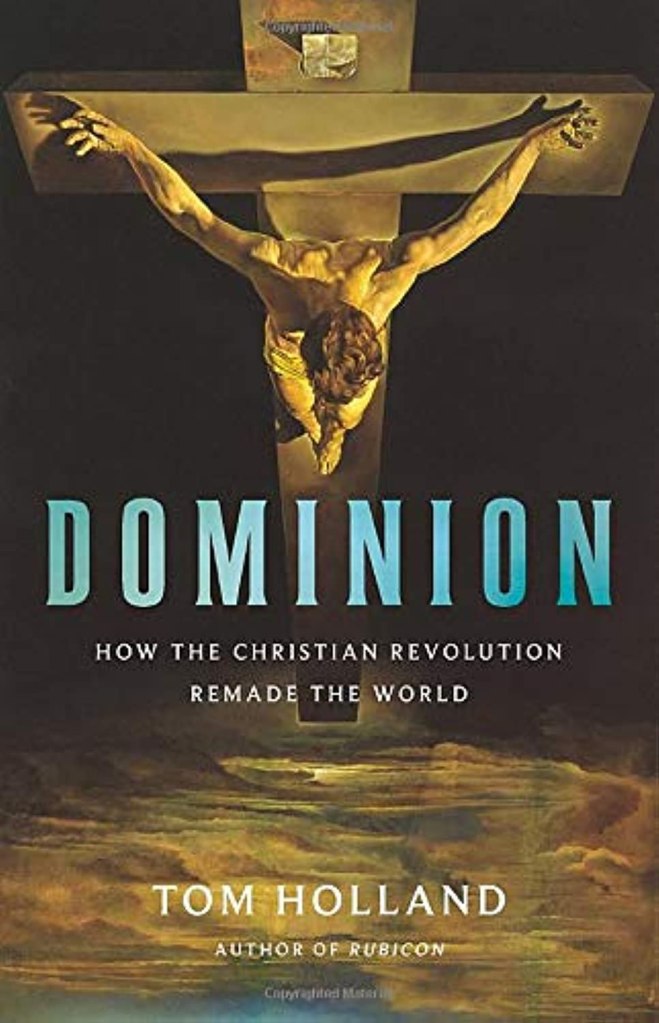
Tom Holland, in his seminal book, Dominion: How the Christian Revolution Remade the World, found the nexus for a radical change in the west in the crucifixion of Jesus. That event and the movement it inspired changed forever how the west (and now the rest of the world) views power and morality.
Tom Holland was an atheist When he did the research for this book. His area of expertise is Greco-Roman history. He was steeped in the brutish nature of the Roman world that championed power and elite, male dominance over all that was weak.
When he set out to trace his secular humanist values in western civilization, he knew there was some discontinuity between the Greco-Roman values he knew so well and his own, modern notions of basic human rights, so he was curious to locate the origin of that seismic shift.
His book, Dominion, traces our modern values from the roots where he found them in the history of western civilization. He found they go back to Jesus of Nazareth and the people who gave their lives to follow him.
The death of Jesus on the cross radically subverted the assumptions that ruled the world to that point. The Greco-Roman world that valued and honored power above all things gave way over time to the man who is claimed to be the Savior of the world who let himself be led like a lamb to his own slaughter. His life and message of self-sacrificial love became the bedrock for modern civil rights, human dignity, and the assumption that the powerful should shelter and care for the weak.
The criticism of Christians for racism and its worst manifestation – slavery – is deserved. Mostly because Christians “should’ve known better”. Of all people, Christians should have known better!
The water gets murky, though, in our modern memory because it has been influenced by a narrative that obscures the truth. The narrative that exposes the failing of Christianity often does so by directing attention away from the nonreligious world of reason and science, as if there is “nothing to see here.”
This view that rose to prominence during the Enlightenment is prevalent still today. It puts the full weight of condemnation for our failings on religion (and Christianity in particular). This is a false narrative, and, it obscures the truth and warps our perceptions that still persist.
There is nothing inherently wrong with science and reason. It is people who are flawed, and the flaws of people are not confined to science, or religion, or to any particular ideology or worldview. No ideology or worldview is immune.
Before getting to my ultimate conclusions, though, I need to prove my point when it comes to our racist history. I could provide abundant proof, but I will settle for a couple of sources, starting with William H. Tucker’s 2002 article in the UN Chronicle, “The Ideology of Racism: Misusing Science to Justify Racial Discrimination, that offers four examples.
The first example is a study conducted by Samuel George Morton in the 1830’s-1840’s that claimed that skull sizes correlate to intelligence, with Europeans ranking highest in skull size and Africans ranking the lowest. His data was selective, and he manipulated it to support his preconceived notions.
The second example is the eugenics movement that thrived in the late 19th Century through the early 20th Century and sought to “improve the human race by promoting the genetic superiority of certain groups” (according to Chat GPT). The faulty science behind this movement is blamed for racial hierarchies, forced sterilization, and targeted abortions.
At the same that eugenics was being advanced, intelligence testing by Lewis Terman (1916) and Carl Brigham (1920) that led to the development of the SATs claimed that this testing demonstrated inherent intelligence differences between races. The tests were flawed because they failed to account for socioeconomic and educational disparities, but they fed preconceived notions.
The last example Tucker provides might seem uncomfortably recent. Richard Herrnstein and Charles Murray claimed that their Bell Curve study in 1994 proved, once again, that differences in intelligence between races are genetic.
Anyone who is paying attention and who appreciates the value of scientific method and scientific endeavor should be quick to point out that these faulty studies and theories were exposed, and the conclusions were discarded. The thrust of scientific method is self-correcting, exposing personal bias to unbiased facts.
Tom Holland points out that the Christianity is self-correcting also. Emblazoned on the shields of the Crusaders was the cross, reminding the very people who crusaded that they conquered for the cause of a God who submitted Himself to death in human form for the love of mankind.
The collective conscience of a society that honors a God who emptied Himself to take on the form of a man, to become a servant to all men, and to sacrifice Himself willingly for them cannot long countenance the incongruity of crusading, even it is for such a God. Indeed, our collective conscience has rejected this incongruity, which is why I submit (in the fashion of Tom Holland) that we talk more about the evils of religious men who were racist than we talk about the evils of scientific men who were racist.
Science and religion have both supported racist ideologies that reinforce systems of oppression. The popular narrative from the Enlightenment that lingers today might lead a modern person to assume that religion is to blame somewhere in this story about science gone wrong, but that assumption would be wrong.
Science unhitched itself from religion during the Enlightenment, and science continues to carry on without religion today. The people in the examples given by Tucker who claimed to support their racist positions with science and reason from the Enlightenment period forward were not religious. They were people of science.
That Christians should have known better seems self-evident to us today. But, what of the men of science and reason who found no justification in religion?
In truth, we don’t say much about them. We have largely forgotten (or ignored) that science has a checkered past on the issue of racism also.
How many times have you come across the full title of Charles Darwin’s revolutionary book on evolution, On the Origin of Species? Do you know it? It seems the historical record has been nearly whitewashed.
All modern copies of the book use the short title because the original, full title of the book reveals the racism of Charles Darwin. We have to go to the antique copies of the book to find the full title: On the Origin of Species by Means of Natural Selection, or the Preservation of Favoured Races in the Struggle for Life.
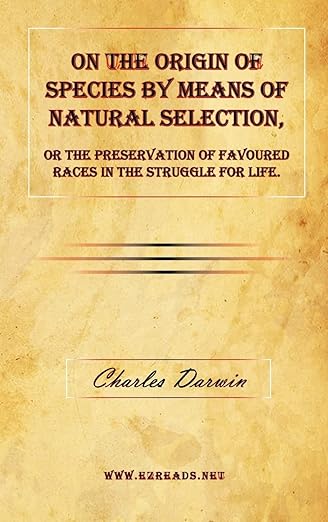
I point this out not to denigrate Charles Darwin or to excuse Christians for their racism. I simply want to set the record straight: that people without religious influence have justified racism through science, also, even if we would like to pretend like it never happened.
That science is no longer used to justify racial prejudice is a credit to science, but the same can also be said of Christianity.
While some Christians used the Bible to justify racism, their resort to the Bible to support racism was an extreme act of denial. As proof, consider the “Slave Bible.” Formally titled Parts of the Holy Bible, Selected for the Use of the Negro Slaves in the British West-India Islands, this version of the Christian Bible created around 1807 was edited to cut out sixty percent (60%) of the text.
People who are ignorant of the arc and sweep and content of the Bible from start to finish might imagine that all or most of the New Testament was removed, leaving large swaths of the Old Testament intact. In fact, it was the other way around. The Slave Bible removed ninety percent (90%) of the Old Testament and fifty percent (50%) of the New Testament.
This is testament to the radical nature of the Old Testament revealed to an Ancient Near East people in a world of arbitrary and capricious gods and brutality in human relationships. The Old Testament is quite candid about the flaws of people. It doesn’t hide them, but it introduces the seeds of a completely transformative story.
People can pull out some passages and texts to make it appear that the Bible supports slavery and the disparate treatment of different people groups. A thorough reading of the whole thing, however, paints a very different picture.
For this reason, the abolitionists who fought to eradicate racism were largely Christian, and they got their inspiration and guidance from the Bible. We can credit science with many discoveries and all the modern conveniences and technological advances we enjoy today. We can and should credit Christianity with the advances we have enjoyed in human rights.
This is because science does not give us moral values in a world that is believed to be blind, pitiless, and indifferent (to echo Richard Dawkins). Good science may tell us that there are no intelligence differences between races, but it doesn’t tell us whether the powerful should dominate the weak.
As Tom Holland uncovers in his book, Dominion, the idea of human rights has roots in the statement that God created all humans (male and female) in His image. (Genesis 1:27) The very first chapter in the Bible embeds the idea that all people (men and women) have intrinsic value, and that view runs from beginning to end.
The instruction to care for marginalized people (orphans, widows, and strangers) is first introduced in the Exodus story. (Exodus 22:21-24) Paul proclaimed to a 1st Century audience that there is neither Greek nor Jew, neither male nor female, and neither slave nor free in Christ (Galatians 3:28-29) because Jesus came to break down the walls that divide people. (Ephesians 2:14) And John’s vision shows us God’s intentions to gather all people from over the world to Himself:
“After this I looked, and there before me was a great multitude that no one could count, from every nation, tribe, people and language, standing before the throne and before the Lamb.”
Revelation 7:9
That many people have missed this theme in the Bible is not a fair critique of the Bible or of Christianity any more than the flawed racist conclusions of scientists and rationalists are fair critiques of science and reason. People are people – both scientists and non-scientists, both Christians and non-Christians. Many bad things can be advanced by resort to bad science and bad religion, but we need good science and good religion to correct the errors of our ways.

 Navigating by Faith
You cover a lot of ground in this thoughtful post. I only recently became aware of the book Dominion by Tom Holland, and since then, the book keeps being mentioned here and there! I am a reader, and clearly I need to get a copy!
LikeLiked by 2 people
Dominion is an incredible achievement Laura! I have a Kindle edition of the book myself although, I have to admit, I found reading it digitally quite a challenge and I would like to re-read it in print form. Please do treat yourself to it. You won’t regret it.
LikeLiked by 2 people