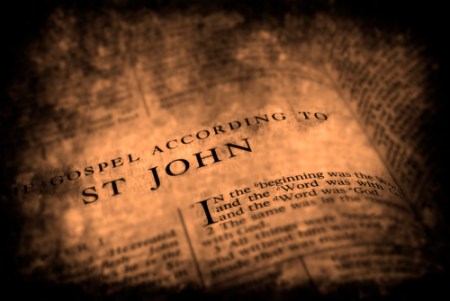
A New (Old?) Take on Inerrancy

The Bible is the book God wanted us to have, and He wanted us to have it the way it is.


I did the research and wrote a thesis in college in support of the concept that Scripture is inerrant. I have mentioned this before. I was not a religion major in college only because I did not turn in my thesis.

I didn’t turn it in because I was having a hard time getting to where I wanted to go using Scripture and the scholarly work that was done up to the early 1980’s. I could not support my thesis with integrity, so I shelved it and did not return to the subject for almost 40 years!

I had a high view of Scripture then, and I have a high view of Scripture now. I read the Bible daily for personal guidance and edification. I believe the Bible is the inspired Word of God (which I can support from Scripture itself. (2 Timothy 3:16-17))

I believe, like the Moody Bible Institute, that the Old and New Testaments are divine revelation from God. The original autographs were verbally inspired by the Holy Spirit. The revelation is God’s self-disclosure recorded in human language. God is the source of it.

I stop, though, in going further to say that every word is true, and the Bible is free from error. The very statement begs the questions: which version? Written in which language? And other questions.

I agree with the Moody statement that the Bible is the supreme source of our knowledge of God and of salvation through Jesus Christ. I agree that it is “our indispensable resource for daily living”. I agree, also, that humans are left to interpret the Bible, and our interpretation is guided by “our reception and understanding of that which God revealed”.

I stop short of saying that God “recorded” Scripture, because we all know that it was written down by men. This difference distinguishes the Bible from the Quran and the Book of Mormon, both of which are claimed to have been dictated to men in a trance-like state.

I agree that “revelation is a divine act”, and “interpretation is a human responsibility”. I agree that our interpretation is fallible, but I must admit the possibility that the writing down of the Bible may, also, be fallible.

I say these things not to argue with anyone about the reliability of Scripture, and I do not desire to make a mountain out of a molehill. I go far down the road on my confidence in the reliability and trustworthiness of Scripture. I have written on the subject many times, and I have even given presentations on the topic.

I also recognize that I am fallible and must remain humble in my approach, so take what I say with a grain of salt and make your own determinations. I share my thoughts for what they are worth.

When I was in college sitting in a World Religion class, reading the Bible for the first time in my life, I was struck by a thought that I believe to this day came from the Holy Spirit (along with others). My professor was liberal and progressive, so I can’t “blame” it on him.

It occurred to me that, if God is real, and the God of the Bible is the creator of the universe, then He could orchestrate His communications to humans in a way that they could understand them and preserve the important points for posterity. If God is sovereign, He can do that.

I believe the Bible is the book God wanted us to have.

NT Wright

I still believe that, but I also like the way NT Wright puts it: “I believe the Bible is the book God wanted us to have.” I can buy that! Other things NT Wright says about the character of Scripture also make sense to me, so I will mix his words with mine in the remainder of this piece.

Continue reading “A New (Old?) Take on Inerrancy”

What Does It Mean that the Word of God Was Inspired by God and Received and Passed on By Men?

The Bible, itself, doesn’t claim to be one hundred percent, word for word, accurate (or even inerrant). The closest we get to a statement like that is that it is “God-breathed” (inspired), and that the people who were “inspired” by God received that inspiration and passed it on.


The written word of God was so important to the Jewish culture that scribes were a distinguished, respected and critical role in Jewish society. The importance of the painstaking process and precision with which they copied Torah, the Prophets and Writings was embedded into the foundation of Jewish culture going back to Moses.

Moses produced the Ten Commandments etched in stone. Those stone tablets were carefully placed into the Ark of the Covenant, carried with the nation of Israel as they traveled through the desert, and kept with ritual attention to detail in the most sacred place in the Tent of Meeting in the middle of their camp wherever they came to rest.

Scribes who carefully and painstakingly copied Scripture were still honored at the top of Hebrew culture in the First Century when Paul, also known as Saul of Tarsus, was alive. Paul was trained as a Pharisee of Pharisees under Gamliel, the most respected Pharisee of his day.

For that reason, I find it interesting, to say the least, the way Paul described the process by which the word of God was given by God to the people. He would have been intimately acquainted with the disciplined, careful and thorough way a scribe would copy Scripture. Yet Paul says,

“All Scripture is God-breathed and is useful for teaching, rebuking, correcting and training in righteousness, so that the servant of God may be thoroughly equipped for every good work.”

2 Timothy 3:16-17

God-breathed, or inspired, is the way Paul described how people received God’s word and passed it on. If Paul wanted to convey the idea of verbatim dictation from God, as Muhammed claimed with the Quran, he would have likely described the process like a scribe painstakingly copying the text, but he didn’t.

Paul was intimate with the way scribes copied the scriptural text, but he didn’t describe the way people received God’s Word and passed it on that way. Paul, himself, received God’s Word and passed it on. That message he received from God and passed on has become scripture! Yet, he didn’t describe the process like a scribe copying verbatim.

I wrestled with what inspiration means in recent articles here and here. Given the way people like Paul described the way Scripture was conveyed and received, it is likely he didn’t mean verbatim dictation from God. If he meant verbatim dictation, he would have described the process more like a scribe copying scriptural text.

Instructive are the other ways Scripture is characterized in the New Testament. Peter, for instance, wrote the following in his second epistle:

“But know this first of all, that no prophecy of Scripture becomes a matter of someone’s own interpretation, for no prophecy was ever made by an act of human will, but men moved by the Holy Spirit spoke from God.”

2 Peter 1:21 (NASB)

Peter says that the prophecy was not initiated by human agency. People didn’t choose to prophesy; they were moved by divine agency. They didn’t interpret what they were moved to communicate; they simply communicated what they received.

The Greek word translated “moved” in this text is φέρω (pheró), meaning “to bear, carry, bring forth”. It has the same connotation as the idea of a conduit or conduction.

If Peter meant to say that the Word of God was “dictated” and copied down verbatim, like the scribes copied Scriptures, he would have likely used a word related to “scribe”, but he described a different kind of process. I think we have to assume that Paul’s inspiration is similar to Peter’s conduction.

Neither one used the well-known analogy of a scribe merely copying what was written, though Peter clarifies that the message prophets received and passed on was not interpreted by them. They passed it on with integrity and, presumably, accurately. Still, that is not the same thing as verbatim dictation.

Paul describes his own encounter with the risen Christ in this way. He says:

“For I would have you know, brothers and sisters, that the gospel which was preached by me is not of human invention. For I neither received it from man, nor was I taught it, but I received it through a revelation of Jesus Christ.” 

Galatians 1:11 (NIV)

Paul uses the same language in his first letter to the Corinthians when he says:

“For I handed down to you as of first importance what I also received….”

1 Corinthians 15:3 (NASB)

But what does it mean that the writers of Scripture were inspired, moved by God, did not initiate, or interpret or invent it. What does it mean that they passed on what they received?

If they didn’t take “dictation” from God, what does it mean that God inspired men and moved men with a message, and they passed on what they received?

Continue reading “What Does It Mean that the Word of God Was Inspired by God and Received and Passed on By Men?”

Wrestling with the Accuracy and Inspiration of the Bible


In episode #82 on the BEMA Discipleship Podcast (dealing with “textual criticism” of the Bible), Marty Solomon made the following statement about growing up in a fundamentalist church: “Inspiration means accuracy in the world I grew up in.” Now he says, “That’s not what inspiration means. Inspiration means it was inspired by God.”

Solomon is talking about one of the few verses in the Bible that gives us explicit insight into how we should view Scripture:

“All Scripture is inspired by God and beneficial for teaching, for rebuke, for correction, for training in righteousness….” 

2 Timothy 3:16 (NASB)

That Scripture is “inspired by God” is what those with a “high view” of Scripture hang our hat on, but what does “inspired by God” mean exactly?

Jesus revered Scripture, and he quoted from it often, He quoted from the Torah at least 21 times and from the Prophets at least 18 times. He referenced those writings when he said,

Do not think that I have come to abolish the Law or the Prophets. I have not come to abolish them, but to fulfill them. For I tell you truly, until heaven and earth pass away, not a single jot, not a stroke of a pen, will disappear from the Law until everything is accomplished.” 

Matthew 5:17-19

His words seem to suggest a high standard of accuracy in “the Law”, but I have noted that the quotations of Jesus in the New Testament do not often match (if ever) the exact phrases from the passages he quotes. Of course, he doesn’t cite “chapter and verse” because there were no chapters or verses then, but the words themselves are often not exactly the same.

Further, the Scriptural texts were written out carefully by scribes who were highly specialized in the tedium of copying the text verbatim, but many people could not read or write. Scripture was committed to memory and quoted often from memory.

Solomon’s comment reveals how his position has changed from the view of the church in which he grew up. He still believes the Bible is inspired by God, but he no longer believes that inspiration necessarily means accuracy.

The exact words quoted in the New Testament writings that were spoken by Jesus were likely spoken in Hebrew, or maybe Aramaic, and they were translated into Greek. We have Hebrew manuscripts, Greek manuscripts and Latin manuscripts. We also have very early manuscripts in Coptic, Syriac, and other languages.

We have a virtual treasure of manuscripts of the biblical texts, so much that they dwarf the text of any other ancient writing many, many times over. We also have many modern translations, each with differences in words, sentence structure, phraseology, etc.

The Bible we have is magnitudes more certain in its reliability and integrity than any other ancient text. We can trust that we have a very, very close approximation in the Bible of what was originally said because of the wealth of texts we can compare to each other. But can we say it is 100%, word for word, accurate in every jot and tittle?

Solomon has a “high view” of Scripture, as I do, but he doesn’t necessarily demand, expect, or hold on to it as if every word is accurate (without error). This can be a difficult “concession” for many people who are Christians and believe the Bible must be viewed as 100% accurate in every word and detail.

A “high view” of Scripture, to me, means to view it with the utmost respect, to embrace it as authoritative and inspired, and to study it regularly as food for the soul/spirit, for guidance in knowing and understanding God and His purposes and how to live as one who would follow Christ.

The idea that the Bible is inerrant (without error) is not to be found in the Bible. Rather, we can find in the Bible that it was inspired by God.

All Scripture is inspired by God and beneficial for teaching, for rebuke, for correction, for training in righteousness….

Most people who claim to be Christians, and some people who don’t, agree that the Bible is inspired. The idea that the Bible was inspired, and inspired by God, is somewhat noncontroversial, but some people take it further: they say that every word in the Bibles we have is from God; they say the Bible is without error; they say the Bible is inerrant (meaning, incapable of being wrong).

We should note, however, when Paul said all scripture is inspired by God, he was likely talking about the Old Testament, as there was no New Testament as we know it when Paul wrote his letter to Timothy. He also doesn’t clarify what he would include in the term, “Scripture”. We have to try to fill in those blanks.

Can we really say the Bible – every word of the text we have today – is 100% accurate to the words that were originally inspired by God, spoken and written down?

Which translation?

In which language?

Maybe there is a reason Paul did not say that Scripture is an accurate, word for word, and verbatim script of God’s words to the people who were inspired to receive them.

Muslims claim that is what the angel Gabriel did with Muhammed. They claim the angel dictated to Muhammed, who wrote down everything exactly as it was spoken to him. The biblical text doesn’t make that claim about itself.

Paul says that Scripture is “beneficial for teaching, for rebuke, for correction, for training in righteousness“. He implicitly says we can trust it and rely on it. He holds it in the highest regard, but he doesn’t say what we try to claim about the Bible – that it is inerrant.

Maybe we shouldn’t go as far in our claims as we do. In writing this piece, I am not suggesting that we should not trust the Bible or not rely on it. I am not saying we should disregard it or discount it.

I believe Scripture is “alive and active. Sharper than any double-edged sword, it penetrates even to dividing soul and spirit, joints and marrow; it judges the thoughts and attitudes of the heart.” (Hebrews 4:12)

Does it need to be 100% accurate to do that?

Does it need to “inerrant”?

NT Wright makes the bold claim that we have the Scripture God wanted us to have.

Human beings have a strong desire to categorize, define, and reduce to certainty. Maybe we should resist that temptation.

“God’s ways are not our ways, and His thoughts are not our thoughts.” We are finite and limited beings. We will always have a measure of uncertainty. Faith involves placing our trust in what we believe is trustworthy. Faith doesn’t require certainty.

We will never have certainty because we are finite, limited beings. We are not gods, and we are certainly not God.

I realize I have not, perhaps, brought much clarity to the subject. I do have some more thoughts on the subject, including what Peter has to say, and what Peter and Paul say about each other. I will pick up where I leave off here in future writings.

Looking at Some of the Oldest Extant Examples of Ancient Biblical Text

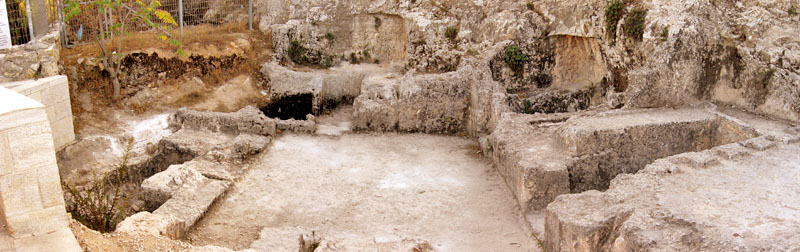
By Tamar Hayardeni, Attribution, https://commons.wikimedia.org/w/index.php?curid=23802552
Ketef Hinnom burial caves

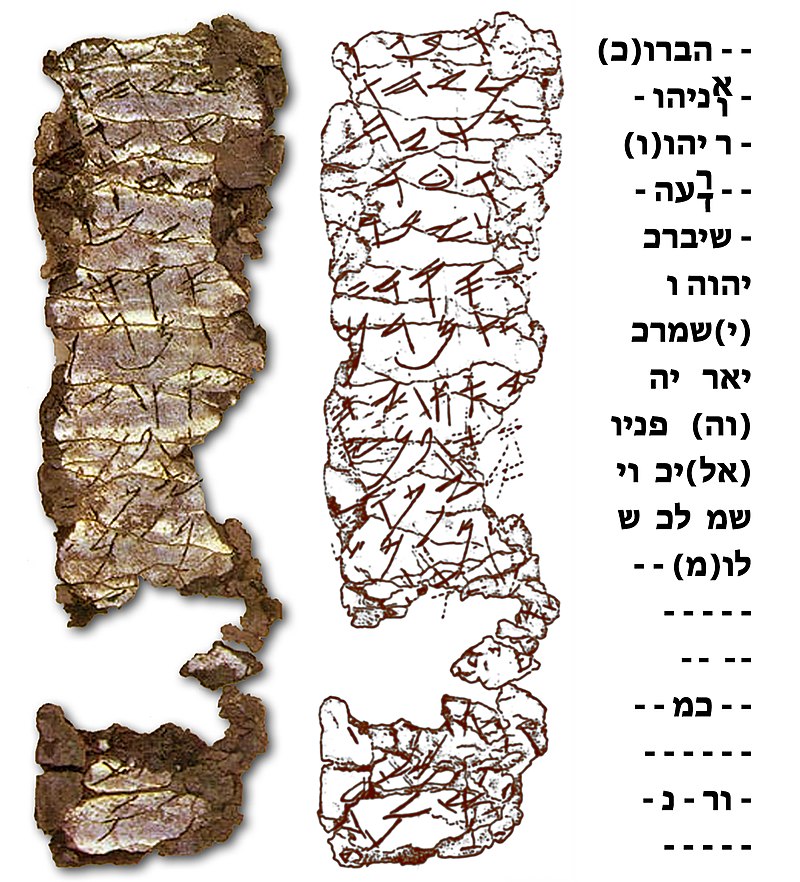
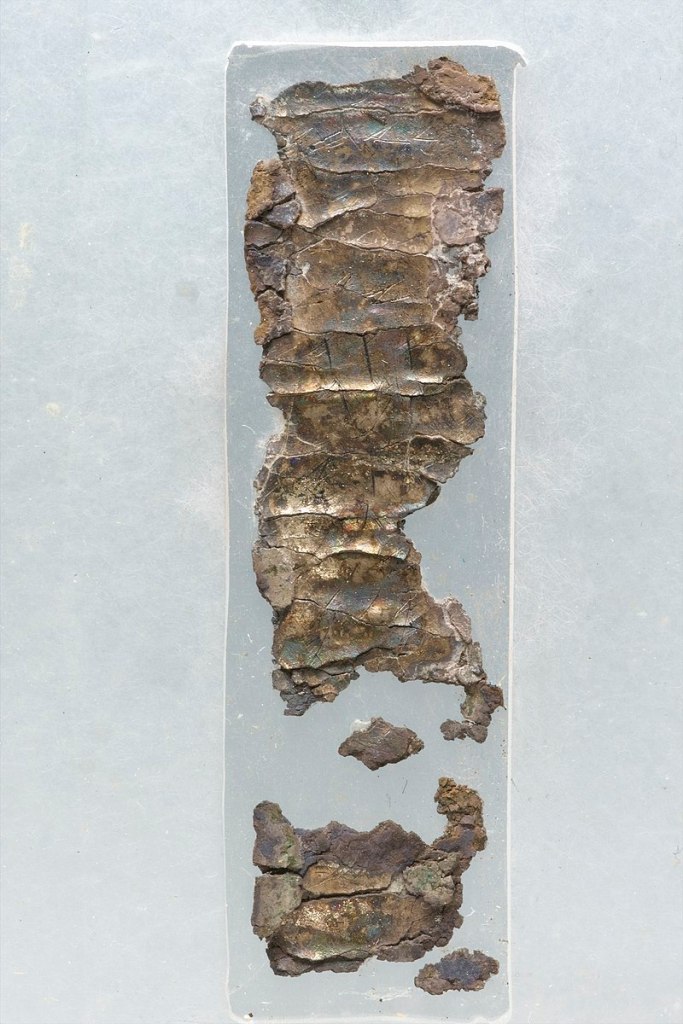
Some of the oldest extant examples of ancient biblical text are the Ketef Hinnom amulets.[i] The silver amulets meant to be worn around the neck are very small. They are actually tiny scrolls made of rolled silver with inscriptions on them. They were found at the First Temple funerary site of Ketef Himmom southwest of Jerusalem.[ii]

Discovered in 1979, the inscriptions on the amulets were not detected until the scrolls were painstakingly unrolled in 1994 by the West Semitic Research Project at the University of Southern California. The inscriptions on one scroll contain text similar to the blessings found in the Tora[iii]h at Numbers 6:24-26[iv]:

6:24 Yahweh bless you and keep you;
6:25 Yahweh make his face shine upon youand be gracious to you;
6:26 Yahweh lift up his countenance upon you, and give you peace.

(The italicized words are not found on the scroll but may have appeared in the area where the scroll has disintegrated.)

The other scroll contained language similar to the parallel passages in the Torah of Exodus 20:6; Deuteronomy 5:10 and 7:9, and the Prophets, Daniel 9:4 and Nehemiah 1:5.[v]


These amulets with the biblical inscriptions date to the First Temple period before the Babylonian exile. Conservative sources date them to the eighth–sixth centuries B.C.E.[vi] More liberal sources date them to the period immediately prior to the destruction of Jerusalem by the Babylonians in 586/7 BCE.[vii] No one dates them after the destruction of the First Temple.

This is significant because the consensus of scholars date the Torah post exile to the Persian Period (539-333 BCE, and probably 450-350 BCE).[viii] While classic rabbinic views hold that the entire Torah was written by Moses during his life in the second millennium BCE, the consensus of modern scholars is that the Torah was written by a number of authors post exile.

The confirmed dating of the Ketef Hinnom amulets doesn’t necessarily prove that the Torah was written and in existence at the time those amulets were created. They could have been produced from oral tradition. It does establish, though, that pre-exilic Jews were familiar with the sayings in the Torah.


It’s also consistent (or not inconsistent) with the view that the Torah was written down before the exile – perhaps, even by Moses.

All five books of the Torah, and every book of the Christian Old Testament, except for Esther, was found among the Dead Sea Scrolls. The earliest Dead Sea Scroll texts date to 300 BCE. The remarkable similarity of the versions of the Hebrew text in the Dead Sea Scrolls to the texts preserved from a millennium or more later amazed scholars. While most of the books of the Old Testament found at Qumran were fragmentary, a complete scroll of Isaiah was found dating to no earlier than the first century BCE.[ix] The Ketef Hinnom amulets, though are much older still.

I have referenced mostly sources that are secular or liberal in their leaning. I did that on purpose, as even these sources attest to a certain factual baseline that is consistent with the biblical narrative, and not contradictory to it. They don’t rule out earlier dates and facts that are not just consistent, but which match the biblical record. Thus, archaeology continues to reveal artifacts consistent with a view of the historical reliability of the Old Testament.


~~~~~~~~~~~~~~~

[i] See Ketef Hinnom at Wikipedia

[ii] See Miniature Writing on Ancient Amulets, by Robin Ngo for Bible History Daily at the Biblical Archaeology Society website March 5, 2021.

[iii] The first five books of the Christian New Testament known as Genesis, Exodus, Leviticus, Numbers and Deuteronomy.

[iv] See Wikipedia

[v] Ibid.

[vi] See Miniature Writing on Ancient Amulets

[vii] Wikipedia.

[viii] See Torah at Wikipedia

See Who Wrote the Dead Sea Scrolls? By Andrew Lawler for Smithsonian Magazine January 2010

[ix] See 6 Things You May Not Know About the Dead Sea Scrolls by Jennie Cohen at History.com

Can We Trust the Bible?


One of the most common skeptical positions in regard to the Bible is that we can’t trust it because it has changed over time. We don’t even have the original text anymore. We don’t have any of the manuscripts, and most of the manuscripts we do have are copies of copies that were produced centuries, sometimes many centuries, later.

The “telephone game” that children play has been used as an illustration of how easily things that are communicated get twisted and changed so that we can’t even tell what the original meaning was by the time the communication comes back to us after being repeated over and over from one person to the next. This illustration is applied to the Bible as proof that it can’t be trusted because it has been translated and copied over and over and over again. How do we even know what the original text said?!

These are serious contentions. An honest person cannot just brush these contentions aside, but it isn’t the end of the story.

Yes, faith is a foundation of Christian belief, but Christian faith is not a blind faith as some suppose. Christian faith means putting our trust in God, and not in ourselves, but Christian faith also does not insist or even ask us to throw out our minds in the process.

In fact, we are specifically instructed to love God not only with our hearts and strength, but with our minds!

As I have stated previously, doubt and skepticism are not sin according to the Bible. Thomas doubted, and he became known for his skepticism but he was a follower of Jesus. He was an original follower of Jesus, and he traveled with Jesus from the beginning of his public life to his death. He wasn’t just known for his doubt, however; he was also known for his faith!

Paul urged the Thessalonians to “test everything”, and hold on to what is good. The Bible urges us to have “honest skepticism”, which should not be confused with skepticism for the sake of skepticism. A person who is skeptical of everything, even the certainty of truth, should not even bother looking into anything because the exercise is pointless.

The quest for truth is pointless for the pure skeptic who is unwilling to commit to any truths. He already knows where he will end up! The contention that there is no objective truth is a self-defeating statement. The statement, itself, is offered as an objective truth, therefore it isn’t even true of itself!

But we digress. Whether the Bible can be trusted is the question, so let’s dive in.

Continue reading “Can We Trust the Bible?”