Is the Big Bang Finally Over?

We are all be at the edges of our seats to learn where all of this will take us

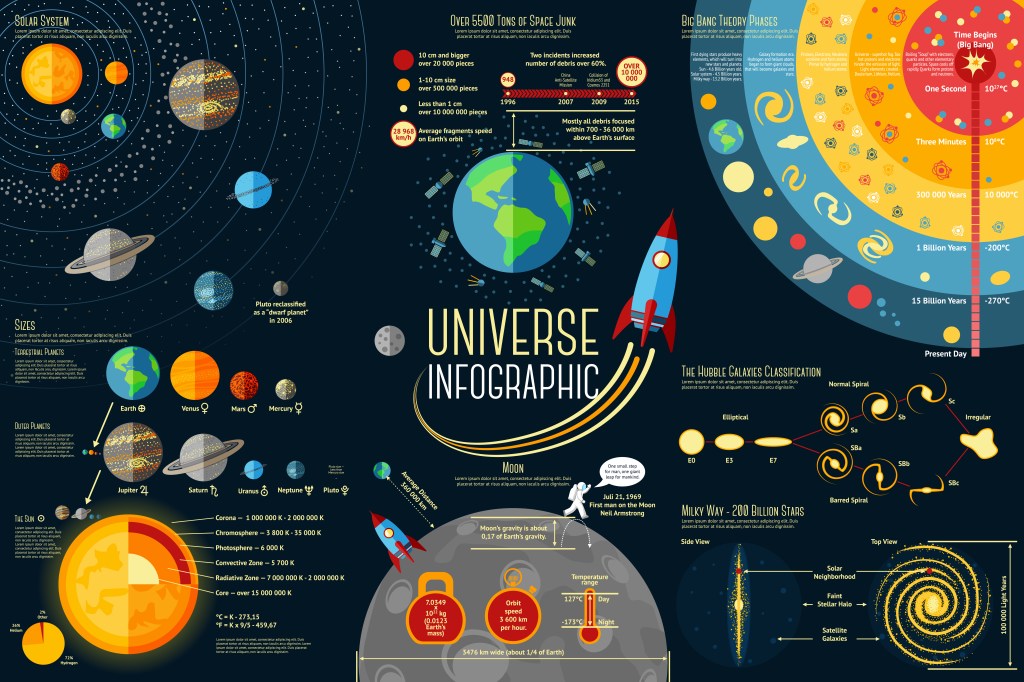
Set of Universe Infographics – Solar system, Planets comparison, Sun and Moon Facts, Space Junk made by man, Big Bang Theory, Galaxies Classification, Milky Way description. Vector illustration

The question that forms the title of this blog article is the subject of a recent video on YoutTube. I am embedding the video here so you can watch and listen for yourself. The suggestion, however, that the James Webb Telescope is disproving the “Big Bang”, is overstated. You might even call it clickbait!


Before launching into my thoughts on this, however, what is meant by the “Big Bang” needs to be defined. The terminology is credited to Fred Hoyle. When Hoyle coined the phrase in a 1949 a talk on BBC Radio, he was probably speaking tongue in cheek.

Hoyle (like most scientists of his age) had long believed in a steady state universe. The new evidence indicating that the universe is expanding was like a big bang to them. It rocked the long-held view that our universe is static and unchanging.

The laws of physics seemed immutable. Why wouldn’t scientists believe the universe was equally immutable?

That the evidence that the universe is expanding was unsettling to the accepted “science” at the time is an understatement. As Hoyle was describing the then recent discoveries and the theories that derived from that evidence, he said:

“These theories were based on the hypothesis that all the matter in the universe was created in one big bang at a particular time in the remote past.”

Because these discoveries came as a shock wave to scientists in the first half of the 20th Century. the term, “big bang”, may have been used to characterize how those discoveries were received!

The evidence that the universe is actually expanding raised the specter that the universe isn’t static, and it might even have had an origination “point”. This realization that the universe may have had a beginning wasn’t lost on scientists at the time, and it wasn’t eagerly received.

The term didn’t really “stick” until the 1970’s, and it isn’t really a good descriptor for what we (think we) know happened. It probably wasn’t a “bang” for instance, because no sound was likely generated. The history of the development of this evidence is interesting and can be found on Wikipedia.

The Big Bang does suggest a beginning to the Universe (to put it bluntly). This possibility, of course, has theological implications, another realization that wasn’t lost on scientists who largely viewed the universe through a materialistic lens. That possibility was largely downplayed then, and many scientists have continued to downplay that possibility.

We still don’t have evidence that reveals how the universe was formed. We can’t see back that far, and doubt exists whether we ever will be able to see back that far. As the Wikipedia article states: “[T]he Big Bang model does not describe how energy, time, and space were caused, but rather it describes the emergence of the present universe from an ultra-dense and high-temperature initial state.”

The current suggestion that the James Webb Telescope is disproving the “Big Bang” (the implication of an expanding universe with a “beginning”) comes from people who would like to downplay the implication of an expanding universe with a beginning, and it seems to be more wishful thinking than reality.

The James Webb discoveries fueling this resurgence in old thinking include images of old stars and galaxies that are more formed than they should be on our standard (Big Bang expansion) model of the Universe. The standard Big Bang expansion model is similar to the concept of evolution. If the universe expanded, it must have progressed from a simpler state to a more complex state.

Just as life began with a simple, self-replicating molecule and progressed to ever increasing complexity over a long span of time, the thinking has been that the universe must have developed in the same progressive sort of way. This is the paradigm that has driven much of modern science: that natural processes developed from the bottom up.

The new James Webb images reveal more highly developed stars and galaxies than we imagined would exist in the earliest stage of the universe on the standard model. The mature development of ancient galactic stars and star formations is surprising on the progressive view.

These images do not contradict the fact that the universe is expanding, however, and they don’t disprove the appearance of a “beginning”.

People are “surprised that things grew so quickly”. People are perplexed that stars and galaxies are so well-formed at such an early stage, when they would expect to find “fledgling” galaxies in more undeveloped states.

People are scratching their heads at the appearance of extremely small and extremely large galaxies in the early Universe because it does not comport with the progression of the expansion of the Universe as modern scientists have modeled it before the advent of the James Webb Telescope.

These observations have nothing to do with the evidence that the universe is expanding. A more accurate statement is that models for how that expansion occurred are being called into question: not the fact of expansion from “a point of beginning”.

The James Webb findings do not negate the evidence we have that our universe is expanding from some very dense “point”. If anything, the findings evoke even more theological implications, perhaps, than the standard Big Bang model.

The idea that the universe developed from simple to complex over time is difficult to maintain when stars, galaxies, and other formations in the farthest (and earliest) regions of the universe that we can see are so well-formed and “mature”. These things conjure up the specter that this evidence is more consistent with the idea of the universe being created than we previously thought.

Of course, we had clues that this should be not surprising to us: the standard expansion inflation model incorporates the assumption that an early, extremely rapid and short “burst” of expansion occurred, and this assumption was necessary to accommodate the short time frame in which the Universe appeared to have “developed” based on what we could see before the James Webb telescope. Perhaps, then, we shouldn’t be surprised to find even greater “development” at earlier stages.

We shouldn’t be surprised either that modern scientists who are committed to a materialistic worldview are struggling with these things. A materialistic worldview has colored modern science for a couple hundred years, at least.

A materialistic worldview was perfectly at home with the old static state view of the universe. It took a hit with the evidence that the universe is actually not static, but expanding from a point of beginning, though materialist thinking held firm, and most scientists have continued to hold to a strictly materialist position.

Stephen Hawking and Roger Penrose famously calculated “singularity” that “proved” the so-called Big Bang (that expansion necessitates a “beginning”). Vilenkin (and some other guy who I can’t remember, lol) determined that even a multiverse that is expanding would have to have a “singularity” (a euphemism, it seems, for a beginning).

So far, modern discoveries have continued to negate good reason to believe in a static universe (which theory was discarded after centuries of use when we found that our universe is expanding) or an oscillating or cyclic universe. Multiverse(s) seem to make sense theoretically, but we will likely never be able to prove it/them anymore than we are likely to see back before the “beginning” of this universe.

Scientists like Neil de Grasse Tyson, Hawking, and Penrose who are committed to finding explanations for these things that do not implicate a Beginner (a/k/a God), will likely continue to try to prove their point. Hawking spent much of the rest of his life after mathematically proving the “singularity” trying to get around “singularity” and its theological implications. Penrose (and Vilenkin) do not concede any theological implications either.

Nothing (much) has changed on that score, but the new james Webb images are certainly is producing some head scratching! Some scientists, like Hoyle, who were once very antagonistic about people drawing theological implications from cosmology have backed off their dogmatic stances. Penrose seems to concede the possibility of a legitimate “metaphysical” component to reality, though he “doesn’t go there” in his own thinking.

There certainly is a lot of head scratching going on, and these are interesting times. We may all be at the edges of our seats to learn where all of this will take us, though I strongly doubt that we will get definitive answers to our most fundamental questions, like the origin of the Universe in my lifetime – if ever.

The new discoveries do call into question the expansion models that scientists have developed, but they do not call into question the evidence that the universe is, indeed, expanding. The new discoveries do not align with they way scientists have believed the universe expanded, but the evidence that the universe expanded from a “point” of singularity remains solid.

A Preface to the Problem of the Origin of Life

The problem of the origin of life is an Achilles heel, not for science, but for the materialist

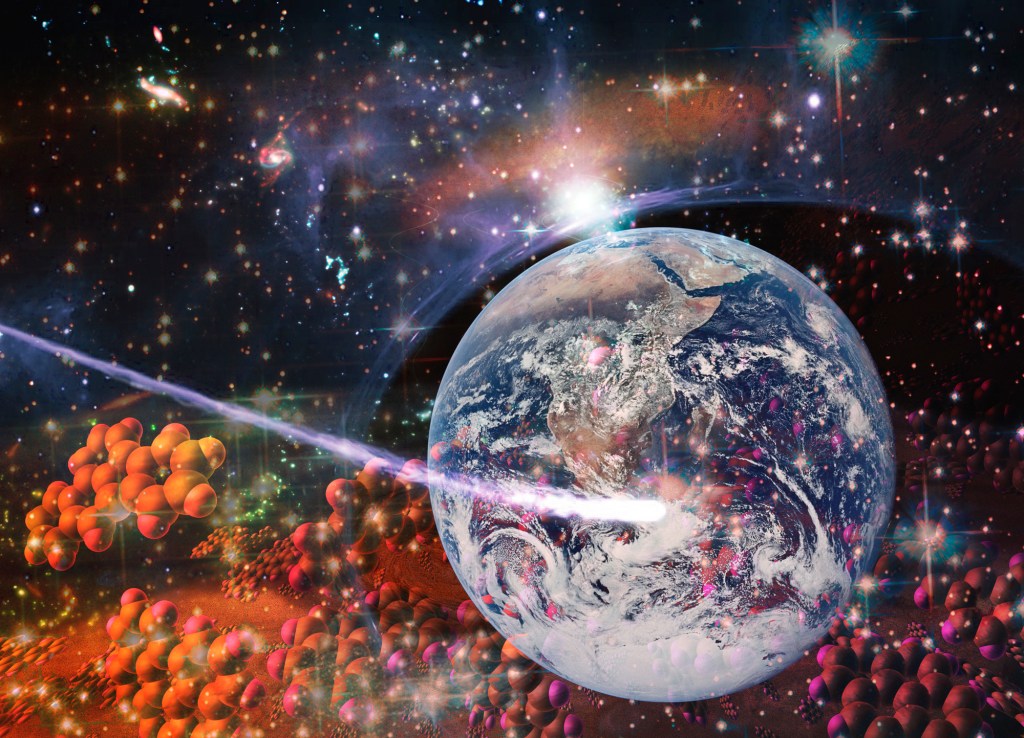
Particles of DNA strands flying through space to Earth.
Concept of the origin of life. Elements of this image furnished by NASA.

Michael Guillen, who obtained degrees in physics and mathematics from Cornell University, where he studied under Carl Sagan and Fred Hoyle, and who taught physics at Harvard University, has a podcast in which he addresses the problem of the origin of life (among many other things). (See Science + God with Dr. G. Episode #44)

Guillen was an atheist into his late 20’s or early 30’s. Then he became a theist, and then a Christian. He has always been a “science guy”, however.

You can find the explanation of how he gravitated from atheism to Christianity in earlier episodes of the podcast. I am not going to address it here. I want to address the origin of life problem using this particular episode as a backdrop because I think he explains the problem well.

Before I do that, I want to preface the origin of life problem and put it in some context. The unspoken and unexamined assumptions we make can cloud our understanding, so I want to seek a little clarity first.

Continue reading “A Preface to the Problem of the Origin of Life”

Thoughts on Perspective, Science and Faith

As finite beings, We have no choice put to adopt our fundamental principles on faith. We do not have the requisite perspective to have more certainty than that.

I have two blogs I maintain currently: Perspective and Navigating by Faith. Perspective and faith loosely characterize my journey over many years: trying to find perspective and understanding the value, the necessity, and the integrity of a faith grounded in reality, both observable and unseen.

Many people believe that faith is the opposite of fact and at odds with science and reason. I strongly disagree. I have come to believe that faith is inescapable for finite beings – both religious ones and non-religious ones alike – and faith lies at the core of everything we believe to be true.

I was listening to a podcast discussion recently when one of the participants said something like this: When we approach any evidence, we approach it with a perspective. This is a non-pejorative way of saying that we are all “biased”.

As finite beings we are all necessarily “biased” by our own perspective, our own experiences, our own knowledge, understanding and ability to grasp, synthesize and categorize what we know and understand. Our perspective is influenced and filtered through our location in the world, our place in the culture and society in which we live, the history that we remember, and too many other things to summarize them adequately in a short blog article.

The discussion in the podcast that prompts this writing focused briefly on the fact that we all bring assumptions to the table when we consider anything. Those assumptions, however intentionally or surreptitiously developed, are the bedrock of each of our worldviews. They are the foundations on which we stand. They are the filters through which we see the world.

Those assumptions are developed, to a greater or lesser degree, by some combination of our external influences, our internal leanings and reactions to those external influences, and our consciously or unconsciously chosen compass points we use to guide ourselves in sorting out the information we encounter.

At the most basic level, those assumptions are axiomatic. They are truths we take for granted. We cannot prove them, and we rarely question them without crisis. We are fortunate if they hold us in good stead, if they are well-enough grounded in reality and fact to be of benefit to us in our dealings with the circumstances of our lives.

If those basic assumptions are not well considered and well-grounded, we can be blown about by every wind. If they are not based in fact and an accurate grasp of the nuance of reality, they can prove little consolation or comfort in times of crisis. If they are not well-anchored in timeless truth, they can leave us adrift when we need to count on them most.

The unique perspectives in light of which finite beings approach any evidence is necessarily limited and biased because we are limited and finite beings. At best, we can only hope to orientate ourselves in the direction of truth. We don’t define truth. We don’t establish truth. We don’t’ generate truth.

This is necessarily the case with finite beings who can only approach reality from a particular location at a particular time in the context of a particular cultural, historical, and philosophical point of view.

If I was omniscient and all seeing, I could have ultimate confidence in my perspective. My perspective would be objective and factual. My perspective would be the measure of all reality.

But no human being can validly make that claim (though we may and often do think and act like we can). In all honesty and humility, we must each admit that we come at evidence from a perspective with bias born out of our own experience, cultural context, limited knowledge and limited understanding.

We don’t know what we don’t know.

As a necessary corollary to these things, which I believe with all the certainty that I can possibly ascribe to these things, we are creatures of faith. All of us. We have no choice put to adopt our fundamental principles on faith. We do not have the requisite perspective to have more certainty than that.

My conclusion in this regard is based on fact (that humans are finite beings) and “logic” or philosophy, which reasons from the fact that we are finite to conclude that our perspective is limited thereby. Because our perspective is limited, we must rely on faith in making our conclusions which, themselves, derive from the fundamental assumptions we also take on faith. We can’t escape these limitations because they are inherent in finite creatures such as ourselves.

Some people even in this modern age, however, have boldly claimed that science is the study of all the reality that exists. Further, they say, therefore, we no longer need philosophy or theology. (I have heard Neil deGrasse Tyson say this very thing.) I am going to push back on that idea in this blog post.

Continue reading “Thoughts on Perspective, Science and Faith”

When Scientists Stray From Science

Some people today have made the mistake of using scientific methodology that is limited to the study of the natural world to conclude there is no reality but for the natural world.

Depositphotos Image ID: 151533714 Copyright: avemario

Methodological naturalism is the basic approach of science. Since science is the study of the natural world, the methodology of science is limited to the parameters of the natural world. Methodological naturalism is theologically neutral.

So what does that mean?

On a very fundamental level, it simply means that science is the study of the natural world, and, therefore, science is limited to naturalistic methodology. Science is limited to the observations of matter, energy, space, and time.

Another way of putting it is that science has no preoccupation with anything that is super natural. Science is limited to a focus on the natural world. Science doesn’t bother itself with anything but the natural world (though scientists might stray beyond it).

Science does not and cannot comment on anything but the natural world (though scientists often do), because the natural world is the focus of science. It’s as simple as that.

None of this should be in the least bit earth-shattering. Confusion arises, however, when we begin discussing the supernatural, the metaphysical, the theological, and the philosophical realms in relation to science.

There are those scientists, for instance, who have recently suggested that the advance of science today has done away with the necessity of philosophy. People like Lawrence Krauss and Neil deGrasse Tyson have made statements like that, though they have both backed off of those initial statements more recently. It’s important to understand that those statements, themselves, are philosophical in nature, and not scientific.

To suggest that science has done away with the necessity for philosophy is to ignore the limitations placed on science in its very methodology. Science, itself, is not philosophical, but evidence from science can support premises that are philosophical, and scientists may draw philosophical conclusions from scientific facts.

Science may inform philosophy, but it can never replace philosophy. To think otherwise is to exalt science beyond its natural parameters (pun intended) and to fail to appreciate the difference between science and philosophy.

Continue reading “When Scientists Stray From Science”

The Myth of Objectivity

 (c) Can Stock Photo

(c) Can Stock Photo

Thoughtful and thought-provoking articles are a source for many articles I write. When those two characteristics are exemplified in the same single article, I often use it as a springboard. An article by Trent Horn, Neil DeGrasse Tyson Shows Why Science Can’t Build a Utopia[1], is my springboard for this article.

Neil DeGrasse Tyson, of course, is the outspoken agnostic ambassador of science. The Horn article was precipitated by Tyson’s tweet: “Earth needs a virtual country: #Rationalia, with a one-line Constitution: All policy shall be based on the weight of evidence”[2] and Horn’s counter-tweet: “@neiltyson ‘Rationalia’ is as useless as ‘Correctistan,’ or a country whose constitution says, ‘Always make the correct decisions.'”

To illustrate what he means by his counter-tweet, the author used the example of a driverless car. Fatalities have already happened with them and will undoubtedly happen again. That isn’t the point, though. The point is this: how should they be programmed when confronted with two options – to run over pedestrians or run into an object that may kill the passengers?

How does Rationalia weigh the evidence to determine which is the best course? Continue reading “The Myth of Objectivity”