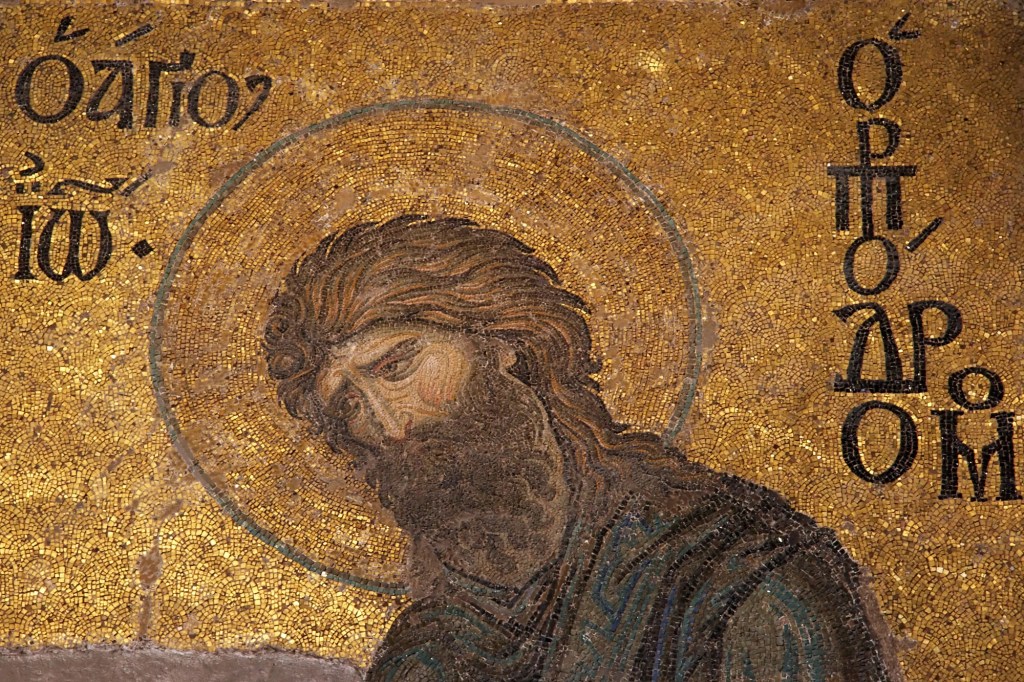
My thoughts today might seem a little obscure, but let me set the stage first. Imagine the scene when two followers of John the Baptist were sent to ask Jesus a question. News of what Jesus was doing had traveled far and wide. People even reported that Jesus brought a dead man to life!
This is the backstory. Jesus happened upon a funeral procession. (Luke 7:11-17) The dead man being carried to his final destination was the only child his mother had, and she was a widow. Jesus was filled with compassion, ands he did the unbelievable. Jesus brought that dead man back from death!
This man and his mother were locals. They lived in a nearby town. They were talking, and it wasn’t just them. People saw it, and they were talking about it also. A crowd had witnessed the whole spectacle.
News about Jesus spread throughout Judea and the surrounding country, so that people were coming to Jesus from all around. John the Baptist heard about these things also, and he sent two of his followers to ask, “Are you the one who is to come, or should we expect someone else?”
(Luke 7:20) (As an aside, Luke does not tell us why John did not come himself, but we know from Mathew that John was in prison. (Matthew 14:1-12)
The “one” John the Baptist wondered about is the Messiah who had long been expected. John and his ancestors kin had been reading about the Messiah in the prophets for centuries. The time seemed right. Many had come recently, claiming to be him, but they were killed, and their following faded. Still, expectation was in the air.
John was imprisoned because he was open and blunt with criticism of Herod the Tetrarch, the local governor, who married his brother’s wife. Herod imprisoned John to silence him.
John was equally straightforward and to the point with the question he sent his followers to ask, “Are you the one?”
John the Baptist’s followers arrived on the scene as Jesus was curing people with diseases, sicknesses and evil spirits, healing people and even giving sight to the blind. When they asked him whether he is the one, or whether there is someone yet to come, Jesus said
“Go back and report to John what you have seen and heard: The blind receive sight, the lame walk, those who have leprosy are cleansed, the deaf hear, the dead are raised, and the good news is proclaimed to the poor. Blessed is anyone who does not stumble on account of me.”
Luke 7:22-23
These words were familiar to John. They come from the book of Isaiah, one of those the prophets that foretold the Messiah to come (see Isaiah 35:5 and 61:1). The Messiah was predicted to be the cornerstone of a new order, but the prophets also warned that he would be rejected, and he would be a stumbling block for many. (See here)
The Pharisees and religious leaders also would have known exactly what Jesus alluded to in his response to John’s followers, though they didn’t even ask the question, and they probably were not privy to the answer. For them, Jesus was a stumbling block. The way Luke describes their response is what prompts me to write today.
I recently heard someone say that apologetics is not good for anything because it is just about proving to other people that you are right. The statement was made by a Christian who is vocal about sharing his faith. So, this was not an excuse from someone who is ashamed to defend the reasons for his hope in Jesus Christ.
Indeed, some people approach apologetics as a kind of intellectual game of one-upmanship. Some people seem to think that apologetics is a kind of silver bullet or kryptonite to combat skepticism and atheism.
I have been drawn to apologetics over the last 12 to 15 years as I have gone through a renewal of my faith. I became a Christian in the academic setting of college, so apologetics was attractive to me. The intellectual exercise is invigorating and stimulating.
Along the way, I developed expectations similar to the ones criticized by my friend on social media – that apologetics has all the answers and engaging in apologetics will turn skeptics and atheists into believers, but it doesn’t necessarily work that way.
Just watch a debate and listen to the responses of the people who observed it. Most skeptics are going to walk away skeptical, thinking that the atheist won, and most believers are going to walk away believing, thinking that the Christian won.
We might call this confirmation bias. It’s human nature. We are naturally inclined to identify with the things we already believe in and to find the arguments that align with our beliefs to be compelling.
Debates tend to promote the kind of one-upmanship that my friend criticized. After all, that is traditionally the point of debate. For me, this seemed to be the wrong format for sharing the Gospel.
Therefore, I dismissed debating as an effective apologetics “tool”. It seemed to me that debates were not an effective way of delivering truth. Therefore, I gravitated toward platforms like the Unbelievable? Podcast hosted by Premiere Christian Radio in Great Britain where dialogues between theists and atheists are carried on civilly (usually) in a dialogue format.
But, I am not sure how much more effective dialogue is than debate in convincing people of the truth of Christianity. Most people remain convinced of their own views most of the time. Human beings are stubborn that way.
Many modern people see themselves primarily as rational beings, so we think apologetics reaches them where (they think) they live. I am skeptical that so many people are such rational beings. I have to question my own rationality sometimes. We are motivated by many things other than reason, and we use reason to cover up ulterior motives.
This is the thesis (more or less) of Jonathan Haidt in his book, The Righteous Mind: Why Good People Are Divided by Politics and Religion. He argues that we reach our fundamental moral judgments about right and wrong at a gut level – not at a rational level. We turn to reason to defend our positions, but our positions are formed at an intuitive level.
I have not read the whole book, and I don’t recall his data and evidential support for the conclusions he reaches, but the general proposition rings true to my own experience and observation, limited as it is. What good is apologetics, then?
If Jonathan Haidt is right, then apologetics is not going to reach people where they actually live – in their gut. If we are aiming at the head, we are missing the mark, perhaps.
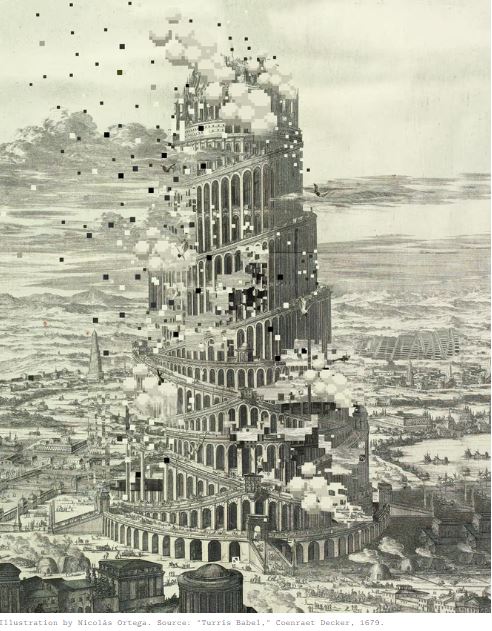
Jonathan Haidt wrote this week in the Atlantic, “The story of Babel is the best metaphor I have found for what happened to America in the 2010s, and for the fractured country we now inhabit.” He says,
“Something went terribly wrong, very suddenly. We are disoriented, unable to speak the same language or recognize the same truth. We are cut off from one another and from the past.”
I resonate deeply with this.
Haidt observes that we are “becoming like two different countries claiming the same territory, with two different versions of the Constitution, economics, and American history.” Many people talk about the tribalism of our times, but Haidt suggests that tribalism isn’t the most accurate description of what is going on. Haidt finds the clearest understanding of the polarization of our times in the story of the Tower of Babel:
“Babel is not a story about tribalism; it’s a story about the fragmentation of everything. It’s about the shattering of all that had seemed solid, the scattering of people who had been a community. It’s a metaphor for what is happening not only between red and blue, but within the left and within the right, as well as within universities, companies, professional associations, museums, and even families.”
Haidt focuses blame on social media. He identifies 2011 as “the year humanity rebuilt the Tower of Babel” with Google Translate symbolically bridging the confusion of different languages. He says (for “techno-democratic optimists”), “[I]t seemed only the beginning of what humanity could do.”
Around the same time, Zuckerberg proclaimed “the power to share” a catalyst to transform “our core institutions and industries”. He may have been prophetic, but I doubt he envisioned such a corrosive change.
Haidt, something of a social scientist, himself, says, “Social scientists have identified at least three major forces that collectively bind together successful democracies: social capital (extensive social networks with high levels of trust), strong institutions, and shared stories.” Social media substantially weakens all three of these fundamental building blocks of a cohesive society.
It started harmlessly with the sharing of personal information to stay connected, but it quickly morphed into a kind of personal performance and branding platform. Along the way it developed into powerful weaponry at the fingertips of anyone and everyone at once.
The “Like” and “Share” buttons became commodities of individual enterprise and personal combat. Algorithms exposed (and exploited) the emotional currency of heightened individuality and the power of anger.
“Going viral” fed the hopes of Internet junkies like the possibility of a jackpot snares gambling addicts in its steely fingers, and the stakes were just as high. Haidt says, “The newly tweaked platforms were almost perfectly designed to bring out our most moralistic and least reflective selves. The volume of outrage was shocking….” The rapidity and its ability to spread was more virulent than COVID, or the plague.
Haidt lauds the framers of the Constitution for designing a republic built on “mechanisms to slow things down, cool passions, require compromise, and give leaders some insulation from the mania of the moment….” Haidt recalls Madison’s warning of “the innate human proclivity toward ‘faction’” so “inflamed with ‘mutual animosity’” that people are “more disposed to vex and oppress each other than to cooperate for their common good.’”
Haidt recalls also that Madison warned of a human tendency toward “factionalism” that can fan “the most frivolous and fanciful distinctions” into passions that ignite our most violent conflicts. Social media has ultimately proven him right.
Thus, Haidt says, “Social media has both magnified and weaponized the frivolous,” chipping away at our trust. The loss of trust makes every decision and election “a life-and-death struggle to save the country from the other side”.
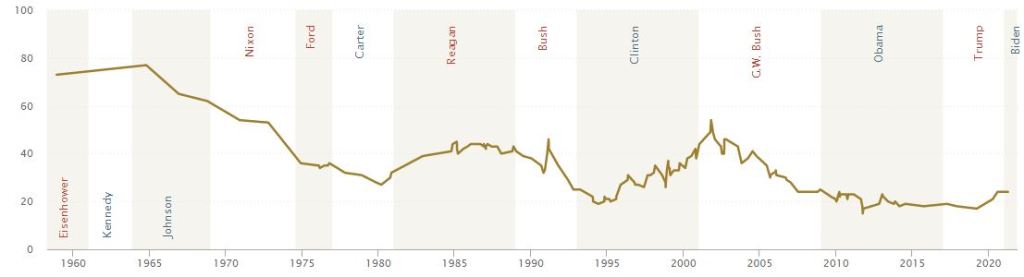
The sagging number of people who have faith in their elected officials hangs at an all time low. In my lifetime, the United Sates of America has gone from a high of 77% trust in the federal government (1964) to a low of 17% in 2019. (See Public Trust in Government: 1958-2021, by PEW Research May 21, 2021)
Social media has corroded trust in government, news media, institutions and people in general. Some claim that social media may be detrimental, maybe even toxic, to democracy, which requires “widely internalized acceptance of the legitimacy of rules, norms, and institutions” for survival. “When people lose trust in institutions”, says Haidt, “They lose trust in the stories told by those institutions.”
Insiders have been warning us of “the power of social media as a universal solvent, breaking down bonds and weakening institutions everywhere”, while offering nothing in return but the chaos of utter freedom and will. Haidt references movements like Occupy Wall Street, fomented primarily online, that “demanded the destruction of existing institutions without offering an alternative vision of the future or an organization that could bring it about”.
We have become a society of “people yelling at each other and living in bubbles of one sort or another”, says former CIA analyst Martin Gurri, in his 2014 book, The Revolt of the Public. The people behind the social media giants may not have intended such a result, but they have “unwittingly dissolved the mortar of trust, belief in institutions, and shared stories that had held a large and diverse secular democracy together”.
Haidt claims he can pinpoint the proverbial fall of the American Tower of Babel to the intersection of “the ‘great awokening’ on the left and the ascendancy of Donald Trump on the right”. Haidt doesn’t blame Trump for the fall; he merely exploited it. Trump proved that outrage is the currency of the post-Babel economy in which “stage performance crushes competence” and Twitter overwhelms newspapers and the nightly news, fracturing and fragmenting the truth before it can spread and take hold.
“After Babel”, Haidt says, “Nothing really means anything anymore––at least not in a way that is durable and on which people widely agree.” Haidt is particularly morose on the prospect of overcoming the rapid dissolution of the American democracy. Unfortunately, I share his pessimism. How did we get here? How do we move forward?
Ed Atkinson was recently interviewed with Austin Fischer by Justin Brierly on his podcast, Unbelievable, on the issue of doubt. (A Tale of Two Doubters) The personal story of both men involves their public dealings with doubt. One ended up on the unbelieving side of the faith divide, and the other on the believing side.
The point that intrigued me most about the discussion was when Ed Atkinson brought up Jonathan Haidt, who wrote a book called The Righteous Mind: Why Good People Are Divided by Politics and Religion. One of the topics Haidt addresses is what he calls “the rationalist delusion”, which Atkinson summarizes as a “wild overestimation of our rationality that was … birthed to us in the Enlightenment”.
Atkinson says, “We like to think of ourselves as very rational beings [who] very rationally work and think our way through the world sorting through the syllogisms and … coming to what is the correct answer.” The work that Haidt and others have done on the subject have debunked that view of ourselves. Atkinson says, “Our decision-making process really isn’t very rational.”
I have often thought about this very thing. When I look back on my own journey, I recall that I went off to college with a passionate desire to discover meaning and truth, believing it was attainable, and having a naïve confidence in the rationality of the human mind. What I found in college was a very mixed bag. Though my quest for meaning and truth never waned, my confidence in the rationality of the human mind was disappointed.
I came to distrust that confidence in myself and in others, especially in others whose confidence in their own rationality seemed unwavering. Elevated self-confidence often seems more like brute will than rationality.
Since that time I have been continually disappointed in the rationality (or lack thereof) of the human mind, especially in those who seem to have no doubt about their own rationality. That I am sometimes guilty of the same over-confidence only adds to my disappointment and angst.
As a lawyer whose vocation is getting at the truth through the presentation of the evidence on both sides of a matter to a neutral judge, I have had generous opportunity to test human rationality. What I have found (over and over again) is that human rationality is often affected by things that have little or nothing to do with reason.





 Navigating by Faith