The Story of Abraham and God’s Redemption of Mankind – Part 2

God works out His purposes through the messiness of human history.

The story of God’s redemption of mankind in the Bible funnels through one man, Abraham from Mesopotamia. I introduced Abraham (known as Abram then) and his family in Part 1 of this series of articles.

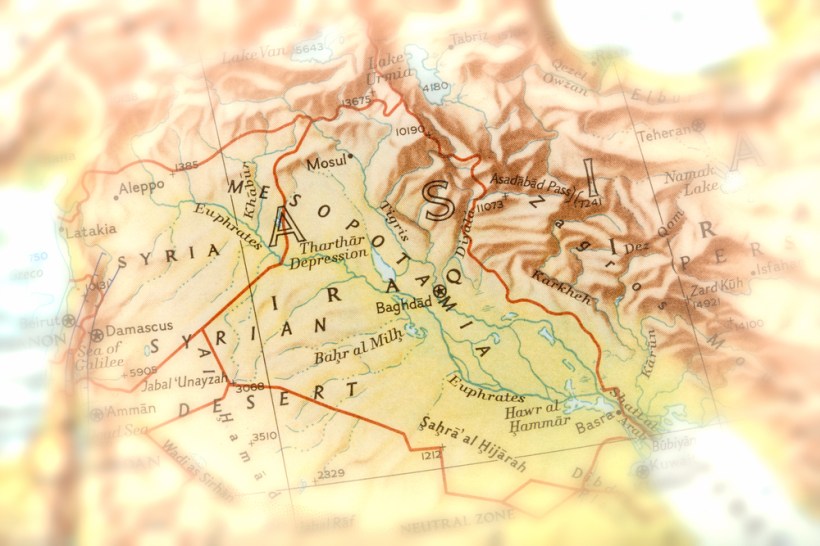
Abram’s sister, Sarai, became his wife. Both of them were children of their father, Terah, by different mothers. Terah’s son, Haran, died in their homeland (Ur). The family with Lot, Haran’s son, left Ur and and traveled to a place they called Haran in southern Turkey, just north of Aleppo Syria.

Terah and Nahor remained in Haran, but God gave Abram the direction, “Go to the land that I will show you”, and the promise, “I will make you a great nation….”, and “Through you every family on earth will be blessed”. (Gen. 12:1-3) Thus, at the age of 75, Abram and Sarah left Haran and continued on to Canaan, and Lot went with them.

When they arrived at Shechem in Canaan, God renewed the promise as Abram looked out over the land: “I’m going to give this land to your descendants.” Abram built an altar there, Then, he continued on to the high country in Canaan, between Bethel and Ai, where he also built an altar and worshiped God. (Gen. 12:7-8)

Though God had promised him twice at this point to give Abram this land, Abram continued on. They traveled south out of Canaan, into the Negev desert, and they kept going further south to Egypt because of famine. (Gen 12:9-10)

Abram remained in Egypt long enough to accumulate some wealth before he started moving again. (Gen. 13:2) It is written that Abram “traveled from place to place” when he left Egypt. He seemed to be wandering.

He traveled north again, back to the Negev and eventually back to Bethel and Ai, where he settled down. (Gen. 13:3-4) It must have been some time, as he and Lot had accumulated so many animals their herds and servants couldn’t coexist peacefully. Thus, they parted ways. (Gen 13:5-13)

Lot settled south of Canaan in the Jordan Valley. Abram remained in Canaan, and God gave him the same promise a third time: “Look north, south, east, and west of where you are. I will give all the land you see to you and to your descendants….”; and “I will also give you as many descendants as the dust of the earth.” (Gen. 13:15-16)

Still, Abram moves again, this time south about 35 miles to another part of Canaan known as Hebron. Many years pass. Abram seems to be waiting for God to do what he said, and, for the first time, Abram begins to show signs of doubt that God’s promises would come to pass, . Perhaps, this is why God promises him a fourth time: “Your own son will be your heir” (Gen. 15:4); and “I will give this land to your descendants.” (Gen. 15:18)

When Abram was 86, however, Sarai takes matters into her own hands and offers her Egyptian servant, Hagar, to Abram. Abram agrees, Hagar conceives, but all is not well in the Abram household. Hagar disrespects the barren Sarai, and Sarai mistreats Hagar so badly that she runs away. (Gen 16)

God comforts Hagar in her distress and says of Ishmael, “He will be free and wild”, but “[h]e will fight with everyone, and everyone will fight with him….,” and “[h]e will have conflicts with all his relatives.” (Gen. 16:12)

It seems that nothing is going right for Abram, and God promise takes on a sour taste. Is this the son through whom God will bless all the nations? This wild and contentious boy? Is the son of Sarai’s now despised Egyptian servant Abram’s heritage?

Continue reading “The Story of Abraham and God’s Redemption of Mankind – Part 2”

Isaac

We all know someone who has struggled in life stemming from a poor or nonexistent relationship with his father.


This may not be what you thought it was. The song, Isaac, by Bear’s Den is the subject. It is about the story of Isaac, tangentially. But that really isn’t the point so much, as far as I understand it.

Isaac is a tender, haunting song, a thoughtful piece, but not a biblical exposition. Still, it is one of my favorite songs (currently), and I think it is worth breaking down a little bit.  Continue reading “Isaac”

The Wrath of God in History

 (c) Can Stock Photo

(c) Can Stock Photo

This is part 2 of the series, Putting God’s Wrath in Perspective. In part 1, we focused on the necessary fact that, if God exists, God is God; so who can question or judge Him if He is wrathful? We are in no position to change God or judge Him. But we are told, if God is wrathful, that is not all He is because we are told that God is love. (1 John 1:14)

With that in mind, I continue this series on the wrath of God by focusing on God in the history revealed in the Bible. I want to pick that history up from the point when God found a man in (Abraham) who was inclined to hear his voice.

Whether you believe that men have evolved from neanderthals to modern intellectuals or believe in Adam and Eve, we have a natural disconnect between us and the divine. This is to be expected based on the fact that we are the stuff of time, space and matter, and God necessarily is not. In that relationship, we need God to reveal Himself to us because we don’t have the tools in our toolbox to understand a timeless, spaceless immaterial God on our own accord.

The biblical story is the story of God reaching out to mankind through people inclined to hear his voice. Abraham was such a man, and God used Abraham to reveal His self in history to mankind. God chose this man, Abraham, to be the vehicle by which he would bless all people because Abraham was inclined to hear God and respond to him.

Through Abraham and one miraculously born son, Isaac, God promised to create a people that would be as many as the stars in the sky. The Old Testament is the story of God establishing these people, though these people were difficult to manage. They grumbled and complained a lot. They didn’t understand what God was doing. They were more inclined to go in a different direction and live differently than God wanted them to live, but God made his promise to Abraham, and He would keep it.

Continue reading “The Wrath of God in History”

Abraham, Isaac and Paradigm Shift

The story of Abraham and Isaac establishes a significant and remarkable shift in worldview for the time.


We live in a specific cultural and historical time and view things through cultural, historical, social, political, and other contexts that are familiar to us. Things in the Bible often do not make sense to us immediately because the filter through which we see the world with modern eyes obscures the context in which the stories in the Bible were told. Whether one believes the Bible is God’s word, no one can understand it as it was written without understanding the context.

The story of Abraham and Isaac is particularly hard to understand in modern context. Why would anyone think to sacrifice a child? They very thought is barbaric! A God who would ask such a thing must be barbaric too! So, the thinking goes.

Let’s set that thinking aside for the moment before we come back to it. Let’s not jump to 21st Century conclusions. Let’s consider the historical and cultural context and give the story the benefit of the doubt to see what we might find.

First, Abraham clearly was doing what he thought God was asking of him. He was willing to do it, even if, perhaps, he didn’t understand it, and it would would be painful to him. Isaac was his only son. Not only that, he was the son God promised to give him and through whom God promised Abraham descendants as many as the stars in the sky.

According the written account, Isaac was a miracle. Abraham and Sarah were past child-bearing age, but God had promised them a child. Now, God seemed to be urging him to take that child’s life. Just as it makes no sense to us, it would not have made sense to Abraham. Even if there was no other reason, it would not make sense because it went against what God had promised.

Yet, Abraham was convinced that he must do it, or at least that he must follow through with this urging from God to wherever it would lead. This belief is central to story, and we need to understand the why before we can fully understand the story.

We have a hard time understanding this particular commitment by Abraham to God in our modern world. Why would Abraham think it was ok for God to ask this of him?

We would never believe that God would tell anyone to murder a child, let alone our child. We would call anyone who believed such a thing psychotic, delusional, or worse – downright wicked. We lock people like that up and throw away the key!

But, not so fast. Let’s take a step back into the Ancient Near East and consider Abraham’s world. We have thousands of years of human progress to thank for how we think, thousands of years of Christian influence by which we now judge the world.

The Christian influence permeates the thinking of post-modern secularists who don’t even appreciate how Christian their thinking is! We have “advanced” in many ways in our collective thinking. Ancients would have never dreamed of the modern notions of humans rights and basic freedoms.

We now live in a world in which an individual’s pursuit of happiness is a protected right, and people are free to follow their own dreams. We highly value individualism. “I did it my way” is an anthem in our modern society. Religion is largely frowned upon if it cuts against these modern grains.

In terms of morality, however, we are not really as different from the ancients as we think. You may know someone who has sacrificed a child. Maybe you have done it yourself. I am talking about abortion.

I don’t say this to condemn anyone. I simply point out that abortion is an accepted practice in our time. Some societies would view our acceptance of abortion with shock (including our own society 50 years ago). Others in the future may think the same.

Therefore, let’s put aside our modern prisms through which we tend to view the story of Abraham and Isaac. Let’s consider the story in it’s ancient context.

Continue reading “Abraham, Isaac and Paradigm Shift”

The Unsettling Nature of Man, and God

2010-06-15 20.12.35I have been reading through Genesis the last couple of weeks. In reading the stories of Abraham, Isaac and Isaac’s twelve sons, who would become the twelve tribes of Israel, I have been impressed, negatively impressed, with them as people. I must not have really noticed before their blemishes.

Abraham, the father of faith, lied about his relationship to Sarah, not once but twice. When Abraham visited Egypt, and the Pharaoh’s princes were struck by Sarah’s beauty, Abraham instructed Sarah to say she was his sister so they would not kill him. When Pharaoh found out, he was appalled and let her go. Years later, when Abraham was living in the land of the Philistines, Abraham openly declared Sarah was his sister. After King Abimelech discovered the truth, he was equally taken aback.  Why did he lie about it? It hardly seems like a noble thing to do. I would call it cowardly.

After Abraham was told by God that he would bear a son and his descendants would become like the stars in the sky, a number of years went by. Sarah then offered her servant to Abraham, and the servant, Hagar, gave birth to a son, Ishmael. Such an act violating the marital covenant does not sit well with a twenty first century reader. It was also not God’s plan. God’s plan was to give Abraham a son through his wife, Sarah.

Isaac, of course, was the son God promised. He, too, seemed less than sterling as a man of God. He followed his father’s footsteps in deceiving the same King Abimelech that Rebekah was his sister, when she was his wife. Like father like son.

Isaac had twin sons, and he favored the oldest, Esau. God blessed the younger son, Jacob. How could Isaac have gotten it wrong?

As for Jacob, he deceived his father for the blessing that his father thought he was giving to Esau, and he did it with his mother’s help. In his old age, Jacob had become blind. Rebekah put Jacob up to pretending to be Esau to receive his father’s blessing. Deception seems to run in the family.

All of this has been unusually unsettling for me for some reason. I have stewed on it for days. Today it struck me that anyone looking at my life would be equally unsettled (or more I dare say). I am no example to follow. I have made many mistakes in my life, too numerous to count. I have done many things of which I am not proud, and my thoughts are another matter altogether. Why should I expect anything other than humanity from these men of old? The amazing thing is that God chose them!

Clearly, it was not their spotless virtue that is the testament of their lives. It was their faith. They heard God. They responded to God. They honored God with sacrifices and pillars and altars where they went. They believed God when He spoke. They lived their lives in deference to God. They relied on God. Their faith was counted to them as righteousness.

My take away is that these men were in right relation to God. I take comfort in that, even if I am bit unsettled by their weakness and humanity, as well as my own.  I am in good company, but more importantly, I am reminded of the importance of living a life with an attitude toward God.