Do We Have Any Evidence of the Resurrection? A Critique of Skepticism and Proof

People confuse proof, as in a mathematical proof, and proof, as in an offer of evidence that tends to support a proposition.


Some people say that we have absolutely no evidence for the resurrection (and no evidence that God exists in the first place). Nothing could be further from the truth. We have evidence. The issue isn’t a lack of evidence; the issue is how we approach the evidence and weigh it it.

A person who approaches “supernatural” phenomenon with purely materialistic assumptions will weigh the evidence differently than one who is open to nonmaterialistic possibilities. Jesus, though, lived in time and space in history. Many people in the first century who saw him die claim to have seen Jesus and interacted with him in the flesh after he died, and those people were willing to die for what they saw.

That is evidence. Full stop. People may be skeptical of it. People may assume Jesus couldn’t have risen from the dead, despite what people think they saw, because miracles don’t happen. But, now I am talking about how people approach and weigh the evidence.

People confuse proof, as in a mathematical proof, and proof, as in an offer of evidence that tends to support a proposition. Fallible, finite human beings deal almost exclusively in the latter realm of evidence, even in science, because we don’t know what we don’t know.

Mathematical proofs are an achievable goal in mathematics (though sometimes not even then). Such proof is impossible outside of mathematics.

Science does not provide us that kind of certainty, either. Science changes all the time on the basis of new evidence, and things we thought we knew in the past are constantly being adjusted, or even discarded, on the basis of additional evidence.

Finite beings such as ourselves are limited in our knowledge, our access to knowledge, and our understanding of how the knowledge we have fits together. We have to be humble as we cautiously put our confidence in the things we think we know because we are limited in our ability to know and understand our world, and we will always lack absolute proof for most, if not all, things.

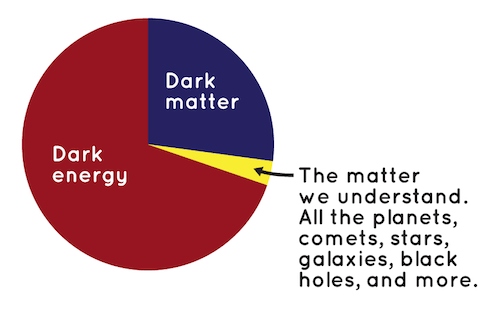
The extent of our limitations can even be quantified. For instance, 95% of the physical universe is invisible to us! The vast, unseen reaches of the universe are comprised of things like dark matter and dark energy that we cannot see and know little about, except for what we can infer about them. We aren’t sure what these things are, but we know they exist by the affects we see on the matter we see and know.


According to scientific consensus, the universe is about about 13.7 billions years old, and the earth is about 4.543 billion years old (give or take about 50 millions years), and homo sapiens appeared only 300,000 years ago (and maybe even only190,000 years ago). Assuming those calculations to be true, human-like beings have existed for only 0.0066% of the time the earth has existed and only 0.002% of the time the universe has existed. (If my math is correct.)

If we view the existence of the earth (not even the universe) on a 24-hour scale from the beginning to the present time, life began at 5:00 AM, the first vertebrates appeared at 8:00 AM, and human beings appeared just a fraction of a second before midnight.
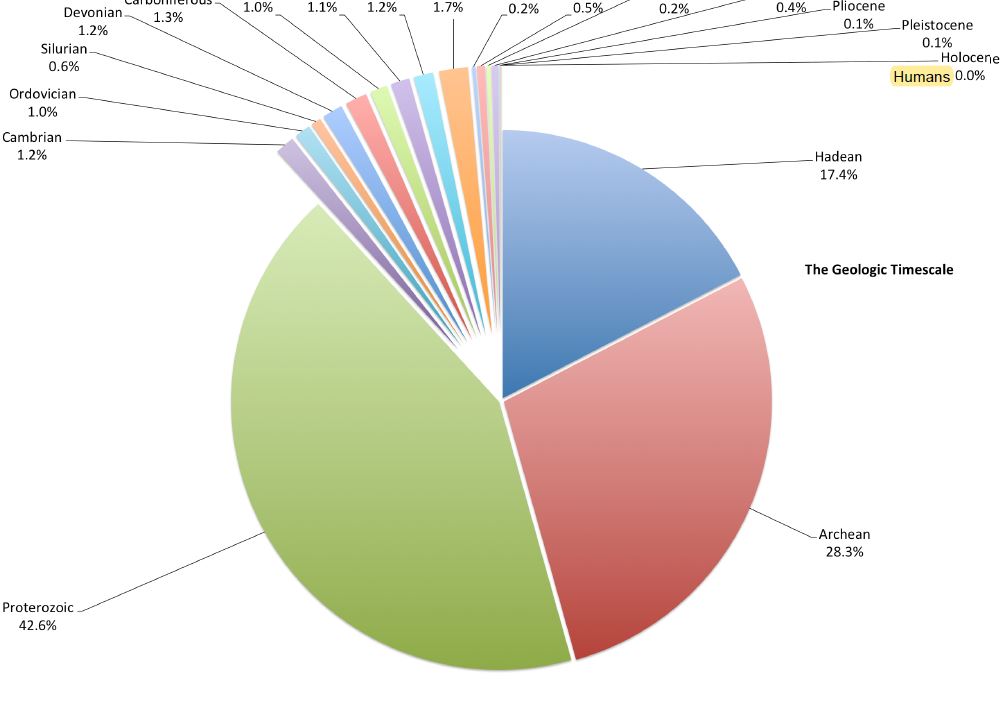
Homo sapiens have only developed knowledge and the ability to communicate and preserve a record of it for about 5,500 years. We have been developing and recording our knowledge for only 0.00022% of the time the earth has existed, which is only 0.00007% of the time the universe has existed.


During that relatively short, 5500-year time period we have developed the capability to see only about five percent (5%) of the universe, though we have actually examined very little of it – and then only at very great distances. We hnave only explored more than five percent (5%) of the oceans on this earth – a very small planet orbiting a very small sun in a very small solar system in the inconceivably large expanse of what we we call the universe.

The body of our scientific knowledge has grown tremendously, even exponentially, especially in the last 200 years, but we have only just begun to know and understand the universe we live in. If humans live another 5,500 years, we will not have explored all of the universe, and we will not know all that there is to know.

Our world is grand and almost inconceivably complex. The DNA of a single human cell contains so much information that if it were represented in printed words, simply listing the first letter of each base would require over 1.5 million pages of text! Imagine how much information exists in the universe and how much we don’t know.

We will likely never know all there is to know about the expanse of the universe and everything in it, large and small, in all the years mankind is on the earth. Thus, we are in no position to write off the possibility of God creating the universe and Jesus rising from the dead.

The title to this piece is (admittedly) a bit misleading, so I need to provide the following disclaimer. Some people will read the title and assume that I am attempting to prove the resurrection. I am not doing that. I am offering only the beginning of proof (as in offering evidence) in this article, but it is evidence. You can weigh it how you will.

We should at least be open to consider what evidence there is for the existence of God and not write off the possibility that God exists. If God exists and made the universe out of nothing, which is what the Bible claims in Genesis 1, John 1, and Hebrews 11, then He could certainly raise Jesus from the dead.

How arrogant it would be for us to determine for ourselves (categorically) that there is no God, that He did not create the universe, and that Jesus did not raise from the dead. We don’t know what we don’t know, and we don’t understand perfectly what we think we know.

With that said, I want to provide some minimal facts that provide some evidence that tends to support the resurrection. These things are not proof; they are an offer of proof. We cannot achieve definitive proof, but there is evidence for the credibility of the claims made that Jesus rose from dead.


Continue reading “Do We Have Any Evidence of the Resurrection? A Critique of Skepticism and Proof”

What Jesus Thinks of Doubters

In light of the recent announcements of Christian leaders struggling with doubt, what does Jesus think of doubters?


Following the announcement of Joshua Harris that he no longer considers himself a Christian, and Marty Sampson, who says he is loosing his faith, the Christian world has exploded with conversation about doubt and doubters. So much angst. Some of the comments have been harsh with criticism.

These kinds of announcements tend to rock a world that may look shaky to begin, especially from the outside. Sometimes even from the inside.

These guys may not be household names, (I didn’t know either name until a few weeks ago), but they have each influenced 21st Century Christianity in the United States (Harris) and beyond (Sampson). Joshua Harris wrote a book, I Kissed Dating Goodbye (1997), that influenced dating culture (or the lack thereof) for a generation of young Christians. Marty Sampson was a worship leader and songwriter for one of the most prolific and visible (if not controversial) Christian churches, Hillsong.

In the wake of his divorce, Joshua Harris publicly eschewed his faith, stating that he is no longer a Christian. Not many weeks later, Marty Sampson, the Hillsong worship leader, announced that he was losing his faith. Since then he has clarified that he hasn’t walked away from the faith. He is simply struggling with doubt – something most Christians have experienced (even if we don’t like to talk about it).

The reactions have predictably poured in. High profile Christians struggling with their faith is like an earthquake that hits close to home (for Christians) or in a third world country (for people who are not). You know there will be casualties. (The fact that we put so much faith in our leaders is another topic in itself!)

Many of those reactions have been negative, even harsh. That’s why I write. That’s why Mike and Debbie Licona have taken to the Internet in a video to discuss the issue.

Mike has written, perhaps, the most significant work on the evidence of the resurrection – The Resurrection: A New Historiographical Approach. His mentor, Gary Habermas, revolutionized the way people think about the resurrection by using the “minimal facts” that even skeptics will accept to make a compelling case for the resurrection.

And here’s the thing: the works that have come to define these men and the quality of their scholarship were born out of doubt. They were once doubters. Their doubts led them to dig deeper and get answers, even as they feared those answers might unravel the faith that had come to define them.

They each stared doubt in the face and dared to seek truth, and their doubts led them on journeys that became their life work.

Doubts are not necessarily a bad thing. Fear, I believe, is worse than doubt. Fear feeds on and exasperates doubt, but fear keeps us from resolving those doubts in a productive way.

When I survey the Bible, I see admonitions against fear that suggest that fear, not doubt, is the antithesis to faith.

As for doubt, we shouldn’t be so reluctant or fearful. If our faith can’t hold up, it isn’t worth holding onto. If God is true, and I believe He is, we have nothing to fear. He is a God of truth that gives us confidence that we can expose our doubts to the truth with assurance that they can and will be resolved.

Further, I think it’s important to consider what Jesus thought about doubters. Jesus didn’t condemn them. He was patient with them. We don’t find him railing against doubters, though he did find fault with people who were more confident in themselves than they had a right to be!

Jesus embraced people who doubted. Consider the observations along these lines by Mike Licona in the video below:


I have often thought about Thomas, (aka Doubting Thomas) in this context. He didn’t just doubt after Jesus died, when he famously demanded to see his hands and side; Thomas was a doubter from the beginning. Do a search for all the places Thomas is mentioned in the Gospels, and you will see what I mean.

Now, consider this: Jesus chose Thomas and invited Thomas to follow him though Thomas was a doubter! That means that Jesus didn’t just leave Room for Doubters and Skeptics; he affirmatively chooses doubters who are willing to follow him, despite their doubts. Thomas walked with Jesus for three years, doubting all the while until Jesus proved himself to Thomas in a compelling and intimate way.

So the message is this: if you are doubting, be honest about it and seek answers. Jesus invites us to knock, and keep on knocking, to seek and keep on seeking, to ask and keep on asking. You might even read the book by Gary Habermas, The Thomas Factor: Using Your Doubts to Draw Closer to God.

And to Christians who are not (presently) wrestling with doubt, remember the words of Jude: “Be merciful to those who doubt….” (verse 22) Jesus demonstrates a merciful attitude towards Thomas, who doubted from the beginning, to Peter, who denied Jesus three times when the chips were down, and toward us when we doubt.

On the Near-Death Experience of an Atheist and Speculation on Its Effect

Whatever our experiences, our beliefs often win out. Our beliefs are not always divorced from what we want to be true, though they may be (by the same token) disconnected from reality. 


The subject of near-death experiences is a deep rabbit hole I have come to find out. I have listened to a number of testimonies recently of people who have had near-death experiences. Trying to make some sense of them led me to look up what Gary Habermas has to say about them. Habermas has been involved in the research of near-death experiences (NDEs) for a couple of decades.

This blog piece follows a summary of what Habermas says about NDEs. (See Habermas on Near-Death Experiences) I am picking up here where I left off about the near-death experience of the famous atheist, Sir Alfred Jules (AJ) Ayer, that is self-described in the article, What I Saw When I was Dead. This piece explores beyond the suggestions Habermas makes (that NDEs may be influenced by worldview) and gets behind the public persona of Ayer after his NDE.

To the extent that Ayer is “arguably the most influential 20th century rationalist after Bertrand Russel“, his encounter with a seemingly irrational near-death experience is interesting indeed.

Continue reading “On the Near-Death Experience of an Atheist and Speculation on Its Effect”

Previewing the Minimal Facts Critique of the Resurrection

canstockphoto18553034


If Jesus Christ was not raised from the dead, Christians are to be pitied above all people. These are not my words, or even the words of a famous pastor or teacher. These are the words of Paul right out of his first letter to the Corinthians:

“[I]f Christ has not been raised, then our preaching is vain, your faith also is vain. Moreover we are even found to be false witnesses of God, because we testified [concerning] God that He raised Christ, whom He did not raise…. and if Christ has not been raised, your faith is worthless; you are still in your sins. Then those also who have fallen asleep in Christ have perished.  If we have hoped in Christ in this life only, we are of all men most to be pitied.” (1 Cor. 15:14-15, 17-19)

Christianity, far from being closed to reason, invites investigation. The importance of reason is built into the greatest commandment: love God with all your heart, soul and mind.

The earliest adherents to Christianity did not hide the fact that the resurrection of Christ is the central tenet of Christianity. They put it out there, front and center, and they were not shy to state the importance of the resurrection.

If the resurrection really happened, it is the single most important event in human history. If it is false, it is the single most influential hoax of all time. Christianity is built on the foundation of the resurrection, and without it, the entire structure of Christianity crumbles.

Dr Gary Habermas knew this when he was struggling with his faith, doubting the veracity of the Bible and Christianity. He knew that the resurrection was the central and crucial component of Christianity. If the resurrection did not happen, not only is the tomb not empty, Christianity is a complete and utter sham.

That was over 30 years ago when Dr. Habermas began exploring the claim that Jesus rose from the dead to confirm or deny his own doubts. That personal exploration led to a career of scholarship on the subject of the resurrection.

Continue reading “Previewing the Minimal Facts Critique of the Resurrection”