Do We Have Any Evidence of the Resurrection? A Critique of Skepticism and Proof

People confuse proof, as in a mathematical proof, and proof, as in an offer of evidence that tends to support a proposition.


Some people say that we have absolutely no evidence for the resurrection (and no evidence that God exists in the first place). Nothing could be further from the truth. We have evidence. The issue isn’t a lack of evidence; the issue is how we approach the evidence and weigh it it.

A person who approaches “supernatural” phenomenon with purely materialistic assumptions will weigh the evidence differently than one who is open to nonmaterialistic possibilities. Jesus, though, lived in time and space in history. Many people in the first century who saw him die claim to have seen Jesus and interacted with him in the flesh after he died, and those people were willing to die for what they saw.

That is evidence. Full stop. People may be skeptical of it. People may assume Jesus couldn’t have risen from the dead, despite what people think they saw, because miracles don’t happen. But, now I am talking about how people approach and weigh the evidence.

People confuse proof, as in a mathematical proof, and proof, as in an offer of evidence that tends to support a proposition. Fallible, finite human beings deal almost exclusively in the latter realm of evidence, even in science, because we don’t know what we don’t know.

Mathematical proofs are an achievable goal in mathematics (though sometimes not even then). Such proof is impossible outside of mathematics.

Science does not provide us that kind of certainty, either. Science changes all the time on the basis of new evidence, and things we thought we knew in the past are constantly being adjusted, or even discarded, on the basis of additional evidence.

Finite beings such as ourselves are limited in our knowledge, our access to knowledge, and our understanding of how the knowledge we have fits together. We have to be humble as we cautiously put our confidence in the things we think we know because we are limited in our ability to know and understand our world, and we will always lack absolute proof for most, if not all, things.

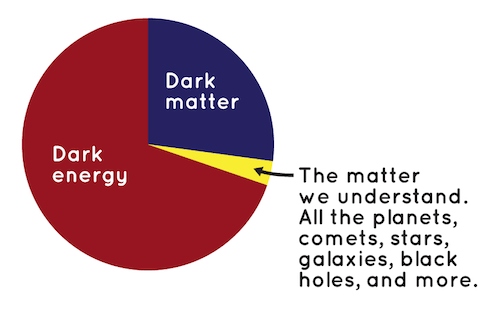
The extent of our limitations can even be quantified. For instance, 95% of the physical universe is invisible to us! The vast, unseen reaches of the universe are comprised of things like dark matter and dark energy that we cannot see and know little about, except for what we can infer about them. We aren’t sure what these things are, but we know they exist by the affects we see on the matter we see and know.


According to scientific consensus, the universe is about about 13.7 billions years old, and the earth is about 4.543 billion years old (give or take about 50 millions years), and homo sapiens appeared only 300,000 years ago (and maybe even only190,000 years ago). Assuming those calculations to be true, human-like beings have existed for only 0.0066% of the time the earth has existed and only 0.002% of the time the universe has existed. (If my math is correct.)

If we view the existence of the earth (not even the universe) on a 24-hour scale from the beginning to the present time, life began at 5:00 AM, the first vertebrates appeared at 8:00 AM, and human beings appeared just a fraction of a second before midnight.
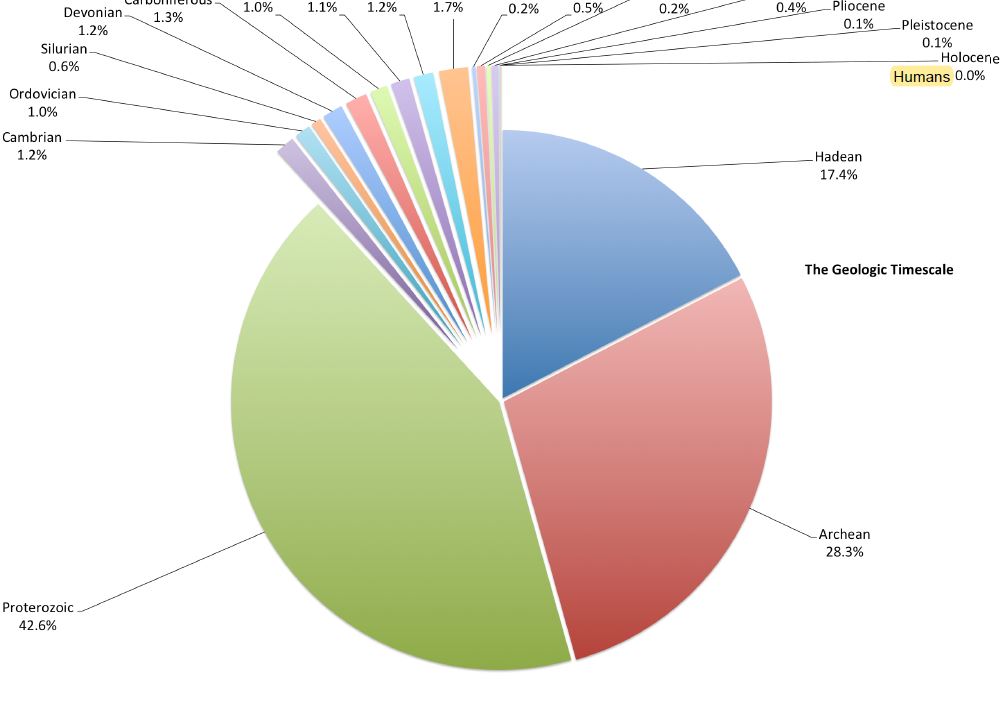
Homo sapiens have only developed knowledge and the ability to communicate and preserve a record of it for about 5,500 years. We have been developing and recording our knowledge for only 0.00022% of the time the earth has existed, which is only 0.00007% of the time the universe has existed.


During that relatively short, 5500-year time period we have developed the capability to see only about five percent (5%) of the universe, though we have actually examined very little of it – and then only at very great distances. We hnave only explored more than five percent (5%) of the oceans on this earth – a very small planet orbiting a very small sun in a very small solar system in the inconceivably large expanse of what we we call the universe.

The body of our scientific knowledge has grown tremendously, even exponentially, especially in the last 200 years, but we have only just begun to know and understand the universe we live in. If humans live another 5,500 years, we will not have explored all of the universe, and we will not know all that there is to know.

Our world is grand and almost inconceivably complex. The DNA of a single human cell contains so much information that if it were represented in printed words, simply listing the first letter of each base would require over 1.5 million pages of text! Imagine how much information exists in the universe and how much we don’t know.

We will likely never know all there is to know about the expanse of the universe and everything in it, large and small, in all the years mankind is on the earth. Thus, we are in no position to write off the possibility of God creating the universe and Jesus rising from the dead.

The title to this piece is (admittedly) a bit misleading, so I need to provide the following disclaimer. Some people will read the title and assume that I am attempting to prove the resurrection. I am not doing that. I am offering only the beginning of proof (as in offering evidence) in this article, but it is evidence. You can weigh it how you will.

We should at least be open to consider what evidence there is for the existence of God and not write off the possibility that God exists. If God exists and made the universe out of nothing, which is what the Bible claims in Genesis 1, John 1, and Hebrews 11, then He could certainly raise Jesus from the dead.

How arrogant it would be for us to determine for ourselves (categorically) that there is no God, that He did not create the universe, and that Jesus did not raise from the dead. We don’t know what we don’t know, and we don’t understand perfectly what we think we know.

With that said, I want to provide some minimal facts that provide some evidence that tends to support the resurrection. These things are not proof; they are an offer of proof. We cannot achieve definitive proof, but there is evidence for the credibility of the claims made that Jesus rose from dead.


Continue reading “Do We Have Any Evidence of the Resurrection? A Critique of Skepticism and Proof”

The Case for Jesus Christ Rests on the Evidence of Eyewitnesses

As a lawyer, I am keenly aware of the central importance of eyewitnesses to getting at the truth of any matter. There is no better proof in the law than eyewitness testimony. The rules of law allow hearsay testimony (the testimony of what someone else said) only in extreme and limited circumstances because eyewitness testimony is considered inherently much more reliable.

Eyewitness testimony is light years more reliable than secondhand testimony, but even eyewitness testimony needs to be carefully considered along with the credibility of the eyewitnesses. People aren’t always good at observing details accurately. People sometimes fill in the gaps in understanding of what happened with details that are assumed, but which aren’t accurate. People do this consciously and unconsciously.

Eyewitnesses can also be influenced by subconscious biases and influences. Sometimes eyewitnesses even lie about what they have seen.

Because eyewitness testimony isn’t foolproof, we always compare eye witness testimony with other evidence, including other eye witness testimony. Judges and juries weigh the credibility of the witnesses, and they look for evidence that corroborates or contradicts the eyewitness testimony. At the end, weigh the totality of the evidence to reach a verdict.

Still, most cases are built on eyewitness testimony. A case can be built on the testimony of a single, good eyewitness, but multiple eyewitnesses are always better. The more eyewitnesses that agree with each other on key facts, and the more evidence that corroborates that testimony, the stronger a case is.

The narrative accounts contained in the Bible that we call the Gospels keys in on eye witness testimony. The the biblical writings are expressly self-conscious of the eyewitness sources of the accounts. Following is a summary of the eyewitness testimony that runs throughout the New Testament.

Continue reading “The Case for Jesus Christ Rests on the Evidence of Eyewitnesses”

Sunday Worship is Evidence for the Resurrection

The sudden change from Saturday observance to Sunday observance in the First Century is evidence of a momentous occurrence that lead to the change.


Many of the things we do have become so traditional and commonplace that we don’t think about when they started and why. One of those things is the practice of Christians gathering on Sundays for “worship” or “church”. After all, Christians have been gathering on Sundays for almost 2000 years!

But why? It isn’t that difficult to figure out from a thematic, theological position, but what is the history? And why is that important?

We are approaching another Easter so the topic of the resurrection is top of mind this time of year. Of course, the resurrection of Jesus is the answer to the questions I have posed.

Christians gather on Sundays because Sunday was the day of the resurrection according to the Gospel accounts (all four of them). While we take the Sunday gatherings for granted (unless you are a Seventh Day Adventist), the change from Saturday gatherings to Sunday gatherings has historical significance that supports the resurrection as an historical fact.

Continue reading “Sunday Worship is Evidence for the Resurrection”

The Resurrection: 2nd Century Legend? or 1st Century Factual Claim?


Easter is just around the corner so thinking about the Christian claim that a man from Nazareth in 1st Century Palestine died and rose from the dead three days later is a timely consideration. The accounts of this event don’t read like mere story or legend. They have all the characteristics of Greek biographies capturing historical accounts.

Many modern scholars accept the Gospels as part of the Greco-Roman biography genre (focusing on the similarities), while others find them uniquely Jewish (focusing on the differences). Central to this ongoing debate is the apparent intention of the authors to assert a factual, historical narrative.[1]

The difficulty modern scholars have with the text, which reads like biographical and historical accounts, is the inclusion of fantastical claims of miracles, the resurrection of Jesus and theological statements, many of which are penned as statements made by Jesus.

From the early to mid-19th Century, much of the biblical scholarship has leaned in a skeptical direction, and that inertia continued robustly into the 20th Century. That scholarly trend produced a skeptical consensus weighted toward a view for instance, that the Gospels, were written long after the events they describe, probably in the 2nd Century, making the resurrection and appearance of Jesus to his followers something akin to legend.

This thread of scholarship suggested that early formulations of the message of Jesus did not include his resurrection or appearances. These things were believed to have been added many decades and two or more generations after the events took place.

The 20th Century view began with skepticism and ended with a skeptical conclusion explaining the resurrection claim by the kind of embellishment that comes with the passage of time. This was the consensus view when I studied religion in the late 1970’s.

But one man, wrestling with his own doubts, took the facts the skeptics would give him and pieced together an analysis that does not square with the view that the resurrection claim is a later embellishment of what the first followers of Jesus believed. These “minimal facts” have changed the views of most 21st Century Scholars, even skeptical ones.

The Scholarly consensus has now changed on when the Gospels were written and on what the early message of the first followers of Jesus was. For instance, the scholarly consensus now agrees that all the Gospels were written in the First Century. Even skeptical scholars date the Gospels between 70 AD and about 95 AD. The scholarly consensus also agrees that the message included the death and resurrection of Jesus from very early on.

Continue reading “The Resurrection: 2nd Century Legend? or 1st Century Factual Claim?”

Ramblings on Faith and Unbelief

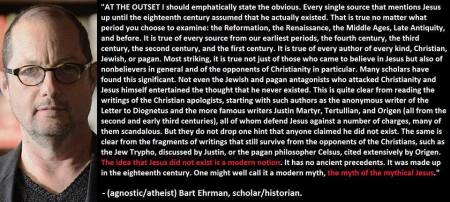
Bart Eherman Quotation


I became a believer, and then a follower, of Jesus Christ in college. It wasn’t just academic for me, though the beginning of my life as a believer and follower of Jesus began in an academic environment and was shaped and influenced by academics. I think that’s why I like the academic pursuit of faith even now, over 30 years later.

It’s important for me to be mindful that faith is not purely an intellectual affair. I think I may differ from many people in that respect, but I need to constantly be reminded of it. Faith is a relationship with the Living God; faith is a life and heart commitment; faith triggers action and change or it isn’t real faith.

I know that the words intellectual and faith probably don’t fit together in the minds of some people. Some people see those terms as opposites. They aren’t, but they can chaff with each other at times. Intellectualism, for instance, really does get in the way of faith (more so in fact than the other way around). Faith and intellectual pursuit can be perfectly compatible unless we compartmentalize them and pit them against each other.

Faith, or the lack thereof, depends on something other than intellectual coinage.  Continue reading “Ramblings on Faith and Unbelief”