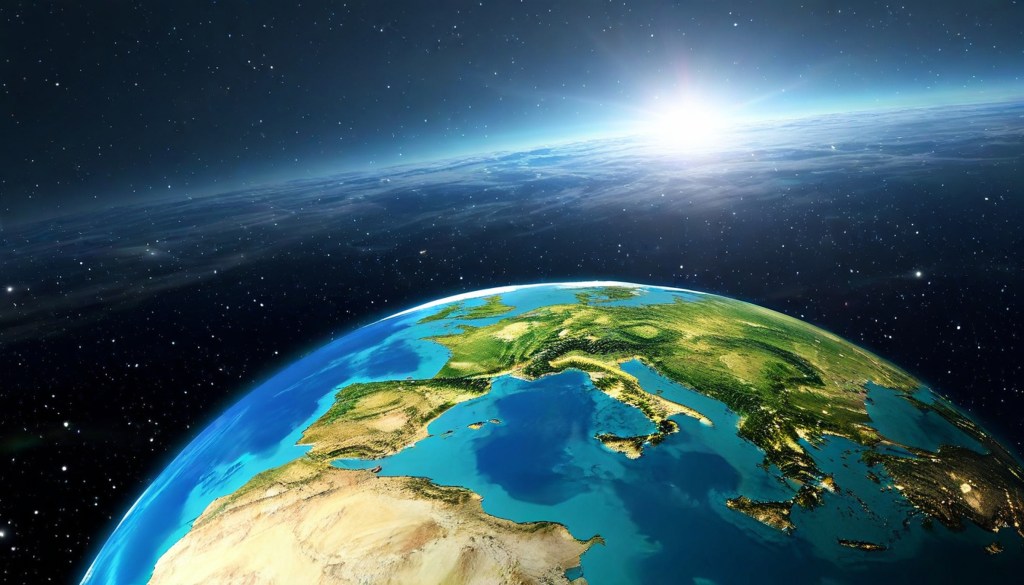
Perspective, The Universe, and God

Perspective is critically important for finite creatures such as ourselves because we view everything from “where we sit”.


My thoughts are inspired by a Daily Galaxy article today, Astronaut’s ‘Lightbulb Moment’ in Space Reveals Humanity’s Biggest ‘Lie’s. Ignoring the obvious clickbait character of the title, I read the article, which is about the importance of perspective. A less sexy summary of the article might go like this: “Seeing the Earth from the vantage point of space provides a different perspective that should lead to a change in priorities.”
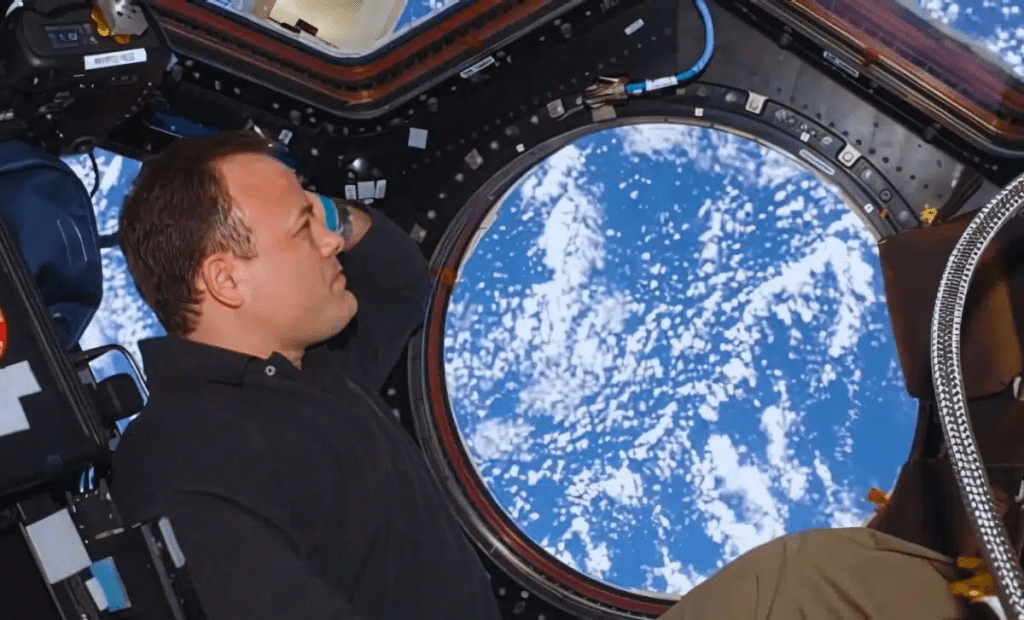
Astronaut’s ‘Lightbulb Moment’ in Space Reveals Humanity’s Biggest ‘Lie’ – © The Daily Galaxy –Great Discoveries Channel

The photo associated with the article illustrates the idea of perspective: that an astronaut viewing the earth from space, seeing the earth from the perspective of distance, hits home in a way that few of us have experienced. This is a perspective few of us have the privilege of attaining. We can imagine what it is like to view the earth from this perspective, but actually viewing the earth from this perspective is more impactful than imagining it.

I can only speculate on this, as I have not experienced it. Even viewing the astronaut’s perspective in a photo, though, hits home in a different way than simply imagining it. This is because our perspective (where we sit in relation to a thing) matters.

Perspective is critically important for finite creatures such as ourselves because we view everything from “where we sit”. We necessarily have a limited perspective. Our perspectives are limited by our location in space/time, geography, and position.

Our perspectives are also limited by our sociology, culture, education, worldview, personal experiences and a host of other physical and metaphysical factors. Many of these factors are external to us (like sociology, culture, and education). Many of these factors are more internal to us, like worldview, experience, and individual psyches (for lack of a better descriptor).

Our perspective can “shift”, as the article states, as we change “location”, experience new things, and view things from a different “angle”. Thus, a change in vantage point provides a potential change in perspective – a change in how we view the world and prioritize things.

“Walking a mile in another’s shoes” speaks to the kind of shift we experience when we gain a different vantage point. Walking a mile in another’s shoes speaks to the impact of experiencing a difference of perspective, and not just considering it abstractly.

Ronald Garan, the astronaut identified in the article, “was struck by the stunning beauty and fragility of Earth’s thin atmosphere” as he viewed the Earth from the distance of space. The reality of the earth’s beauty and fragility is nothing new, but the actual experience of viewing the earth from such a distance hit him in a more visceral way than simply knowing these things intellectually.

Tethered to the small oasis of a space station on the edge of the infinitely vast regions of a dark, cold, and apparently lifeless universe, Garan was struck by the thinness of the Earth’s atmosphere that harbors all the living beings on its surface. Experiencing the small and vulnerable bubble we call Earth from the yawning chasm of space, Garan gained new appreciation of the need for humans to prioritize care and stewardship of this highly privileged planet.

Perspective and its impact on us is not just a matter of physical location. Another person sitting immediately next to Garan with the same view of Earth might have “missed” what Garan “saw” because perspective is more than just physical location.

Continue reading “Perspective, The Universe, and God”

Climate Change and the Gospel


Many Christians deny that climate change is happening, perhaps because many Christians distrust science. More accurately, perhaps, they distrust scientists, as a large number of scientists are atheists, especially some extremely vocal scientists who “preach” a form of scientism[1].

As Christians, though, we need to be careful here. We need to respect truth wherever we find it and wherever it leads. Without letting go of the revealed truth of God in Scripture, we need to recognize and acknowledge truth that science reveals – the truth of God’s creation.

We also need to recognize and understand the difference between science and scientists. Science, done right, reveals the truth of God’s creation. The scientists who do science are influenced by their own biases, assumptions and preconceptions, worldviews and individual perspectives, but that doesn’t mean that the results of the science they do can’t be trusted.

We have to separate out the science and the conclusions drawn by scientists from the science. Even there, those conclusions shouldn’t be discarded without consideration. Scientific conclusions (conclusions that naturally and inevitably follow from proven premises) should be distinguished from philosophical conclusions (extrapolations from the scientific conclusions that go beyond the bare facts and enter into philosophical territory).

What does that mean? A very extreme example might be the assertion by Neil deGrasse Tyson that science has replaced philosophy and made it irrelevant. He maintains that science tells us everything we need to know about reality. This very statement is a philosophical statement. (Hint: it’s not science.) Just because a scientist says something doesn’t make it true.

We also have to keep in mind that science has been reduced over the decades and centuries to mean something more limited than what it once meant. (Theology was once known as the Queen of the Sciences). Science is now limited in its definition to mean the study of the natural world and its material components and processes. Scientific method is limited to what can be proven by observation of the material world and its processes.

Science is a species of knowledge, but we sometimes conflate science with knowledge, thinking that science is the end-all and be-all of knowledge and that knowledge is only that which science reveals to us. As Christians, we don’t believe this. Philosophers don’t believe this. Artists, and poets and musicians don’t believe this. Many scientists don’t believe this as well.

But, I digress. I believe that the science for climate change is accurate – at least to some extent. To what extent, I am unable to conclude, as I don’t know the science well enough. But that the climate is changing is fact. It is changing, and we shouldn’t be ignorant of that fact.

It is also fact that we are contributing to that change. CO2 emissions, for example, have gone up dramatically since the industrial revolution. That is science that can’t (shouldn’t) be denied. It’s been substantially demonstrated in a multitude of ways.

To what extent has our activity contributed to the change? To what extent is our activity driving the change? To what extent can we reverse the change? Can we reverse climate change by our efforts? I think these are all open questions as I understand the state of the science.

As Christians, I think we need to be careful to respect the truth of science; otherwise we are guilty of denying and misrepresenting truth. We need to respect truth wherever it is found because our God is true, Jesus was truth personified. For that reason, also, we have no reason to be afraid of the truth.

Our approach should be appropriately nuanced on issues like climate change. How we deal with the truth and respond to it must be placed into context. There is a higher truth than climate change: God and His purposes that we learn from revealed truth found in Scripture.

For the Christian, the prospect of climate change does not appear as the ominous a threat it is for the non-believer. This is because we understand that the earth is passing away;[2] and God has promised a new heavens and a new earth.[3] In fact, Jesus warns us not to store up our treasures on earth where they are subject to rot, decay and destruction (sounds like the second law of thermodynamics), but to store them up in heaven.[4]

But we also need to be mindful that God made us stewards of the earth, and He expects us to be good stewards. Continue reading “Climate Change and the Gospel”

Are People Responsible for the Earth?

There is an irony at play today in regard to the way Christians see the world and the prevalent way modern westerners see the world.

Photo by Randy Schoof

There is an irony at play today in regard to the way Christians see the world and the prevalent way modern westerners see the world. Modern westerners largely believe that human beings are affecting climate change and are arguing that we must change the way we do things because we are breaking the world.

Christians may or may not believe in climate change and may or may not believe that we can affect climate change, but Christians believe that human beings broke the world because of sin, because we rebelled against God, because we are flawed.

The irony is that modern westerners don’t believe in sin. They don’t believe in God or that we are opposed to God in our nature. They don’t believe that people are fundamentally flawed. They don’t believe that we are responsible for the brokenness of the world.