Contentment in Weakness

“‘My grace is enough for you, for my power is made perfect in weakness’ …. Therefore I am content with weaknesses….”


Last night, I was texting with a good friend who asked me if was OK.  The back story is that my wife of almost 40 years decided she was not happy in our marriage, and she left me about two years and three months ago. I tried for about 6 months to seek reconciliation with her, but she had made-up her mind.

Since she left, I have gone through cycles of grief, depression, and numbness. I have battled anger, bitterness, and resentment. I have alternately gravitated between guilt and in self-justification

She filed for divorce a month ago, but I have been in limbo for over 2 years. I have felt out of sorts, off balance, and stuck. Neither of us can afford to keep the house and maintain it alone, so I have been clearing out 40 years worth of stuff, and I am living right now in a house with very little in it but boxes, two cats and a dog.

Though it was clear that she didn’t want to try to salvage our marriage, I hoped that we wouldn’t have to involve lawyers. I was hoping we could talk and come to an agreement on how to unravel ourselves without lawyers, but she stopped communicating with me (for the most part) when she left. 

My attempts to open channels of communication have largely not been reciprocated, other than short, incomplete answers. Thus, I have felt stuck for over 2 years. Now the lawyers are involved, and it is out of my control (not that I was ever in control to begin with).

I have continued in my daily Bible reading. I could write very little for a long time, and whatever I wrote was a labor and a chore. I have continued to be faithful to the local church I attend, attending weekly small groups and Bible studies, as I can, and I continue to be involved in Administer Justice, a faith-based legal aid organization. I have continued to lean on God and lean into his presence in my life (more or less successfully at times), so I am doing OK

Thus, when my friend and sister in Christ asked me if I am doing OK, I said with honesty, “Yes, but I feel like I need to move on, and I need to regain my footing. I have been in limbo for over 2 years. I wish I could be content in my circumstances, but I am not there.”

As God would have it, read the following passage in my daily reading plan for the year this morning:

“But he said to me, ‘My grace is enough for you, for my power is made perfect in weakness.’ So then, I will boast most gladly about my weaknesses, so that the power of Christ may reside in me. Therefore I am content with weaknesses, with insults, with troubles, with persecutions and difficulties for the sake of Christ, for whenever I am weak, then I am strong.”

2 Corinthians 12:9-10 NET

As I sit here stunned by the timing of this reading, I am struck that contentment is a choice that we make. It doesn’t just happen to us. We choose to be content in our circumstances. 

Perhaps, it doesn’t mean that we must feel contentment. Perhaps it simply means that we choose to be content, to stop complaining, to stop waiting for things to change, to “seize the day”, as the popular saying goes, to let go of the excuses for why I am not doing everything I can do to be who God made me to be today.

I got out of bed this morning after reading these things and meditating on them, and I chose to worship God and praise Him instead of listening to a podcast, as I often do, while getting ready for the short ride into the office. God was with me as I offered a “sacrifice of praise”.

It was a sacrifice of praise, because I didn’t feel like praising Him! I often don’t, and it’s easier to occupy my mind with podcasts and music. There is nothing wrong with that, but I realized this morning that I need to be more intentional. I need to choose to be content and to praise God even when I don’t feel like it.


Can We Find Peace in These Politically and Socially Tumultuous Times?

What if you could tap into peace, joy and gratitude regardless of your circumstances?

What year in our lifetimes has been more filled with angst and anxiety than 2020? The year, 1968, might be a close rival, politically and socially. Add to the political and social tensions a global pandemic, widespread unemployment and growing economic uncertainty caused by our response to it, and 2020 is easily the most difficult year in my lifetime.

The political anxiety and uncertainty has overflowed into tensions within families, among friends, in communities and even within churches. Collective and personal anxiety is even higher, now, with the Presidential election coming up. Hope is mixed with fear. What if the right person doesn’t get elected?

Everything seems to ride on this election, but there is that nagging doubt that even an election – even if it goes “right” (whatever you happen to believe that means) – will not calm the tensions and bring peace where current circumstances are boiling on the edge of overflowing.

We know in the pit of our stomachs that the “others” will not go down without a fight. A presidential election may shift the leverage (or not), but the fight is going to continue. It isn’t going away. COVID isn’t going away. The economy teeters on brink of failure.

The mantra during the 1960’s – the closest thing to our present circumstances – was peace and love. We don’t even dare hope for peace and love anymore. The hope held out in the ’60’s has been been replaced with anger, condemnation and unkindness. The peace has been replaced with rioting, gun violence and looting.

Not that the 1960’s didn’t see its share of violence and unrest. It’s just that we don’t pretend anymore that peace and love are achievable (or even laudable) goals. We will settle for an authoritarian dictatorship or equality forced by the arm of the law and reparations wrested from the clinging hands of people who inherited privilege.

It’s easy to feel that our generation faces difficulties that are unlike the difficulties faced by others in the past. We may feel that we are alone in these times, facing the anxiety of an uncertain future, but it isn’t so.

The details of our circumstances are unique, but nothing is new under the sun: other generations have faced similar hardships and much worse. Every previous generation shared the experience of angst and anxiety of an uncertain future, just as we do.

Looking back at history in static words written on sterile pages, we may not appreciate the common experience. In the fog of our present struggle, we can’t see as clearly as we do when we look back. Our emotions are in full flight as the noise and chaos happens around us. We don’t have the luxury of viewing the present from a comfortable chair in a quiet library.

On what basis, then, can we hold on to hope? What assurance do we have that peace will prevail?

The predominant view of politics, sociology and culture in academia today is idea of the oppressed ever rising up against their oppressors in an endless cycle of unrest, violence and change. Peace no longer has value. Hope is limited to the immediate future when the currently oppressed can change places – for a time – before the cycle repeats itself.

In the middle of our present angst and unease, I am reminded of a man who wrote about peace that defies that is not dependent on circumstances and hope that lasts beyond the foreseeable future. He wrote of peace that gave him confidence and sustained him in circumstances worse than you or I have ever experienced.

If we compare his circumstances to ours, I think most people would agree they were worse, by far, than anything we have experienced. Yet, he was fed by hope, and he experienced real peace in the midst of those circumstances – despite the circumstances. His story is worth considering.

Continue reading “Can We Find Peace in These Politically and Socially Tumultuous Times?”

Thoughts on Prayer, Circumstances and God’s Purposes

God uses the circumstances of our lives to change us and accomplish His purpose in us.


Many of us pray to God to change our circumstances. We pray for things that we want, sometimes things that really need. We pray according to our perspective, telling God what we want and need.

He knows, of course, what we want and what we need. He knows before we ask. He knows as the words are forming on our tongues and formulating in our minds.

Jesus told us to pray and ask God for our daily bread. Jesus told us to ask, seek, knock….

“Ask, and it will be given to you; seek, and you will find; knock, and it will be opened to you. For everyone who asks receives, and the one who seeks finds, and to the one who knocks it will be opened. Or which one of you, if his son asks him for bread, will give him a stone? Or if he asks for a fish, will give him a serpent? If you then, who are evil, know how to give good gifts to your children, how much more will your Father who is in heaven give good things to those who ask him!” (Matthew 7:7-11)

He even illustrated with a parable:

“And he said to them, “Which of you who has a friend will go to him at midnight and say to him, ‘Friend, lend me three loaves; for a friend of mine has arrived on a journey, and I have nothing to set before him’; and he will answer from within, ‘Do not bother me; the door is now shut, and my children are with me in bed; I cannot get up and give you anything’? I tell you, though he will not get up and give him anything because he is his friend, yet because of his importunity he will rise and give him whatever he needs. And I tell you, Ask, and it will be given you; seek, and you will find; knock, and it will be opened to you. For every one who asks receives, and he who seeks finds, and to him who knocks it will be opened. What father among you, if his son asks for a fish, will instead of a fish give him a serpent; or if he asks for an egg, will give him a scorpion? If you then, who are evil, know how to give good gifts to your children, how much more will the heavenly Father give the Holy Spirit to those who ask him!” (Luke 11:5-13)

We are expected to ask, supposed to ask, and ask persistently. And many, many people do ask God for things, but God doesn’t seem to answer. He doesn’t give us what we want, and sometimes He doesn’t even give us the things we desperately feel we need. Sometimes it seems He doesn’t answer at all.

It’s common to human experience to ask God to change our circumstances. When the circumstances don’t change, we are discouraged, depressed, frustrated and sometimes even angry. Many walk away from God as a result.

Atheists challenge me, “Prove to me that God answers prayers, and I will believe.” As if God was a kind of vending machine in the sky, or a barterer or maybe just a slot machine. Sometimes you win with God, and sometimes you don’t. Just keep trying.

But that’s not the right way to approach God. Jesus called Him Our Father. He is also the same God who formed the universe out of nothing. If you spend any time contemplating all that science informs us about the vastness, complexity and elegant, austere beauty of the creation, you begin to understand how great God must be… mind-boggling. He isn’t a “tame lion” as CS Lewis says.

Continue reading “Thoughts on Prayer, Circumstances and God’s Purposes”

Diamonds and Coal and the Pressures of Life that Shape Us by Our Reactions to Them

We don’t choose our circumstances, but we can choose how we respond to them.


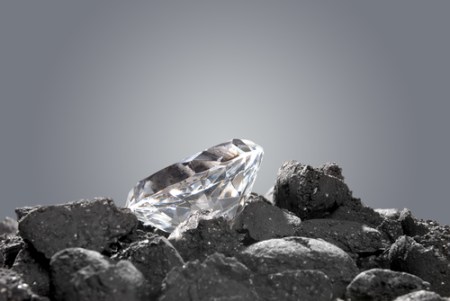
Diamonds and coal are made from the same substance, carbon.[1] They are both formed by heat and pressure, but the results are very, very different. We can learn some very poignant things from diamonds and coal that I will explore in this piece.

The properties of the two substances are interesting, and very different, though they form from the same substance. Coal is relatively soft. Coal burns and provides a source of energy, but it is not a very clean source of energy because coal is full of impurities.

Diamonds, on the other hand, are relatively hard – one of the hardest substance that exist. Diamonds have few impurities, and diamonds won’t burn. Diamonds can be used for cutting hard metals and similar uses because they are so hard and immutable.

Coal is readily available. It is soft and combustible. Coal is dirty and rubs off everywhere. Coal is really only useful for burning. Appropriately, a coal in the stocking has become cliché for an unwanted “gift”.

Diamonds are clean, translucent, rare and beautiful. Diamonds are highly valued for their own sake. So much, that we wear them on our fingers and around our necks as adornment for special occasions. They are also highly useful in all kinds of industrial applications.

Interestingly, diamonds and coal are both formed by heat and pressure. The difference is only in degree and location.

Coal is formed relatively near to the surface of the Earth, while diamonds are formed deep within the Earth. Diamonds are formed under tremendous heat and pressure over a long period of time. Coal forms relatively quickly under less heat and less pressure.

The result is that coal is full of impurities. Coal is still combustible, though it is formed under heat. Diamonds, on the other hand, undergo so much heat and so much pressure, that they are no longer combustible. All the impurities have been burned away.

I have heard that diamonds form from coal, but they don’t. Though diamonds and coal do form from the same substance – carbon – one doesn’t form from the other.

Carbon can be formed into diamonds, or it can be formed into coal. It’s one or the other. Coal never forms into diamonds, and diamonds never form into coal. The paths for the two elements are completely different, and the difference in the process under which they form results in two completely different elements – though they form from the same basic substance.

These facts that I have taken some time to gather in relation to diamonds and coal prompt some very poignant thoughts, beginning with the question: Would you rather be a diamond or a lump of coal? How do the processes of the formation of diamonds and coal, and nature of diamonds and coal, instruct us?

Continue reading “Diamonds and Coal and the Pressures of Life that Shape Us by Our Reactions to Them”

Destined for Tribulations

canstockphoto22892406
(c) Can Stock Photo

“I, John, your brother and partner in the tribulation[1] and the kingdom and the patient endurance that are in Jesus, was on the island called Patmos on account of the word of God and the testimony of Jesus.”

This is how John begins relating the revelations he received that are preserved in the Book of Revelation, the last book of the New Testament. Sometimes we read over things quickly that other times will stick out. This verse sticks out today, perhaps, because we have a good friend who is fighting cancer. Today is also the 15th anniversary of 9/11.

I recently wrote about the charge from atheists that people have faith in God because of wishful thinking. Nothing could be more wishful. True faith is forged only in tribulation. Continue reading “Destined for Tribulations”