Metaphor for Heaven’s Sake (Literally)

Literal is not the right way to interpret the Bible when it “literally” means something else.


I have been writing and thinking about the odd similarity in the way atheists and fundamentalists interpret the Bible, which is the subject of Digging Deeper to Mine the Meaning from Scripture. At the same time, I have been going through the New Testament in my daily reading. As I read through Matthew, I have been thinking about the ancient tendency to use figures of speech, like metaphor and hyperbole. Perhaps, that is why I began to notice how often Jesus used figures of speech when Jesus spoke.

We are well-acquainted with the frequent use of parables throughout the Gospels. At one point Matthew observed, “All these things Jesus spoke to the crowds in parables, and He did not speak to them without a parable.” (Matt. 13:34)

He also used other figures of speech. A figure of speech is defined as “a word or phrase used in a non-literal sense for rhetorical or vivid effect”. Some of the more common figures of speech are hyperbole, symbol, simile, personification and metaphor.

For people who insist on reading Scripture literally, Jesus must be maddening. His words are full of figures of speech, and he interpreted the Old Testament by extrapolating on figures of speech in the Old Testament. A person would be hard-pressed to read very far in the New Testament or the Old Testament without encountering figures of speech.

Continue reading “Metaphor for Heaven’s Sake (Literally)”

Digging Deeper to Mine the Meaning from Scripture

We have to dig a little deeper below the surface to mine the meaning of the Scripture. 


I have written on the subject of the similarity in the interpretation style of atheists and fundamentalists, or more specifically, perhaps, young earth creationists. Probably several times or more in fact. But, I am not the only who has noticed the similarity.

Among others who have made this observation is Michael G. Strauss, professor at University of Oklahoma. Strauss has been a research physicist at the Stanford Linear Accelerator, the Fermi National Accelerator Laboratory, and more recently at CERN. Strauss has studied the interaction between quarks and gluons and the theory of Quantum Chromodynamics, and, most recently, the properties of the Higgs Boson and “the top quark”. Dr. Strauss is a pretty smart guy, and he is a Christian.

He writes in a blog article dated September 16, 2018, about A Shared Characteristic Between Atheists and Young Earth Creationists, observing that they interpret the Bible the same way. Both camps insist on a literal interpretation of the Bible, particularly the creation narrative in Genesis. It’s kind of like the person listening to the announcer giving the play-by-play of a baseball game on the radio when he says, “The runner is hugging the base at third.” Should we imagine that the runner is literally embracing third base in his arms?

Of course not, because we know from the context of our modern culture and language what the announcer is saying. While his words may convey a certain literal meaning, his actual meaning is different. We all know exactly what he means. He means that the runner is holding close to the base. We call this a “figure of speech” among other things.*

We don’t have to struggle to know when to take someone “literally” and when to grasp the nuance of metaphorical meaning. We don’t have to think very hard about it, usually, because we are immersed in the culture and intimately familiar with language usage that gives us clues from in the context of the statements.

We have to use that same approach with the Bible. The only difference is that we are not so immersed in the culture and familiar with ancient Hebrew that we can make those same “common sense” connections with the Bible without a little help. But, it’s not that difficult either.

Continue reading “Digging Deeper to Mine the Meaning from Scripture”

Letting the Bible Speak for Itself


I have been coming back to a similar theme in recent months on how we read and interpret the Bible. I have noted that fundamentalists and atheists tend to read the Bible in the same rigid way. The only difference is that fundamentalists believe all of it, and the atheists believe none of it. They both assume and insist that the Bible must be read literally, even though everyone knows that many passages can’t be taken literally.

For instance, when Jesus said he is the vine, he obviously didn’t mean he was a plant. We have to use some common sense and understanding to determine when the text is intended to be metaphorical, and when it is meant to be literal. Sometimes, it might even have both literal and metaphorical meanings. We can’t rigidly assume that the Bible must always be taken literally if we are serious about understanding it.

Some people think that either the Bible must be taken literally, or not at all. This is a false dichotomy. We don’t read other literature that way. Frankly, when we approach the Bible in that way, insisting that it be read literally, we are doing the Bible a disservice, and we are failing to take the Bible seriously enough. We are insisting that the Bible speak to us the way we want to be spoken to, rather than trying to understand what the Bible is saying on its own terms, not ours.

Continue reading “Letting the Bible Speak for Itself”

Back to an Early Church View of Genesis

We make a critical mistake when we think that Adam and Eve and Eden were perfect. Only God is perfect.


I have much enjoyed reading Joel Edmund Anderson’s blog, resurrecting orthodoxy. So much that I am reblogging his latest post which is part of a walk through Genesis: Making Sense of Genesis 3 (Part 1): The Big Picture, Nakedness, and Two Trees. Knowing history allows us to avoid the mistakes of those who came before us, but not knowing history makes it likely that we will repeat those mistakes.

So it seems that some have made the mistake in this modern day and age of reading Genesis too literally. Just suggesting that triggers a slight shudder as I can imagine someone taking umbrage with the suggestion that we shouldn’t take the Bible literally.

I maintain that we should take the Bible seriously, which means that we should let the Bible inform us when we should read it literally, when we should read it figuratively, and when it has both literal and figurative meanings. (Should we take the Bible Literally? Or Seriously?)

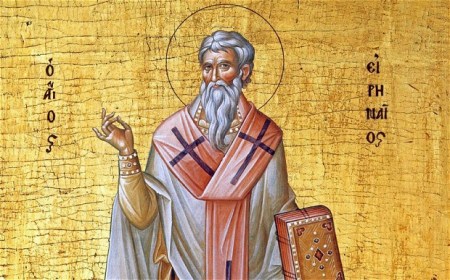
Anderson reminds us that this is how some of the most influential early church fathers viewed Scripture. For authority, he cites all the way back to Irenaeus, the disciple of Polycarp who was a direct disciple of John –  the disciple of Jesus and writer of the Gospel, epistles and Revelations. Irenaeus is just one spiritual generation removed from Jesus.

I realize that people might want simple formulas for Bible interpretation, but there is nothing simple about the universe we live in, reality or (most of all) God.

His ways are higher than our ways. We shouldn’t lean on our own understanding. Jesus left the Holy Spirit to guide us into all truth, and Jesus said we must learn to worship God in spirit and truth.

I am  not talking about New Age spiritualism or secret Gnostic knowledge. The Living God spoke to Abraham and David and took on human form in the body of Jesus, lived obediently to His own purpose as a man to the point of dying on a cross for our sins and rising from the dead in that same body to give us hope. This is the uncreated Word of God who was with God in the beginning, and was God, and through whom all that was created was made – the seen from the unseen.

Anderson says in his latest article:

“Genesis 3 was not claiming that God had created a ‘perfect’ world, because God alone is perfect. In fact, Irenaeus called the teaching that Adam and Eve were originally ‘perfect’ a gnostic heresy. Irenaeus was emphatic: God didn’t create Adam and Eve as ‘perfect’ beings.”

God called the world He made “good” (not perfect). It was good for His intended purpose, and it still is.

He certainly knew humanity would fall and fail. That was inevitable because we are not perfect; we are not God. God knew we would fail because He can see the end from the beginning, and everything in between. When He hit the “start” button on the creation, He saw how His purpose would unfold before the foundations of the earth. And, He saw that it was good.

Through our experience we learn good and evil, and the value of embracing good and rejecting evil. In this way, our experience is intended to lead us to God who alone is perfect. Through our experience, we learn to rely not on ourselves, but on God. Through our experience we learn to embrace God and His purpose. As we yield ourselves to Him, God works in us what we could never do in ourselves – perfecting us in Him.

We make a critical mistake when we think that Adam and Eve and Eden were perfect. Only God is perfect.

I’ve heard people say that there was no pain or death before the fall. Why, then, does God tell Eve that her pain in childbirth will increase (multiply)? (“To the woman He said: “I will sharply increase your pain in childbirth; in pain you will bring forth children. Your desire will be for your husband, and he will rule over you.” (Genesis 3:16)(Berean Study Bible))

We need to be careful not to let the agendas and theological constructs of others inform us rather than the Word, itself. The Word of God is living and active, sharper than a double edged sword, and is able to discern the thoughts and intents of the heart. (Hebrews 4:12-13) We need to let God’s Word inform us through the guidance of His Holy Spirit.

The danger of systematic theologies and secret formulae is that we don’t know how much of the system or the formula is our own invention. We need to be guided by the Word of the Living God, the Bread of Life.

All Scripture is God-breathed and “useful for teaching, rebuking, correcting and training in righteousness, so that the servant of God may be thoroughly equipped for every good work.” (2 Timothy 3:16-17)

The idea that Genesis should be taken absolutely literally and historically is more of a modern construct than a biblical one. (See Is Young-Earth Creationism Another Gospel?) That doesn’t mean Scripture isn’t God-breathed and we shouldn’t take it seriously.

From the beginning the followers of Jesus read Scripture as the word of God. They took it so seriously they were willing to die for it – not for it alone, but for the God it revealed. And though they clung to the Scripture, for in it was revealed the Messiah, Jesus, who they followed, they didn’t read Genesis as literal, historical record.

~~~~~~~~~~~~~~~~~~~~~~

Postscript:

Irenaeus was born in Smyrna (now Turkey) to a Christian family in 130 AD, just a generation after John the apostle died. He stood against heresy, being one of the first theologians to use apostolic succession to protect the integrity of the Gospel. His close connection to Jesus, Himself, through Polycarp who was mentored by John the apostle, was his authority.

“Irenaeus’ point when refuting the Gnostics was that all of the Apostolic churches had preserved the same traditions and teachings in many independent streams. It was the unanimous agreement between these many independent streams of transmission that proved the orthodox Faith, current in those churches, to be true.” Irenaeus is credited with arguing that all four Gospels (Matthew, Mark, Luke & John), and only those four Gospels, were Scriptural. (See Wikipedia)

He preached the rule of faith, one of the earliest church creeds, as a standard for orthodoxy:

…this faith: in one God, the Father Almighty, who made the heaven and the earth and the seas and all the things that are in them; and in one Christ Jesus, the Son of God, who was made flesh for our salvation; and in the Holy Spirit, who made known through the prophets the plan of salvation, and the coming, and the birth from a virgin, and the passion, and the resurrection from the dead, and the bodily ascension into heaven of the beloved Christ Jesus, our Lord, and his future appearing from heaven in the glory of the Father to sum up all things and to raise anew all flesh of the whole human race…

We might credit Irenaeus for solidifying and defending the idea of the Trinity, being one God in three persons. “Irenaeus used creation to distinguish the Father, Son, and Holy Spirit from that which is created, to identify the Three as the one Creator God, and to secure their distinction. In so doing Irenaeus became the first to support his belief in the Three as God with an account of God as three.” (See Iranaeus: the Creation and the Father’s Two Hands)

Taking the Bible Literally? Or Seriously?


Some people urge Christians to take the Bible literally. I don’t think taking the Bible literally is taking the Bible seriously enough. I think it’s a far more important matter to take the Bible seriously.

Consider John 1:1-3

In the beginning was the Word, and the Word was with God, and the Word was God. He was with God in the beginning. Through him all things were made; without him nothing was made that has been made.

John Lennox, the brilliant Oxford mathematician, relates a conversation he had with Peter Atkins, the prolific atheist scholar. When Lennox referred Atkins to John, Chapter 1, Atkins called Lennox naïve to believe that God has lungs, a voice box and a voice. Of course, that isn’t how Lennox (or anyone who takes the Bible seriously) understands those words at all.

I find it interesting that both atheists and fundamentalists tend to adhere to a literal reading of the Bible. The only difference between them is that one believes all of it, and the other believes none of it.

A literal reading of John 1:1-3 clearly misses the point. No one believes that God has lungs, a voice box and a voice. Rather, God is so “Other” from us that we must use devices, like metaphors, to conceptualize God. Metaphor conveys meaning in ways that meaning cannot be conveyed literally.

People often misunderstand what it means to read something “literally”. Lennox suggests that understanding the metaphor is reading the Bible literally. The metaphor is the literal meaning that is intended.

We have to take the Bible very seriously in order to understand this and to see the actual meaning that is there. When we read the Bible always “literally”, we are not taking the Bible seriously enough! (Not to mention that no one actually read every verse of the Bible literally, not even the literalists!)

Continue reading “Taking the Bible Literally? Or Seriously?”