
Joel Furches recently posted the following on social media:
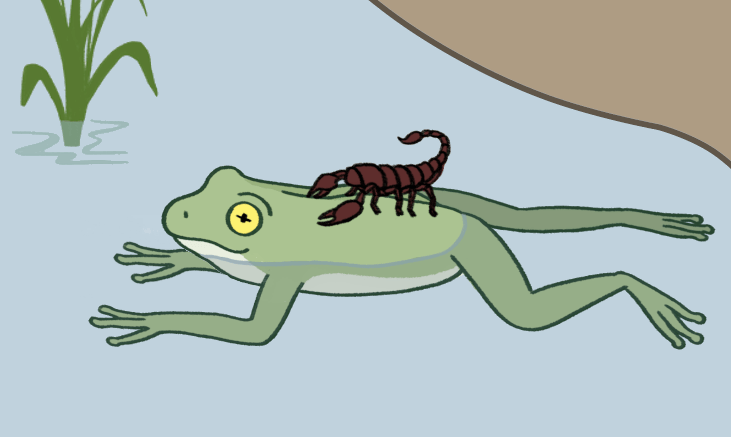
“The Aesop’s Fable I have come to most appreciate over the years is ‘The Frog and the Scorpion’. If you’re not familiar, it’s about a scorpion who asks a frog to swim him across the water. The frog doesn’t want to, because he’s afraid of getting stung. The scorpion points out that if he stings the frog, they will both drown. So the frog swims him, the scorpion stings the frog, and they both drown. Why? Because it is the nature of scorpions to sting.
“The moral: things act out of their nature, even at the expense of their self-interest. Or as my dad used to say, ‘a person will never do something that person wouldn’t do.’ Which, I suppose, could be rephrased, ‘A person’s always going to do what that person does.’ (My dad would say ‘peoples are peoples’)”
A more modern version of this idea is the tiger that can’t change its stripes or the leopard that can’t change its spots. The fable or adage stands for the proposition that people don’t change their essential nature or character.
We shouldn’t expect people to be anything other than who they really are. Despite what the scorpions tells you, the scorpion IS going to sting you. That’s what they do. That’s who they are.
Fables are meant to teach life lessons. They are meant to pass on wisdom to help us avoid having to learn it the hard way – from experience. (Though it seems most of us need firsthand experience to learn wisdom, and even then we don’t always get it.)
Still, these fables are helpful in allowing us to crystallize those hard learned lessons into memorable, graphic illustrations that we can hold onto and pass on – if only people would listen. Right?
But what is the lesson? Don’t trust people? Fool me once, shame on you, but fool me twice shame on me!
Fables teach us something about human nature, but fables don’t give us specific guidance tailored to our own dilemmas. We still need wisdom to apply the lessons we learn (however we learn them) in our particular circumstances. “A word to the wise” requires wisdom for its application in our own lives.
Aesop may have been a very wise man (if there really was an Aesop), and Aesop’s fables carry with them the ring of truth, but truth is often more complicated than we like to think it is. Just when you think you understand the laws of physics, quantum mechanics comes along and turns everything inside out.
The fable of the Frog and Scorpion is something we identify with, but Scripture provides a different angle. Scripture provides guidance to deal with the scorpions in our lives.

 Navigating by Faith