What’s In Your Primordial Soup?

 (c) Can Stock Photo / jgaunion
(c) Can Stock Photo / jgaunion

I am reminded of a Farside cartoon when I think of primordial soup. For instance, the amoeba reading a book titled, Primordial Soup for the Soul. The concept of a primordial soup isn’t a joke, of course. It is the idea that life began many millions of years ago as chaotic elements churned in the boiling atmosphere and electric charges of a primitive earth – a kind of Frankenstein-like beginning to be sure, but a serious elementary concoction.

The ramifications of this primal stew are far reaching. They imply that nothing but natural forces were necessary for the creation of life. For many, the ultimate implication is that God doesn’t exist or we don’t need God (which isn’t quite the same thing): we don’t need God to explain the origins of life because there is a plausible natural explanation.

But is that the case?

For a century or so, people have sought alternative explanations for the origins of the universe and of life as a way of chasing off the specter of God. Richard Dawkins, for instance, asserts that the “greatest achievement” of mankind is the theory of evolution, giving man the power to cast off the shackles of faith in God and allowing man to stand unfettered on his own two feet firmly planted in terra firma against all odds.

Whether God exists, or doesn’t, what ingredients might have primed that primordial soup that seems to explain how life can rise from non-life, without need of a God, without anything other than the basic stuff of an infantile universe? Continue reading “What’s In Your Primordial Soup?”

Did Nature Cause Itself?

 (c) Can Stock Photo


I haven’t heard anyone say specifically that nature caused itself, in so many words,(other than the Hawking axiom about the laws of gravity causing the universe), but that is the question begged by any assertion that God doesn’t exist. Anyone who maintains that nature and natural causes are the beginning and the end of all reality is begging that question: did nature cause itself?

Perhaps the greatest obstacle to the assertion that nothing supernatural exists is the Big Bang. The Big Bang is accepted science. The evidence is very compelling, though it wasn’t received well when it was first postulated. The thought that the universe was not eternal and had a beginning was thought to be “repugnant” and to “betray the very foundations of science”.[1]

This is because a beginning to the universe suggests that the universe had a Beginner. The initial reluctance to accept the Big Bang has long ago changed, however, as the evidence has accumulated. Stephen Hawking proved it mathematically, but struggled with the implications of it the rest of his life. Continue reading “Did Nature Cause Itself?”

The Myth of Objectivity

 (c) Can Stock Photo

Thought-provoking articles are a source for many articles I write, and I often use them as a springboard for my own thoughts. An article by Trent Horn, Neil DeGrasse Tyson Shows Why Science Can’t Build a Utopia[1], is my springboard for this article.

Neil DeGrasse Tyson, of course, is an outspoken and popular agnostic ambassador of science. The Horn article was precipitated by Tyson’s tweet:


Earth needs a virtual country: #Rationalia, with a one-line Constitution: All policy shall be based on the weight of evidence[2] 


and Horn’s counter-tweet:


@neiltyson ‘Rationalia’ is as useless as ‘Correctistan,’ or a country whose constitution says, ‘Always make the correct decisions.'”


To illustrate what Horn means by his counter-tweet, he used the example of a driverless car. Fatalities have already happened with them and will undoubtedly happen again. Knowing that fatalities are unavoidable, the question becomes: how should driverless cars be programmed when confronted with two options: 1) to run over pedestrians or 2) to run into an object that may destroy the car and kill the passengers?

How does Tyson’s “Rationalia” weigh the evidence to determine which is the best course?

Continue reading “The Myth of Objectivity”

Atoms, Empty Space and Opinion

N. Dakota Sunset - Alex Fleming 2


I am a follower of Christ, and a believer in truth. Not that I have a monopoly on truth. Truth is truth, I like to say. Facets of it are available to everyone at all times.

Truth might be overrated. I say that only partially tongue in cheek.  Jesus says He is the way, the truth and the life, so truth is only part of the equation – even for Jesus.

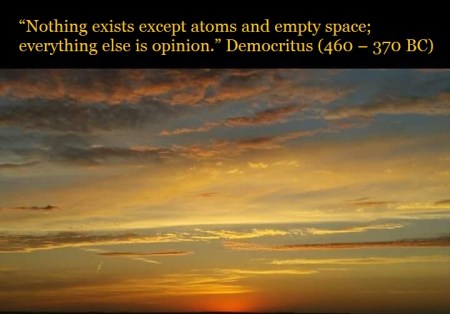
This is also a truth: there is nothing new under the sun. To “prove” that statement, I offer Democritus, who lived centuries before Christ and millennia before “modern” scientific discoveries.

He might have been a typical modernist, eschewing any reality but matter and energy, but for the fact that he was born in another era, and he believed in gods.

Iron age ignorance is what moderns call it now. That fits into the opinion part, between atoms and empty space.

I think we take comfort, or try to, in the vastness of time and space. It leaves a lot of room to stretch out. We don’t like being hemmed in. Me included.

But, there is this nagging small voice. Continue reading “Atoms, Empty Space and Opinion”

Ten Quick Responses to Difficult Questions on Faith with the Help of John Lennox

john-lennox-houses-of-parliament


The ten statements and responses suggested below are inspired by a presentation by John Lennox, the famous mathematician, philosopher and Christian theist. Neither the statements nor the responses are comprehensive in the least, but they offer a quick look into the richly rational world of faith through a theistic (and Christian) lens. At the same time, they expose the shallowness of many atheistic objections to the idea of God.

                1)   Christians are really just atheists regarding Zeus and other gods. True atheists go one god further and reject the Christian god.

Statements like these reveal a willful ignorance. The Christian God (as with Allah of Islam and Yahweh of Judaism, for instance) is an exclusive claim: there are no other gods. That Christians, Muslims and Jews cannot all be correct in their understanding of that exclusive God does not negate the possibility that such a God exists. Continue reading “Ten Quick Responses to Difficult Questions on Faith with the Help of John Lennox”