It Is All Relative

On the application of scientific theory to theological constructs.


I encourage reading the post I am reblogging (https://wp.me/p13zfD-1zB) if you like science and faith, or just thinking generally. I firmly believe that science and faith are not only reconcilable, they are intricately synergistic. One informs the other. Whether we study the special revelation of the Word of God or the natural revelation of the creation of God, we learn something of our Creator in the process.

I have often played (only played) with the thought that we misunderstand God and sin and judgment when we see them primarily through a moral filter. It’s not necessarily that the type of filter is the problem so much as our perception of that filter, perhaps. In western thought, we tend to view moral absolutes as ideals that exist in and of themselves. Thank you Plato.

We view moral absolutes as stand alone ideals, independent of God and, therefore, applicable to God. We get caught in the undertow of the Euthyphro dilemma because of this misconception. (Are morally good acts willed by God because they are morally good, or are they morally good because they are willed by God? (See God’s Love is Not Platonic)) There is no way out of the construct, but the construct, itself, is wrong.

Rather, God is God and everything flows from Him. Goodness is good because it is God’s nature and character. Good is only determined relative to God. The article that I am reblogging quickly reviews the book, Faith Across the Multiverse, by Andy Walsh. Walsh applies scientific theory to theological principals with some interesting illumination. Among those scientific theories is the theory of relativity and what it might illuminate about faith. If you like thinking about these things as much as I do, you will like the article and may want to buy the book.


Doubts About the Viability of Darwinian Theory Increase

sad chimpanzee


I am reblogging this post as I have the distinct impression that most of the world, including most of the academic world, don’t realize that the Theory of Evolution, which seems to be accepted more like a fact in modern society, is still not completely settled. While the official face of the scientific world continues to bow in homage to Darwinian Theory, doubts of its ultimate viability and explanatory scope are increasing.

This is not to say that doubts about evolution, generically, are increasing. Evolution can mean any number of things, including the adaption of species over long periods of time. Garden variety evolution is not seriously in question (to put a layman’s spin on it).

Rather, evolution as an explanation of the origin of life and which defines the entirety of the biological process, from beginning to end, is still in some flux. If you don’t believe me, listen to Stephen Meyer and Perry Marshall debrief the Royal Society meeting of eminent biologists last November. (See Unbelievable? What happened to evolution at the Royal Society? Stephen Meyer & Perry Marshall)

Their report (as well as others) reveals a Neo-Darwinian theory in crisis. Many scientists are finding it increasingly difficult to maintain the old paradigm, even with a face lift, in light of ongoing research and discovery. The old model is straining under the pressure.

It isn’t any wonder, then, I suppose, that the number of scientists willing to sign a petition expressing skepticism about the contemporary theory of Darwinian evolution has risen ten times since 2001.

Skepticism About Darwinian Evolution Grows as Over 1000 Scientists From Around the World Declare Their Doubts About Darwinism WASHINGTON, Feb. 5, 2019 /PRNewswire/ — Over 1000 doctoral scientists from around the world have signed a statement publicly expressing their skepticism about the contemporary theory of Darwinian evolution, according to Discovery Institute. The statement, located online at http://www.dissentfromdarwin.org, reads: “We are […]

via Doubting Darwin — God does not believe in atheists

Commitment to a Worldview

The commitment to atheism can be as dogmatic as any other belief.

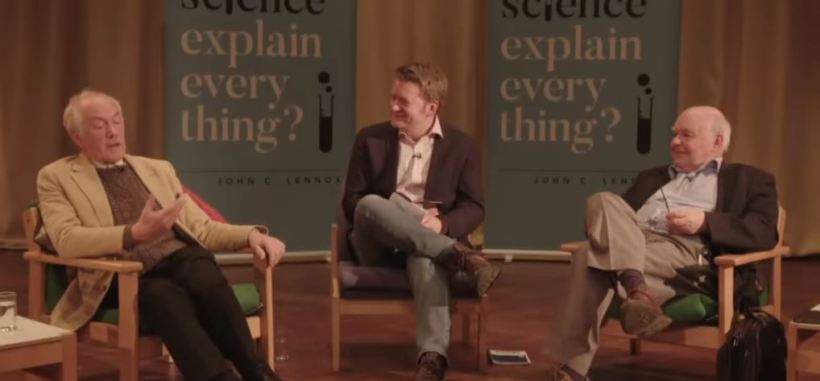
From the Unbelievable! discussion involving John Lennox vs Peter Atkins – Can science explain everything?

In a recent discussion on theism and atheism with the Oxford professors, John Lennox and Peter Atkins representing both ends of the spectrum, the dialogue stopped, and a time of questions and answers began. One person, a scientist, wrote in saying that he is an atheist, but his commitment as a scientist to follow the evidence suggested to him that God does exist. For him, the issue isn’t the evidence, but his own feelings, instincts and emotions.

When this question was put to the two guests to respond, the answers were very intriguing. John Lennox, the Christian, suggested that the man should continue to question and research and to test the position (that God exists) personally, not from afar. The response of the atheist, Peter Atkins, was simple: stick to your “commitment to rationality” (which to him presupposes atheism).


Think about it. Would you suppose the answer, to stick to your commitment, would more likely come from the Christian or the atheist? I would. I think most people would expect that answer to come from the Christian, but it doesn’t in this case. It’s the atheist sticking dogmatically to a presupposition.

Continue reading “Commitment to a Worldview”

The Trickiness of Consciousness

Is the ghost in the machine nothing more than information?


Justin Brierley has been doing a series of interviews entitled “the Big Conversation” on his Unbelievable? podcast on the British Premiere Christian Radio. In the latest, and I believe the last, episode, he interviews Daniel Dennett, the Tufts professor and so-called “new atheist” and Keith Ward, the British philosopher, theologian, priest and scholar. Their topic is consciousness. The idea of the “ghost in the machine” comes up about half way through the discussion, and Dennett responds in the segment below:


Among other things, Dennett says that the “ghost in the machine” is nothing more than information. He says, “Information is embodied in the brain”, and “the user of the brain is the brain.” There is no “ghost”.

Of course, to call what Keith Ward describes as the most important aspect of you and me a “ghost” is to minimize it and to reduce it to something of insignificance. Dennett, though would say that the information is the significant thing. There is nothing going on other than the embodiment, transfer and process of information.

So what about consciousness?

Dennett says, “Consciousness is the user illusion of the brain itself…. The brain has been designed to have user interfaces inside it…. Consciousness is a user illusion that is designed by evolution and by learning and by cultural evolution to make our brains capable of getting out bodies through this complicated world.” [Emphasis added]

These remarks are the backdrop for my thoughts today.

Continue reading “The Trickiness of Consciousness”

Recognizing Leon Lederman and the God Particle


Leon Lederman has passed away today at the age of 96.[1] “What’s the big deal”, you might ask. Well Leon Lederman is a big deal around these parts – Batavia, IL where I graduated from high school and where my office has been since 1994. That’s because Batavia is home to the Fermi National Accelerator Lab where Leon Lederman worked and earned a Nobel prize.

Leon Lederman was the director of Fermilab, as it is more commonly known, from 1978 to 1989, and was the principal driver behind the development of the Tevatron, the world’s highest-energy particle collider from 1983 to 2010. He also won the Nobel Prize in physics in 1988 for proving the existence of a new type of neutrino, muon neutrino.

Leon Lederman is a local, national and international legend. He taught for years at the Illinois Mathematics and Science Academy in Aurora, IL, which is a model for high school education for students from all over the state who are gifted in math and science. The law firm I started my career with and the predecessor to the present firm I am in drafted the legislation for IMSA, and we represented IMSA for many years even after I joined the firm.

On this day, it is more than fitting that I recognize the incredible person Leon Lederman was and the significant contribution he made to the study of physics and science. Among other things, Lean Lederman is the person who called the Higgs Boson the “God Particle” in a 1993 book he wrote by the same name.[2]

On this day, therefore, I honor Lean Lederman by some consideration of that name he gave the Higgs Boson, which stuck somewhat to his own dismay.

Continue reading “Recognizing Leon Lederman and the God Particle”