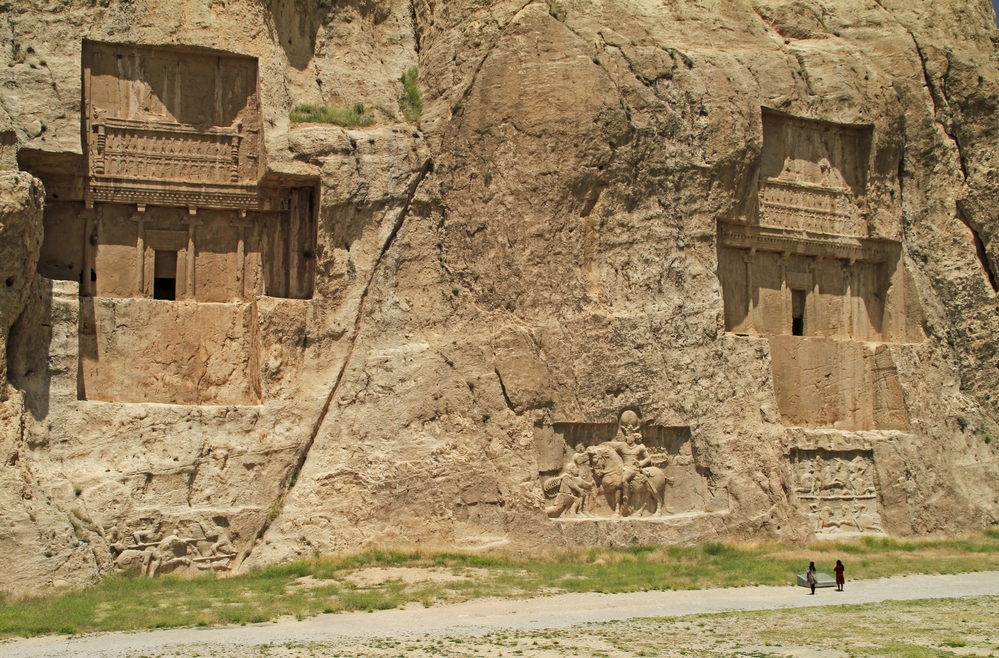
The graves of the Persian kings Darius and Xerxes near Persepolis, Iran
I am finding a wealth of subject matter in Tom Holland’s history of western civilization, Dominion: The Making of the Western Mind. Of particular interest is the place where he starts his history of the west – with Darius, the great Persian conqueror of the Assyrian and Babylonian empires in the east.
It seems that Holland’s candid explorations of history have fascinated him as much in tracing the threads of his childhood fantasies about ancient history as in busting the myths that arose as part of those childhood fantasies. Below he describes the busting of one of those myths – that the Greeks fought off the evil Persians from the east to save the west:
In Persian Fire: The First World Empire and the Battle for the West, which focuses on the Persian incursion into Greek territory, Holland realized that the Spartans were no champions for freedom, and the Persians were no moral monsters comparatively. In fact, the Persians were the ones motivated by what they believed were moral callings – something that would have been a completely foreign concept to the Greeks.
Darius and the Persians during his reign believed in Ahura Mazda, the Zoroastrian supreme, creator God. When I was in college, I learned in my World Religion class that Zoroastrianism was the first monotheistic religion. I had my doubts then about that statement, as I do now (see The Roots of Modern Ethics in the Ancient Near East), but the fact is that monotheism developed in the ancient Near East. Not in the west.
The first reference to Ahura Mazda appears in the Behistun Inscription by Darius. Darius reigned from 522 BCE until his death in 486 BCE. While Holland uses more “traditional” historical sources for Dominion, Hebrew Scripture intersects with Persian history in this time period.
Before Darius, the nation of Judah was exiled to Babylon when Nebuchadnezzar II conquered Jerusalem in 587 BC. The Prophet, Jeremiah, describes the siege of Jerusalem (Jer. 39:1-10 & 52:1-30), and Nebuchadnezzar is mentioned throughout the first four chapters of Daniel, who was one of the exiles from Jerusalem in Babylon.
Though Nabonides succeeded to the throne after Nebuchadnezzar, his son, Balshazzar, was left in charge in Babylon for ten years while Nabonides was away on an archaeological expedition. Balshazzar is mentioned in Daniel, chapters 5, 7 and 8. Daniel mentions his death, which occurred after Cyrus II (Cyrus the Great) conquered Babylon (539 BC). Nabonides was also killed on his return to Babylon that same year.
Cyrus conquered Babylon while the Hebrews were exiled there, and the Hebrews were still exiled in Babylon when Darius 1 (Darius the Great) took over as the king in 522 AD. Again, the biblical reports intersect with the more “traditional” archaeological and historical sources.
Miniature showing siege scene of conquest of Jerusalem, 1099. Nunez de Balboa House-Museum, Jerez de los Caballeros, Spain
I am working my way through Tom Holland’s book, Dominion: The Making of the Western Mind. I have just finished the segment on Pope Gregory VII and Pope Urban II at the turn of the first millennium since the birth of Jesus Christ.
Since Jesus first told an antagonistic group of religious leaders that people should “render unto Caesar that which is Caesar’s, and render unto God that which is God’s”, and for centuries afterward, the church was at the mercy of the state. Not even a generation after Jesus died, the Roman government, which controlled Judea where Jesus lived and his following sprung up, ransacked Jerusalem, scattering Jews and Christians into the countryside and beyond.
Through the first three centuries, the best the followers of Jesus could hope for was an indifferent Caesar or provincial ruler. At various times, they suffered at the hands of a Nero or more local prefects of local Roman rule in places like Lyons, Vienne or Carthage. The powerful Roman government was to be suffered and obeyed.
Christianity was illegal until Constantine decreed the prohibition lifted. Within a generation or two, Christianity was not just legal in the Roman Empire; it became the favored religion. Christian rulers became part of the governing structure of Rome, serving by the appointment and the pleasure of ruling authorities from mid-way through the 4th Century on.
Over the centuries, the Roman Church became a player in the ebbs and flows of power and influence in western and central Europe. When Gregory VII was made Pope by acclamation of the people, however, he hid himself, not having been chosen through the usual protocols. When he was affirmed, nevertheless – his affirmation having as much to do with popular will as with political protocols, it marked the beginning of a change.
Gregory and Henry IV, the Roman Emperor, had a fitful relationship. Gregory excommunicated him three times, each time undoing it, the last time on his death bed in a remote outpost to which he been banished by the powers that be. Henry IV, for his part, declared antipopes in opposition to the papacy of Gregory, but his antipopes never rose to the position of acceptance by the people. The tide was turning.
When Pope Urban II gathered and commissioned a vast army in the sacred duty of marching on Jerusalem to reclaim it from the Saracens who had overrun it a couple centuries earlier, the victory they attained in 1099 AD (the First Crusade) marked the completion of a transition. Carrying forward the efforts of Pope Gregory to divorce the church from the state, the goal was accomplished by the military victories won for Christendom – not by any Caesar or secular emperor, but by people marching under the banner of The Church.
Holland described the irony that, in obtaining freedom from the state, the church became a state. Holland calls it is “a supreme paradox” that ‘the church in freeing itself from the secular itself became a state”.
Tom Holland, in his book, Dominion: The Making of the Western Mind, published in 2019, traces western civilization from Darius, the Persian king, through the present time. Holland links the development of modern thinking to its various sources as expressed through the thread of religious views form age to age.
The mode of his analysis is, perhaps, a unique one for an atheist. It also exposes the wellspring of one predominant source for most of the fundamental assumptions of the modern western world. Holland was surprised, himself, to find how prominently one source showed through.
To his chagrin, Holland found that source flowing from the influence of an itinerant, first century carpenter of humble background. Holland’s work reveals that the source of modern western thought is decisively Judeo-Christian, and particularly Christian.
The river in which the Christian spring wells up is, first, Mesopotamian (the Persian version), then Greek, then Roman, but the source of the thinking that invigorates all our basic, western assumptions is not reducible to Persian, Greek or Roman principals – or any combination of all three. Holland’s work demonstrates how the spring of Christianity overwhelmed the river leading to modern western thought and irrevocably changed and defined its course.
Holland traces the assumptions of the modern western world forward through the evolution of religious expression. From Persian Zoroastrianism that was, perhaps[1], the beginning of monotheistic thought, through Judaism converging into the Roman world that combined Greek gods and philosophy, Holland finds from the currents of religious expression the sources of those assumptions that inform the modern western mind and sensibilities.
Holland’s history reveals that the values we take for granted, like the water that comes from a tap, find their source predominantly in Christian origins. Like a spring that swelled the river and came to define it over time, despite its headwaters and tributaries, Christianity overtook the river and ineffably changed and defined its course.
For Holland, the discovery that the values that inform his modern, humanist worldview are Christian came as a paradigm shift from the Enlightenment, modern and post-modern position. His book shows how a modernist can no more escape the spring of Christian influence than drain the water from the river.
The ways in which the theme reveals itself are myriad. Following is one example revealed through the life of Flavius Claudius Julianus. Julian, who would be known as Julian the Apostate, was the nephew of Emperor Constantine. Constantine, of course, set the course of history in his conversion to Christianity and decree to lift the prohibition against its practice. Up to that point, Christianity flourished only despite the efforts to curtail it.
Julian was also raised Christian, but he renounced Christianity to embrace the paganism of his ancestors. Tom Holland describes how Julian sought to reclaim the empire from people who had “’abandoned the ever-living gods for the corpse of the Jew’”.
Julian believed the god, Cybele, had rescued him from the darkness of Christianity. In his effort to promote the worship of Cybele, Julian wrote a letter to the priests in Galatia, blaming them for what he called a lack of faith in Cybele, the god whose temple they kept. His accusation against them? That they were getting drunk in taverns instead of devoting themselves to the poor. Julian committed the funds himself to a program of providing food and drink to the poor, travelers and beggars.
What’s the big deal?
Holland, was a noted historian of the Greco-Roman world before writing Dominion. He knowing well the values of that world. They were incongruous with Julian’s plea. He addresses the incongruity of Julian’s appeal as follows:
“The heroes of the Iliad, favourites of the gods, golden and predatory, had scorned the weak and downtrodden. So, too for all the honour that Julian paid them, had philosophers. The starving deserved no sympathy. Beggars were best rounded up and deported. Pity risked undermining a wise man’s self-control. Only fellow citizens of good character, who through no fault of their own had fallen on evil days, might conceivably merit assistance. Certainly, there was little in the character of the gods whom Julian so adored, nor in the teachings of the philosophers whom he so admired, to justify any assumption that the poor, just by virtue of their poverty, had a right to aid. The young emperor, sincere though he was in his hatred of ‘Galilean’ teachings, and in regretting their impact upon all that he held so dear, was blind to the irony of his plan for combatting them: that it was itself irredeemably Christian.”
“’How apparent to everyone it is, and how shameful, that our own people lack support from us, when no Jew has ever to beg, and the impious Galileans support not only their own poor, but ours as well.’ Julian could not but be painfully aware of this. The roots of Christianity ran deep. The apostles, obedient to Jewish tradition as well as to the teachings of their master, had laid it as a solemn charge upon new churches always ‘to remember the poor’. Generation after generation, Christians had held true to this injunction. Every week, in churches across the Roman world, collections for orphans and widows and the imprisoned, and the shipwrecked, and the sick had been raised. Over time, as congregations swelled, and ever more of the wealthy were brought to baptism, the funds available for poor relief had grown as well. Entire systems of social security had begun to emerge.”
Holland was keenly aware of the pagan world to which Julian wanted to return. It was his focus as an historian. In an interview and discussion with Justin Brierley and AC Grayling, Holland describes how he was fascinated by the extravagant decadence and pomp of the classic Greco-Roman world, but he found nowhere in it any hint of the ethic that is ingrained in modern humanism to care for the poor, save for one source alone: Christianos, the derogatory term given to the followers of Jesus by the Romans.
Throughout the book, Holland identifies the various roots of modern ethics and principals that are no longer seen as distinctly Christian, because they are simply taken for granted – like Julian’s assumption that caring for the poor was a moral obligation, though no such obligation can be traced to the gods and philosophers he embraced in rejecting Christianity.
The idea that correct thinking (belief) is more important than ritual practices, inalienable (human) rights and equality, the importance of education (not just for the elites), the separation of church and state, and many other things find their origins in spring of uniquely Christian thought. The book is well-written and provides much food for thought.
I am interested in peoples’ stories. I can trace my interest in personal stories to my own experience of becoming a Christian and my own spiritual journey. I have found much common ground with other people who have had similar experiences. The story of spiritual journey (a “testimony”) is part of the fabric of the evangelical Christian tradition. The testimony is a test of sorts of the authenticity of the journey, of a real encounter with God that we call being “born again”.
A testimony is the most personal evidence for the existence of God for the person who claims to be a Christian, but it isn’t evidence in a scientific sense. It’s evidence that is easily discounted by the naturalist who relies only on science and empirical, measurable and falsifiable evidence.
It can also be problematic for the Christian community. There is a certain social, group pressure – unintended, or not – for every Christian to have “a testimony”. The more dramatic the better. The person who was “always a Christian” may feel a tinge of self doubt. The person whose story does not line up with more “typical” testimonies may feel out of step.
Personal stories are subjective, and the subjective nature of them engenders some natural and warranted skepticism.
Don’t get me wrong. The intimate and private nature of a personal experience with God is exactly the most compelling thing about it. Like the woman at the well who told everyone of her encounter with Jesus – “Come and see a man who told me everything I ever did!” (John 4:4-30) – the intimate and highly personal nature of the experience is what makes it so meaningful and convincing.
But personal encounter, ultimately, is meaningful and convincing mainly to the one who experiences it. It can’t be empirically verified, and it doesn’t carry the same weight with other people who don’t have the same intimate connection to the personal details.
Personal experiences are not bound by logical, rational or empirical factors. If we rely on personal experiences, especially to the exclusion of more “scientific” analyses, the highly subjective and personal nature of personal experiences can led a person down some questionable rabbit holes. We probably all know people who have been so influenced by their own personal experiences which, unchecked by some objective analysis, have led them onto some strange and questionable paths.
For the Christian, that objective analysis is Scripture, doctrine and tradition. For each religion, that objective analysis is some combination of that religion’s scripture, doctrinal corpus and tradition, and for the naturalist, that objective analysis is empirical evidence, proven theory and scientific analysis.
I read today this tweet by David Cassidy (found here):
The average Christian in the world is not male but female[1], not white but brown or black[2], third world, not firstworld[3], farmore Pentecostal than Presbyterian[4]. The “average” Christian in the world today is a 22-year old brown female[5]. She has not been to your conference…
…she has not read CS Lewis or Christianity Today; she has not read your blog, nor mine, and does not go to Starbucks or care one bit about alternative endings to Game of Thrones or if the latest lyric from Hillsongs [sic] agrees with our confessional standards.
She is also likely the vessel God will use to prophesy to the next generation. She’s not afraid of suffering either: Over 215 million believers are persecuted with intimidation, prison, and even death for their faith in Jesus Christ across the world (Open Doors, USA)[6]
42% of the world’s population is under 25[7], half in sub-Saharan Africa and South Asia[8]The median age of the global population is 28[9]. If your ‘mission’ is preservation or expansion of White Christian USA nationalism, you need to wake up & repent
South American and Central American churches are thriving and reviving. Thank God. We have to be about global mission and embrace all people everywhere with the love of God. That starts with neighbors next door but won’t stop there.
White American Nationalist Christians need to be at the feet of these global Christian communities and LEARN again the power of prayer, the presence of God’s power in the absence of political power, and the joy of the Gospel. Man, I have so much to learn!
Much of this tweet rings true to me based on what I have been reading over the past several years, but I spent some time fact-checking the various statements. The results of what I found are linked above to the references below.
I was able to verify most of the statements. The only ones I couldn’t verify are the statements about the average age of Christians worldwide and the median age of the world population, which was 28 a few years ago, but more recent numbers show a rise to 30. Studies also seem to show that the average age of religious people in the world is increasing (especially in the west), but I couldn’t find anything specific to Christianity.
Still, most of what David Cassidy says in this tweet is true and can be verified. The key points being that Christianity is not a white, European-centric or western … at least, not anymore. It wasn’t when it started, and it isn’t anymore.
Think about that for a moment…. While American Christianity still looks very white, with European origins and a paternalistic feel, the church worldwide looks very different.