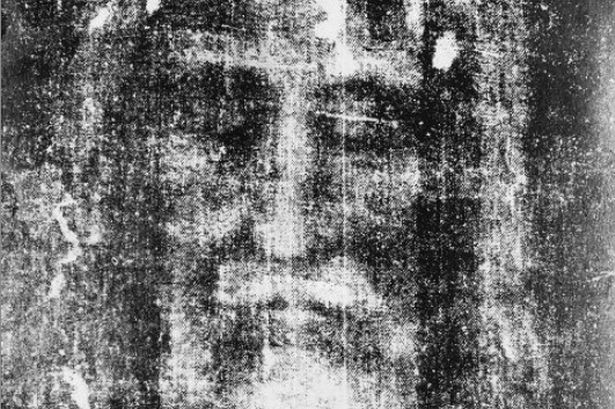
On Good Friday we remember the ultimate sacrifice God made for us. Not only did He empty Himself of His glory to become like us, taking on human flesh, but He was obedient to the law that He established for us – obedient to death – even death on the cross. We shudder at the thought of hanging on a cross, but it’s hard for us to imagine how utterly shameful crucifixion was in the 1st Century.[1]
This was not just a person, though, this was God who had already shed his glory to become like us and walked in humble obedience to all that He required of us – something that we do not even do ourselves. This man who hung tortuously and shamefully on the cross was also fully God who certainly suffered all the pain and shame that a man and God could possibly feel at the hands of His own creation.
The Great Isaiah Scroll (1QIsaa) • Qumran Cave 1 • 1st century BCE • Parchment • H: 22-25, L: 734 cm • Government of Israel • Accession number: HU 95.57/27
The plans of the heart belong to man,
but the answer of the tongue is from the Lord. Prov. 16:1
God expects us to make our plans. The ability to plan, to exercise choice, was given to us by God, who created us in His own image. But we do not control the outcomes. On the one hand, we do not control our own destinies. On the other hand, we are not left to our own devices.
The heart of man plans his way, but the LORD establishes his steps. Prov. 16:9
We have the responsibility to plan our ways, but God determines the outcomes. We can spend our entire lives planning our ways without any thought to God, who determines our outcomes. We have the ability to live as if God does not even exist, but we do not escape the One who establishes the course we actually take. We may have no choice in the outcomes, but we have choice in our planning.
To that extent, we could plan our ways with God in mind, seeking God’s wisdom, God’s purposes and God’s plans. Or we can choose to plan our ways without regard to God at all. God gives us that choice.
A man’s steps are from the LORD; how then can man understand his way? Prov. 20:24
The actual courses we take, however, are affected by the “circumstances” of our lives, the opportunities and obstacles that come our way, and the almost unlimited variety of influences, happenings and factors that ultimately determine the “steps” we take. This is just another way of saying that God establishes our steps.
Come now, you who say, “Today or tomorrow we will go into such and such a town and spend a year there and trade and make a profit”— yet you do not know what tomorrow will bring. What is your life? For you are a mist that appears for a little time and then vanishes. Instead you ought to say, “If the Lord wills, we will live and do this or that.” As it is, you boast in your arrogance. James 4:13-16
We don’t control our own way though we often think (presume) and act as if we do. God doesn’t frown on our plans. He made us with the capacity to plan our own ways, but we err (sin) if we fail to understand that we are not in control of the outcome of our plans. Our ability to freely plan our ways creates an illusion that we are the captains of our own destinies, but thinking and acting as if we actually do captain our own destinies is arrogance of the first order.
What is your life? For you are a mist that appears for a little time and then vanishes. James 4:14
Our lives are but a breath. (Job 7:7) Our lives are like clouds that appear and then vanish into thin air. (Job 7:9) Our days on earth are just a shadow. (Job 8:9) Our days are like the runner, fleeing away. (Job 9:25) Our days pass on like grass boats slipping downstream. (Job 9:26) Our lives are like a wind that passes and never returns. (Psalm 78:39) We are like flowers that bloom and quickly wither. (Job 14:2)
LORD, make me to know my end and what is the extent of my days; Let me know how transient I am. Psalm 34:9
Don’t presume about your life. Be mindful that life is short. Be aware that God is ultimately in control. God has his purposes. Pray and seek God and to understand His purposes. Make plans, but always be mindful of God and his plans and purposes. Invite God into your plans; seek for your plans to be harmonious with God’s plans.
We can live our lives on our own, going our own ways or we can live life in harmony with God and His ways. God gives us that choice, and we are responsible for the way we exercise that choice. At the end of our short days, as the bloom withers, what will be the outcome of our lives if we lived them our own ways?
The creed of this world lived our own way, apart from God, is I Did It My Way. We can do that. We can boast we did it our way. But, to what end?
As for me, when I think of the alternatives, when I consider the temptation to be the captain of my own soul, come hell or high water (as it is said), I think of the disciples complaining of the words of Jesus spoken to the crowds:
“This is a hard saying; who can listen to it?” (John 6:60)
Jesus didn’t change His message to accommodate His followers, and, as a result, “many of his disciples turned back and no longer walked with him”. (John 6:66)
In this context, Jesus turned to the twelve disciples and asked,
“Do you want to go away as well?” (John 6:67)
This is the question we all must face. This is point to which we all have or will arrive, either in this life, or when our days are done. How we respond to it is the ultimate choice we make or will make.
We don’t control when the light that is our life will go out. Our days are numbered, and they are in God’s hands. We don’t control when the choice to accept and follow Him can be made.
The plans of the heart belong to man,
but the answer of the tongue is from the Lord. Prov. 16:1
We make our choices, but God is the determining factor in our destiny. Will we choose to submit our selves, our plans, our destinies to God? Or will we go our own way.
When Jesus asked his disciples whether they wanted to go away too, as the others followers did when the message got difficult for them, Simon Peter answered for the group:
“Lord, to whom shall we go? You have the words of eternal life, and we have believed, and have come to know, that you are the Holy One of God.”
This, too, is my response. Though I often stumble, there is no other path for me. There is nothing else for me. There is nowhere else I want to be.
I have never been into New Age religion. I swerved close to it at one time. I was intrigued by Buddhism and tended toward Eastern religion in college before I became a Christian.
New age philosophy was also intriguing to me in those days, though I didn’t have a label for it. Buddhism has made for a good entre into New Age religions in the west, but my path took a turn away from New Age philosophy and Eastern religion a long time ago.
I have been a student of religion since I took a world religion class in college. For what it is worth, I have never thought that scientific truth and religious truth were incompatible, but I have never felt that one necessarily leads to (or excludes the other) the other.
Further, it seems self-evident that all truth is harmonious. Any contradiction between the science and religion, or one belief and another, is likely due to an errant interpretation of one or the other, or both.
Science deals with the realm of the natural world, matter, energy and all the things that we can touch, feel, measure and quantify. Religion deals in the metaphysical. Metaphysical reality is no less true for being hard to “grasp” (physically). Beauty is no less “true” than gravity, but they cannot be approached in the same way.
We all put our faith in something; though materialists don’t want to believe that. A materialist is someone who believes simply and only in the natural, material world and science, which reveals the truth of the natural world. So they say.
The materialist puts his confidence in the premise that nothing exists but for the time, space, matter and energy and entrusts himself to that proposition. Such a statement, ironically, is a metaphysical one for which the materialist can provide no scientific proof.
Such a premise and commitment to it is belief and requires faith as sure as anyone who believes in a god.
Truth matters.
I could ignore the truth of gravity, but I do that to my own peril. My disbelief in gravity at some point is likely to get me into trouble, and it might land me in the hospital.
Spiritual truth matters as well, though it is much more difficult to grab hold of for obvious reasons. So I am attracted to people who are able to reach some clarity in the realm of spiritual truth, like Steven Bancarz, a former expert in “spirit science”.
Steven Bacarz was the owner and editor of the Facebook page, Spirit Science and Metaphysics. He wrote for the largest New Age website on the Internet. Steven’s website was so successful that he had 150,000 to 200,000 views every day and “was making a killing off of ad revenue”.
Then, he terminated the webpage and now advocates a different way. He describes his “journey down the rabbit hole” that led him into the New Age movement and his change of direction in his own words in the following video:
One of the more iconic things Jesus is recorded to have said is, “Come follow me!” We read those words or similar words over and over in the Gospels. According to Wikianswers, Jesus talks about people following him at least 23 times in the Gospels. He is noted to have asked specific people point blank to follow him about a dozen times by my count.
Following Jesus is so much of a primary theme in the Gospels that even today, 2000 years later, we talk about people “following Jesus”. People identify themselves as “followers of Jesus”. The idea of following Jesus, therefore, is central to Christianity and what it means to be a “Christian”. The idea is so ubiquitous in our western society that we might even take that phrase for granted, forgetting the significance of it.
The unique significance of the idea of following Jesus is, perhaps, best noted by looking at people in the non-Christian world. As I was writing this and thinking of the examples of the areas where we see the idea in operation, starting with the Gospels and extending to the way Christians refer to themselves today, it dawned on me that non-Christians don’t seem to use the same phrase in referring to Christians.