I recently gave a presentation on faith (and doubt). We moderns tend to think of faith as the opposite of doubt – as in proof or evidence, or the lack thereof – but that isn’t the way Scripture presents faith to us. Cosmological and fine-tuning arguments for the existence of God and so on are elementary.
We shouldn’t be commended for merely believing God exists. God has made himself obvious. (Rom. 1:20) Even the demons believe … and bristle! (James 2:19)
Rather, faith involves trust and relationship. It involves a willingness to rely on God, rather than rely on ourselves. A willingness to wait on Him, to trust Him, and to be confident in His goodness toward us. Faith is believing God loves us and desires us to love Him.
We receive God’s grace by faith; it’s not anything we do, lest anyone boast. Rather the grace we receive is the gift of God offered to us out of His love for us. (Eph. 2:8-9)
“Anyone who comes to God must believe He exists”
Hebrews 11:6a
Of course!
“and that He rewards those who earnestly seek Him.”
Hebrews 11:6b
Faith is not just believing that God exists, but believing that He really does reward those who desire Him.
I had not previously thought of the story of Adam and Eve in the context of faith before. After all, they didn’t doubt God existed. God walked with them in the cool of the day in the garden. They knew God face to face!
When Satan tempted them, however, they lacked faith. They failed to trust that God was trustworthy.
It may not seem immediately obvious that the story of Adam and Eve is a story of unbelief, but I think it is. When Satan focused their attention on the seeming goodness of the fruit to eat and questioned why God would not want them to eat what was good for them, Satan was tempting them to doubt God’s goodness toward them.
Adam and Eve ignored God’s warning, determining for themselves what was best for them. Unbelief is an unwillingness to rely on God and a choosing to rely on ourselves and our own ability to determine what is best for us – rather then rely on God.
Adam and Eve were intrigued by Satan’s claim that eating the fruit would make them like God. They bought into the claim that God didn’t want them to be like Him, knowing good from evil. At the core of that temptation is the desire not to be dependent on God and to be self-sustaining, self-determining, and self-righteous.
Of course, God did want them to be like Him. After all, God made them in His very image! It was the very core purpose of His plan for them to be like Him!
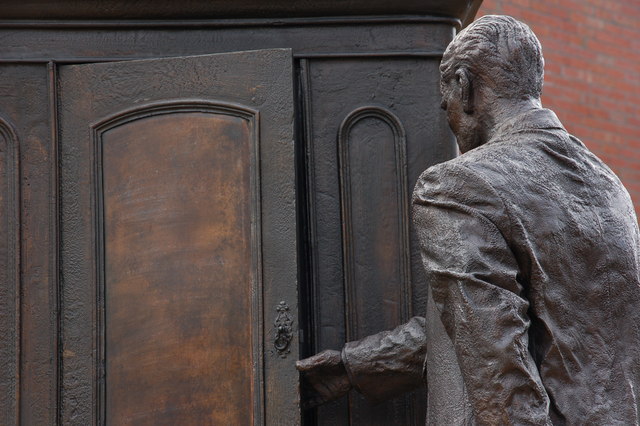
The statue outside the library in the Irish town where CS Lewis was born depicts him, as the Narnia narrator Digory Kirke, stepping into a wardrobe.
Ever since I read Mere Christianity in college as a new believer I have been a lifelong admirer of CS Lewis. He may be better known for his children’s series of books, The Chronicles of Narnia, but he wrote other fiction, including a trilogy of science fiction novels, and Lewis was much more than a writer of fiction.
Lewis was a professor, a poet, a critic of English literature, and he was a first-rate Christian thinker with an ability to tease nuanced meaning out of complex ideas with rare clarity in his writing. Having been an atheist up to his 30’s. Lewis came to Christianity with a wealth of knowledge in the classic languages and literature from a scholarly and secular perspective.
His autobiographical book, Surprised by Joy, is a literary cornucopia of allegorical references to the classics. Ancient Greek, Roman, Celtic and Germanic writings were the universe in which his mind operated and found meaning. He was intimately familiar with the myths found in these writings.
When he became a Christian, and he looked back on that wealth of knowledge with new insight, the language of classic literature became the background and (in some ways) the springboard for his belief in “the true myth”, as he came to call it. The “true myth” is the life, death and resurrection of God who became flesh in the person of Jesus of Nazareth.
While Lewis is known for being a Christian apologist in addition to being a writer of children’s fiction, he was first and foremost a scholar of classic literature. He was a lifelong professor of English Literature with tenures at Oxford University (Magdalen College, 1925–1954) and Cambridge University (Magdalene College, 1954–1963). His books include a highly regarded and well-used critique of Paradise Lost and a textbook on Sixteenth Century English literature.
To say that Lewis was a prodigious writer and thinker is to understate the fact. He wrote over 30 books of varying types in addition to his “fulltime job” as a distinguished university professor and sought-after lecturer.
Given the legacy of thought and writing that Lewis generated, one might suppose that Lewis had no time for the more mundane matters of life. One might suppose that his ego was as prodigious as the volume of his writing, and one might be wrong about such suppositions.
Lewis was one of a kind. Born in 1898, Lewis didn’t marry until 1956. One might suppose that bachelorhood allowed him the luxury of time, but Lewis made a different kind of lifetime commitment that infringed greatly on his time. Lewis took in an older woman he didn’t previously know and cared and provided for her until she died.
The backstory is that Lewis and Paddy Moore met as soldiers in the trenches during the Great War (WWI). They made a pact with each other that the survivor of them would take care of the family of the other if one of them did not survive the war. Lewis, himself, was injured and ended his involvement in the war in the hospital, but Paddy Moore went missing and was never found.
True to his word, CS Lewis, who had interrupted his college years to volunteer for the war, took Paddy’s mother and sister in to live with him on a very modest student’s budget. Lewis cared and provided for Mrs. Moore the rest of her life – a total of 30 years – routinely doing the household chores himself. After she developed dementia and was moved to a nursing home, Lewis visited her every day until she passed.
Perhaps because of that care and provision (and very generous charitable giving), Lewis lived a very modest life, but he always found time for hospitality. Lewis was, perhaps, as generous with his hospitality as he was prodigious in his writing and professorial vocation.
When the Germans invaded Poland, Lewis opened up his home to several groups of children forced to evacuate the big cities. Lewis also regularly hosted the Inklings on Thursday evenings in his classroom for nearly two decades. (They met alternately at the Eagle and Child Pub, affectionately known as The Bird and Baby) on Tuesdays at midday).
The Inklings were more or less an ad hoc group of writers and thinkers who met to discuss their literary works in progress and whatever other subjects suited their fancy, often late into the night. J.R.R. Tolkien was a faithful member of this group from the beginning, reading the Lord of the Rings to his fellow Inklings, who critiqued it, before it was published. Including a small handful of regulars, the group included about 15 frequent visitors and another dozen infrequent visitors and guests over the years.
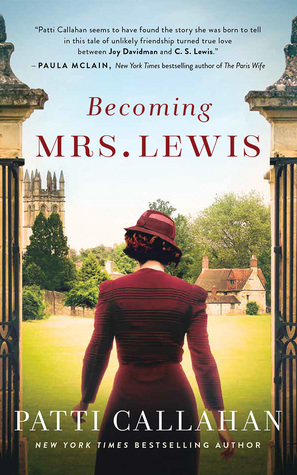
As noted above, Lewis married later in life. The marriage, itself, was an exercise in hospitality. Lewis opened his home to Joy Gresham Davidman, a writer from New York city, and her two sons, David and Douglas. They eventually married in a civil ceremony so she could gain British citizenship. What began as a gesture of generous hospitality, turned into true romantic affection.
They were married a short while later, by a priest this time. Their wedding vows were exchanged in a hospital because Joy developed cancer. They spent four more years together, but cancer eventually claimed her. Their unlikely story is the subject of the movie, Shadowlands, starring Sir Anthony Hopkins and Debra Winger and directed by Sir Richard Attenborough. Lewis also wrote about her death in A Grief Observed.
But all of this is prelude to the real purpose for which I write today. My inspiration comes from Douglas Gresham, one of Joy’s sons, who was very young when he went to live with his mother in the home of CS Lewis.
My great, great grandfather, Enoch Jones, and his brother, Silas Jones, fought in the Civil War for the north. They were members of the 40th Illinois Infantry, Company F. They mustered in August 10, 1961, at Springfield.
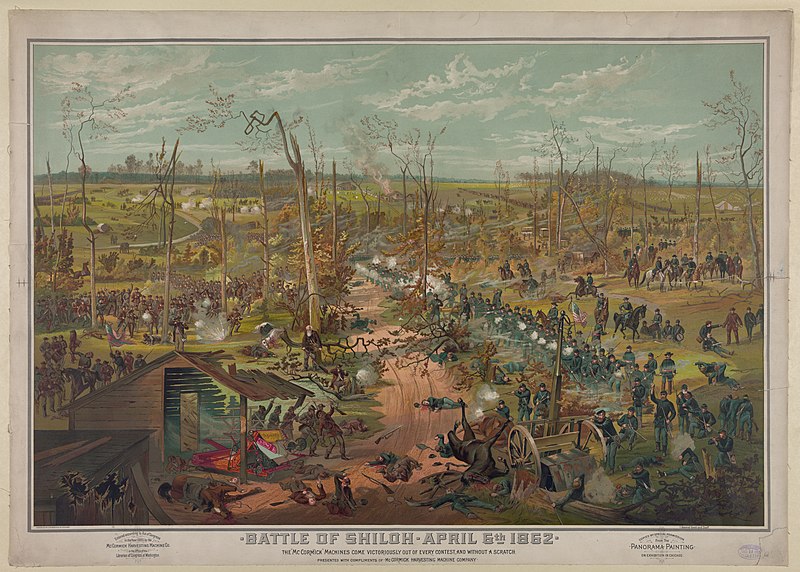
In March 1862, the 40th Illinois, 46th Ohio and Morton’s Battery was organized into a Brigade commanded by Colonel Hicks under General Sherman, and they boarded transport ships that carried them up the Tennessee River. They re-combined with the 6th Iowa under Colonel McDowall and entered the Battle of Shiloh. It would be their first armed conflict.
The north took a beating at Shiloh. The 40th Illinois was commended for standing ground under heavy enemy fire even after their cartridge boxes were empty. A total of 196 men of the 40th Illinois were killed or injured in the one battle, including Colonel Hicks.
Silas suffered mortal injuries. He mustered out of this life two weeks later. Enoch mustered out of the 40th Illinois Infantry on May 15, 1865, two days after Jefferson Davis was captured and one month after President Lincoln was assassinated. The north was victorious, but at great cost.
Enoch saw action at the Battle of Shiloh, Siege of Vicksburg, Battle of Missionary Ridge, Battle of Kennesaw Mountain and Siege of Atlanta, and other places before he returned to a humble life in central Illinois. Enoch didn’t participate in the famous “March to the Sea”, because he took a bullet in Atlanta. The bullet drove a button into his chest, but that button saved his life. It earned him the Purple Heart my parents have to this day.
I was fortunate at a Civil War memorabilia show years ago to find a tattered and yellowed dairy written by another volunteer in the 40th Illinois Infantry. He was in a different company, but his periodic reports of the movements and activities of the Brigade gave me a ground level view of the experiences of my ancestors as Union Civil War infantrymen.
When the diary opens, the author anticipates with patriotic and religious confidence the mission they are about to partake. The 40th Illinois was a completely voluntary unit. The diary expresses a kind of righteous hope and abandon to the cause of fighting for God and for country.
I could not help but think of the horrendous carnage of human and equine life they would encounter. Sinew, flesh and bone left exposed to the gaping air as the smoke slowly drifted off future battle scenes. The groans of shattered men lying in their own blood would be the only sound remaining as infantrymen regrouped to count their ranks. Trees splintered by the shrapnel of canons and muskets would stand starkly against the acrid stench of gunpowder lingering still that gaping air.
Did they know what they were in for?
I recalled seeing Civil War physicians’ bags. They carried saws, and picks, and hammers and other objects of painful reminders of the brutality of war without modern anesthetic or antiseptic. Saws saved what was left of the living by cutting off limbs susceptible of gangrene. Many, like Silas Jones, survived the battle with injuries only to die later of infection.
Knowing these things, I was intrigued to read the thoughts and expressions of resilient faithfulness to the duty fight for God and country continue on the pages of that diary after the Battle of Shiloh, and all the way past the Battle of Kennesaw Mountain. Then the diary ended – abruptly. No resolution. No postscript. No clue as to why it simply ended.
I can only imagine the writer mustered out early – maybe in Atlanta. I assume he wasn’t as lucky as my great, great grandfather. But I am not writing merely to tell a story of my ancestor. There is a bigger picture.
But when one turns to the Lord, the veil is removed.
2 Corinthians 3:16
Paul, the First Century Hebrew of Hebrews, wrote the statement above. He knew what he was talking about. Before a personal encounter with the living, risen Jesus Christ, Paul was aggressively opposed to Jesus and his followers.
He experienced life with a veil over his eyes, but he didn’t know it. That is the nature of a veil: what’s behind it is hidden. You don’t know what you don’t know until the veil is removed. When the veil is removed, a person sees what was previously hidden from view.
For Paul, the veil was removed suddenly and in dramatic fashion. Complete with a flash of light, a voice from heaven and blindness that was removed when the truth of Paul’s encounter was revealed (Acts 9), Paul’s experience was a bit unusual.
His words (or something similar), though, are a common way people describe their experience in coming to Christ, regardless of the drama, or lack thereof: when one turns to the Lord, the veil is removed. They resonate deeply with me as well.
The truth of Christ was veiled to me all of my life at one point. I became a searcher of truth, looking in all the suspect places, until “one day” the veil was removed when I turned to the Lord.
For me, it was a journey leading up to that point. It was a process. There were markers along the way that I followed, and some gates I went through. In the end, I was confronted with a choice: accept Jesus for who he said he was; I turned to him, and the veil was removed.
Looking back, we might say, I was blind, but now I see.” During the process, I didn’t know that I was blind, though I did feel like groping in the dark toward some point of light that was off in the distance.
Have you ever wondered who are the people to whom God may say, “I never knew you; depart from me”?[1] If you are like me, those words ring ominously. We might be tempted to gloss over them, because they are uncomfortable to consider, but there they are.
These words contrast with the verse that inspires this article, which informs the title to this blog piece. But first, I want to focus briefly on people whom God never knew. Jesus described them for us.
They are people who prayed to God, “Lord, Lord.” They are people who prophesied in God’s name. They are people who cast out demons and even did “mighty works” in God’s name. They are highly religious people, but they didn’t “do the will of the Father who is in heaven”. (Matt. 7:23)
What does that mean?
For starters, it means that religiosity is not a ticket to heaven. Public piety is not anything that impresses God; if anything, it may even be repulsive to Him.[2]
Power and influence and doing things that amaze people, even if done in God’s name, are not keys to heaven. An eloquent speaker who can bring people to tears and repentance is not, thereby, assured of any place in God’s kingdom. The prophet and the teacher who speak the very word of God are not, by virtue of the gift of prophecy or knowledge, assured of eternity with God.
In the “Love Chapter” of the Bible (1 Corinthians 13), Paul says,
If I speak in the tongues of men and of angels, but have not love, I am a noisy gong or a clanging cymbal. And if I have prophetic powers, and understand all mysteries and all knowledge, and if I have all faith, so as to remove mountains, but have not love, I am nothing. If I give away all I have, and if I deliver up my body to be burned, but have not love, I gain nothing.”
1 Corinthians 13:1-3
These realities are at once sobering and liberating. Nothing we can “practice” or do will propel us into God’s heaven. We are saved by grace, though faith, of course (Eph. 2:8-9), but even faith that can move mountains is of no gain to us by itself.
And here is the kicker – not even sacrifice, not even the sacrifice of our own bodies, by itself gains us anything.
David knew this when he said, “For you will not delight in sacrifice, or I would give it; you will not be pleased with a burnt offering.” (Ps. 51:16)
Jesus said, “Greater love has no one than this, that someone lay down his life for his friends.” (John 15:13) Laying one’s life down might be considered a sacrifice, yes; but it done out of love it is more than merely a sacrifice. It isn’t the act itself that is important, but the motivation, the inspiration, the desire behind the act that matters.
Jesus is the ultimate example of love. When he sacrificed himself for our sakes, he didn’t do it to earn some heavenly brownie points. He gave himself for us out of love for us. He gave himself to us for our benefit. This is love, which focuses not one the benefit of the sacrifice to himself, but on the benefit for other another.
“For the letter kills, but the Spirit gives life.” (2 Cor. 3:6) Legalism and fundamentalism and dogmatism and doctrine and theology can never save a person. It doesn’t matter how much we do, or how much we know, or how accurate our understanding is when we have not love.
God, who we are to worship in spirit and truth (John 4:24), is love.[3] All the Law and the Prophets are summarized in this one statement: Love God above all things and love your neighbor as yourself. (Matt. 22:40) Thus, Paul says,
This is the verse that got me thinking about these things today. If you love God, you are known by God. The people of whom God will say, “Depart from Me; I never knew you”, are people who don’t really love God. Their motivation was wrong.