I saw Haley Heynderickx this evening at Space in Evanston, IL. She was (once) an obscure, modern folk artist. Then, a song of hers went viral on TikTok. (So, my son tells me.) The crowd this evening was young, even for this trendy venue on Chicago’s ever hip north shore.
Existential angst (or dread, depending on your flavor of melancholy) is the thread that runs through her work. She is a siren for the spirit of this age. Her chords strike true with my son, who turned me on to her, and with my daughter, who accompanied us to the show.
I was young once also, and the existential angst of my youth drove me on a quest that led me to the threshold of Jesus, the Lamb of God who was slain for the sins of the world. A different generation, now, leans into a similar ages old myopia.
“Meaningless! Meaningless!” …. “Utterly meaningless! Everything is meaningless.”
Ecclesiastes 1:2
This words may have accompanied a more ancient tune played on a lyre from a more distant youth, but the melody sounds the same.
Existential first visited me one night when I was too young to have a vocabulary for the experience. We watched old home movies from a projector in our living room. Younger ghosts of my parents and grandparents played on the grainy screen in washed out black and white.
I remember it like a dream sequence. The images and feelings of the past are equally washed out in my mind now, but the poignance and clarity of the dread that I felt is clear.
This was, I believe, the first time I became aware of the unforgiving and unrelenting passage of time. This was the first time, perhaps, that I stared the inevitability of death in the face, and the eyes of death stared back, penetrating into my soul.
The next sequence in this dream is now (and always has been) more palpable and imminent than those grainy home movies. Later that night, I found myself detached …. floating in a yawning chasm of outer space …. utterly alone and disconnected.
I don’t know to this day whether I had a dream when I fell asleep that night or whether it came to me in a ghastly vision. It doesn’t matter. If claustrophobia can be felt in an endless void, the experience would be close to what I felt. Angst and dread have nothing on the feelings I had that night.
I say this to frame my thoughts as I recall the song with which Haley Heynderickx closed out the evening: the Untitled God Song.
I am reminded again in my daily reading of Scripture of the prominence of women in the life and ministry of Jesus. Every time I read through the Gospels, I see it. As I read through the Old Testament with eyes sensitized by the Gospels, I see the theme there also. This theme is somewhat, hidden, however.
We have only committed to the idea that women should be equals of men in very modern times, and that idea is still not universal around the world. A cultural revolution was required in the western world to change ancient paradigms. The change has been slow, difficult, and filled with tension.
Christianity was influential in bringing about that change, but many Christians have also resisted it. This is true even while the roots of that cultural revolution are embedded in Judeo-Christian Scripture.
Tom Holland, in his epic book, Dominion, traced modern, secular humanist values back to a surprising root. He had no idea where the values he took for granted came from: gender equality, racial equality, individual freedoms, civil rights, etc. When he searched for them, he for found them in Genesis, in the Gospel accounts of Jesus, and in the letters of Paul, the apostle.
Rebecca McLaughlin writes about the prominence of women in the Gospel accounts of Jesus in her 2021 article, Jesus Changed Everything for Women. She quotes Holland to remind us of the cultural context in which those accounts were written:
In Greco–Roman thinking, men were superior to women and sex was a way to prove it. “As captured cities were to the swords of the legions, so the bodies of those used sexually were to the Roman man,” Holland wrote. “To be penetrated, male or female, was to be branded as inferior.”
In Rome, “men no more hesitated to use slaves and prostitutes to relieve themselves of their sexual needs than they did to use the side of a road as a toilet.” The idea that every woman had the right to choose what happened to her body was laughable.
Jesus chantged Everything
Jesus didn’t introduce the these radical notions, however. They go all the way back to Genesis, where we read that God made men and women, together, in His image. (More on that below)
Modern westerners have learned to reject and even to despise the paternalism of most of the history of mankind (pun intended), so it’s easy to miss the way the Bible elevates women. After all, the Bible was written by many men many centuries ago, before anyone in the west (or anywhere else) got the notion that women should be treated as equals.
Let that sink in a moment: the Bible was written by men.
As much as modern westerners like to recoil from the idea of men treating women as second class citizens, the 1st Century Roman world thought nothing of it. Aristotle taught that women are “defective men”. He believed that “women were fit only to be the subjects of male rule“, and “they are born to be ruled by men”. Aristotle and most men for millennia thought that the inferiority of women was obvious, stemming from their nature as the “weaker gender”.
Given that context, the “clues” we find “hidden” in the Bible of a different narrative about women is remarkable. Though the Bible was written, literally, by men, Christians like myself maintain that it was inspired by God, and a divinely inspired narrative shines through it. This is true despite the obvious cultural influences we see on the face of it.
The Bible was written by men during times in which men dominated thought and culture. it is no wonder that the Bible is often criticized for being backward and paternalistic, but that view can only be sustained on a cursory, shallow reading of the Bible. A closer reading belies a very different narrative!
I was listening to the podcast, Apollos Watered hosted by Travis Michael Fleming, recently when NT Wright made a very simple, but poignant, statement:
“One of the most fundamental things about Christianity is that it is for everyone.”
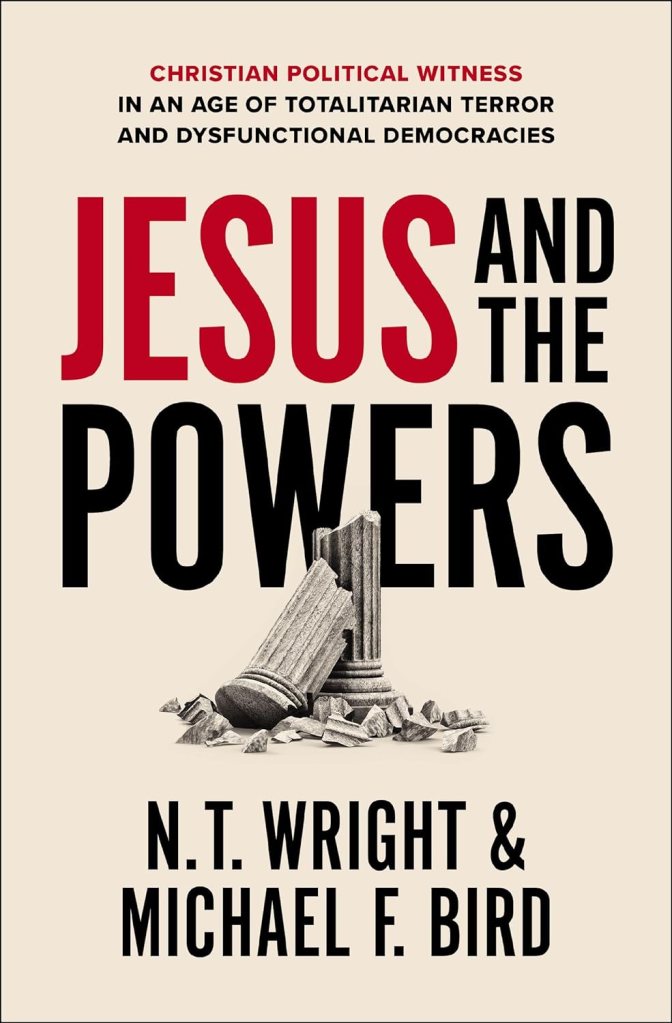
NT Wright, of course, is from the UK. He just authored and published a book with Michael F. Bird, that is called JESUS AND THE POWERS, Christian Political Witness in an Age of Totalitarian Terror & Dysfunctional Democracies.
The context in which he made this comment was a discussion on Christian nationalism. Christian nationalism is currently a hot topic in the United States, though we are hardly the first nation that has religious, nationalist tendencies. England had such a period in its history.
The nation of Israel had arguably the most provenance to think that way. After all, Israel was a nation of “God’s chosen people”. God became incarnate in Jesus in the 1st Century, and He “came to His own” – His chosen people. Before moving on to the point I am inspired to write about today, I want to focus on how God’s chosen people reacted to God becoming flesh and walking among them.
The Apostle, John, tells us in the first chapter of his Gospel that they, tragically, “did not receive him!” (John 1:1-11) They did not recognize God who had become flesh and was standing right in front of them!
That stunning fact should cause us to ask, “Why?” How is it that God became flesh, and He walked among the very people He chose, and they didn’t recognize Him?
We might excuse them on the basis that we have the Holy Spirit, and they didn’t. We might be tempted to think that we would respond differently today because of that advantage. But then again, they had God in human flesh!
We might assume that having the Holy Spirit makes us different than them. Perhaps, that is true. Theoretically, a person who actually has the Holy Spirit and who actually lives by and listens to the Holy Spirit does seem to have advantage.
Of those who have the Holy Spirit, do we actually live by and listen to the Holy Spirit? All of the time? Even most of the time? I can’t answer that question for you, but I think it is a question worth asking ourselves.
NT Wright is a prolific and influential theologian. He has written key works on Paul and Romans. His insights are particularly relevant and poignant as such an expert who has no dog in the political and cultural “war” that rages in the United States of America.
Such a simple statement: “Christianity is for everyone.” Who would not agree with that statement? Jesus said he came for everyone who believes. Paul said there is no Jew nor Gentile; and we are all one in Christ.
In the 1st Century Jewish world, only two groups of people existed: Jews and everyone else. The Jews called everyone else Gentiles. What Paul means, therefore, is that everyone in the world is unified in Jesus Christ. This should be our reality as Christians, right?
Paul said that Jesus tore down the wall that divided the two groups of people in the world, and he made the two groups one. He reconciled all people to himself through the cross. (Ephesians 2:14-16)
The danger of Christian nationalism in the United States (or anywhere) is that some Christians may see themselves as uniquely Christian, uniquely privileged by God, and they may conclude that their own nation that they consider to be Christian is uniquely, divinely authorized by God. That attitude can lead to us to see other people as less uniquely blessed and less divinely privileged.
This is dangerous because we are tempted to view ourselves as better than others. We may even excuse some of our ungodly behavior because we are a Christian nation that has divine authority in the world.
This attitude can hinder us from seeing our own faults and weaknesses that are unique to our culture. We are apt not to see the planks in our own eyes while we focus our attention on the specs in others’ eyes, assuming ourselves to be better than others.
We might also tend to focus on maintaining our privileged position we believe God has given us to the exclusion of other people. We might be tempted to focus on our own good while we should be focusing on helping our neighbors, including our foreign neighbors – and even our enemies.
Jewish people in the 1st Century had this kind of attitude, and it blinded them from seeing who Jesus was – the Messiah they had been waiting for – because they thought he was only their Messiah, and he would liberate only them. They weren’t prepared for a Messiah who came to liberate the whole world!
Though “God’s own” didn’t receive Him, “Yet to all who did receive him, to those who believed in his name, he gave the right to become children of God….” (John 1:12) We might be so familiar with the following verse that we miss the scope of God’s focus:
“For God so loved the world that he gave his one and only Son, that whoever believes in him shall not perish but have eternal life. For God did not send his Son into the world to condemn the world, but to save the world through him.”
John 3:16-17
God’s focus is the world – the whole world. He even gives us a sneak peak at His end game through the same Apostle, John:
“After this I looked, and there before me was a great multitude that no one could count, from every nation, tribe, people and language, standing before the throne and before the Lamb.”
Revelation 7:9
With Christian nationalism, however we might define it, our perspective is too narrow. The danger is that we focus too much on us when God is focused on the world.
Religious people wanted to kill Jesus in his hometown because he challenged their views as God’s privileged people. They became angry with Jesus when he talked about Elijah visiting and blessing the Canaanite woman in Sidon to the exclusion of all the widows in Israel. They were enraged when Jesus said that Elisha healed the Samaritan war general of leprosy rather than people in Israel who had leprosy. They were so incensed by Jesus pointing these things out that they tried to throw him off a cliff! (Luke 4:24-29)
Christian nationalism of any kind flirts with unhealthy pride in national identity. Pride and identity associated with anything other than Christ has a tendency to warp us inwardly and to diminish our sense of primary identity in Christ. Thus, Christian nationalism can lead us to diminish our love for God, as well as our love for our neighbors.
When we think too highly of ourselves, we value our own culture and ways of looking at and doing things more than we should. When we think too highly of ourselves and value our own ways too much, we also tend to devalue others and the ways of other people. Thus, Christian nationalism can lead us to diminish our love for others.
As finite human beings, we all have a deficiency of perspective. Each individual and cultural perspective is limited, which is why Isaiah said:
“For my thoughts are not your thoughts, neither are your ways my ways, declares the Lord. For as the heavens are higher than the earth, so are my ways higher than your ways and my thoughts than your thoughts.”
Isaiah 55:8-9
In short, we do not have the perspective of God. His perspective is far greater than ours. This is true individually, of course, but it’s also true of humankind. It is equally true of people groups, cultures, and nations.
People are talking about Christian nationalism everywhere. The term, Christian nationalism, is often used and often invoked, but I don’t see it often defined. It can mean different things to different people. The phrase has increasingly become a pejorative label, though some people wear the pejorative label proudly now like a badge of honor.
My concern about “Christian nationalism” grows out of my own Christian experience. I admit that my experience is primarily anecdotal, but I find in Scripture adequate cause for that concern, and Scripture shines light on my experience and on any form of Christian nationalism, as I will explain.
I am chiefly concerned about the Church’s faithful witness and faithful adherence to following Christ. I am concerned that the world often confuses Christianity with particular political expressions, and I am concerned that Christians often do exactly the same thing.
The very fact that “Christian” nationalism has become a pejorative label suggests my concerns have some warrant. And not just me; I see a rising tide of concerned followers of Christ wrestling with the issue.
Jesus was clear to his detractors, and to his followers, that people should give to Caesar what is Caesar’s, and to God what is God’s. (Mark 12:17) I don’t see Jesus confusing or conflating what is Caesar’s and what is God’s, but the idea of Christian nationalism does both.
The very term, Christian nationalism, blurs the lines between what is Caesar’s and what is God’s. It suggests a conflation of biblical and political principles. It creates confusion that results in (or from) not knowing where politics end and Christianity begins.
I have the same issue with the way people use the term, evangelical. Originally, the term had a purely religious and theological meaning. Today, media and political pundits ascribe a political meaning to it. For the majority of people today (perhaps), the meaning conflates political and religious ideas into a confused mess that can mean very different things for different people.
As for a definition of Christian nationalism, I “asked” Bing’s Copilot for help. The resulting definition is my starting place for the rest of my thoughts today (not that I think it is a particularly good definition):
“Christian nationalism is an ideology that seeks to fuse Christian religion with a nation’s character.”
I would agree that Christian nationalism is an ideology, but ideologies do not seek. (People do.) (So much for the power of AI.) It seems more accurate to say that Christian nationalism is an expression of Christianity and of nationalism that fuses the two ideologies together. Whether people seek to fuse them, or simply do fuse them, together may be splitting hairs.
Having become a Christian in college in the late 1970’s and early 1980’s, I can attest to the organic nature in which patriotism fused with my own newfound beliefs in the milieu of the post-Jesus Movement. I didn’t seek or set out to fuse them together. They just became entangled.
Before I became a Christian, I grew up pledging allegiance to the flag of the United States of America, as did all public-school students in the 1960’s and 1970’s. The Fourth of July rivaled only Christmas on my list of favorite holidays. Parades and flags and fireworks were the traditional rituals of the observance of nationalism and those rituals continue today.
Columbus Day served as reminder of our good fortune that God-fearing explorers with perpetual good will braved stormy seas and the specter of a flat earth to discover our fair land. Thanksgiving was encouraged as reminder that God ordained these things and established our manifest destiny in His good graces.
The groundwork for nationalism was laid in my life long before I became a Christian. I am a Boomer who was educated in an atmosphere of post-war optimism, but I am also a late Boomer. I was born on the cusp of the tumultuous 1960’s.
I witnessed the backlash against that post-war patriotism on the nightly news. The protests and protest songs, the burning of American flags, the “sit ins” and “love ins”, and increasing counter cultural attitudes pushed back against that patriotism institutionalized in the 1950’s and ingrained in my educational experience in the 60’s.
Many people in the American Church resisted the rising tide of rebellion against conventional norms, both in the Church and outside the Church. Many people clung reflexively to patriotism and national pride in reaction to the countercultural protest and unrest.
If traditional churchgoers were like the older son in the parable of the prodigal son in that time, the protesters were like the (younger) prodigal son. Our focus may be drawn to the excesses of the younger son, but we realize in the back of our minds that the older son is prodigal too.
My own story links up with the Jesus People Movement. The Jesus People were countercultural prodigals who found Jesus. They repented, turned from their rebellious ways, and embraced the Ancient of Days, God who became incarnate and died for the sins of the world.
I became a believer in 1980, and I joined a church with roots in the Jesus People Movement in 1982. The “radicals” who got saved in the early days of the church had long turned from their rebellious ways, when I joined them, and they had settled into a cultural conservatism that belied their former years.
Sometimes, we throw out the baby with the bathwater. Sometimes, in rescuing the baby, we take some bathwater in. Their newfound cultural conservatism was turning political and patriotic when I arrived. It was a patriotism not simply informed by secular pledges of allegiance; it was a patriotism that was infused with biblical blessing and mandate.
I spent six years in that church formed by hippies who migrated to the northeast in the late 60’s and early 70’s and found Jesus on their way.
These people had turned from flower power to a higher power, from the Rolling Stones to Randy Stonehill, and from sticking it to the man to worshiping the God who became man in Jesus and died for us.
When I joined this church, the original members had already closed their candle shops to become landlords and insurance salesmen. They no longer lived in communes where they shared resources in common. They were no longer long-haired hippie freaks. They had stable families and businesses and owned their own houses.
With their conversion, they repented of their sins, and they rejected their former radicalism. In rejecting their former radicalism, they embraced a newfound conservatism that included a renewed sense of patriotism.
While I was living with them, I saw the influence of the Moral Majority take hold. The post-war patriotism of the Baby Boomer generation turned religious when hippies converted, rejected their former radicalism and were welcomed into the church by older prodigals who championed the Moral Majority.
I also saw portents of a darker future. On the edges of that idyllic, “New Testament church” with communal roots from a more radical past lurked associates of the John Birch Society and sundry other political influences.
My church embraced politics as an expression of working out God’s purposes in our local community and to the ends of the earth. But the path to the kingdom of God is always a narrow one. We don’t have to wander far from it to find ourselves invoking God to work out our own purposes in our local community and to the ends of the earth.
Christian nationalism involves a blurring of the lines between God’s purposes and our own purposes. Christian nationalism is a form of syncretism – the blending of Christian belief into a new system, or the incorporation of other beliefs into the expression of our Christian beliefs.
In a recent podcast conversation I listened to Skye Jethani speaking with Brian Zahnd who mentioned his disillusionment with American Christianity at one point in his pastoral career. (Beginning at about 54 minutes into the podcast) Zahnd shared that he came to a place where he thought, “Jesus deserves a better Christianity than what I have experienced.”
What Zahnd may have been talking about is the kind of consumeristic Christianity that grew alongside the Charismatic renewal as the turbulent 1960’s gave rise to the Jesus People Movement and leveled out into a new style of conservatism and the allure of the Prosperity Gospel. that was his world, and it was partly my world as well.
I can relate to Zahnd. Though I grew up Catholic, I became a Christian in college and plugged into that environment – a more or less loosely associated connection of independent, charismatic churches in the 1980’s that had grown out of the Jesus People Movement. That religious culture was variously impacted by PTL with Jim and Tammy Faye Baker, the Christian Broadcasting Network with Pat Robertson who ran for President, and Jerry Falwell’s Moral Majority, which became a political rallying cry.
And then I went to law school.
Influences during my time of “growing up in the faith” in my twenties included the prosperity gospel and right-wing political groups ostensibly intending to bring our country back to its “Christian roots”. These influences focused on gaining prosperity for ourselves and regaining power and control that we perceived we were losing in our society.
Brian Zanhd described a period of time in his life in which he began trying to “untangle American Christianity from Americanism”. I was forced into that same position by law school and what I learned about our founding fathers.
Today, someone might call what I experienced “deconstruction”. I began to see things from other perspectives. I began to see that separation of church and state was a mechanism that people hoped would protect the church from the state, as much as anyone hoped it might protect the state from the church. I began to see a disconnect between the things Jesus said and the ways we twist them to suit our own ends.
In more recent years, I have come to see that “empire” isn’t the way of Jesus. Empire is the way of the world. Jesus said his kingdom isn’t of this world! Jesus preached an upside down kingdom that many Christians warp into a religious version of an earthly kingdom.
Jesus rejected the temptation of empire in the wilderness. When the devil offered Jesus all the kingdoms of the world and their splendor (Matt. 4:8-9), Jesus responded this way:
“Away from me, Satan! For it is written: ‘Worship the Lord your God, and serve him only.’”
Matthew 4:10
The podcast focused on “Americanism”, understandably, because that is the cultural milieu in which we live in the United Stated of America. Americanism, however, is indicative of tendencies that are common to all human beings. These are the tendencies Satan tried to capitalize on when he tempted Jesus in the wilderness with the promise of power, influence and privilege.
These human tendencies are antithetical to everything Jesus taught:
Consider others better than yourselves;
Love your neighbor;
Love your enemy;
The parable of the Good Samaritan;
The greatest among you will be servant of all; and
Give to Caesar what is Caesar’s, but give to God what is God’s.
(God’s ways are not our ways, and His thoughts are not our thoughts.)
We naturally are attracted to what is familiar. We naturally advance our own interests. We naturally protect ourselves and our own kind. We naturally see ourselves as the good guys. We assume the best about ourselves. We identify with our own people, and we have a hard time protecting others from ourselves because we don’t see the need to protect them from us.
People were no different in the 1st century. Jesus was well aware of this human tendency, and he addressed it head on with his first followers.
The first time we see him doing that is right after the temptation in the wilderness in which the authority and splendor of all the kingdoms of the world were offered to him. The next thing Jesus did after leaving the wilderness was to walk into his hometown synagogue, pick up the Isaiah scroll, and read from it:
“The Spirit of the Lord is on me, because he has anointed me to proclaim good news to the poor. He has sent me to proclaim freedom for the prisoners and recovery of sight for the blind, to set the oppressed free, to proclaim the year of the Lord’s favor.”
Luke 4:18-19
When he finished, he sat down, and he said, “Today this scripture is fulfilled in your hearing”. (Luke 4:20)
At first, the townspeople spoke well of him. They were even amazed at his words. Their amazement began to wane when someone remarked, “Isn’t this Joseph’s son?” (Luke 4:22) Then, Jesus dropped a bomb on them:
“Surely you will quote this proverb to me: ‘Physician, heal yourself!’ And you will tell me, ‘Do here in your hometown what we have heard that you did in Capernaum.’”
Luke 4:23
They did not even have time to process what Jesus just said when he added, “Truly I tell you … no prophet is accepted in his hometown.” They still didn’t understand, but they they were about to become really agitated.
With the next words Jesus spoke, Jesus picked a fight when no one was (yet) in a fighting mood, but he knew what was in their hearts. It is the same thing that is in our hearts, if we are not careful to root it out. I think you will see what I am getting at if you read on.