Born is the King

born-is-the-kingThe people walking in darkness
have seen a great light;
on those living in the land of deep darkness
a light has dawned.
You have enlarged the nation
and increased their joy;
they rejoice before you
as people rejoice at the harvest,
….
For to us a child is born,
to us a son is given,
and the government will be on his shoulders.
And he will be called
Wonderful Counselor, Mighty God,
Everlasting Father, Prince of Peace.
Of the greatness of his government and peace
there will be no end.
He will reign on David’s throne
and over his kingdom,
establishing and upholding it
with justice and righteousness
from that time on and forever.

spoken by the prophet Isaiah around 700 BC

Connecting to Our Theological Hardwiring

Children come by the inward conviction of God naturally; adults have a harder time with it.

Julia4 at Hershey

Jesus instructed His disciples to let the children come to Him, and he instructed His disciples to become like children to enter the Kingdom of God.

“Faith comes naturally and normally for children. Certain assumptions about the world and its creator seem to arise intuitively at an early age. For example, children tend to believe in spiritual beings without any trouble, and they distinguish between fairy tales and God in sophisticated ways. They believe the world was made for a purpose and by something greater than human beings. Essentially we have the beginnings of theology in some way hardwired.” (A statement from an article in Christianity Today, The Great Congruence of Science and Faith.)

Faith and science hardly seem to be a place of congruence in popular opinion and even less congruent with that popular opinion is a statement about theology hardwired in children. Or is it? Charles Darwin once commented that he could not trust his “inward conviction… that the Universe is not the result of chance”. (The Darwin Project, UK) Darwin recognized the “hard wiring”, but he rejected it on the basis of evolutionary principles. (See also Random Thoughts on Evolution)

Children come by this inward conviction naturally; adults have a harder time with it. Modern thinkers might say that other things are hardwired into people, such as sexual tendencies and gender identity. The Bible recognizes that we are born into sin, which is why we need to be born again. There is something in the way a child approaches the world, however, that is productive toward faith.

I am reminded of the words of Jesus, “Let the little children come to me, and do not hinder them, for the kingdom of God belongs to such as these.’” (Luke 18:16) The context in which He spoke those words is as important as the words themselves. People were bringing small children to Jesus for him to pray for them, but the disciples attempted to keep them away from the important things Jesus was doing. Instead of continuing with whatever he was doing, Jesus stopped and welcomed the children. Then he said something even more important:

“‘Truly I tell you, anyone who will not receive the kingdom of God like a little child will never enter it.’” (Luke 18:17)

God does not want us to lose that “theological hard wiring”. We have in us a tendency toward sin as well as a tendency toward faith. Paul would say that truth is written on our hearts so we are without excuse, regardless of the intellectual gyrations we use to quash that hard-wired tendency to believe in God.

As we get older, we become more self-sufficient and more self-important. We become more dependent on ourselves, and we have a hard time allowing anyone or anything to dictate to us. We blaze our own trails. We chart our own courses. We separate from our parents, and we separate from God. We lose the wonder of childhood. We become jaded, hardened and tend toward the sinful tendencies if we are not careful.

Disillusioned Politician


Is it any wonder that we need to be born again to see the kingdom of heaven? We need a different approach than what we would naturally take as we get older. We need to become like a child to approach God, stripped of the self-reliance that we strive to attain as adults.

Faith opens the eyes of the believer up to the wonder of God in the world. The congruence of faith and science and reason and the reality in which we live is natural and normal, but we live in a fallen world that is tending away from God, tending toward destruction and decay. Faith takes us in a different direction.

At the end of the day, what is more reliable about our ability to reason over that inward conviction? Both reside in finite human frailty. One will take us to the gate of heaven; the other will take us no further than the grave. One is not more prone to error than the other. Or is it?

Without faith we will not see the kingdom of heaven. If we will not receive what God has provided for us like a child, we cannot grasp it at all. The congruence of faith and truth is found in God who can only be worshiped in spirit and truth. Spirit requires that we let go of our own conceptions that are limited by our finite experience and knowledge and ability to reason and open up to what God would reveal to us.

To approach the world like children, as God instructs us, is to remain open to correction and change of direction as God would guide us. In fact, in the same context in which Jesus said we must be born again, Jesus added:

“‘You should not be surprised at my saying, ‘You must be born again.’ The wind blows wherever it pleases. You hear its sound, but you cannot tell where it comes from or where it is going. So it is with everyone born of the Spirit.’” (John 3:7-8)

If we are to be born again, born of God, was must be open to the influence of God, to the direction of God. We must be sensitive to the wind, the breath of God, His Holy Spirit. Like a child, we may not always be happy or understand the direction that we are going, but a child would not think to go in any direction apart from God in whom and on whom we are utterly dependent. We need to plug into the hard-wiring God built into us that is connected to Him and walk away from any sinful tendencies we might have.

Reprinted from NavigatingByFaith

The Thoughts of Many Hearts Revealed

canstockphoto14185731
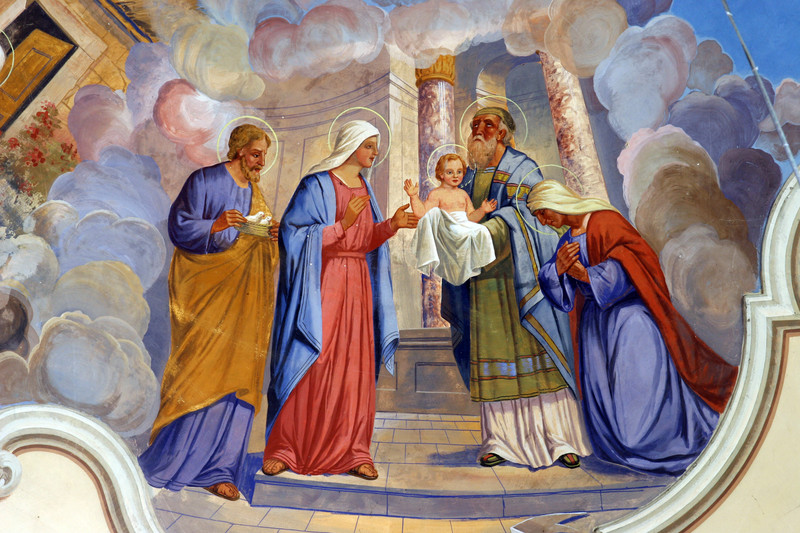
Young Jesus presented to Simeon at the Temple

“Then Simeon blessed them and said to Mary, his mother: ‘This child is destined to cause the falling and rising of many in Israel, and to be a sign that will be spoken against, so that the thoughts of many hearts will be revealed.'” (Luke 2:34-35)

People tend to focus on the “Christmas story”, but this verse that follows the account of the birth of Jesus is significant, if not subtle, in its ramifications.

Simeon was a temple priest who entertained the rituals performed by Mary after Jesus was born. Luke says that it was revealed to Simeon by the Holy Spirit that Simeon would not die before he had seen the Messiah.

Devout Jews of the time were expecting a Messiah (“Christ” in Greek). Keep in mind that more than 300 years had passed since the last of the Old Testament prophets who foretold the Messiah. Simeon knew this baby was the One because the Holy Spirit had spoken to him!

Following an article I read recently, the author had a back and forth discussion with a reader about whether Jesus actually existed. The skeptic questioned the reliability of the Bible and did not believe that Jesus of Nazareth was an historical figure. Among other things, he questioned the lack of reference in First Century historical accounts sources external to the Bible of Jesus and the miracles that the Bible describes. The reader argued: if so many miraculous things really happened, wouldn’t everyone have heard about them and made mention of them in historical accounts?

Never mind that social media was late to arrive in First Century Galilee and CNN had not yet been picked up Jerusalem at that time. I wonder, though, even if social media and CNN existed, would you believe accounts of miracles if they were reported in India? Mexico? Montana? Would you have even give it a second thought if some fishermen, homeless people, or prostitutes claimed to be healed?

Of course, this question begs another question: Is the Bible an historical account? The “books” of the New Testament are written like historical accounts, especially the Gospels and the Book of Acts. The epistles (letters) also have historical significance.

Simeon is recorded as saying to Mary that the Christ child was “destined to cause the falling and rising of many in Israel”. Isn’t that what happened with Jesus, who only lived a short 30 some years? He caused quite a stir, and the stir even continues today, almost two millennia later.

Many continue to speak against Jesus today, just as Simeon said they would, which is an odd thing if Jesus was never an historical figure. The thoughts of many hearts are revealed if this Jesus really was God who came in the flesh to walk among us. He is the continental divide between those who are open to God and those who deny him.

But, what is the evidence that Jesus was an historical figure who claimed to be God in the flesh?

Continue reading “The Thoughts of Many Hearts Revealed”

In Times of Trouble

lightstock_62496_xsmall_user_7997290We have all been there. You have done your best, but your best is not good enough. Maybe you have not done your best, and now your best is not good enough to fix the mess you are in. Maybe your impossible circumstances are totally beyond your control.

The feeling of abject desperation is the same.

In those times, the temptation may be to withdraw, curl up and bury your head. Maybe the temptation is to beat yourself up, hang your head in despair and live in condemnation. Maybe the temptation is to throw up your hands, say it doesn’t matter anyway and drown your woes in alcohol or drugs. The options may seem dismal and dark.

But, this is a critical point! The last place we often want to turn is the first place we should go – down on our knees in prayer to the God who made us and loves us.

There you will find God greeting you, not with judgment, but with open arms. “For God did not send his Son into the world to condemn the world, but to save the world through him.” (John 3:17)

You may not be able to see your way out of the predicament you are in, but God stands high above your predicament. He is also with you in your circumstances, and He is bigger than your circumstances

When you are trapped in a hopeless situation, or what seems hopeless to you at the time, when you cannot see your way out of the darkness and the world is caving in all around you, cry out to God. He hears you! (Psalm 18:6) The righteous are those who cry out to God in their distress (Psalm 34:17), and God will deliver you from your troubles!

We are not righteous because we are good; we are righteous because we cry out to God!

He may (or may not) deliver you from your circumstances, but He will deliver you from your troubles. That is the promise of God, and “God is not human, that he should lie, not a human being, that he should change his mind.” (Numbers 23:19)

When we go to God, we go to the Maker of the Heavens and the Earth, of all that is seen and unseen. When He makes a promise, He keeps his promise.

“Rejoice in the Lord always. I will say it again: Rejoice! …. Do not be anxious about anything, but in every situation, by prayer and petition, with thanksgiving, present your requests to God. And the peace of God, which transcends all understanding, will guard your hearts and your minds in Christ Jesus.” (Phil. 4:4-7)

Rejoice always means to rejoice in every circumstance, good and bad. God is above all of our circumstances! When we are anxious, that is exactly the time for us to go to God in prayer. When we are anxious, we should petition God. With Thanksgiving, we should make our requests known to God. We should appeal to God in all of our troubles…. and the promise of God is peace for our troubled hearts!

In this verse, we are not promised deliverance from our circumstances, but we are promised peace – peace from our troubles!

“God is our refuge and strength, an ever-present help in trouble.” (Psalm 46:1)

Sometimes God allows us to come to the end of ourselves, to a place where we are powerless (or feel powerless) to help ourselves, and in that place is where God does His most significant work in us. We simply need to turn to Him.

We can choose not to turn to God. We can go it alone. That is always our choice, but in turning to God we not only have ready help, peace that passes understanding and a deliverer from our troubles, we have a Savior – One who delivers us not only from our troubles but from ourselves and the sin that leads to death. When we turn to God, we have Life and, we have life more abundantly.

“The thief comes only to steal and kill and destroy; I have come that they may have life, and have it to the full.” John 10:10) The thief, the robber of our souls, is a condemner, an oppressor and a liar. When we feel desperate and hopeless, the thief is at your door.

Turn to God in your time of trouble; cry out to God, and then rejoice in God and His promises; pray to God – He will meet you where you are. That is His promise!