I recently listened to an interview of Dr. Craig Evans, who wrote the book, Jesus and the Remains of His Day: Studies in Jesus and the Evidence of Material Culture. The book is described as a collection of articles demonstrating how archaeological evidence “enlightens our understanding of the life and death of Jesus and the culture in which he lived”. The interview focused on archaeology, generally, and especially on the way archaeology sheds light on the New Testament.
In this piece, I am following up on the more general discussion. When asked if he was aware of any finds that have failed to support the biblical record, Dr. Evans could not think of any. Rather, he commented that archaeological evidence is found every year that confirms the biblical record. Of particular note are the people mentioned in the Bible that archaeology has affirmed.
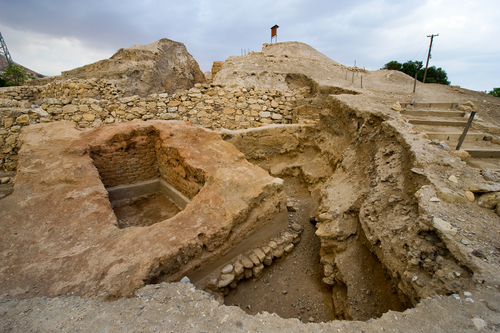
Old ruins in Tell es-Sultan better known as Jericho the oldest city in the world
I recently attended a conference at which Ted Wright, an archaeologist, presented information related to the exodus of the Jewish people from Egypt and the later conquest of the area of Canaan. Ted Wright has participated in the excavation of Jericho and Khirbet el-Maqatir, thought to be the modern location of the city, Ai, mentioned in the Bible. One thing that Ted Wright said, which has stuck with me, is that modern archaeology continues to affirm people, places and other information contained in biblical accounts.
As an example, Ted Wright recounted the story of an archaeologist, John Garstang, who excavated Jericho in the 1930’s. Garstang concluded that the site dated to 1400 BC, consistent with the biblical account (John Garstang, “Jericho and the Biblical Story,” p. 1222.):
“In a word, in all material details and in date the fall of Jericho took place as described in the Biblical narrative. Our demonstration is limited, however, to material observations: the walls fell, shaken apparently by earthquake, and the city was destroyed by fire, about 1400 B.C. These are the basic facts resulting from our investigations. The link with Joshua and the Israelites is only circumstantial but it seems to be solid and without a flaw.”
Ted Wright observed in his talk that most of the battle in modern archaeology is not whether places, like Jericho, really existed, or the happening of events, but rather the timing of when they existed and happened. Continue reading “Timing the Walls of Jericho”→
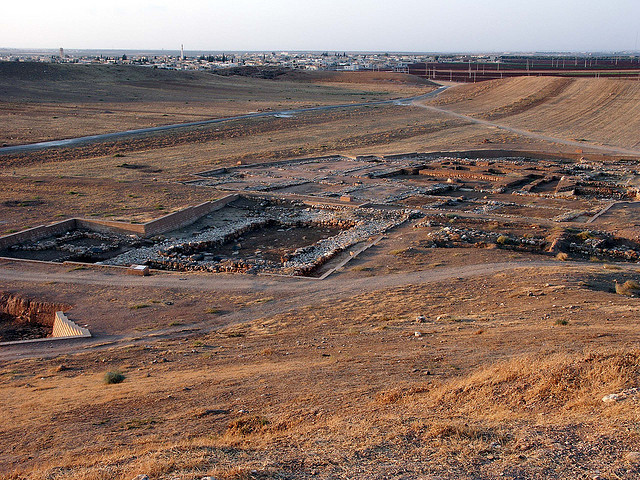
Bible skeptics often talk as if there is a dearth of evidence that any of the events in the Bible took place. Skeptics consider the Bible, and especially the Old Testament, as fictional, a fanciful product of the imagination trumped up many, many years after the actual events took place, and full of places and characters that never actually existed. The Ebla Tablets found in Northern Syria tell a different story.
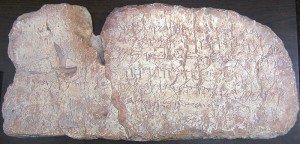
Siloam Tunnel inscription records when workers from the 8th Cent. B.C. met when digging from opposite directions. The inscription is now located in the Istanbul Archaeological Museum
When skeptics claim that Bible believers are biased, they are right. The truth is we all are biased, skeptics included. Some may be more aware of their own bias than others, but we all have our biases.
I am fascinated with stories of people who had one “bias” at one time and changed to the opposite “bias”. It happens both ways: atheist to believer/believer to atheist. Someday I will explore the similarities and the differences in those stories. There are some common threads, but that is a topic for another day. Continue reading “Bias is Revealed in What we Consider and Fail to Consider”→
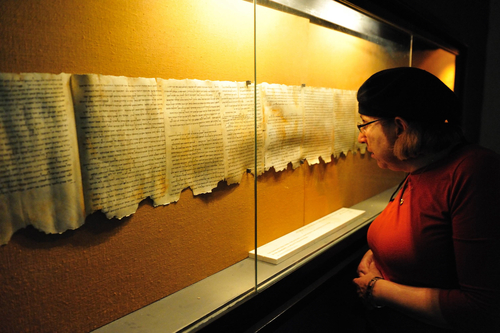
The Dead Sea Scrolls on display at the caves of Qumran that located on the edge of the Dead Sea in Israel.
Many people say they “do not believe” the Bible. But, what does that mean? The Bible is an ancient document that has been around in virtually the same form for centuries. For instance, the Dead Sea Scrolls reveal that the Old Testament has changed very little since well before the tie of Jesus. Less than 1% of the substance of the Bible has changed since the time of Jesus.
Some people argue over which writings should be included or not included in the canon that we call the Bible. The writings that are included in the current iterations of the Bible have been established for at least 1600 years. They were largely settled by consensus for at least a couple hundred years before that,
The Bible is an historical record of people and places. Many of those people and places and some events have been cross referenced by other sources, including Babylonian, Assyrian, Hittite, Roman, and other sources. Archaeological finds have also verified many of the people and places in the Bible. People may argue whether every person and place referenced in the text is actual, accurate and factual, but few people seriously argue that it has no historical value.
The Bible is also a collection of stories, poems, songs, and sayings (wisdom literature). As literature, it is full of imagery, compelling stories and words of wisdom. It has great literary value.
The Bible is a collection of writings covering a span of about 1600 years by many authors focusing on particular people group in a particular geographical area of the Middle East during a particular time period in history. Some of the writings purport to be relatively contemporaneous accounts, and others seem more like historical accounts when they were written.
The writings that comprise the Bible have been collected and preserved as sacred text. Scribes were carefully trained to copy the manuscripts. Those scribes devoted their lives to the careful transcription of the text from generation to generation.
What is most likely meant when people say they “do not believe the Bible” is that they do not believe the Bible is the “Word of God”. People do not believe it is divinely inspired. People do not believe that the Bible is the revelation of God to people.
When people say the do not believe the Bible, they most likely mean they do not believe the Bible can be taken at face value. At face value, the writings of the Bible purport to a collection of God’s communications with a certain group of people, in a particular region of the world, over a particular time span in history.
Various people have various theories about the Bible. I have even recently heard people say that the Bible was put together by Roman dictators to “control the people” by giving them something to believe in. There is little to no scholarly support for that position by the way, but this theory and other theories abound.
Most scholars agree that the Bible has cultural, sociological, literary, and other value. Though people disagree over the degree to which the Bible has historical value, it does have some historical value as any ancient text does.
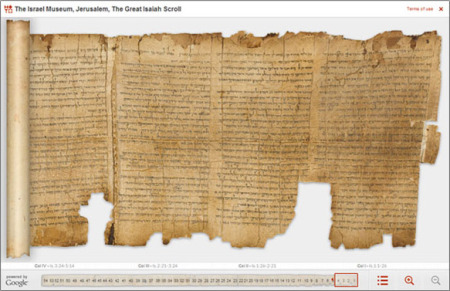
Significantly, the evidence suggests that the Old Testament writings pre-date the first Century. The Dead Sea Scrolls, which pre-date the First Century, include manuscripts from every book in the Old Testament except for Esther. Among the manuscripts found in the Qumran caves that we call the Dead Sea Scrolls, was a complete scroll of the Book of Isaiah dating to at least 200 BC that is virtually the same as the “book of Isaiah” we have preserved in modern Bibles.
It is fact that the Bible is by far the most well-preserved and well-attested ancient text in the history of humankind. We have more ancient manuscripts of the Bible, by a large volume, than any other ancient text. The volume of New Testament manuscripts is stunning compared to any other ancient text.






 Navigating by Faith