Counter-Critiquing the Moral Argument for God

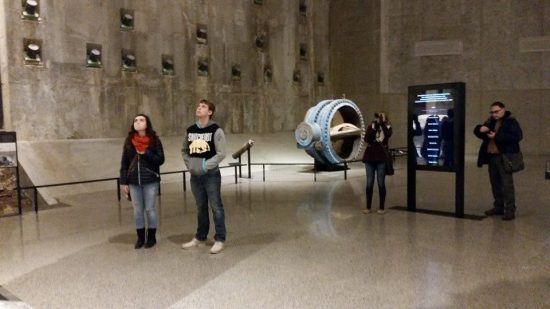
At the 9/11 Museum underneath the World Trade Center

The moral argument for God is one of the basic arguments for proving that God exists. In this piece I follow a critique Dr. William Lane Craig presents of a critique done by Richard Dawkins of the moral argument for God. Continue reading “Counter-Critiquing the Moral Argument for God” →

One Too Many Gods

The idea that there is no God to interfere with our freedom to do what we want may be as much the product of wishful thinking as the idea that there is a God who loves us.

 (c) Can Stock Photo

(c) Can Stock Photo

A.C. Graying, in The God Argument, the Case Against Religion and for Humanism, claims that religious belief is really just wish fulfillment. The book accepts the premise that many atheists and agnostics assume, which is that people believe in God for psychological reasons. I would add that people believe for emotional reasons as well, but generalizations usually belie a different truth.

The wishful thinking premise is a common assumption and is often used to undermine the basis of faith. But does it really support the point it boasts of making: that faith is the product of wishful thinking? Continue reading “One Too Many Gods” →

Musings on Shakespeare and One Less God

 (c) Can Stock Photo

(c) Can Stock Photo

Stephen F. Roberts famously said that we are all atheists, he just believes in one less God (or less gods) than others. It is a rather clever statement that many self-described atheists or agnostics have repeated, but it’s more kitsch than substance.

Atheism could be defined as belief in no God, but atheists often object to that because they don’t perceive themselves, or don’t want to perceive themselves, as believing or having faith in anything. That’s absurd, of course. We all believe in something – even if we only believe in the material world and our ability as humans to comprehend it. Continue reading “Musings on Shakespeare and One Less God” →

Atoms, Empty Space and Opinion

N. Dakota Sunset - Alex Fleming 2


I am a follower of Christ, and a believer in truth. Not that I have a monopoly on truth. Truth is truth, I like to say. Facets of it are available to everyone at all times.

Truth might be overrated. I say that only partially tongue in cheek.  Jesus says He is the way, the truth and the life, so truth is only part of the equation – even for Jesus.

This is also a truth: there is nothing new under the sun. To “prove” that statement, I offer Democritus, who lived centuries before Christ and millennia before “modern” scientific discoveries.

He might have been a typical modernist, eschewing any reality but matter and energy, but for the fact that he was born in another era, and he believed in gods.

Iron age ignorance is what moderns call it now. That fits into the opinion part, between atoms and empty space.

I think we take comfort, or try to, in the vastness of time and space. It leaves a lot of room to stretch out. We don’t like being hemmed in. Me included.

But, there is this nagging small voice. Continue reading “Atoms, Empty Space and Opinion” →
Ramblings on Faith and Unbelief

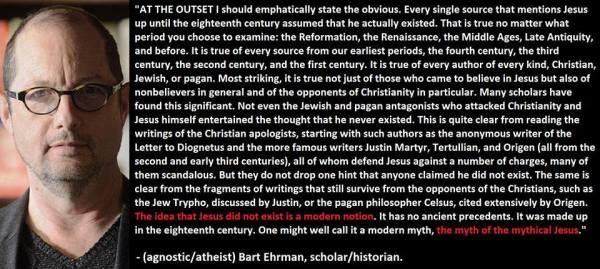
Bart Eherman Quotation


I became a believer, and then a follower, of Jesus Christ in college. It wasn’t just academic for me, though the beginning of my life as a believer and follower of Jesus began in an academic environment and was shaped and influenced by academics. I think that’s why I like the academic pursuit of faith even now, over 30 years later.

It’s important for me to be mindful that faith is not purely an intellectual affair. I think I may differ from many people in that respect, but I need to constantly be reminded of it. Faith is a relationship with the Living God; faith is a life and heart commitment; faith triggers action and change or it isn’t real faith.

I know that the words intellectual and faith probably don’t fit together in the minds of some people. Some people see those terms as opposites. They aren’t, but they can chaff with each other at times. Intellectualism, for instance, really does get in the way of faith (more so in fact than the other way around). Faith and intellectual pursuit can be perfectly compatible unless we compartmentalize them and pit them against each other.

Faith, or the lack thereof, depends on something other than intellectual coinage.  Continue reading “Ramblings on Faith and Unbelief” →