Fear, Love and the Spirit of God

Image ID: 86629260 Copyright: photoholic

The apostle, John, wrote, “Perfect love casts out fear.” (1 John 4:18) This was written by a man who, when the chips were down for Jesus, scattered in fear with the rest of the apostles. As Jesus tried to tell them of the need for him to die and be raised from the dead, something the apostles did not understand, he predicted they would all forsake him.

“You will all [i]fall away because of Me this night…. (Matthew 26:31)

Peter might have pumped his chest with bravado as he protested that others might leave Jesus, but he would never leave. (Matthew 26:32-33) But, Jesus knew better than Peter knew himself. He predicted that Peter, though swearing allegiance at that very moment, would deny him not once, but three separate times. (Matthew 26:34)

So great was the fear that overtook the disciples that they scattered after Jesus was taken by the Roman soldiers. Even Peter, who didn’t scatter, but stayed back to witness the interrogation, beatings, mocking and humiliation to which Jesus was subjected, denied that he knew him… three times.

Fear is a powerful emotion. It can overwhelm us and cause us to stumble from the path that we know is right. How do we overcome fear?

Continue reading “Fear, Love and the Spirit of God”

Timing the Walls of Jericho

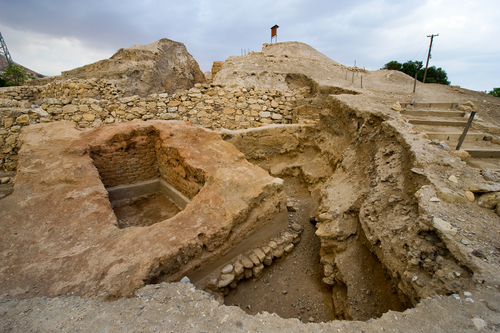
Image ID:73289745 Copyright: Buurserstraat38
Old ruins in Tell es-Sultan better known as Jericho the oldest city in the world

I recently attended a conference at which Ted Wright, an archaeologist, presented information related to the exodus of the Jewish people from Egypt and the later conquest of the area of Canaan. Ted Wright has participated in the excavation of Jericho and Khirbet el-Maqatir, thought to be the modern location of the city, Ai, mentioned in the Bible. One thing that Ted Wright said, which has stuck with me, is that modern archaeology continues to affirm people, places and other information contained in biblical accounts.

As an example, Ted Wright recounted the story of an archaeologist, John Garstang, who excavated Jericho in the 1930’s. Garstang concluded that the site dated to 1400 BC, consistent with the biblical account (John Garstang, “Jericho and the Biblical Story,” p. 1222.):

“In a word, in all material details and in date the fall of Jericho took place as described in the Biblical narrative. Our demonstration is limited, however, to material observations: the walls fell, shaken apparently by earthquake, and the city was destroyed by fire, about 1400 B.C. These are the basic facts resulting from our investigations. The link with Joshua and the Israelites is only circumstantial but it seems to be solid and without a flaw.”

Ted Wright observed in his talk that most of the battle in modern archaeology is not whether places, like Jericho, really existed, or the happening of events, but rather the timing of when they existed and happened. Continue reading “Timing the Walls of Jericho”

When Sin Crouches At the Door

depositphotos Image ID: 39910063 Copyright: ectorass

“If you do well, will you not be accepted? And if you do not do well, sin is crouching at the door. Its desire is for you, but you must rule over it.” Genesis 4:7

We know the story of Cain & Abel. They were the sons of Adam & Eve. They both offered sacrifices to God. Cain gave an offering from “the fruit of the ground”, and Abel of the “fat portions”[1] from the “firstlings”[2] of his flock. (Genesis 4:3-4) All was good, right?

Well, no. God “regarded” Abel’s offering, but didn’t “regard” Cain’s offering, and that is when the problem started. Cain became angry[3], and his “countenance fell”. (Genesis 4:4-5) We know the rest of the story: Cain ends up killing Abel.

Lest we be tempted to think that we don’t need to pay attention to the details of this story because we aren’t like Cain – we would never kill anyone – consider these words of Jesus:

“You have heard that the ancients were told, ‘You shall not commit murder’ and ‘Whoever commits murder shall be liable to the court.’ But I say to you that everyone who is angry with his brother shall be guilty ….” (Matthew 5:21-22)

Anyone who has ever been angry with another person, might do well to consider the details of the story of Cain and Abel.

Continue reading “When Sin Crouches At the Door”

To Be Immortal by Mitch Teemley

High School graduation was a big deal. We were adults, and underclassmen suddenly seemed so young. En route to prom, my lacey-gowned girlfriend and I were asked if we were married. Married? That’s what grown-ups do! A few days later, I threw an all-night party, something my parents had never let me do before. Why […]

via To be Immortal — Mitch Teemley

Before (or maybe after) reading Mitch’s great piece, To Be Immortal, consider that the greatest writers in history have returned again and again to that well of desire for immortality (or is it posterity? or maybe just fame?).

Shakespeare in his famous Sonnet XVIII rued that “summer’s lease hath all too short a date” while clinging to the consolation that his “eternal lines” would live “so long as men can breathe, or eyes see” and give some sense of life to Shakespeare, the poet, longing to live on in his poetry.

And Keats, in his Ode to a Grecian Urn, sought some “immortality” by his lines immortalizing the Grecian urn. But what immortality did he earn? Some fleeting fame in his own time? Some lingering posterity lasting so long as men breath?

William Wordsworth, in Ode on Imitations of Immortality, wondered, “Whither is fled the visionary dream? Where is it now, the glory and the dream?” While “heaven lies about us in our infancy” the “shades of the prison-house begin to close” even “upon the growing boy”; and the light and joy and vision the boy beholds, the man see “die away and fade into the light of the common day.”

Emily Dickinson and many others waxed on about death and dying, mortality and posterity, and the longing for immortality has lurked in those themes since the beginning of human time.

But, God it is who made everything beautiful in its time and put eternity into our hearts. (Ecclesiastes 3:11)

Like the Grecian urn will someday return to dust, the lines by which the greatest writers among human kind sought their own version of immortality will cease to be known. Time will take them. Men will breath no more. The science by which we gain vantage into the wonders of the universe as certainly show us that our end is inevitable.

Our immortality does not lie in the art that men can mold with their hands or the lines they can pen. Immortality lies in something more transcendent than crafted artifacts of dust that to dust will return or lines fading from the finite consciousness of men.


On the Proposition of Looking for God

In the context of searching for God, if I can’t “find God”, does that mean God doesn’t exist?

If I can’t find something I am looking for, does that mean it doesn’t exist?

In the context of searching for God, if I can’t “find God”, does that mean God doesn’t exist?

My inability to find something I’m looking for is not proof that the thing I am looking for doesn’t exist. Ask my wife. She will often describe an object to me and asked me to go retrieve it for her. I am reluctant to say how many times I have come back without what she sent me to retrieve. I might even be embarrassed to admit how many times I’ve wanted to tell her that the object doesn’t exist (before she walks right up to it and grabs it herself).

How many times have we said to ourselves when looking for something, “It isn’t anywhere!”? Do we mean, literally, that the object isn’t anywhere? Not usually. Intellectually we know that it is somewhere, but we just can’t find it.

Maybe I am looking in the wrong place. If I’m looking for an object I’ve never seen before, maybe I have the wrong picture of the object in my mind and I am not looking for the right thing. Maybe the object isn’t where I thought it was. Maybe the object is hidden and needs to be uncovered.

These examples are allegorical when it comes to the idea of searching for God.

Continue reading “On the Proposition of Looking for God”