God’s Special Purpose


God reminds us who He is because we are creatures, the product of His creation, and we could not understand God without Him revealing Himself to us. We also could not understand purpose in our lives apart from the God who made us, and it turns out that He made us for a special purpose.

Among the various revelations that can be read in the various writings we call the Bible is the revelation of a God who created humankind in His own image. We reflect many of the characteristics of the God who fashioned us. Perhaps of greatest significance is the ability He has given us to govern our own wills.

We can choose to see and relate to God for who He is. We can choose to be the captains of our own souls. We can either commit ourselves to our God and Maker, or we can choose to go our own ways. If we choose to go our own ways, however, we go it alone; we wander alone without the blessing or grace of the God who made us.

“Return to me, for I have redeemed you”

Isaiah 44:22

This is what God says through the prophet, Isaiah.  The God who gave us this capacity to accept Him or reject Him, calls us to Himself.

In the end, God is all that we could want, all that we are made for and all that we ever need. In Him is love and peace and eternal life.

God is ever reminding us who He is. Our destiny rests on our willingness to grasp this reality and to submit ourselves to it.

We will not need to be told to “sing for joy….” (Is. 44:23) when we do submit and yield to our Maker because in Him is our joy. It is the natural expression of the child returning home to her Father. God is who He says He is, and God reminds us who He is in His lovingkindness.

Limitations in Science and Logic and the Leap of Faith

Science and reason and the measures available to finite beings can take finite beings only so far in determining the existence of a non-finite God.

Photo from ChristianPics.co


I recently had a short exchange with a friend who is an atheist over an article I wrote about science and faith. He is intimating familiar with the world of science, his father being a scientist, and he making a living on scientific principles.

He found my article and analysis of atheism and science to be colored by my faith. And, of course it is, just as his view of religion and science is colored by his atheism. We all start with basic assumptions, and they color the world as we see it, the atheist no less than the theist.

He views God as a fiction. I view God as reality, transcending all the reality I think I know. We couldn’t be more opposed in our views of the world, though our different views do not mean we cannot be friends and learn from one another.

I suggested to him that both theism and atheism are rational conclusions, but the conclusions depend on the starting places. These ideas come from philosophy, and specifically from Immanuel Kant and Søren Kierkegaard.

Kant, in particular, set up syllogisms that were logically airtight. One syllogism proved the existence of God, and the other syllogism proved the nonexistence. He showed that both atheism and theism can both by logically “proven”. Syllogisms reaching both conclusions can hold up logically. The only difference is the starting premises.

To put it more simply: if you start with a premise that assumes God, a logical syllogism can be constructed that proves the existence of God. If you start with a premise that assumes no God, a logical syllogism can be constructed that proves the nonexistence of God. This is an oversimplification, but it makes the point.

How, then, does a person resolve the tension between these diametrically opposite conclusions? Logic cannot suggest an answer to this conundrum because logic can only operate on the basis of premises, and the premises with which we start make all the difference.

If we could determine which premise is correct, we would be well on our way, but it turns out that this is easier said than done. What then?

Science doesn’t help us either. Science is, by definition, the study of the natural world. God is, by definition, “other” than (“outside” from) the natural world.  Science can take us back to nanoseconds after the Big Bang, but we can peer no further into our past. We can’t see the very beginning, and we can’t see beyond it.

We can’t see through the lens of science and our senses beyond this natural world, and this leads many, like my friend, to conclude that nothing exists beyond the natural world. It’s a fair conclusion, to be frank.

But it’s a bit short sighted. Why we do presume that our mental faculties, finite and limited as they are, have the capability of determining the measure of all reality that we did not create?

How do we know if there is anything beyond the natural world? How do we know if there is a God?

Continue reading “Limitations in Science and Logic and the Leap of Faith”

Of Monuments, Saints Stephen and God, Our King Forever

We build monuments to kings, and even sometimes to martyrs, but only God endures.

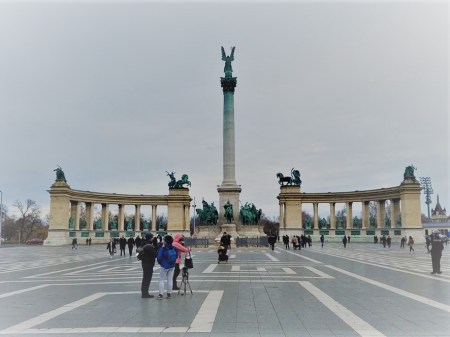
Heroes Square Budapest, Hungary

I recently returned from a trip to Budapest Hungary. Traveling to foreign lands and meeting foreign people expands our horizons and opens us up to new perspectives, and sometimes helps us to understand ourselves better.

I didn’t know much of Hungary before we left, not nearly as much as I know now. We had the intimate advantage of a guided tour by our own daughter who is living there now. She regaled us with some of the rich history that is proudly displayed throughout the sprawling city.

Budapest is a City full of strong, stately buildings and monuments to its past, good and bad.  We have our own monuments to the past that are no less stately, though many centuries more recent, but viewing the unfamiliar Hungarian monuments got me thinking.

Why do we do this? Why do we erect such proud monuments to our past?

Continue reading “Of Monuments, Saints Stephen and God, Our King Forever”

Reflections on Gauging the Light and the Dark

Though we have the greatest intellectual and cognitive faculties of any other creature in the world (that we know), we are limited in our knowledge and ability to understand.

Depositphotos Image ID: 80301160 Copyright: SergeyNivens

I’ve heard the following Chinese parable a couple of times. It’s on my mind today:

An old farmer who had an old horse for tilling his fields. One day the horse escaped through the fence. When the farmer’s neighbors sympathized with the old man over his bad luck, the farmer replied, “Is it bad luck? Good luck? I don’t know?”

A week later the horse returned with a herd of wild horses from the hills. This time the neighbors congratulated the farmer on his good luck. His reply was, “Is it bad luck? Good luck? I don’t know?”

The next day, when the farmer’s son attempted to tame one of the wild horses, he fell off its back and broke his leg. The neighbors came around again and commiserated with the old farmer about his very bad luck, but the farmer’s reaction was, “Is it bad luck? Good luck? I don’t know?”

Some weeks later the army marched into the village and conscripted every able-bodied youth they found there. When they saw the farmer’s son with his broken leg they let him off. Now was that good luck? Or was it bad luck?

We like to jump to conclusions, and we have a tendency to jump to those conclusions pretty quickly. We do this even with ultimate, worldview positions. We have a tendency to want to measure everything by the tools that are convenient and familiar to us, but sometimes we need to be willing to venture off from the light of our comfortable positions into the darkness of unfamiliarity to gain a bigger perspective.

Continue reading “Reflections on Gauging the Light and the Dark”

Top Ten Navigating By Faith Articles in 2017

Depositphotos Image ID: 57089233 Copyright: seenaad

As I reflect on the past year and look forward to the coming New Year, I am somewhat surprised by the top ten blog articles on this site based on the numbers. Many of the them are articles written in prior years. Only two of the top ten were written in 2017, and those are at the bottom. Six articles were written in 2015. I am not sure what that says about how I am trending as a writer!

For all of the people who have stopped by, read an article or two and for those who responded by a “like”, a comment or a share of what I have written, thank you! I have enjoyed getting to know some of you through your own writing, and I look forward to reading what you have to say in the coming year.

Top Ten Blog Articles of 2017

1.    The Ebla Tablets Confirm Biblical Accounts (2015)
2.    It is Well with My Soul: The Story (2014)
3.    C.S. Lewis on Individualism, Equality and the Church (2015)
4.    The Message in the Earliest Creeds in the New Testament (2015)
5.    The Story of Norma McCorvey (aka Jane Roe) (2015)
6.    Tuning In To God’s Frequency (2016)
7.    What if God is Cruel (2015)
8.    Timing the Walls of Jericho (2017)
9.    Have Christians Lost the Moral High Ground on Immigration? (2017)
10.   My Journey (2015)