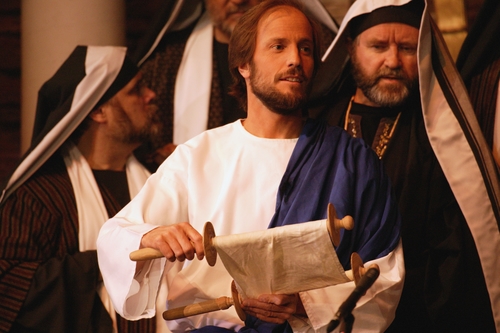
Is Jesus God? Part 3

What did the people closest to Jesus and those who were opposed to him think that Jesus was saying about himself?


Jesus said to his followers, in no uncertain terms, “You shall worship the Lord your God and serve him only.” (Luke 4:8, quoting Moses Deut. 6:13) Why, then, do Christians have this notion that Jesus was God?

That is the question being addressed in this blog series. The question was introduced in the first piece: Is Jesus God? Part 1. The question is being posed as part of a series of questions, that is being discussed among over 800 churches presently in the Chicago area. (See exploreGod) In the second blog post, Is Jesus God? Part 2, I covered the things Jesus said about himself.

In this third installment on that question, I will review what others said about Jesus in his time, both those who followed him and those who opposed him. The statement Jesus made about worshiping and serving only God is important to consider in light of the claims Jesus made about himself as well as the way other people reacted to Jesus.

Surely Jesus would not deign to suggest that he was God after making such a statement, right? How could his followers be confused about his deity? (If, indeed, there was any confusion.) What did others say about him? And how did they relate to him?

Continue reading “Is Jesus God? Part 3”

God’s Love is Not Platonic

The love that God offers is relational, intimate and personal.


John the Apostle, a Hebrew from a remote province in the Roman Empire, lived a long life. The other apostles died premature deaths, but John, a typical Hebrew, lived long enough to be elevated out of his provincial Jewish world by the God who created it. His writing, as much as any of the New Testament authors, has a strong philosophical theme, but that philosophical theme is no abstract intellectual construct.

John the one-time fisherman became familiar with the greater Greco-Roman world by which the Palestinian province of his birth was governed and influenced. That familiarity is reflected in the Gospel that bears his name.

His gospel begins philosophically: “In the beginning was the Word”, the Logos.  (John 1:1)  The word, logos, carried poignant philosophical meaning in the Greco-Roman world. John’s use of that word to open his account of the life and message of Jesus shows that John, the provincial Hebrew, familiarized himself with that world and its thought.

This is in keeping with the instruction from Jesus to his followers to go into all the world explaining the message Jesus gave them. To go into the world, we have to become familiar with it and conversant with the thought that predominates in the world to which we go.

Though John’s Gospel begins philosophically, focusing on the loaded word, logos, he didn’t have the abstract notions of philosophy in mind. John’s use of that word pointed outside the Greco-Roman world and transcended it.

Continue reading “God’s Love is Not Platonic”

The Place for Experience in the Mix of Science, Faith and the Evidence for God

When asked what would make them believe, some atheists say a personal experience with God would do it.


On the show and podcast, Unbelievable! On Christian Premiere Radio in the UK hosted by Justin Brierley, the host often asks people, atheists and Christians, what would make them believe (or not believe, as the case may be). Most people think of arguments or historical or scientific proofs, but not everyone.

In one particular episode Michael Ruse, a professor and philosopher of biology at Florida State Universality, participated in discussion with John Lennox, a professor of mathematics and philosophy at Oxford, on the subject of Science, Faith and the Evidence for God. When asked the question about what would make him believe, Michael Ruse surprisingly (for me at least) said that it would have to be a personal experience with God.

Michael Ruse is a Fellow of the Royal Society of Canada and the American Association for the Advancement of Science. Ruse is an evolutionary biologist who has debated against intelligent design proponents. He has been on the Advisory Council to the National Center for Scientific Education. He is a Bertrand Russell Society award winner for his dedication to science and reason.

Thus, my surprise to hear him provide such an “unscientific” answer to the question of what it would take for him to become a believer. I have since heard other atheists provide similar answers. Intelligent Christians, I think, underestimate the power of personal experience.

To be fair of Michael Ruse, though is a decided atheist, he has a healthy respect for theology. Maybe that is because he is a philosopher, and not just a scientist.

I say “just a scientist” because there is a school of thought among modern scientists that we don’t need philosophy anymore, that science is all we need. (People like Richard Dawkins and Neil deGrasse Tyson have expressed this view.)

But science, by definition, is limited to the study of the natural world, matter and energy (or “molecules in motion” as some like to say). Anyone who makes the claim that science is all we need has made an a priori determination (an initial presupposition) that molecules in motion are the sum of all reality. Neither theology, nor philosophy, fit into a world like that. And, where, then, does that leave mathematics and logic?

Michael Ruse, being an expert in philosophy takes great offense at the notion that philosophy has gone the way of God and is dead (alluding to Nietzsche’s great contention). It’s natural for a philosopher to take that position, I suppose, even an atheist philosopher. After all, he has devoted his life to philosophy!

But then, consider that he knows something of what he talks about. Just as scientists know a great deal more about science than me, a philosopher knows a great deal more about philosophy than, well… a scientist (who studies only molecules in motion). It isn’t hard to understand why such a person might begin to see the world as nothing but molecules in motion when that is the constant and continual focus of life long study, but the theologians and philosophers, even atheistic one, protest there is more.

Continue reading “The Place for Experience in the Mix of Science, Faith and the Evidence for God”

The Ebla Tablets Revisited

Ruins of the outer wall of Ebla and the “Damascus Gate”

One of the most popular articles on this blog is The Ebla Tablets Confirm Biblical Accounts. Though it was posted in 2015, it was still the most read article on the blog in 2016 and 2017 and was still third on the list in 2018.  Perhaps, that is why I feel prompted to revisit the subject today.

Digging a little bit deeper into the subject (pun intended), I found a 1979 Washington Post article that boasts no biblical claims. (Literally, it’s in the title.) The article asserts that, after initial enthusiasm that the tablets would reveal biblical treasures, “three years of intense study” disclosed no biblical claims. Dr. Robert Biggs, professor of Assyriology at the University of Chicago’s Oriental Institute, announced the verdict, “People who are looking to the Ebla tablets for proof of the authenticity of the Bible are going to be sorely disappointed.”

At the time of the article in 1979, 11,000 tablets had been discovered dating from 23 centuries before Christ in the ancient Sumerian city of Ebla in what is now northern Syria that was destroyed by fire around 2300 BC. Of course, only 48 tablets had been translated and published at the time of the article. While Professor Biggs was quick to render a verdict against the Bible, other scholars were not as quick to jump to judgment as noted by a Smithsonian expert who speculated at the same time that Ebla tablets may support the historicity of the Patriarchal narratives, “but we won’t know for decades.”

Fast forward to 2015, the number of tablets recovered from the ancient library in the ruins of Ebla had increased to 15,000, and the early verdict that they contain no “biblical claims” is much in doubt. (See Controversial Discovery: 15,000 Ancient Ebla Tablets Prove Old Testament To Be Accurate) The current number of tablets and portions of tablets may be closer to 17,000, and assessments are changing,

Continue reading “The Ebla Tablets Revisited”

Perspective and Worldviews

We should not hold on so tightly to our own perspectives that we cannot be molded by God’s eternal perspective and gentle hand.


It’s always interesting to listen to people who come from outside our own circles. I have become a religious listener of the Unbelievable Podcast hosted by Justin Brierley in the UK. The difference of perspective that is driven by our different experiences, individual, familial and cultural, is the subject of this piece.

Two recent podcasts come to mind. The first included two Christians, one with an egalitarian view on women and the other with a complimentarian view on women (Unbelievable? #MeToo and the Church: Egalitarian vs Complementarian • Natalie Collins & Phil Moore). The egalitarian position is the progressive view, and the complimentarian position is the conservative view. That seems obvious enough. What interested me was not only the difference in opinions, but the influences that shaped those opinions.

The other podcast (Unbelievable? Render unto Caesar – Should the church keep out of economic politics? Andy Walton vs James Price) involved two more Christians, one with a view that the church should speak to politics, and another with a view that the church should not speak to politics, but should stick to theological things. These guys, being from Great Britain, turn the American views of these things on their heads. Thus, a difference in perspective that prompts me to write this blog piece.

Continue reading “Perspective and Worldviews”