
I have been meditating on the hiddenness of God lately and leaning into the mystery of God’s hiddenness. I am intrigued by it. The Bible is forthright about the hiddenness of God.
As I think about the hiddenness of God, the mind of the skeptic plays in my ear: “How do you know God exists? Why does God seem hidden? Maybe it’s because He doesn’t exist!” Believing in a “hidden” God is belief without evidence; it’s belief in the teeth of the evidence (as Dawkins says).
My response is that we all have faith in our basic assumptions about reality. The scientist assumes only matter and motion. He sees evidence for things like gravity and neutrinos, and dark matter and dark energy that cannot be seen. The scientist reasons to the best explanation for the things that cannot be seen in order to make sense of the reality in the world, and he does so within the “limitations” of materiality.
Science, after all, is the study of the material world. That is is the scope of science as it is defined in the modern world. Science is based on what is quantifiable, measurable, observable, and reproducible.
When I do theology or philosophy, I also start with assumptions. I start with an assumption, or a theory if you like, that God exists. The proof of God, however, is necessarily different than scientific proof.
God is not a substance in the universe to be quantified, measured, observed, or reproduced in the way we can study the natural world. He is not a component of the universe. He is not comprised of matter and motion like the universe. God is not a principle of physics that can be observed in its regularity and tested by its regularity.

If God exists and created the universe, He is separate and apart from the universe. That does not mean that God is not present in some way; it means that He is not present in the same way that you and I are present. Rather, God is transcendent. He is imminent (near in some way), but not contained within the creation.
God also must have agency to have determined to create. We understand the necessity for agency by our own agency. This makes sense of the question: why is there a universe; why is there something, rather than nothing.
For the life of me, I can make no sense of the assertion that a universe can create itself. What kind of voodoo magic is that? That conclusion is based on an assumption that matter and motion is all that exists, but we cannot prove that assumption.
To say that God must have agency is not to be anthropomorphic about it but to reason to the best explanation based upon what we know, which is our own agency and the way we conduct ourselves in the world. Where does a universe come from? The simple answer is that it comes from a creator who has agency, who has intentionality, and the ability to will and to act according to His purpose and design.
Where does intricate, fine-tuned complexity that is complex to the nth degree come from? It comes from a mind, from a creator who conceives a plan and then implements it. We know that from the way human beings create things. Where did we get that capacity? Like things produce or reproduce like things.
We know that the universe is “winding down”. That is what the law of thermodynamics tell us. Entropy is the rule. This means the universe is not getting more complex; it is breaking down, evening out, cooling, and becoming less complex over time.
Over course, this is occurring over a very, very long period of eons, so (perhaps) there is enough energy in the universe for complexity to form in areas of the universe even while entropy is working its very long way toward the inevitable heat death of the universe as a whole.
Maybe, but where did the energy come from to cause the so-called Big Bang? What triggered the universe to begin to begin with?
No one can explain that who doesn’t believe in a “Big Banger”, a Creator. It is the best explanation that we have. It makes the most sense of the reality that the Universe had a beginning.
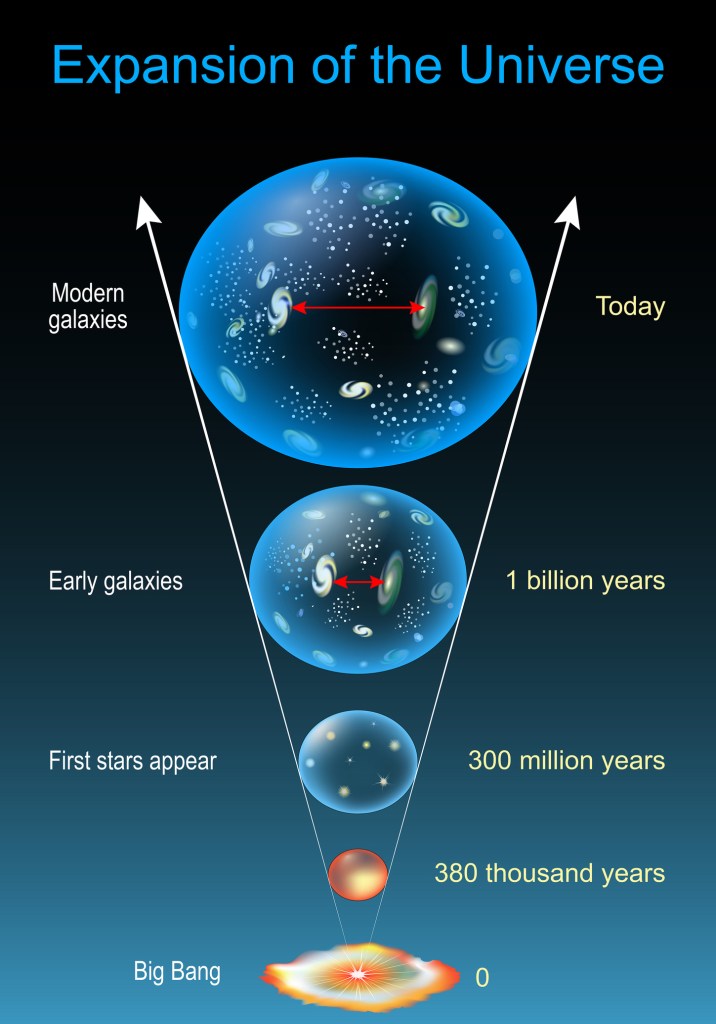
The multiverse doesn’t solve the “problem” of a beginning. It just kicks the can back down the road further. What triggered the multiverse into being? It’s an endless regression.
The Christian (Jewish and Muslim) conception of God is that God is the timeless, eternal being who always existed and was never created who chose to trigger the universe (or multiverse) into existence.
This, frankly, makes much more sense than a past eternal, non-sentient universe that just poofed life into existence. How do you get life from nonliving matter? What animates that matter?
But the questions don’t stop there. What triggers consciousness from inert, non-conscious matter? How do the fundamental “building blocks” of matter develop consciousness? It’s a complete mystery, and there is no mechanism known to modern science to explain it – other than the brute fact that human beings and (to some lesser degree) animals (and maybe plants) are conscious beings.
Consciousness is proven by the sheer fact that we are conscious of ourselves. It seems to “reside” in or be attached to the brain, but the brain by itself is not consciousness. The brain is a perfect, intricate receptacle for consciousness, but the brain and consciousness are not perfectly coexistent. They are not the same things, and science has no adequate explanation for that.
Because these things suggest looking outside the limitations of the material world for our answers, we have theology and philosophy, which can be “scientific” loosely in method and approach, but defies the limitations of scientific inquiry.
That doesn’t mean that theology and philosophy should be divorced from science (or that science should be divorced from theology and philosophy). All reality must ultimately cohere harmoniously, or we cannot call it reality.
But, I have digressed (only slightly) from the point, which is the mystery of the hiddenness of God.

It seems obvious to me that the kind of God conceived in the Abrahamic religions would be largely “hidden” to created beings such as us. We are finite beings located in a given space and time with VERY limited perspective. That we have an amazing capacity for reasoning and understanding does change the fact that our perspective is severely limited compared to the vastness of time, space, and matter.
If such a God is Other than the universe created by Him, and we are locked into that universe, our perspective is limited indeed. Our perspective is limited even in the universe in which we live because our presence in the universe barely amounts to a mist in the eons of time and sheer immensity of space. We can barely observe five percent (5%) of the known universe. approximately, ninety five percent (95%) of our universe consists of dark matter and dark energy of which we know precious little, other than its effect we can see over the little bit that is observable to us. We would naturally have a very, very difficult time understanding and relating to a God who created the universe, which itself stretches our understanding and capacity to know.
Of course, the skeptic will say that such a God could make Himself easily known. I actually agree with that. I think such a God could, indeed, make Himself evident to us.
Perhaps, God could make Himself known like a human is evident to an ant. If an ant had the relative reasoning capacity comparatively of a human to God, how would the ant perceive us? We can speculate about it, but we can’t really know. It also isn’t really even a fair comparison. Both humans and ants are part and parcel of the universe. God remains “outside”, transcendent, and infinitely Other.
The fact that we are living, conscious, creative, capable of rationality, relational, and have a sense of agency are all indicative of the source of our existence. We are the proof of the existence of God. We can reason from our own capacities to grasp that the source or our existence somehow has similar characteristics – though exponentially greater in scope.
If you came across a watch on the beach, you would not we know wonder whether the watch formed there. You would assume it came from a human being, because only human beings are capable of producing a watch, and the only rational explanation is that a human left it there.

When see the complexity of language that communicates meaning, we know that a sentient being created it. This is the foundational principal of the SETI Project that has been ongoing for decades searching for intelligent life in the universe. The project is searching for code or language that displays enough complexity to carry meaning.
When we look at computer code, we know a human being created it and created it with a purpose to generate results that are designed and intended. When we look at DNA, which Bill Gates compares to computer code on steroids, we can reason to the best explanation, which is that DNA comes from a source of intelligence – a source of intelligence that is exponentially more intelligent than we are to the extent that DNA is exponentially more complex than computer code.

And, it isn’t just the DNA that communicates on the basis of complex language. Epigenetic materials in living cells communicate with DNA and other components of cells in an interrelationship that rivals factories, cities, and civilizations in complexity.
There may even be some uncanny form of “consciousness” or “programming” in all those intricate, parts that drive them to protect the life and replicate it of which each part is only a very small component of a mind-bogglingly complex system of life.
The “language” of life is an indicator of intelligence with agency. If we are to look for another “culprit” (explanation) in all the universe, what would it be? What other possibility is there of what we know in the universe to exist? Short of making up something that has no basis in the reality we see, there is nothing else.
Of course, we may discover something. Right? This is the God of the gaps argument. We may find something tomorrow that we don’t know today that explains how language, life, consciousness, and everything can form out of all the component matter in the universe spontaneously without outside input. We could, but that is pure speculation, and it requires robust faith to believe we will discover such a thing.
Even if we were to find mechanisms that explain how all of these things can be generated, those explanations do not dismiss the existence of an intelligence that designed and triggered those mechanisms into action. Like the multiverse, material explanations only kick the proverbial can back down the road further.
To finish with the mystery of the hiddenness of God, it makes perfect sense that such a God capable of creating the universe in which we live would be very difficult for us to ascertain, but the fact that we are sentient, and rational, and relational, and have some form of agency makes it not impossible. In fact, it makes it probable that we can grasp the concept that such a Being that we call God exists.
A materialist demands scientific proof of God, but such a God is not capable of being proven in the way the materialist desires, limited to proof in the material of the universe. Such proof would be like limiting the examiner of a painting to the components of the painting to prove the existence of a painter. If you can’t introduce evidence from outside the painting (like the painter, herself). It’s an exercise in futility.

Even the materialist, however, has likely painted or known people who have painted and, therefore, doesn’t doubt the existence of painters. If the materialist desires to know the painter, though, the materialist will need to extend her queries beyond the painting to seek out the painter. Even if he cannot locate the painter, he might locate people who have interacted with the painter – the more intimately the better to understand the painter. Perhaps, the materialist would even encounter the painter, herself, in the process. There is no better source for understanding the painter than the painter, herself, of course.
It begins with grasping the idea that such a God must (or just might) exist and a willingness to be open (or even just curiosity) to discovery. In other words, we start with a hunch, and assumption, a theory, but the inquiry will look different than a scientific inquiry into the natural world. We must leave the light of the natural world (despite all the dark matter and dark energy) and begin to grope about the relative darkness seems immaterial to us in our human flesh.
Again, the Bible has already anticipated this, as Paul said to the Athenians, we must seek and reach out (the word means to grope) for God in or to find/perceive God. (Acts 17:27) Naturally, if God has agency, and so is relational, this is a two-way street. We “experiment” with God by seeking, reaching out, and being receptive for Him to communicate back.
In reaching out, however, we should not assume that God will bend to our desires or purposes. We don’t approach the God of the universe with our own agendas and hope to get very far. That doesn’t mean that He will necessarily rebuff our efforts if we do, but it wouldn’t be surprising, would it?
Consider that a God who designed the universe with such complexity must have had purpose in creating it. Determining and understanding that purpose, therefore, becomes an essential aspect of our quest to find and understand God.
We should look for people who claim to have had some encounter with God, like people who know the painter, and we should look for communications from God, Himself, that will not necessarily come through the medium of the material world, though He certainly would be able to do that if He so desired.
The Bible, which purports to be communications from people who have encountered God and bears the integrity of consistent witness of people throughout the agrees who claim to have encountered God, is a revelation about God through the prism of those encounters. It is a place to start, and a place to come back to in calibrating your own inquiries.
I think Christians have gone too far in claiming that the Bible have should be treated like a textbook or code of laws or instruction manual of sorts. It doesn’t purport to be anything like that. It is filled with stories that need to be absorbed and sifted for the seeds of fruit that are in them.
It includes law (the Law of Moses) that ultimately is part of the story that points toward something beyond itself. That law is described as a tutor meant to instruct a childish faith that is intended to grow into maturity that does not need the law as its basis. Jesus said the fulfillment of the law is loving God and loving our neighbors. In a sense the law is the training wheels that are meant to come off when we learn how to ride the bike.
Because God is revealed to be relational (like us, or more accurately as reflected in us who are His creation), we learn through people who claim to have experienced relationship with God what it looks like to have such a relationship. This allows us to test the development of a similar relationship as we grope our way to find/perceive God.
We can be “scientific” about this in the sense that we do not need to settle for wishful thinking or a false hope. We should maintain our integrity in the seeking so that we can have confidence in what we find/perceive about God.
As this is getting long, I will end just as I get to the good part, but I hope I have piqued your curiosity. We have to assume that God’s hiddenness is part of His design. If He could make Himself clearly known (like a human to an ant, perhaps), but has not done that, we have to assume there is a reason – a method to the madness.
I believe the reason is that God – who is described as love itself (1 John 4:8) – desires loving relationship with us. He doesn’t want robots, and He doesn’t want mere belief. Even the demons believe, James says (James 2:19), but they bristle at God. They hate Him and oppose Him.
And that is part of His design, also, because it gives us real choice. We can choose to engage Him and to seek and ultimately to love Him – or not; because that is what love requires – freedom to choose without coercion or manipulation.

 Navigating by Faith
The big question is whether the universe we see today was created by random events or was there intelligence (i.e. “God”) behind it? Mathematics can reveal the most-likely answer. A simple cell with 250 short proteins with each protein containing 150 amino acids equates to 10**41,000 random attempts to produce 1 cell. If you assume 10**80 atoms in the universe and 10**12 atomic interactions per second over 14 billion years, you would only have 10**10 interactions… FAR short of the required 10**41,000 interactions. The bottom line in that the universe is NOT old enough to be explained by random events…. thus you can conclude there was non-randomness (i.e. intelligence… God) behind it.
LikeLiked by 1 person
That analysis seems compelling to me
LikeLike
Of all of the “proofs” of the existence of God, it is THE most compelling argument I’ve seen..MUCH more than even arguments like the fine-tuning of the the universe or multiverse. The universe is simply NOT EVEN CLOSE to being old enough to explain its complexity using a random events argument. The source of this is in a book called “What Time is Purple?”
LikeLiked by 1 person