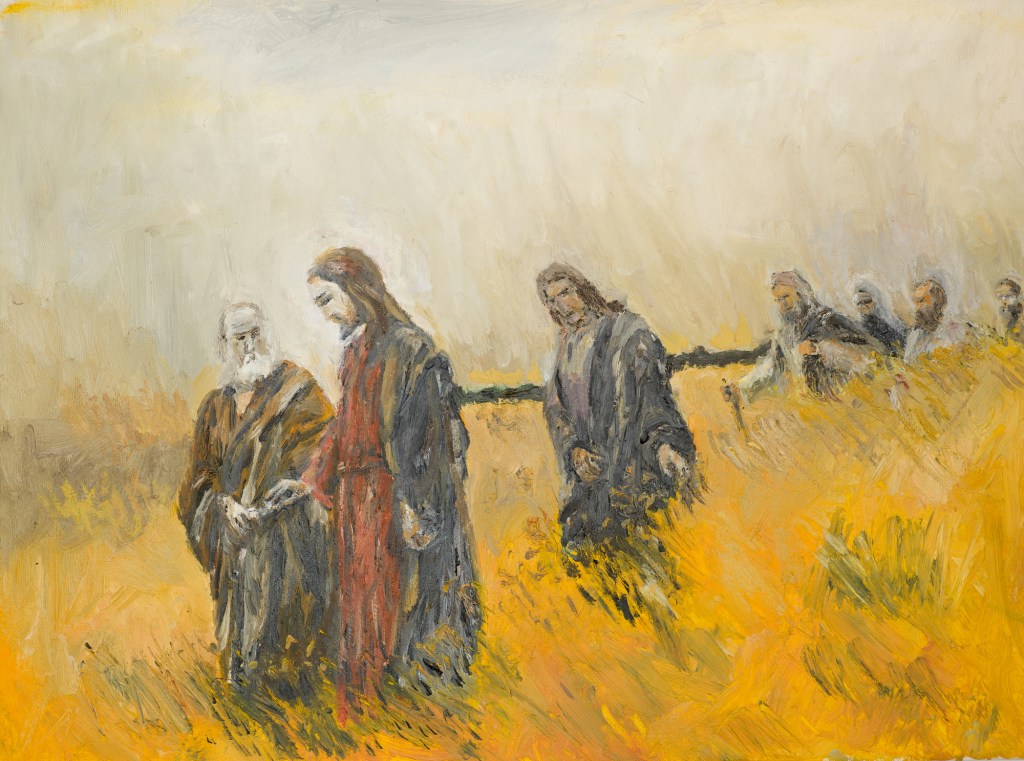
I have spent some time lately considering the various influential groups of people in the time of Jesus and the orientation of those groups toward Jesus. I have wondered why Jesus seemed to pick on the Pharisees more than the other groups, especially since they seemed most aligned with him and had the most in common with him.
As I researched and thought about the various groups of Jewish influencers in the First Century in relation to Jesus, I began to think about the apostles, and their connections to these groups. I am always mining for insight as I read Scripture, and today my mind turns toward the relationship of the twelve apostles to those same groups of First Century, Jewish influencers.
We don’t know much about the background of the twelve disciples, except that most of them were “common” men of generally humble means. One disciple was identified with the Zealots (Simon, the Zealot, also known as Simon the Canaanite). Matthew, the tax collector, might have been Herodian (or may have been viewed as one).
We really don’t know about the group affiliation of the other disciples, at least not from the explicit text. They seem to have been ordinary people with no distinct association with particular groups. They did not seem to be closely associated with any of the five groups Jewish leadership groups in First Century Judea.
Even Simon, who is known as the Zealot, probably left his group behind to follow Jesus. Just as Matthew left behind his livelihood (tax collection) to follow Jesus. Of course, Simon (Peter) and Andrew dropped their fishing nets to follow Jesus, as did the brothers, James and John. It’s no stretch, therefore, to imagine that Simon, the Zealot, would have similarly “dropped” or left behind his affiliation with the Zealots to follow Jesus.
In fact, the theme of leaving behind your group seems to run throughout the teaching and example of Jesus. Jesus said, “[E]veryone who has left houses or brothers or sisters or father or mother or children or lands, for my name’s sake, will receive a hundredfold and will inherit eternal life.” (Matt. 19:29)
He called Peter and Andrew and James and John away from their profession of fishing. He called Matthew, the tax collector, away from his profession of tax collecting. I think it’s fair to assume that Jesus called Simon, the Zealot, away from the Zealots to follow him.
The theme of leaving behind family, livelihood and group identity runs deep in Scripture, all the way back to Abram (as Abraham was originally known) when God called Abram to leave his country, his people, and his father’s household and go to the land God would show him. (Gen. 12:1)
Hebrews 11 commends Abraham for the example of faith demonstrated in responding to God’s call and leaving behind the familiarity of all the things that typically identify people and their place in the world. Abraham and all the people of faith commended in Hebrews 11 demonstrated a kind of faith that made them “aliens and strangers on earth”.
Jesus called the rich young ruler to walk away from his wealth. (Matt. 19:16-30) Jesus told Nicodemus, the Pharisee, that he would have to be born again to see the kingdom of God. (John 3:3) Nicodemus was born into an enviable position in his community and may have winced at the thought of needing to be “born again”.
The kingdom of God is something I have been mulling over for many weeks, and months. It’s a theme I have written about often lately, and it has occupied a prominent place in my meditations lately.
The five main groups of Jewish influencers in the First Century had one thing in common – they were operating on a spectrum of influential relationship to the political structures and religious structures in their world. They were invested and embedded into their positions, and identities, with the people with whom they affiliated – like the partisanship and critical group affiliations we have today.
Along came Jesus, however, and he called people “out of the world”. (John 15:18-19) Jesus called people to leave their lives, and identities, and associations behind to follow him. I believe he is still calling people to the same allegiance today.
We don’t know much about the backgrounds and affiliations of the twelve disciples, perhaps, because they did just that. They left those things behind to follow Jesus. They became known, simply, as disciples of Jesus. They were, simply, Christ followers.
I am interested in these things because of what it means for us. If we would be disciples of Jesus and Christ followers, how do these things translate to our lives in the 21s Century?
I don’t claim to know for sure, but I want to know. Like Nicodemus, I want to know how I can see the kingdom of God. Like the rich young ruler, I want to know what is necessary to inherit eternal life. These are dangerous questions, though, as the rich young ruler discovered.
When Pontius Pilate asked Jesus whether he was king of the Jews, Jesus responded (essentially), “Where did you get that idea?” (My paraphrase). Pilate replied, “Am I a Jew?” …. “Your own people and chief priests handed you over to me.” (John 18:33-35) Pilate sought to identify Jesus by his association with the Jews.
Jesus, of course, was a Jew by his background, ancestry, religious training, etc. Yet, Jesus answered Pilate this way:
“My kingdom is not of this world. “
John 18:36a ESV
Jesus did not confirm the obvious association with the Jews when Pilate pressed him. He very intentionally refused to be identified by his religious, political, cultural, and societal group in this world. Jesus had a higher calling, a more fundamental identity than his “place” in this world. His kingdom is not of this world!
Jesus said also of his followers that they are “not of the world”; rather they are chosen “out of the world”. (John 15:18-19) Their primary and fundamental identity, which overshadows and eclipses all other identities in this world, is in relation to Jesus. They are disciples and followers of Jesus. Full stop.
Perhaps, this explains why we don’t know much about them. We can’t peg them into a First Century group because they left behind their group allegiances and affiliations to follow Jesus. They were no longer of the world, and those group affiliations no longer defined them.
I meditate on these things as I read and hear about Christians in the news, including the labels pinned on them and the labels they take on themselves. I wonder if we have lost a sense of what it really means to follow Jesus. I wonder if many of us have failed to respond to Jesus calling us out of this world.
When Jesus responded to Pilate to say, “My kingdom is not of this world,” he added another statement. He said,
‘If my kingdom were of this world, my servants would have been fighting….”
John 18:36b ESV
The Zealots fought the Roman who controlled Judea. The Herodians and Sadducees aligned with Rome. The Essenes removed themselves from the Roman controlled communities to retreat to the dessert. The Pharisees lived in their own bubble, neither aligning with nor opposing the Roman government, but they controlled the religious life of common believers. They all had their group associations, and they all opposed Jesus who threatened those associations.
They were all fighting to protect their own turf, but Jesus said he and his followers are not of this world, otherwise they would be fighting for his turf also!
Interestingly, though Jesus called his followers away from professions, and status, and people groups and families, he did not call them out of community or away from society. Jesus spent time away from populated areas, especially alone, but Jesus did not set up a monastic community far from population centers, like the Essenes. He remained very much engaged with community and people.
Yet, he was distinctly not of this world, and he refused to be associated fundamentally with any particular group, not even his own cultural and ancestral tribe, His followers, also, demonstrated a similar not-of-this-worldness. They were simply, fundamentally, and primarily Christ followers. so much, that we don’t know what other associations they had with the various groups of their day.
As I look on my social media feeds, read opinions, listen to the news and absorb what is going on in the world today, I see the same kind of group affiliations – religious, political, cultural, philosophical, ancestral, and societal – as were present in First Century Judea. I also see many American Christians fighting and jockeying for position and influence in the middle of the fray.
I can’t help but think that this is not the right way to follow Jesus.
Paul, perhaps, said it best:
“Though I am free and belong to no one, I have made myself a slave to everyone, to win as many as possible. To the Jews I became like a Jew, to win the Jews. To those under the law I became like one under the law (though I myself am not under the law), so as to win those under the law. To those not having the law I became like one not having the law (though I am not free from God’s law but am under Christ’s law), so as to win those not having the law. To the weak I became weak, to win the weak. I have become all things to all people so that by all possible means I might save some. I do all this for the sake of the gospel….”
1 Corinthians 9:19-23

 Navigating by Faith