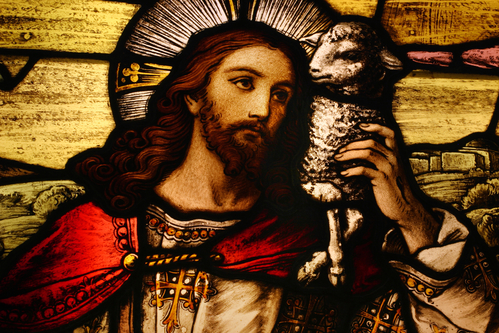
Who Was Jesus?


Who was Jesus? A friend recently asked, “Jesus was a Jew preaching Judaism. Right?” He explained his thought that the people who came after Jesus created a new religion using him as the central figure in spite of who he really was – just a Jewish man preaching Judaism.

This is a popular Internet characterization of Christianity. I am not a scholar on the subject, but I did minor in religion in college. I took all the courses for a religion major, including the thesis course, and I even did the research and wrote the thesis. I would have had a religion major if I had turned in my thesis. I didn’t do it because I didn’t need the major. I took the classes because I was interested in them. I didn’t hand in the thesis paper because I didn’t feel good about it.

A religion major at a small liberal arts school meant majoring in “religion” generally. There were no flavors available for particular study. We looked at all religions, though we focused most heavily on Judaism and Christianity. That is because there was one “Christian” professor and one “Jewish” professor.

The Christian professor took the position that “all roads lead to the top of the same mountain”. Of the Christian road, he was very fond of Liberation Theology that took the position that the God has been changing, progressing and more or less learning to be God throughout time. Liberation Theology was born in South America among the people who were oppressed by the corrupt government and military forces in the 1970’s, and the Catholic priests who espoused this theology believed in taking arms in counter-insurgence against the oppressive political and military regimes.

My “Christian” experience included some very progressive literature. We were encouraged to sit in on lectures given by people like Hare Krishnas and a European Muslim – both lectures that I attended, among others. The Jewish professor was very much the modern, reformed variety – not conservative or Hasidic. This was my introduction to religion and to the Bible.

I did read the Bible from cover to cover in college, not only as an academic exercise as part of my course of study, but because I was drawn to it. In the midst of the all-roads-lead-to-the-same-mountaintop atmosphere in which I studied, I began to be taken by Jesus, who said, “I am the way, and the truth and the life, and no one comes to the Father but by me.” (John 14:6) This is because Jesus stood head and shoulders above all the other religious personalities that I read about. There was something transcendentally different about him.

As I have been thinking about the (largely rhetorical) question my friend posed about Jesus, I think of the sweep of the Bible – Old Testament to New Testament, beginning to end. Having been intimate with it for well over 30 years, having read it many times over, and recounting my own journey of discovery, I feel compelled to tackle the question, but the scope of the answer is daunting.

Continue reading “Who Was Jesus?”

The Lord Waits to Be Gracious to You

Having sought the holistic promise of Buddhism for most of her adult life, Madelena found that God was waiting for her all of her life.


I have written a number of times on the subject of Buddhism as compared to Christianity. Buddhism attracted me as a young college student seeking truth. It lured me with the promise of harmony with the world and oneness with myself and reality. I was searching for meaning and purpose, and Buddhism promised a journey into a much larger universal reality.

Listening to the testimonies of ex-Buddhists is interesting to me. I could have gone down that road. I started tentatively down that road at one point in my life, testing the waters. When I found the Living Water, Jesus Christ, however, I didn’t need anything else to quench my thirst. I found what my soul was looking for.

As I listened to the testimony of a woman identified only as Madelena, I realized that part of the allure of Buddhism for her was just a mirage. She left the Eastern Orthodox Church she knew as a child to become a Buddhist, and she lived it for many years. The promise of losing oneself in some kind of cosmic oneness is the mirage she exposes in her testimony.

Madelena’s father was a priest in the Eastern Orthodox church. She described it as “intense”, but the religiosity turned her off. She knew what it was to fear God, but she didn’t know the love of God.

When her father separated from her mother, she and her mother were left without support from the church, feeling disconnected. A time of searching and experiences with depression and disconnection from family support led her to embrace Buddhism.

Continue reading “The Lord Waits to Be Gracious to You”

The Difference between Following a Teaching and Following a Teacher

Central to Christianity is an invitation to connect with the Teacher of the teaching.


“They are teachers who point to their teaching or show some particular way. In all of these, there emerges an instruction, a way of living. It is not Zoroaster to whom you turn. It is Zoroaster to whom you listen. It is not Buddha who delivers you; it is his Noble Truths that instruct you. It is not Mohammed who transforms you; it is the beauty of the Koran that woos you. By contrast, Jesus did not only teach or expound His message. He was identical with His message. ‘In Him,’ say the Scriptures, ‘dwelt the fullness of the Godhead bodily.’ He did not just proclaim the truth. He said, ‘I am the truth.’ He did not just show a way. He said, ‘I am the Way.’ He did not just open up vistas. He said, ‘I am the door.’ ‘I am the Good Shepherd.’ ‘I am the resurrection and the life.’ ‘I am the I AM.’ In Him is not just an offer of life’s bread. He is the bread. That is why being a Christian is not just a way of feeding and living. Following Christ begins with a way of relating and being.”
― Ravi Zacharias, Jesus Among Other Gods: The Absolute Claims of the Christian Message

I imagine it’s hard for someone, generally, to understand when another person talks about “having a personal relationship with Christ”. The quotation above provides some explanation for a statement like that, but I suspect it isn’t enough.

Continue reading “The Difference between Following a Teaching and Following a Teacher”

Christmas Thoughts: God Redeems the Line of Judah through Tamar

Originally posted on Navigating by Faith:
(c) Can Stock Photo / halfpoint Amazingly, the genealogy of Jesus in Matthew lists five women. In a patriarchal society governed by paternal lineage, that fact should jump out at us and cause us to take notice. What is God saying? What was He doing? How should we view…


Families and Christmas can be messy. The vast majority of us do not live in a Hallmark world. The fact that Christmas season always sees an uptick in the incidence of suicide is testament to the fact that the gap between Holiday cheer and reality can be a big on

But there is hope! Christmas is the remembrance of God stepping into world like a light shining in the darkness.

Last year at this time, I began a series of blogs on the women listed in the genealogical lineage of Jesus in the Gospel of Luke. That a total of five women are even listed in his genealogy is kind of mind blowing. Genealogies, especially in the First Century patriarchal world, are dominated by men. What are these women doing there?

It occurs to me that maybe God is saying something particularly important by including five women in the genealogy of Jesus.

For starters, God’s view of women, I believe, has always been higher than patriarchal history gives them credit. After all, God made us, male and female, in His image. Men are only half the image of God if you do the math.

But something else is going on as well. When you dig into the stories of the people in the lineage of Jesus, the Messiah, the Savior, surprises are plentiful. His lineage isn’t particularly saintly. It’s “complicated”.

Jesus came not only as a light in the darkness of the world; he came as a light in the darkness of his own lineage. The story of Tamar is just one such example. She is the first woman listed in that lineage.

kevingdrendel's avatarNavigating by Faith

 (c) Can Stock Photo / halfpoint(c) Can Stock Photo / halfpoint

Amazingly, the genealogy of Jesus in Matthew lists five women. In a patriarchal society governed by paternal lineage, that fact should jump out at us and cause us to take notice. What is God saying? What was He doing? How should we view that today?

We can gain insights by looking at the women who are listed. The first woman listed is Tamar. Her story is found in Genesis 38, and it is a wild one for people of polite sensibilities.

Tamar was the wife of Judah’s oldest son, Er. Judah was the fourth son of Jacob (son of Isaac, son of Abraham). It might seem odd that Judah, the fourth son, is the one from whom Jesus (the Messiah) descends, but that is only a minor oddity compared to the rest.

View original post 1,702 more words

Questions of Greatness and Goodness: The Influence of Jesus on Western Civilization

Jesus wrote no books, created no great art, built no monuments and spent only three years as a public figure two millennia ago.


“The historian’s test of an individual’s greatness is ‘What did he leave to grow? Did he help men think about new ideas with a vigor that persisted after he was gone?’” H.G. Wells

H.G. Wells, the great English writer considered “the father of science fiction”, was a forward thinker, believing in the progression of man in the vein of the evolutionary theory of Charles Darwin. He was no friend of orthodox Christianity, nor of any religion. (See Wikipedia) “None of his contemporaries did more to encourage revolt against Christian tenets and accepted codes of behaviour, especially as regards sex….” (See Britannica).

It’s ironic I suppose, then, that I am thinking about Jesus as I read his words.

Wells expressed a hope in his writing “that human society would evolve into higher forms”. He believed from early on in the “doctrine of social progress”. (See Britannica) World War I impacted the idealistic hopes of his youth, but Wells continued to believe that humankind could progress through knowledge and education.

I wonder what Wells would say today?

How much have we progressed?

Wells’s last written work, Mind at the End of its Tether, written at the outbreak of World War II, suggests some further erosion in the hope of his youth. He painted a very bleak picture of the future of mankind in which nature itself rebels against the evils of men.

Would his waning optimism have shriveled altogether if he had lived long enough?

Though H.G. Wells visited with both Lenin and Stalin, he probably didn’t know all the details of the atrocities that Stalin (particularly ) committed. A grim estimate of people killed at Stalin’s direction is 40 million! (See ibtimes)

What would Wells have thought about the progression of mankind if he knew the truth? What if he knew of all the genocides that occurred and would occur in the 20th and 21st centuries alone? (See The worst genocides of the 20th and 21st Centuries)

Should we really measure humankind by their greatness?

What about the goodness of humankind?

An atheist friend of mine challenged me to prove to him that the world is a better place with religion (and Christianity in particular). I don’t recall exactly how I responded to him, but I have thought about his challenge since then.

We can’t deny that bad things have been done by people in the name of religion, including Christianity. I would not deny it. But what of the good?

H.G. Wells poses a question about greatness. My friend poses a question about goodness. What of our goodness?

Continue reading “Questions of Greatness and Goodness: The Influence of Jesus on Western Civilization”