
Of Shepherds, Angels, the Glory of the Lord, and the Christ Child Born in Humble Estate

At Christmas, we celebrate God coming to us and revealing Himself to us in human form to draw us to Him


“An angel of the Lord appeared to them, and the glory of the Lord shone around them, and they were terrified. But the angel said to them, ‘Do not be afraid. I bring you good news that will cause great joy for all the people. Today in the town of David a Savior has been born to you; he is the Messiah, the Lord.'”

Luke 2:9-11 NIV

This is a classic Christian text remembered at this time of year about the birth of the Christ child. The birth of Jesus in the town of David would have drawn the attention of 1st Century Hebrews who knew their Scripture. The significance of that understanding is preserved for us today by Luke, the traveling companion of Paul the Apostle.

Bethlehem was the birthplace and early home of King David, who is Israel’s most venerated and celebrated king. (1 Samuel 16:1, 1 Samuel 17:12). The prophet, Samuel, who presided over the coronation of David, foretold that God would establish from the lineage of David a kingdom that would last forever. (2 Samuel 7:12-16)

The prophet, Isaiah, lived about three centuries after David. Fourteen kings reigned between David and King Hezekiah, Isaiah’s contemporary. After a span of time longer than the United States of America has been a country, Isaiah repeated and expanded on what Samuel foretold:

“For to us a child is born,
    to us a son is given,
    and the government will be on his shoulders.
And he will be called
    Wonderful Counselor, Mighty God,
    Everlasting Father, Prince of Peace.
Of the greatness of his government and peace
    there will be no end.
He will reign on David’s throne
    and over his kingdom,
establishing and upholding it
    with justice and righteousness
    from that time on and forever.”

Isaiah 9:6-7

The prophet, Micah, a contemporary of Isaiah, He riffed on the same theme:

“But you, Bethlehem Ephrathah,
    though you are small among the clans of Judah,
out of you will come for me
    one who will be ruler over Israel,
whose origins are from of old,
    from ancient times.”

micah 5;2

According to the biblical chronology, these predictions of a coming kingdom and a king “whose origins are from ancient times” were declared 700-1000 years before the birth of Jesus. Those predictions were memorialized in the writings we identify with Samuel, Isaiah, Micah and others, and they were preserved for many centuries before Luke penned his own words tying them to the birth of Jesus of Nazareth, who was born in Bethlehem.

Though it was an ignoble birth by all accounts, we still remember back almost 2000 years now, recalling the prophecies declared from of old. We remember the birth of Jesus, lying in “humble estate” in a manger in the same space where the animals lived.

Hold that thought…. because today, I want to focus on the first half of the verse with which I introduced this article. The passage began with these words:

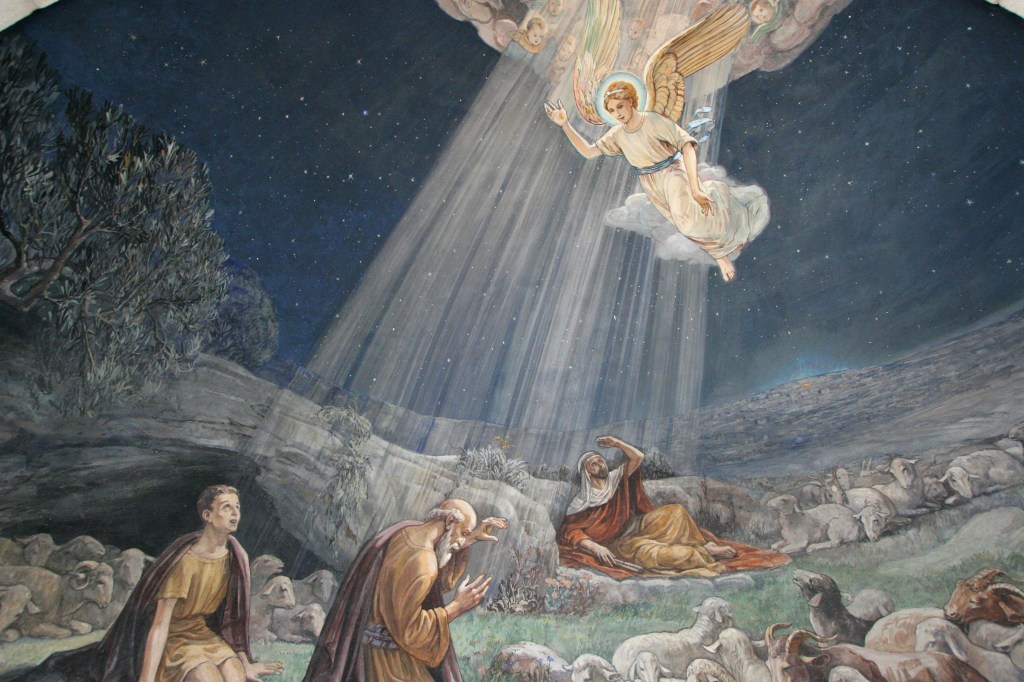
An angel of the Lord appeared to them, and the glory of the Lord shone around them, and they were terrified….

This may seem like a strange twist to the way I have started this article, but I will bring it back around. I think you will be glad to stick with me as I take seems like a left turn.

Continue reading “Of Shepherds, Angels, the Glory of the Lord, and the Christ Child Born in Humble Estate”
Take a Risk to Prepare Room for God in Your Life

If you won’t leave what you’re guarding to see what God is doing, then what you are guarding is your god.

An angel of the Lord visited the shepherds and informed them of Jesus’ birth, Bethlehem, Church at the Shepherds’ Fields

My inspiration today comes from the sermon at church.[1] Very little of my material in this blog is original. If I am being perfectly candid, none of it is. After all, there is nothing new under the sun!

The sermon today was on the shepherds who left their fields in response to the message they received from an angel to seek out and visit the Christ child who was born near them in a manger used to feed animals.[2] If we are tempted to think that the purpose of this story in Luke’s Gospel is the miraculous appearance of an angel to these shepherds, I believe we would be wrong.

The story of the shepherds follows right on the heels of the story of Joseph and Mary traveling to Joseph’s ancestral home, Bethlehem, for a census that was being taken. While they were there, Mary gave birth to Jesus. Luke concludes that story with this seemingly insignificant statement:


“Then she gave birth to her firstborn son, and she wrapped him tightly in cloth and laid him in a manger, because there was no guest room available for them”.

Luke 2:2:7


We have the wrong picture in our heads if we are imagining a guest room in an inn. Mary and Joseph went to Joseph’s ancestral community where his family was gathering from wherever they were scattered. They may not have known their extended family members well, but they likely stayed in one of their homes.

The guest room in the home would have been upstairs, and it was already taken by the time they arrived, so they were forced to stay on the ground floor of the home with the animals. The manger was a food trough. Their accommodations were not the least bit inviting.

The smell of animal dung, urine, and straw hung in the darkness of the cold, dank air. The animals slept or chewed their cud. There was no fanfare for God who was had just entered His own creation in the humblest of circumstances.  

Meanwhile, an angel suddenly stood before a watchful group of shepherds in the outlying hills of Bethlehem. The abrupt apparition broke the silence like lightning from the sky. They were alarmed, but the angel calmed them. “Do not be afraid”, the angel said.


“Look, I proclaim to you good news that will be for all the people: Today in the city of David a Savior was born for you, who is the Messiah, the Lord.”

Luke 2:10-11


The angel added the instruction that they would find a sign: a baby wrapped tightly in cloth, laying in a manger. (Luke 2:13) Nothing seems special about this sign. A little unusual, maybe, that the child would have no other place to lay. Perhaps, though, the shepherds heard echoes of these words in the angel’s statement:


“Therefore the Lord himself will give you a sign: The virgin will conceive and give birth to a son, and will call him Immanuel.”

Isaiah 7: 14


An inkling from the Prophet Isaiah may have just dawned on them when “a multitude of heavenly host” appeared with the angel praising God and saying:


“Glory to God in the highest heave, and peace on earth to people he favors.”

Luke 2:14


They were moved. The angel encouraged them to “look” for themselves, and they didn’t hesitate. They decided among themselves “to go see”. (Luke 2:15)

We might be tempted gloss over the scene and fail to consider their circumstances. They were shepherds, and their job was to watch over the sheep. Sheep are prone to wander off. Even if they don’t stray, they are sitting ducks for large predators like lions, wolves and bears. Guarding the sheep was their livelihood.

The shepherds risked losing the sheep to leave them. They risked the sheep wandering off or being attacked if they left them. They risked losing their jobs.

The shepherds were menial laborers, dispensable and easily replaceable, but when the angel encouraged them to go see, they didn’t hesitate. They responded and went.

The word, “see”, is emphasized in this passage. They responded and saw for themselves. They experienced God for themselves. They didn’t just listen and ponder; they went and saw for themselves.

As I reflect on this, I note that they might have missed the Messiah if they didn’t respond right away. It occurs to that, when God prompts us, perhaps not as dramatically, how we respond is critical. Whether we respond at all, and how promptly we respond, may be a matter of whether we encounter God… or not.

Continue reading “Take a Risk to Prepare Room for God in Your Life”