Joe Rogan Interviews Stephen Meyer on Intelligent Design

Joe Rogan tackles intelligent design


I am going to do something unusual (for me) today. I have listened to long podcasts and summarized them or focused on particular aspects of them. I have also read books and done the same.

Today, I am going to link to a long podcast without much comment. the podcast is the Joe Rogan Experience, the most poplar podcast available today. I am not really a Joe Rogan fan. I don’t often listen to his podcast. I am not sure I have ever listened to an entire episode, so this is a first for me.

Joe Rogan is unquestionably a curious and surprisingly intelligent interviewer. He can say some stupid things, but then (I have to confess) so can I. I suppose that combination of “common guy” persona, willingness to ask the “stupid” questions and challenge the status quo, and a modicum of intelligence is why he is so popular.

In the episode I am embedding below, Joe Rogan interviews Stephen C. Meyer, a “proponent” of “intelligent design”. The interview is particularly interesting because Joe Rogan tends toward people like Sam Harris, and Bart Erhman, and other materialists, atheists, and skeptics of religion.

Rogan isn’t just a Cretan (to use an old biblical word) as his popular persona might suggest. Though he clearly favors materialist explanations of the world, he asks good questions and gives his guests opportunity to explore contrary points of view. This is the case in the embedded interview that lasts for over 3 hours.

I am still working my way through it, but I have heard enough at the 50 minute mark to consider it worthy of putting it out there. Maybe I will come back to summarize or focus on particular aspects of the conversation. If you have listened to it (or are listening to it as I am), feel free to post your own comments.

Stephen Meyer is the author of the New York Times bestseller Darwin’s Doubt: The Explosive Origin of Animal Life and the Case for Intelligent Design and Times (of London) Literary Supplement Book of the Year Signature in the Cell: DNA and the Evidence for Intelligent Design. His many other publications include contributions to, and the editing of, the peer-reviewed volume Darwinism, Design and Public Education (Michigan State University Press, 2004) and the innovative textbook Explore Evolution (Hill House Publishers, 2007). His most recent book, Return of the God Hypothesis: Three Scientific Discoveries That Reveal the Mind Behind the Universe, is generating much discussion, like the interview embedded in this blog.

Meyer graduated from Whitworth College in Spokane, Washington, in 1981 with a degree in physics and earth science. He worked as a geophysicist before returning to academia at Cambridge University, to earn an M.Phil. in 1987 and a Ph.D. in 1991 in the Philosophy of Science. His doctoral thesis was titled “Of Clues and Causes: A Methodological Interpretation of Origin-of-Life Research.”

Exploring the Edges of Our Knowledge on Matters of Science and Faith


As often is the case with me as I read, listen to discussions, and watch YouTube videos, a number of strands from those media come together. I am going to attempt to weave some of those strands together today as I tackle the edges of our human limitations, dark matter, and knowing God.

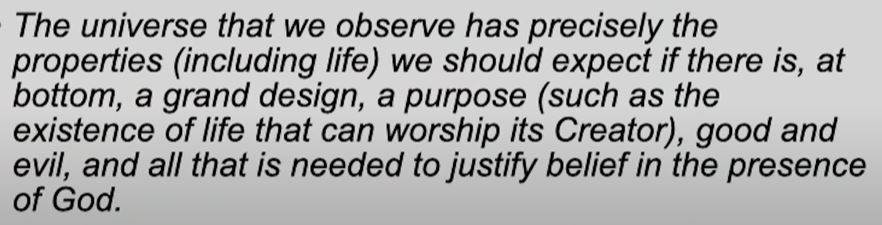
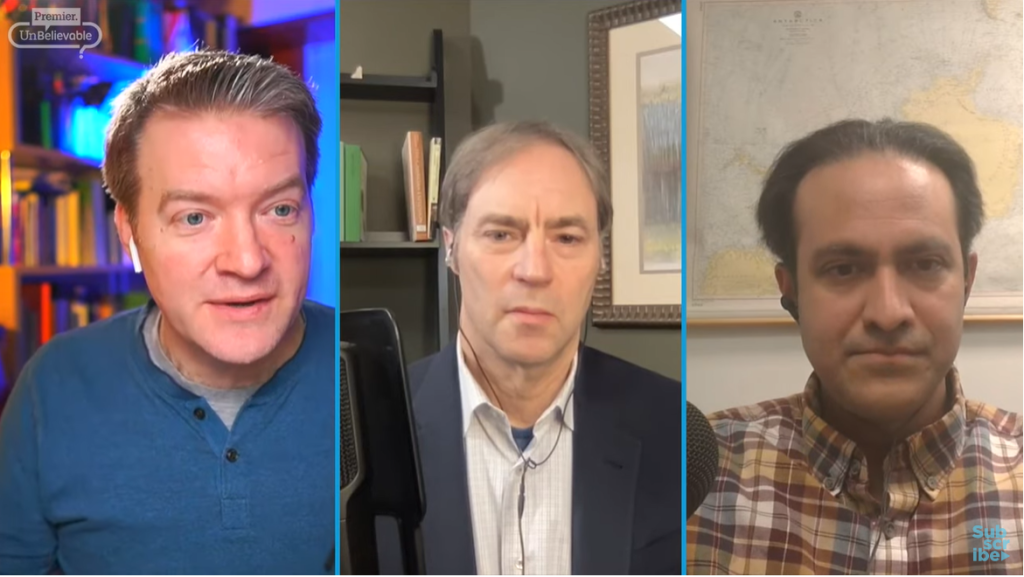
In a recent discussion between Saleem Ali and Stephen Meyer on the Unbelievable! podcast, Some things that Ali said prompted me to want to respond. I wrote of the discussion recently in What is the Basic Order of the Universe? Bottom Up? Or Top Down? But, today, I want to take my observations a bit further.

Saleem Ali has a background in chemistry and environmental studies, and Stephen Meyer has a background in physics, history and the philosophy of science. In their discussion, Meyer argues that our study of the physical world reveals evidence for a God who created it (a top-down design). In Ali’s response, I agree with his statement that certain things are unknowable to human beings because of our empirical limitations.

Ali said these things to highlight that we cannot know with scientific certainty that God exists. I agree with that. I would simply add this: Because science is the study of the natural, physical world, and humans are creatures of the natural, physical world, we are constrained to the limitations of the natural, physical world in our scientific endeavors.

Ali also admits that we may not ever be able to know the origin of the causes of the universe, or of the origin of the laws of physics, or of the origin of life because these things would require us to search beyond the parameters of the constraints of the natural, physical world in which we are bound.

Since we, ourselves, are physical creatures in a world that is limited by physical constraints, we may never know with scientific certainty what else exists.  

This assumes, however, that we have no capacity to know of anything that exists beyond the natural world. Some people are content to foreclose the idea that we are incapable of knowing anything that is not material and physical in nature. I am not convinced, and I see evidence that we are not so limited.

We have basically two choices: 1) assume that the existence of the universe is nothing more than a brute fact; or 2) assume that the universe had a creator. We can either resign ourselves to agnosticism or choose to test one of those two assumptions.

I made the assumption that the universe makes more sense on the premise of a creator, and I have been testing that hypothesis ever since. I won’t apologize for making that assumption, and the degree to which I have tested that assumption has not left my unsatisfied.

To those people want to judge me on that point, I say that you may be in a worse position than me to be a judge. I assume an intellect far greater than me created me with intellect. I do not trust it on my own account. On what basis do you have confidence in your intellect and agency that derived merely from inert, unintelligent matter?

To the extent that you believe your reasoning power evolved from lower life forms, why do you have confidence in the reasoning of a monkey’s mind? I say this not of my own accord; I am applying Darwin’s reasoning that he applied to own his convictions. (See Reflections on Faith and Atheism and Universal Design Intuition and Darwin’s Blind Spot))

As hints of the painter appear in his painting, our study of the natural world can (and does I believe) give us hints of the God who created it. We see the personality of the painter in his painting as we see the personality of God in His creation – including the creation of human beings.

I cannot prove that, just as I could not prove the painter by virtue of his painting. If I had no connection with the painter and knew no one who knew him, my knowledge of him would be mere speculation. But, I would be right in assuming a painter.

Ali says that finite creatures such as ourselves are going to encounter a certain amount of mystery and awe, but that mystery and awe does not necessarily validate a theistic explanation. Mystery and awe by themselves do not warrant a conclusion that God exists. I agree with him on the statement, as far as it goes, and I think we need to be candid about these things.

If God exists, who preexisted, and caused the universe and all things that we know to come into being, including ourselves, we may be cut off from knowing that God and from viewing that causality by our physical limitations and the physical limitations of the universe in which we are bound. Even if the universe hints of Him, we may be incapable of knowing Him by our own abilities because of our limitations.

The only exception I can think of would be for such a God to reveal himself in some way to us. Of course, that is the claim of theism.

We do not know the painter of a painting unless we meet him, and we cannot know the God of the universe unless we “meet” Him in some way. We might be able to track down the painter of a painting, because that painter exists within the same bounds of the same world as we do. Because of our limitations, however, God would have to introduce Himself to us.

That is the claim of people who claim to have “met” God in some fashion. We can explore those claims as we can explore the claims of anyone who witnessed an event or met a person we we have not met ourselves, but let’s lay that aside for the moment.

Continue reading “Exploring the Edges of Our Knowledge on Matters of Science and Faith”

By Faith We Know God and Our Place in the World

God is greater than the creation He made, that God is timeless, and He will outlast the creation as it is and as we know it

M74, nicknamed the Phantom Galaxy, as seen by the James Webb Telescope

In my daily reading today, I read these verses from the Letter to the Hebrews:


“In the beginning, Lord, you laid the foundations of the earth, and the heavens are the work of your hands. They will perish, but you remain; they will all wear out like a garment. You will roll them up like a robe; like a garment they will be changed. But you remain the same, and your years will never end.” 

Hebrews 1:10‭-‬12 NIV


These words were written in the 1st century, and they recall the words in Genesis that were written many hundreds, maybe even thousands of years before:

“In the beginning God created the heavens and the earth.”

Genesis 1:1

The statements written in the letter to the Hebrews and in Genesis, long before that, were all written before the revelations of modern science.

We argue today over the passages in Genesis about the creation of the world, whether God did it in seven days or over seven periods of time. Some people say we should take Genesis “literally” (whatever that means), and other people say that the creation account in Genesis is simply poetry and should not be taken literally. There are many people in between, and many people who do not believe or take the Bible seriously either way.

Yet, whether these words are intended to be read as a literal, seven day creation event, seven periods of time, merely a poetic conception or otherwise, they express by faith an understanding that God created the world we live in – “the heavens and the earth”. They also expressed an understanding that God is greater than the creation He made, that God is timeless, and He will outlast the creation as it is and as we know it.

Whatever you believe about the description of creation in Genesis and elsewhere, the understanding is accurate: that the earth and the greater universe as we know it will not remain the same. It is subject to entropy governed by the Second Law of Thermodynamics. In poetic words, “[The Heavens and the Earth] will wear out like a a garment…. like a garment they will be changed.” In more philosophical terms, the Apostle, Paul, says:


“[T]he creation was subjected to futility….”

Romans 8:20


We don’t need to have a sophisticated scientific understanding of the Second Law of Thermodynamics to realize that the universe is, in a sense, winding down and wearing out, that it is “subjected to futility”. The earth, which is such an incredibly minute part of the universe, will not support the life that teams on it very far into the future.

We live in a very narrow band of time in which creatures such as ourselves can thrive on planet earth, sandwiched between ice ages and other inhospitable fluctuations and epochs space and time. Out time will pass like a flower that blooms one day and is gone the next in relation to the full space/time continuum.

Regardless of any Herculean efforts we give on our part to preserve the environment of this planet as we know it, the laws of the universe guarantee that life will no longer be supportable on planet earth, or anywhere in the universe for that matter, at some point in the future. It is inevitable.

It is remarkable to me that the writers of these ancient texts understood this fact by faith, though they had no hint of the science behind it. Knowing nothing of the Second Law of Thermodynamics, they understood nevertheless that this world will wear out.

They also had faith that the God who created it is the constant. Ignorant of the science, they nevertheless perceived and understood the reality of God, His creation and their place in the world.

Though modern science seems to reveal that our universe had a beginning, just as these ancient writings stated, many modern people who have the aid and benefit of science fail to see or acknowledge the creator. This is not a failing of science, though; it’s a failing of faith.

Though science provides many benefits, science is not essential for our faith or relationship to God. All the science in the world is not sufficient to gain us knowledge of God, as it necessarily rests on faith. At the same time, we can have none of the knowledge and understanding of science and still know God and our place in the world.

I love science, as it reveals the wonder of a universe that God made understandable and searchable by us. By faith we grasp all the reality we need to know, but science reveals majesty and wonder and appreciation of the greatness of our God all the more.

By faith, we also understand that God loves us. We understand that there is more to reality than the physical, space/time continuum. We perceive that God had a purpose in subjecting the creation to futility:


“For I consider that the sufferings of this present time are not worth comparing with the glory that is to be revealed to us. For the creation waits with eager longing for the revealing of the sons of God. For the creation was subjected to futility, not willingly, but because of him who subjected it, in hope that the creation itself will be set free from its bondage to corruption and obtain the freedom of the glory of the children of God. For we know that the whole creation has been groaning together in the pains of childbirth until now. And not only the creation, but we ourselves, who have the firstfruits of the Spirit, groan inwardly as we wait eagerly for adoption as sons, the redemption of our bodies.”

Thoughts on Perspective, Science and Faith

As finite beings, We have no choice put to adopt our fundamental principles on faith. We do not have the requisite perspective to have more certainty than that.

I have two blogs I maintain currently: Perspective and Navigating by Faith. Perspective and faith loosely characterize my journey over many years: trying to find perspective and understanding the value, the necessity, and the integrity of a faith grounded in reality, both observable and unseen.

Many people believe that faith is the opposite of fact and at odds with science and reason. I strongly disagree. I have come to believe that faith is inescapable for finite beings – both religious ones and non-religious ones alike – and faith lies at the core of everything we believe to be true.

I was listening to a podcast discussion recently when one of the participants said something like this: When we approach any evidence, we approach it with a perspective. This is a non-pejorative way of saying that we are all “biased”.

As finite beings we are all necessarily “biased” by our own perspective, our own experiences, our own knowledge, understanding and ability to grasp, synthesize and categorize what we know and understand. Our perspective is influenced and filtered through our location in the world, our place in the culture and society in which we live, the history that we remember, and too many other things to summarize them adequately in a short blog article.

The discussion in the podcast that prompts this writing focused briefly on the fact that we all bring assumptions to the table when we consider anything. Those assumptions, however intentionally or surreptitiously developed, are the bedrock of each of our worldviews. They are the foundations on which we stand. They are the filters through which we see the world.

Those assumptions are developed, to a greater or lesser degree, by some combination of our external influences, our internal leanings and reactions to those external influences, and our consciously or unconsciously chosen compass points we use to guide ourselves in sorting out the information we encounter.

At the most basic level, those assumptions are axiomatic. They are truths we take for granted. We cannot prove them, and we rarely question them without crisis. We are fortunate if they hold us in good stead, if they are well-enough grounded in reality and fact to be of benefit to us in our dealings with the circumstances of our lives.

If those basic assumptions are not well considered and well-grounded, we can be blown about by every wind. If they are not based in fact and an accurate grasp of the nuance of reality, they can prove little consolation or comfort in times of crisis. If they are not well-anchored in timeless truth, they can leave us adrift when we need to count on them most.

The unique perspectives in light of which finite beings approach any evidence is necessarily limited and biased because we are limited and finite beings. At best, we can only hope to orientate ourselves in the direction of truth. We don’t define truth. We don’t establish truth. We don’t’ generate truth.

This is necessarily the case with finite beings who can only approach reality from a particular location at a particular time in the context of a particular cultural, historical, and philosophical point of view.

If I was omniscient and all seeing, I could have ultimate confidence in my perspective. My perspective would be objective and factual. My perspective would be the measure of all reality.

But no human being can validly make that claim (though we may and often do think and act like we can). In all honesty and humility, we must each admit that we come at evidence from a perspective with bias born out of our own experience, cultural context, limited knowledge and limited understanding.

We don’t know what we don’t know.

As a necessary corollary to these things, which I believe with all the certainty that I can possibly ascribe to these things, we are creatures of faith. All of us. We have no choice put to adopt our fundamental principles on faith. We do not have the requisite perspective to have more certainty than that.

My conclusion in this regard is based on fact (that humans are finite beings) and “logic” or philosophy, which reasons from the fact that we are finite to conclude that our perspective is limited thereby. Because our perspective is limited, we must rely on faith in making our conclusions which, themselves, derive from the fundamental assumptions we also take on faith. We can’t escape these limitations because they are inherent in finite creatures such as ourselves.

Some people even in this modern age, however, have boldly claimed that science is the study of all the reality that exists. Further, they say, therefore, we no longer need philosophy or theology. (I have heard Neil deGrasse Tyson say this very thing.) I am going to push back on that idea in this blog post.

Continue reading “Thoughts on Perspective, Science and Faith”

Christianity’s Ties to the Scientific Method

Christianity was the fertile soil in which scientific method and modern science began to grow


I have heard a number of people assert that Christianity gave birth to the scientific method. Perhaps, the first time I heard that claim was from John Lennox, the famous Oxford University professor of mathematics. I was intrigued, but I didn’t take the time to research his claim at the time.

I have heard the claim repeated multiple times, most recently by Dr. Michael Guillen the astrophysicist, former Harvard professor and TV personality. In fact, he devoted a podcast to the subject (embedded below), so I figured it was time to learn more.

I started with Wikipedia, which has a page on scientific method. Wikipedia begins with Aristotle and focuses on rationalism as the basis for scientific method.

Properly speaking, rationalism is not a method. It is a philosophy, a way to approach the world. Rationalism and Aristotle, though, seem to have led the way to the development of the scientific method.

Aristotle’s inductive-deductive method that depended on axiomatic truths and the “self-evident concepts” developed by Epicurus was an early conception of the way to do science. It was jettisoned, however, for something more like the modern scientific method beginning around the 16th Century. Perhaps, this is why Guillen doesn’t mention Aristotle, except in passing.

After those early pioneers, Wikipedia references some great Muslim thinkers who were influenced by Aristotle (including Avicenna (Ibn Sina) and Averroes (Abū l-Walīd Muḥammad Ibn ʾAḥmad Ibn Rušd)). They placed “greater emphasis on combining theory with practice”, focusing on “the use of experiment as a source of knowledge”. Guillen starts his history of scientific method with these early “flashes” of scientific method in the Muslim world.

These men of the Islamic Golden Age pioneered a form of scientific method, but the inertia did not continue. Moses ben Maimon (Maimonides), the great Jewish theologian, physician, and astronomer, developed a similar emphasis on evidence. He urged “that man should believe only what can be supported either by rational proof, by the evidence of the senses, or by trustworthy authority”. He foreshadowed a future scientific posture, but his prescience also did compel further advancement at the time.

Dr. Guillen credits Robert Grosseteste and Roger Bacon with the formation of the first actual principles of scientific method. Their ideas “caught fire” in Christian Europe from the tinder of academies that began just after the turn of the first millennium, igniting a blaze that would fuel scientific inquiry and endeavor for centuries to come.

“Concluding from particular observations into a universal law, and then back again, from universal laws to prediction of particulars”, Grosseteste emphasized confirmation “through experimentation to verify the principles” in both directions.

Roger Bacon, Grosseteste’s pupil, “described a repeating cycle of observation, hypothesis, experimentation, and a need for independent verification”, including the recording of the way experiments were conducted in precise detail so that outcomes could be replicated independently by others. Bacon’s methodology lead to the modern emphasis on peer-review in science, says Guillen.

Wikipedia mentions Francis Bacon and Descartes. Bacon and Descartes emphasized the importance of skepticism and rigid experimentation, expressly rejecting Aristotle’s dependence on first principles (axioms). Guillen, however, glosses over Descartes to get to Galileo Galilei and Isaac Newton.

Galileo Galilei introduced mathematical proof into the process and continued to distance science from reliance on Aristotelean first principles. Galileo and Newton reformulated the terms of scientific method that would inform modern scientists ever afterward.


That the two latter men were men of faith, along with Grosseteste (a Catholic Bishop) and Roger Bacon, his student, is significant. Maimonides and the Islamic thinkers before him were also men of faith. These men who pioneered the way to modern science were all monotheists who believed in a creator God. 

Science did not really take off until the 17th Century. The trailblazers of the modern scientific method were religious men, and the modern scientific method was born in the religious environment in Christian Europe lead, primarily, by men of faith.

Why did science catch fire in Christian Europe and not in other parts of the world? Why not in China? Or in the world of the eastern religions? This is a question Guillen poses, and he provides a possible answer.

Continue reading “Christianity’s Ties to the Scientific Method”