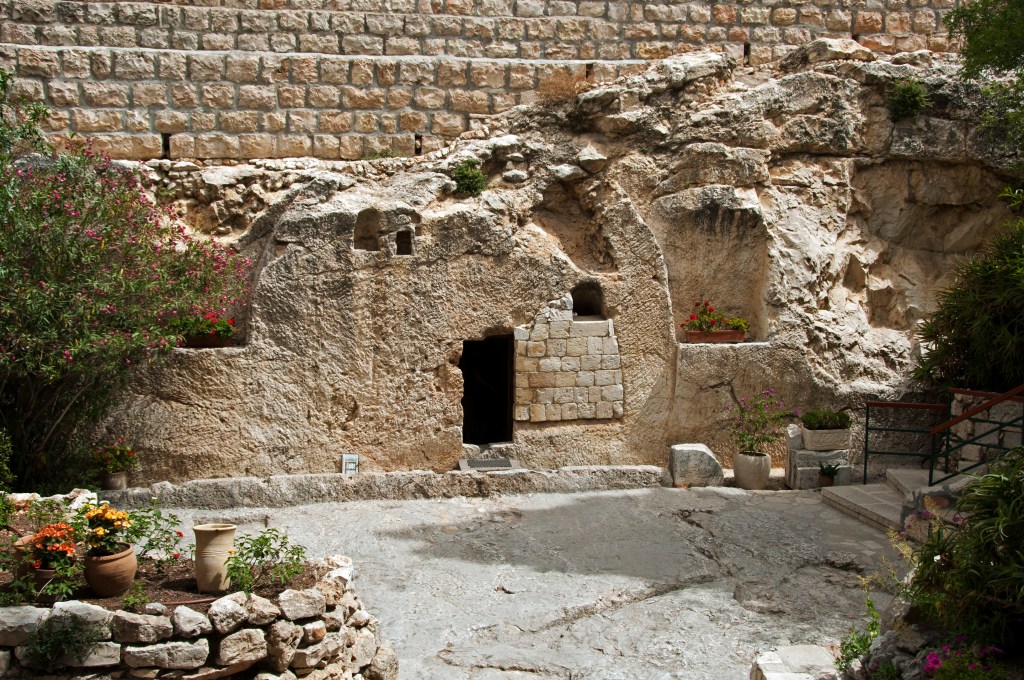
Thought to be the place of the resurrection of Jesus Christ in Jerusalem Israel
The title of this piece is tongue-in-cheek, a play on the “minimal facts” evidence for the resurrection made famous by Gary Habermas. I don’t really have a killer piece of evidence that uses fewer facts (or no facts) that trumps all other arguments. But, maybe I got your attention!
As often is the case, my inspiration comes from what someone said or wrote. In the podcast interview linked below, Mason Jones describes how he he decided to read through the Gospel accounts as an atheist who knew next to nothing about Christianity. He quickly caught on that the resurrection is the centerpiece of Christianity, so he focused his attention on that.
He researched the evidence for the resurrection. He googled arguments for the resurrection and arguments against the resurrection. Though he was an atheist at that time, he was willing to give the evidence that exists a chance. (Whether there was any, he didn’t know.)
As he considered the arguments and counterarguments, he found that the arguments against the resurrection didn’t address very well the arguments for the resurrection. They didn’t take them seriously.
Then he realized that the arguments against the resurrection only work if you start with the presupposition that the resurrection didn’t happen. Because it is impossible. Because people don’t come back to life. Ever.
If you take that presupposition out of the equation, thought Jones, the evidence favors the conclusion that the resurrection occurred, and the arguments against the resurrection loose their luster. If you want to hear the rest of Mason Jones’s thought journey from atheism to theism to Christianity in his own words, you can listen here.
Meanwhile, I want to spend a little time considering the presuppositions people make about the resurrection.
Some people say that we have absolutely no evidence for the resurrection (and no evidence that God exists in the first place). Nothing could be further from the truth. We have evidence. The issue isn’t a lack of evidence; the issue is how we approach the evidence and weigh it it.
A person who approaches “supernatural” phenomenon with purely materialistic assumptions will weigh the evidence differently than one who is open to nonmaterialistic possibilities. Jesus, though, lived in time and space in history. Many people in the first century who saw him die claim to have seen Jesus and interacted with him in the flesh after he died, and those people were willing to die for what they saw.
That is evidence. Full stop. People may be skeptical of it. People may assume Jesus couldn’t have risen from the dead, despite what people think they saw, because miracles don’t happen. But, now I am talking about how people approach and weigh the evidence.
People confuse proof, as in a mathematical proof, and proof, as in an offer of evidence that tends to support a proposition. Fallible, finite human beings deal almost exclusively in the latter realm of evidence, even in science, because we don’t know what we don’t know.
Mathematical proofs are an achievable goal in mathematics (though sometimes not even then). Such proof is impossible outside of mathematics.
Science does not provide us that kind of certainty, either. Science changes all the time on the basis of new evidence, and things we thought we knew in the past are constantly being adjusted, or even discarded, on the basis of additional evidence.
Finite beings such as ourselves are limited in our knowledge, our access to knowledge, and our understanding of how the knowledge we have fits together. We have to be humble as we cautiously put our confidence in the things we think we know because we are limited in our ability to know and understand our world, and we will always lack absolute proof for most, if not all, things.
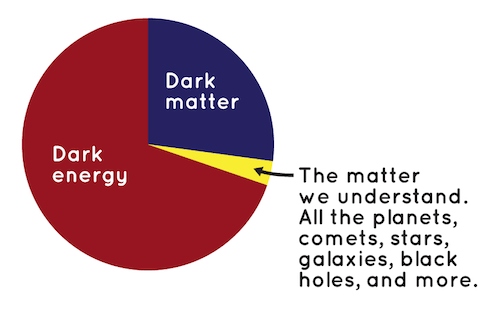
The extent of our limitations can even be quantified. For instance, 95% of the physical universe is invisible to us! The vast, unseen reaches of the universe are comprised of things like dark matter and dark energy that we cannot see and know little about, except for what we can infer about them. We aren’t sure what these things are, but we know they exist by the affects we see on the matter we see and know.
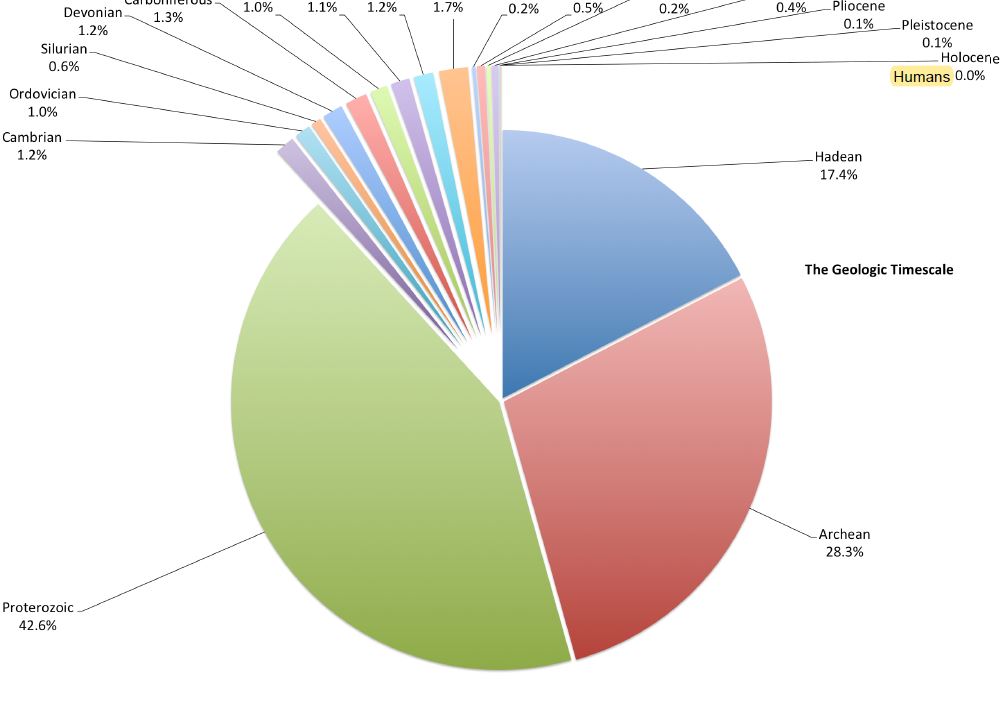
If we view the existence of the earth (not even the universe) on a 24-hour scale from the beginning to the present time, life began at 5:00 AM, the first vertebrates appeared at 8:00 AM, and human beings appeared just a fraction of a second before midnight.
Homo sapiens have only developed knowledge and the ability to communicate and preserve a record of it for about 5,500 years. We have been developing and recording our knowledge for only 0.00022% of the time the earth has existed, which is only 0.00007% of the time the universe has existed.
During that relatively short, 5500-year time period we have developed the capability to see only about five percent (5%) of the universe, though we have actually examined very little of it – and then only at very great distances. We hnave only explored more than five percent (5%) of the oceans on this earth – a very small planet orbiting a very small sun in a very small solar system in the inconceivably large expanse of what we we call the universe.
The body of our scientific knowledge has grown tremendously, even exponentially, especially in the last 200 years, but we have only just begun to know and understand the universe we live in. If humans live another 5,500 years, we will not have explored all of the universe, and we will not know all that there is to know.
We will likely never know all there is to know about the expanse of the universe and everything in it, large and small, in all the years mankind is on the earth. Thus, we are in no position to write off the possibility of God creating the universe and Jesus rising from the dead.
The title to this piece is (admittedly) a bit misleading, so I need to provide the following disclaimer. Some people will read the title and assume that I am attempting to prove the resurrection. I am not doing that. I am offering only the beginning of proof (as in offering evidence) in this article, but it is evidence. You can weigh it how you will.
We should at least be open to consider what evidence there is for the existence of God and not write off the possibility that God exists. If God exists and made the universe out of nothing, which is what the Bible claims in Genesis 1, John 1, and Hebrews 11, then He could certainly raise Jesus from the dead.
How arrogant it would be for us to determine for ourselves (categorically) that there is no God, that He did not create the universe, and that Jesus did not raise from the dead. We don’t know what we don’t know, and we don’t understand perfectly what we think we know.
With that said, I want to provide some minimal facts that provide some evidence that tends to support the resurrection. These things are not proof; they are an offer of proof. We cannot achieve definitive proof, but there is evidence for the credibility of the claims made that Jesus rose from dead.
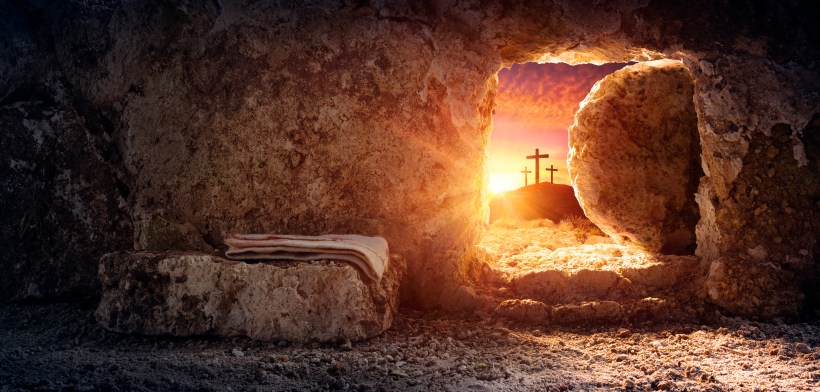
Mary Magdalene, Mary, & Salom walking up to the bright empty tomb of Jesus Christ early Sunday morning
Three days and two night ago, Mary’s entire world came crashing down. The earth opened up and swallowed Jesus, whom Mary loved, into the abyss. Mary’s world was thrown into darkness and confusion, leaving only soul crushing grief, bewilderment, and emptiness.
She barely had enough time to get him down from that tree on which he had died. A very generous leader risked his life and reputation to help her with the body and prepare the body properly for burial before Sabbath began. (John 19:42)
The crash of his arrest and the whirl of those events that followed came upon her in a rushing torrent so quickly that she was completely overwhelmed, reeling, barely able to breath from beginning to end, and they ended with his death. The commotion of the last minute burial gave way to the silent weight of yawning emptiness and overwhelming grief in the dark night that followed.
All the men abandoned Jesus as the world began to unravel. The petty squabbling that broke up dinner the night before left Mary confused about what Jesus had been saying. Jesus was trying to tell them something important, but she could only remember bits and pieces….
Something about a cup… and pouring out his blood and…. It was all so surreal and confusing. So impossible to fathom. Jesus seemed to know what was going to happen. She could see it in his eyes. He was resigned to it, but she didn’t understand.
All the mysterious things Jesus said during the exciting and hopeful years they traveled with the Jesus played in her mind like a long, beautiful song ending in a discordant whimper. The mystery that seemed so poignant and momentous now seemed ominously empty. Through the looming darkness, a slight flame of hope sputtered amid the whirlwind of elements around her.
Jesus wouldn’t let anyone try to defend him. “He just gave himself up!” she thought. He utterly gave himself over to them. It was painful to watch, and painful to remember.
But even in his weakness he was noble. He was so beautiful. He seemed like everything they thought he was. Even in the end. Even as he resigned himself to death. She wept.
And those men were always arguing about who was the greatest. They didn’t do anything. They couldn’t even stay awake with him and pray. They were too dull to realize Jesus needed them!
They could have, at least, gone with him! But, they left him. They knew what was happening, but they pretended not to know! they didn’t lift a finger. When Jesus needed them most, they abandoned him. Peter even claimed he didn’t know Jesus! Peter!
Mary and the other women would not leave him. They saw the whole, unimaginable thing … and John. At least, John was there. Not that he did anything.
If it wasn’t for Joseph, who knows where his body would have ended up. Mary was grateful that Joseph owned a tomb nearby and even more grateful that Joseph and his associates helped with the body. (Luke 23:50-53). Even so, Mary couldn’t help but wonder where they were when Jesus needed someone. Anyone!
Even as she felt her heart shrink in anger and frustration, she knew they could not have stopped what happened. She softened, and she wept again.
They had no time to prepare him properly. It was the Sabbath, and night was upon them. The hours labored by. It seemed like Jesus lay there for an eternity through the night. Everything weighed so heavily on Mary’s heart. She needed to get to him.
Joseph and Nicodemus came through with the spices and ointments for Mary to prepare the body in the morning. (Luke 23:56) She was up before the dawn. She couldn’t sleep anyway.
The hopeful sounds that emerge in light’s first dawn might have lifted her heart on any other morning. Tears came in waves. She could hardly see at times.
Tears she could not manage to wipe way with the back of her hands fell from her cheeks into the mixture of ointment and spices. She recalled the day she wiped tears from his feet with her hair in waves of repentant gratitude and joy, knowing her sins were forgiven, and her life was forever changed.
Her tears turned to waves of incontrollable sobs. She could not continue until they subsided.
Mary could not adequately express the depth of gratitude for Jesus for rescuing her from the demons that haunted and tormented her from her youth. She didn’t care what anyone thought.
Nothing had been more precious to her than the ointments she collected… until Jesus set her free. She would have spent her entire life pouring her very self out for him.
She desperately longed to wind time back. The impossibility of it all was maddening. Those demons lurked again in the back of her mind. She shuddered as if to shake them off, and she continued with the ointment and spices.
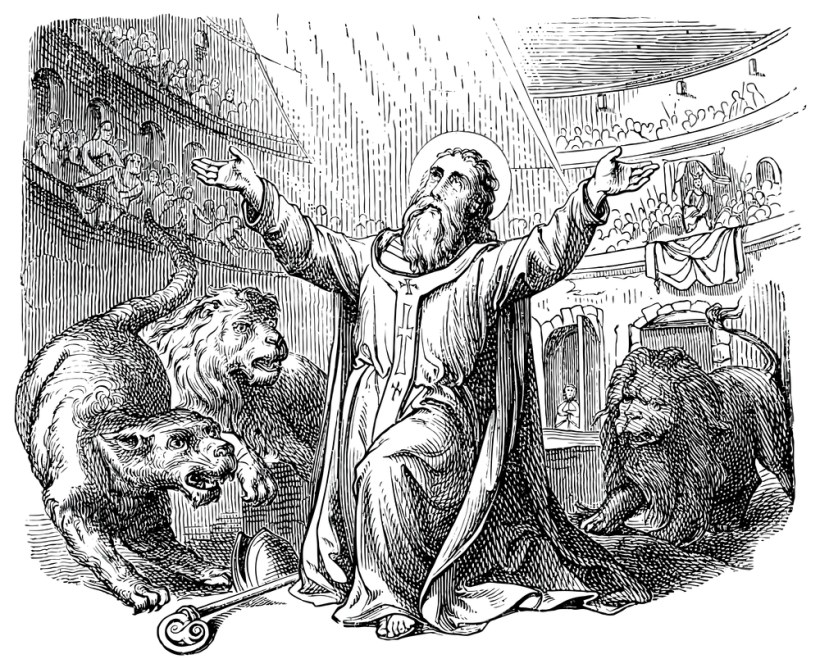
Sean McDowell did his doctoral dissertation on the fate of the Apostles of Jesus. Legend has it that they all died as martyrs, except for the Apostle John, because they witnessed the death and resurrection of Jesus and were willing to attest to it with their own deaths.
But is that really true? That is the question Sean McDowell set out to answer with scholarly research and analysis.
Church “tradition” maintains that all the apostles, except for John, were martyred. This is my understanding also, more or less, going back many years, though we may not have historical evidence that comports with modern standards to support what happened to all the Apostles.
The deaths of Peter and Paul are pretty well-attested. They died martyrs’ deaths, but what about the others?
Sean McDowell recently did a short video inspired by the results of his doctoral study, A Historical Evaluation of the Evidence for the Death of the Apostles As Martyrs for Their Faith, and the book, The Fate of the Apostles. While his study reveals we lack evidence that meets a standard of modern historiography about the martyrdom of most of the apostles, we have solid evidence for least two of them, and we have some evidence for the martyrdom of other eyewitnesses of the death of Jesus. From these facts, McDowell raises five key points.





 Navigating by Faith