The Story of Abraham and God’s Redemption of Mankind – Part 2

God works out His purposes through the messiness of human history.

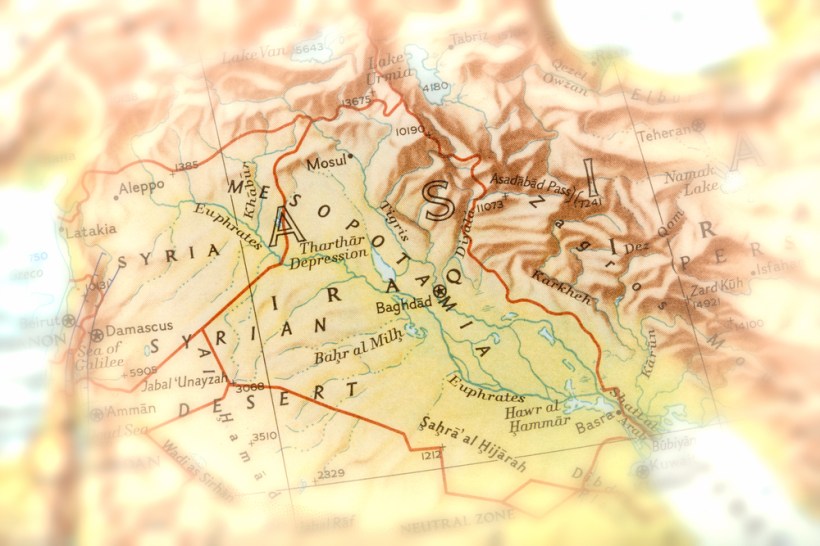
The story of God’s redemption of mankind in the Bible funnels through one man, Abraham from Mesopotamia. I introduced Abraham (known as Abram then) and his family in Part 1 of this series of articles.

Abram’s sister, Sarai, became his wife. Both of them were children of their father, Terah, by different mothers. Terah’s son, Haran, died in their homeland (Ur). The family with Lot, Haran’s son, left Ur and and traveled to a place they called Haran in southern Turkey, just north of Aleppo Syria.

Terah and Nahor remained in Haran, but God gave Abram the direction, “Go to the land that I will show you”, and the promise, “I will make you a great nation….”, and “Through you every family on earth will be blessed”. (Gen. 12:1-3) Thus, at the age of 75, Abram and Sarah left Haran and continued on to Canaan, and Lot went with them.

When they arrived at Shechem in Canaan, God renewed the promise as Abram looked out over the land: “I’m going to give this land to your descendants.” Abram built an altar there, Then, he continued on to the high country in Canaan, between Bethel and Ai, where he also built an altar and worshiped God. (Gen. 12:7-8)

Though God had promised him twice at this point to give Abram this land, Abram continued on. They traveled south out of Canaan, into the Negev desert, and they kept going further south to Egypt because of famine. (Gen 12:9-10)

Abram remained in Egypt long enough to accumulate some wealth before he started moving again. (Gen. 13:2) It is written that Abram “traveled from place to place” when he left Egypt. He seemed to be wandering.

He traveled north again, back to the Negev and eventually back to Bethel and Ai, where he settled down. (Gen. 13:3-4) It must have been some time, as he and Lot had accumulated so many animals their herds and servants couldn’t coexist peacefully. Thus, they parted ways. (Gen 13:5-13)

Lot settled south of Canaan in the Jordan Valley. Abram remained in Canaan, and God gave him the same promise a third time: “Look north, south, east, and west of where you are. I will give all the land you see to you and to your descendants….”; and “I will also give you as many descendants as the dust of the earth.” (Gen. 13:15-16)

Still, Abram moves again, this time south about 35 miles to another part of Canaan known as Hebron. Many years pass. Abram seems to be waiting for God to do what he said, and, for the first time, Abram begins to show signs of doubt that God’s promises would come to pass, . Perhaps, this is why God promises him a fourth time: “Your own son will be your heir” (Gen. 15:4); and “I will give this land to your descendants.” (Gen. 15:18)

When Abram was 86, however, Sarai takes matters into her own hands and offers her Egyptian servant, Hagar, to Abram. Abram agrees, Hagar conceives, but all is not well in the Abram household. Hagar disrespects the barren Sarai, and Sarai mistreats Hagar so badly that she runs away. (Gen 16)

God comforts Hagar in her distress and says of Ishmael, “He will be free and wild”, but “[h]e will fight with everyone, and everyone will fight with him….,” and “[h]e will have conflicts with all his relatives.” (Gen. 16:12)

It seems that nothing is going right for Abram, and God promise takes on a sour taste. Is this the son through whom God will bless all the nations? This wild and contentious boy? Is the son of Sarai’s now despised Egyptian servant Abram’s heritage?

Continue reading “The Story of Abraham and God’s Redemption of Mankind – Part 2”

The Story of Abraham and God’s Redemption of Mankind – Part 1

As I start my third journey through Scripture from beginning to end in as many years, I am picking up on things I didn’t see the first two times through. In this series of articles I am tracing some stories in the great theme of God’s redemption of mankind through the descendants of Abraham.

Scripture is multi-layered and contains many themes large and small. I expect a person can study Scripture for a lifetime and always be seeing new things. Today I am seeing something in the line of Abraham that I kind of knew already, but I am digging into it in more detail.

The intricate tapestry that is the 60-some writings of the Bible authored by 40 some different people over 1500 or so years always amazes me. That tapestry is often veiled to us, as if we were seeing it from the wrong side. Unless we see it from the side from which it was meant to be viewed, the picture won’t be clear to us.

When we read the stories of ancient people, they feel foreign to us today. For instance, Sarai (later known as Sarah) is the wife of Abram (later known as Abraham), and she is also his half-sister. (Gen. 20:12) They shared the same father, but they had different mothers.

We shudder at the thought today of a person marrying a close, blood relative like that – a sister to boot! (Such close relations were later explicitly banned in Leviticus 18:9.) It was common a couple of thousand years before Christ, though. Perhaps this was due to limited spousal options and the greater distances people lived from each other.

We also need to understand that large segments of the Bible read like a narrative of things that simply happened, often without commentary. A recitation of the facts does not necessarily mean an “endorsement” of them. They simply are what they are, and we are often left to draw our own conclusions.

What we see throughout Scripture is that all people are deeply flawed, even the people with whom God found an audience. Ethical shortcomings have existed throughout every era of recorded human history. The Bible is nothing if not candid about the human condition.

I am setting the stage, here, for the point I eventually want to make about God’s plan to redeem all of mankind that weaves through the tapestry of the biblical narrative. I will have to lay this out over a number of articles.

In this article, I want to focus on Sarai and Abram and their origins. In Abram, who God renamed Abraham, God found a willing ear, and so God made His covenant with Abraham and gave Abraham a promise to bless not only him and his descendants, but all the nations.

This covenant and promise becomes the central story of all Scripture and needs to be recognized to make sense of it. It is one of the biggest themes in the biblical narrative tapestry.

Continue reading “The Story of Abraham and God’s Redemption of Mankind – Part 1”

The Redemption of Korah: the Sons of Korah

I would rather be a doorkeeper in the house of my God than dwell in the tents of the wicked.


Have you ever heard of the rebellion of Korah? How about the Sons of Korah? The rebellion of Korah and the Sons of Korah have a connection with each other, and the connection is fascinating.

The rebellion of Korah occurred during the 40 years Moses led the nation of Israel in the wilderness following God’s miraculous deliverance of the people out of captivity in Egypt. Korah rose up during their time of desert wandering and rallied a group of people to oppose Moses.

Korah was a grandson of one of Levi’s three sons (Kohath). He was a Levite, which meant that he was involved in the Levitical duties of caring for the tent of meeting and the tabernacle where God’s “presence” resided in the midst of the people. The Levitical duties were sacred and honorific.

The Kohathites were specifically in charge of caring for the Ark of the Covenant, the table, lamp stand, altars, articles of the sanctuary and the curtain behind which the priests performed the sacred rituals God passed down to Moses. (Numbers 3) Unlike the other Levites who were allowed to transport their items in carts, the Kohathites were required to hand carry their items.

The Ark of the Covenant was particularly sacred, of course, but the Kohathites may have been jealous of the ease enjoyed by the other priests who didn’t have to hand carry the items for which they were responsible. We don’t know. The text doesn’t tell us.

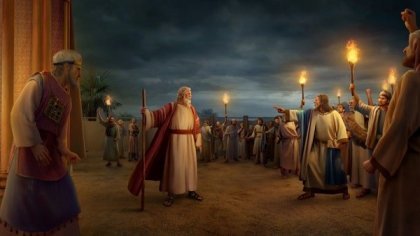
The text does tell us that Korah and several others rallied 250 other men in public opposition to the authority of Moses. They claimed that all the people of Israel are holy, and they questioned why Moses and Aaron “exalted themselves” above everyone else. (Numbers 16:3) They might as well have said more pointedly, “Who put you in charge?!”

Moses responded by challenging Korah and his followers to put the issue before God. He said, “This is how you will know that the LORD has sent me to do all these things and that it was not my idea.” (Num. 16:28)

As the story goes, they gathered publicly before all the people in front of the Tent of Meeting, each man with incense burning in censors. This is how Moses and Aaron faced off with the contentious lot led by Korah. I am really not sure of the point of this faceoff. If anyone has any insight, post in the comments below.

In any event, God warned Moses, and Moses warned the crowd to stand back. When he finished talking, the ground opened up and “swallowed” up the 250 men rebels that supported Korah in his opposition to Moses. (Numbers 16)

The story stands as a warning to those who are not content with their place in the world and people who get jealous of others to whom God has given greater responsibility and authority. God chose Moses and Aaron to lead the people. By opposing God’s chosen leaders, Korah and his band of rebels were ultimately opposing God and God’s authority.

From this story, I assumed that Korah and his clan were wiped out. The text seemed to imply that all his family were included in the 250 agitators. It turns out that my assumption was wrong, however, because the “sons of Korah” appear many generations later, and their place in the history of God’s people is truly intriguing.

Now, for the “rest of the story”, as Paul Harvey used to say.

Continue reading “The Redemption of Korah: the Sons of Korah”

When the Trees in the Fields Clap Their Hands

We tend to see the world through modern eyes colored by the enlightenment, rationalism and reductionism


“For as the rain and the snow come down from heaven and do not return there but water the earth, making it bring forth and sprout, giving seed to the sower and bread to the eater, so shall my word be that goes out from my mouth; it shall not return to me empty, but it shall accomplish that which I purpose, and shall succeed in the thing for which I sent it. ‘For you shall go out in joy and be led forth in peace; the mountains and the hills before you shall break forth into singing, and all the trees of the field shall clap their hands. Instead of the thorn shall come up the cypress; instead of the brier shall come up the myrtle; and it shall make a name for the Lord, an everlasting sign that shall not be cut off.’”
Isaiah 55:10-13 ESV

The language in these verses from Isaiah 55 are figurative. Will the mountains and hills really break forth into singing? Will the trees of the field clap their hands? (What hands do trees have?)

The language isn’t meant to be taken literally, but the language still conveys a truth: the world was created in response to God and awaits the fulfillment of God’s purposes for which He created it.

Just as the rain and snow produce the intended results of watering the earth, sprouting the seeds that grow up and produce grain, allowing the sower of the seed to produce bread, God’s word goes out and accomplishes the purposes for which it was intended. This is true from the beginning to the end.

God spoke the world into being. He set the heavens and the earth (the universe) into motion by His word. (2 Peter 3:5) The world came into being in response to God speaking. And the ultimate ends God has purposed will sprout (and have sprouted) into the seed that produces the material from which the sower ultimately accomplishes His end purpose.

Continue reading “When the Trees in the Fields Clap Their Hands”

Four Misconceptions about Christianity

Four basic assumptions that seem to be prevalent in the modern American world that are not not biblical.


I am continually impressed by the persistence of misconceptions about Christianity, even in the United States. The US is considered by many (still) to be a “Christian” nation. Most people may identify as Christian in the US, but that doesn’t necessarily mean that we all understand the basic tenets of the faith. Maybe it’s an example of familiarity leading us to assume things that aren’t necessarily true. Following I address just four very basic assumptions that seem to be prevalent in the modern American world that are not consistent with the Christian perspective that is revealed in the Bible. Continue reading “Four Misconceptions about Christianity”