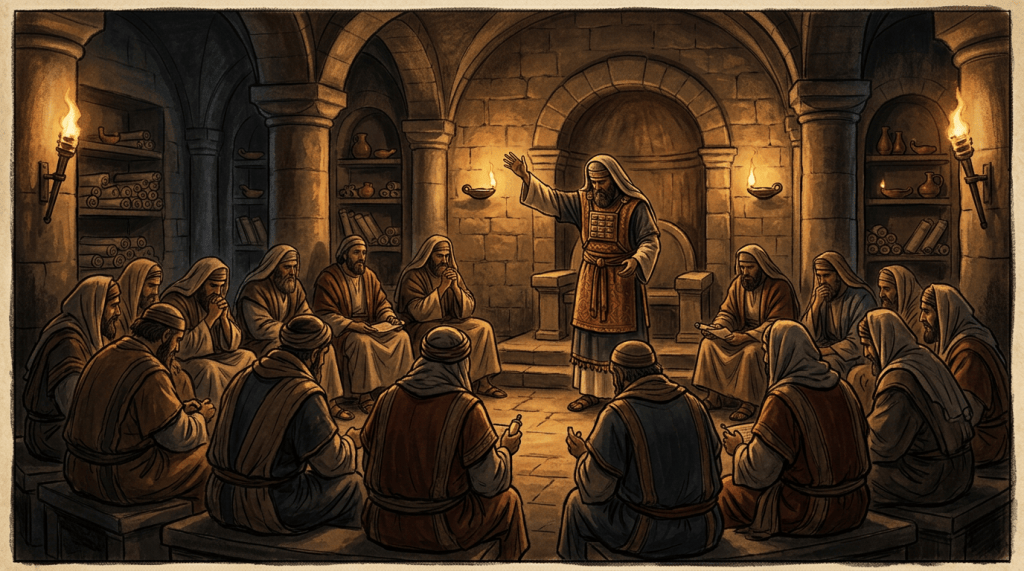
Immediately after Jesus publicly raised Lazarus from the dead, some of the Jews who were mourning with the family went to the Pharisees and told them what happened. The news prompted the following discussion:
“Then the chief priests and the Pharisees called a meeting of the Sanhedrin.
“‘What are we accomplishing?’ they asked. ‘Here is this man performing many signs. If we let him go on like this, everyone will believe in him, and then the Romans will come and take away both our temple and our nation.'”
John 11:47-48
The Sanhedrin, the ruling religious council, served with the permission of the Roman government. The Romans were known to flex their power, domination, and control, which was no doubt on the mind of the Jewish religious rulers. Rather than marvel that Jesus raised a man from the dead, the Jewish Council became concerned about the political implications of the report.
Reports of healing people is one thing, but raising a man from the dead is quite another! If “everyone” believes in Jesus,” the potential uprising might not only threaten their own authority in the eyes of their people, it might threaten the Temple and the entire Jewish nation!
Hyperbole and politics have always gone together. Nothing sells like a “sky is falling” message to get people motivated in the political arena.
Of course, it’s easy to criticize these religious leaders 2,000 years later. We might cynically accuse them of using fear tactics to hide a motivation to protect their own political power. Maybe there is some truth to that cynical assumption, but it’s also true that Rome was known for its brutality to people who dared to stand up to it.
The Romans invented crucifixion as the ultimate display of Roman power over its subjects. It was designed to be the ultimate form of public humiliation and a warning to anyone who might have a mind to take on the Roman government.
The Sanhedrin served at the pleasure of the Roman government, and its members would have been anxious to avoid a misstep with the Roman Empire. If Rome thought the Jews were a threat to the authority of the Caesar or Roman rule, the potential consequences – including the possibility of crucifixion – loomed large.
It wasn’t just a matter of staying in office. It was literally a matter of life and death. If Roman authorities thought a local official was pushing an agenda against them, a local ruler didn’t just fear losing a position of power and influence. A local leader had to be aware of the possibility of crucifixion to make an example of them.
They also had to be aware that they stood in a tenuous position as a people in the Roman Empire. They were outsiders who refused to acknowledge the Roman pantheon of gods. Though Rome tolerated them, they were suspect.
The political position of the chief priests and Pharisees was a delicate one. A messiah fever was in the air. Many would-be messiahs had risen up in recent years and had been squashed like bugs by Roman authorities when they pushed too far. There was tension in the air.
The fear was legitimate that Roman authorities might get tired of another uprising and remove the local religious leaders from their tenuous positions of authority if they didn’t control the people. Rome tolerated them only as long as they suited Rome’s purposes and didn’t cause problems.
At the same time, the Pharisees and Sadducees were angry at Jesus for picking on them. Jesus repeatedly challenged the Pharisees by healing on the Sabbath. He spoke out brashly against them and the Sadducees in front of the people. Jesus was showing them up, and the people were increasingly siding with Jesus.
Getting rid of Jesus would eliminate the challenge to their authority and avoid a possible confrontation with Roman authorities. Getting rid of Jesus was politically expedient and that is exactly what Caiaphas, the high priest, recommend. He justified it by saying that sacrificing Jesus would save the Temple and nation. (John 11:49)
As I read and think about these events, I see a parallel to the concerns and political expediencies faced by politicians today. Politicians want to protect their political positions and advance their careers. They also have legitimate concerns for the country. They use fear tactics – threatening the worst consequences – if their agendas do not succeed, the political expediency of protecting their own interests, along with legitimate interests for the country often motivate the solutions that are developed.
This parallel to 21st Century politics in the United States is where things get interesting. When political expediency aligns with prophecy our spidey senses should be tingling.
Continue reading “When Prophecy and Political Expediency Align: Danger in the American Church”

