The Beginning of an “Unapologetic” Argument for God

Faith is the inevitable position of a finite being who does not know all there is to know.

I really like apologetics. I find it interesting to think about, but apologetics has limited power as a tool to convince people to believe in God. It is not a magic bullet. There is no magic argument to prove the existence of God.

When I see article titles or social media posts that make claims of proving the existence of God, I cringe a little bit. It’s a promise we can’t deliver. We really shouldn’t “go there”. I feel that we should be more honest than that.

Of course, the “promise” depends on the definition of “prove”. The Oxford online dictionary defines the word, “prove”, as follows:

  1. demonstrate the truth or existence of (something) by evidence or argument. (“The concept is difficult to prove.”)
  2. demonstrate to be the specified thing by evidence or argument. (“Innocent until proven guilty.”)

If everyone accepted and applied these definitions, perhaps, we could find more common ground. A “proof” in the first sense is just evidence or argument that demonstrates the truth of the existence of something. Whether that proof actually, definitively and absolutely provides the truth or existence of that something, is another matter. A proof in this sense is still open to judgment whether it accomplished the goal.

A proof in the second sense is similar, and the example includes a standard of proof (one that we use in criminal proceedings). This example raises a key point: Without agreement on the standard of proof, the determination whether a proof is successful in proving that point is a moving target.

The success of any evidence or argument in proving a point depends on what standard of proof is applied. Two people may apply two very different standards of proof and, therefore, arrive at two very different conclusions on the determination whether the proof was successful.

Most of the arguments between theists and atheists gloss over and fail to recognize this fundamental issue. Not only do they apply different standards of proof, they make all kinds of different assumptions, and worse: they define their terms differently. It’s no wonder the debates and discussions produce so much disagreement. They are basically talking in foreign languages to each other.

Wikipedia defines “proof” as “sufficient evidence or a sufficient argument for the truth of a proposition.” What is “sufficient” evidence, though, depends on the standard of proof that is applied. Different standards of proof will yield different results.

For instance, we generally apply different standards of proof in the American legal system in different contexts. In civil cases, the applicable standard of proof is “more likely than not”, and in criminal proceedings, the applicable standard of proof is “beyond a reasonable doubt”.

Proving a case under the “more likely than not” standard is much easier than proving a case “beyond a reasonable doubt”. The higher standard (“beyond a reasonable doubt”) is designed for criminal cases with the purpose of causing “the system” to err on the side of finding a guilty person innocent (rather than erring on the side of convicting innocent people).

At least, that is the theory. People still disagree on the outcomes of criminal cases, and innocent people are sometimes found guilty, even when applying the much higher standard of proof. I am reminded of the axiom: to err is human.

These problems of proof are inevitable for finite beings. We don’t know what we don’t know, and we are always prone to “getting it wrong”. If we don’t take that limitation seriously, we become arrogant and prideful.

Therefore, I am reminded of the propriety of maintaining humility. Even if we are certain in our own minds of the truth of a matter, we should be mindful of the human tendency to get things wrong.

This is where faith comes in. Faith, in part, is an exercise in humility. Faith is the inevitable condition of being human, and that goes for faith in the truth that science reveals and faith in the truth that the Bible reveals. Let me explain.

Continue reading “The Beginning of an “Unapologetic” Argument for God”
Elijah: Closing the Curtain on Bitter Disappointment in the Gentle Presence of God

Most of us can’t relate to the boldness of Elijah’s faith, but I think we can all relate to the devastation of Elijah’s disappointment.

Elijah was the hero of the story that provided the backdrop for a sermon on faith and fear at Ginger Creek Community Church where I attend. The sermon series contrasts faith and fear, but I believe the Holy Spirit nudged me in a different direction. The message about faith and fear was a good one, but the disappointment of Elijah is what caught my attention.

For context, Israel was experiencing a 3-year drought and famine. Ahab, the notoriously corrupt and ungodly leader, was king. The entire nation was enthralled with worshiping foreign gods, and especially Baal, the Canaanite god of weather and fertility[1]

Baal was maybe a natural choice for them in the midst of a severe drought and famine. The popularity of Baal in Elijah’s culture was at an all-time high, but Elijah remained true to Israel’s covenant God, Yahweh.

Yahweh was Israel’s traditional God. The claim from ancient times was that He was the only true God, but it was no longer popular to worship Him. People still clung to a semblance of traditional, cultural practice, but other, foreign gods were much more popular, so, Elijah challenged them: 

“How long will you go limping between two different opinions? If the Lord is God, follow him; but if Baal, then follow him.” (1 Kings 18:21) 

The brashness of Elijah’s faith in God is hard for us to appreciate, perhaps. We get a clue from the fact that there were 450 prophets of Baal, and Elijah was the only prophet in the bunch who remained loyal to Yahweh. Elijah proposed a challenge that would put his life at stake. He said,

“’Let two bulls be given to us, and let them choose one bull for themselves and cut it in pieces and lay it on the wood, but put no fire to it. And I will prepare the other bull and lay it on the wood and put no fire to it. And you call upon the name of your god, and I will call upon the name of the Lord, and the God who answers by fire, he is God.’” (I Kings 18:23-24)

The loser(s) in this challenge would be put to death, which was the penalty for false prophets at the time. Elijah put everything on the line for God. 

If the gambling industry in Las Vegas existed in Israel at that time, the odds were stacked heavily against Elijah, but Elijah wasn’t intimidated in the least. Elijah even let the prophets of Baal choose the bull they wanted first and offered to let them go first. (1 Kings 18:25)

The other prophets set to work. They prepared the bull of their choice, and they called on Baal.

From morning to noon, they called on the god of popular culture, but there was no response. (1 Kings 18:26) When Elijah mocked them, they cried louder and cut themselves until they bled, but nothing happened. (1 Kings 18:27-29)

When it was Elijah’s turn, he invited the people to help him rebuild a small altar to Yahweh that had been torn down (a symbolic gesture no doubt). He prepared the remaining bull and stacked the wood.

Then he did the unthinkable: he upped the ante by having water poured over the offering – not once, but three times – until it was thoroughly soaked. (1 Kings 18:30-35) When Elijah was done, he prayed:

“O Lord, God of Abraham, Isaac, and Israel, let it be known this day that you are God in Israel, and that I am your servant, and that I have done all these things at your word. Answer me, O Lord, answer me, that this people may know that you, O Lord, are God, and that you have turned their hearts back.” (1 Kings 18:36-37)

Elijah’s wanted to demonstrate the power and authority of Yahweh, to vindicate himself, to renew the covenant between his people and God and turn their hearts back to Yahweh. He was so confident God could do these things, that he put his own reputation and his very life on the line.

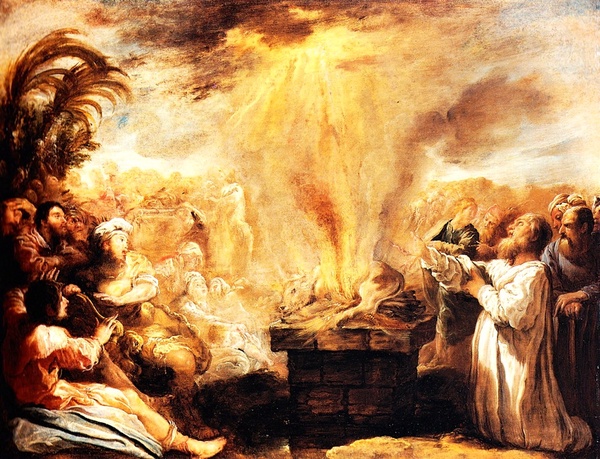
Of course, we know the story: God showed up. God’s fire didn’t just consume the offering; it consumed the bull, the wood, the stones on the altar and even the dust, and then the fire “licked up” the water left in the trench around the altar. (1 Kings 18:38)

There are few demonstrations of faith in the Old Testament as bold or powerful as this one. Elijah stood against all his contemporaries. He stood against the king, himself. He was the only prophet still faithful to Yahweh (as far as he knew). He put it all on the line, and God showed up in a powerful way!


The people fell on their faces and acknowledged God. (1 Kings 18:39) Elijah was vindicated, and his prayers were answered. His expectations were met. Or so it seemed.

This isn’t the end of story, though. The rest of the story is where I want to pick up.

Continue reading “Elijah: Closing the Curtain on Bitter Disappointment in the Gentle Presence of God”

The Story of Abraham and God’s Redemption of Mankind – Part 2

God works out His purposes through the messiness of human history.

The story of God’s redemption of mankind in the Bible funnels through one man, Abraham from Mesopotamia. I introduced Abraham (known as Abram then) and his family in Part 1 of this series of articles.

Abram’s sister, Sarai, became his wife. Both of them were children of their father, Terah, by different mothers. Terah’s son, Haran, died in their homeland (Ur). The family with Lot, Haran’s son, left Ur and and traveled to a place they called Haran in southern Turkey, just north of Aleppo Syria.

Terah and Nahor remained in Haran, but God gave Abram the direction, “Go to the land that I will show you”, and the promise, “I will make you a great nation….”, and “Through you every family on earth will be blessed”. (Gen. 12:1-3) Thus, at the age of 75, Abram and Sarah left Haran and continued on to Canaan, and Lot went with them.

When they arrived at Shechem in Canaan, God renewed the promise as Abram looked out over the land: “I’m going to give this land to your descendants.” Abram built an altar there, Then, he continued on to the high country in Canaan, between Bethel and Ai, where he also built an altar and worshiped God. (Gen. 12:7-8)

Though God had promised him twice at this point to give Abram this land, Abram continued on. They traveled south out of Canaan, into the Negev desert, and they kept going further south to Egypt because of famine. (Gen 12:9-10)

Abram remained in Egypt long enough to accumulate some wealth before he started moving again. (Gen. 13:2) It is written that Abram “traveled from place to place” when he left Egypt. He seemed to be wandering.

He traveled north again, back to the Negev and eventually back to Bethel and Ai, where he settled down. (Gen. 13:3-4) It must have been some time, as he and Lot had accumulated so many animals their herds and servants couldn’t coexist peacefully. Thus, they parted ways. (Gen 13:5-13)

Lot settled south of Canaan in the Jordan Valley. Abram remained in Canaan, and God gave him the same promise a third time: “Look north, south, east, and west of where you are. I will give all the land you see to you and to your descendants….”; and “I will also give you as many descendants as the dust of the earth.” (Gen. 13:15-16)

Still, Abram moves again, this time south about 35 miles to another part of Canaan known as Hebron. Many years pass. Abram seems to be waiting for God to do what he said, and, for the first time, Abram begins to show signs of doubt that God’s promises would come to pass, . Perhaps, this is why God promises him a fourth time: “Your own son will be your heir” (Gen. 15:4); and “I will give this land to your descendants.” (Gen. 15:18)

When Abram was 86, however, Sarai takes matters into her own hands and offers her Egyptian servant, Hagar, to Abram. Abram agrees, Hagar conceives, but all is not well in the Abram household. Hagar disrespects the barren Sarai, and Sarai mistreats Hagar so badly that she runs away. (Gen 16)

God comforts Hagar in her distress and says of Ishmael, “He will be free and wild”, but “[h]e will fight with everyone, and everyone will fight with him….,” and “[h]e will have conflicts with all his relatives.” (Gen. 16:12)

It seems that nothing is going right for Abram, and God promise takes on a sour taste. Is this the son through whom God will bless all the nations? This wild and contentious boy? Is the son of Sarai’s now despised Egyptian servant Abram’s heritage?

Continue reading “The Story of Abraham and God’s Redemption of Mankind – Part 2”

The Story of Abraham and God’s Redemption of Mankind – Part 1

As I start my third journey through Scripture from beginning to end in as many years, I am picking up on things I didn’t see the first two times through. In this series of articles I am tracing some stories in the great theme of God’s redemption of mankind through the descendants of Abraham.

Scripture is multi-layered and contains many themes large and small. I expect a person can study Scripture for a lifetime and always be seeing new things. Today I am seeing something in the line of Abraham that I kind of knew already, but I am digging into it in more detail.

The intricate tapestry that is the 60-some writings of the Bible authored by 40 some different people over 1500 or so years always amazes me. That tapestry is often veiled to us, as if we were seeing it from the wrong side. Unless we see it from the side from which it was meant to be viewed, the picture won’t be clear to us.

When we read the stories of ancient people, they feel foreign to us today. For instance, Sarai (later known as Sarah) is the wife of Abram (later known as Abraham), and she is also his half-sister. (Gen. 20:12) They shared the same father, but they had different mothers.

We shudder at the thought today of a person marrying a close, blood relative like that – a sister to boot! (Such close relations were later explicitly banned in Leviticus 18:9.) It was common a couple of thousand years before Christ, though. Perhaps this was due to limited spousal options and the greater distances people lived from each other.

We also need to understand that large segments of the Bible read like a narrative of things that simply happened, often without commentary. A recitation of the facts does not necessarily mean an “endorsement” of them. They simply are what they are, and we are often left to draw our own conclusions.

What we see throughout Scripture is that all people are deeply flawed, even the people with whom God found an audience. Ethical shortcomings have existed throughout every era of recorded human history. The Bible is nothing if not candid about the human condition.

I am setting the stage, here, for the point I eventually want to make about God’s plan to redeem all of mankind that weaves through the tapestry of the biblical narrative. I will have to lay this out over a number of articles.

In this article, I want to focus on Sarai and Abram and their origins. In Abram, who God renamed Abraham, God found a willing ear, and so God made His covenant with Abraham and gave Abraham a promise to bless not only him and his descendants, but all the nations.

This covenant and promise becomes the central story of all Scripture and needs to be recognized to make sense of it. It is one of the biggest themes in the biblical narrative tapestry.

Continue reading “The Story of Abraham and God’s Redemption of Mankind – Part 1”

The Longing of Faith and the Pleasure of God

Faith is the exercise of rejecting all other choices in this life but God.

I recently gave a presentation on faith (and doubt). We moderns tend to think of faith as the opposite of doubt – as in proof or evidence, or the lack thereof – but that isn’t the way Scripture presents faith to us. Cosmological and fine-tuning arguments for the existence of God and so on are elementary.

We shouldn’t be commended for merely believing God exists. God has made himself obvious. (Rom. 1:20) Even the demons believe … and bristle! (James 2:19)

Rather, faith involves trust and relationship. It involves a willingness to rely on God, rather than rely on ourselves. A willingness to wait on Him, to trust Him, and to be confident in His goodness toward us. Faith is believing God loves us and desires us to love Him.

We receive God’s grace by faith; it’s not anything we do, lest anyone boast. Rather the grace we receive is the gift of God offered to us out of His love for us. (Eph. 2:8-9)

“Anyone who comes to God must believe He exists”

Hebrews 11:6a

Of course!

and that He rewards those who earnestly seek Him.”

Hebrews 11:6b

Faith is not just believing that God exists, but believing that He really does reward those who desire Him.

I had not previously thought of the story of Adam and Eve in the context of faith before. After all, they didn’t doubt God existed. God walked with them in the cool of the day in the garden. They knew God face to face!

When Satan tempted them, however, they lacked faith. They failed to trust that God was trustworthy.

It may not seem immediately obvious that the story of Adam and Eve is a story of unbelief, but I think it is. When Satan focused their attention on the seeming goodness of the fruit to eat and questioned why God would not want them to eat what was good for them, Satan was tempting them to doubt God’s goodness toward them.

Adam and Eve ignored God’s warning, determining for themselves what was best for them. Unbelief is an unwillingness to rely on God and a choosing to rely on ourselves and our own ability to determine what is best for us – rather then rely on God.

Adam and Eve were intrigued by Satan’s claim that eating the fruit would make them like God. They bought into the claim that God didn’t want them to be like Him, knowing good from evil. At the core of that temptation is the desire not to be dependent on God and to be self-sustaining, self-determining, and self-righteous.

Of course, God did want them to be like Him. After all, God made them in His very image! It was the very core purpose of His plan for them to be like Him!

Continue reading “The Longing of Faith and the Pleasure of God”