The Story of Abraham and God’s Redemption of Mankind – Part 1

As I start my third journey through Scripture from beginning to end in as many years, I am picking up on things I didn’t see the first two times through. In this series of articles I am tracing some stories in the great theme of God’s redemption of mankind through the descendants of Abraham.

Scripture is multi-layered and contains many themes large and small. I expect a person can study Scripture for a lifetime and always be seeing new things. Today I am seeing something in the line of Abraham that I kind of knew already, but I am digging into it in more detail.

The intricate tapestry that is the 60-some writings of the Bible authored by 40 some different people over 1500 or so years always amazes me. That tapestry is often veiled to us, as if we were seeing it from the wrong side. Unless we see it from the side from which it was meant to be viewed, the picture won’t be clear to us.

When we read the stories of ancient people, they feel foreign to us today. For instance, Sarai (later known as Sarah) is the wife of Abram (later known as Abraham), and she is also his half-sister. (Gen. 20:12) They shared the same father, but they had different mothers.

We shudder at the thought today of a person marrying a close, blood relative like that – a sister to boot! (Such close relations were later explicitly banned in Leviticus 18:9.) It was common a couple of thousand years before Christ, though. Perhaps this was due to limited spousal options and the greater distances people lived from each other.

We also need to understand that large segments of the Bible read like a narrative of things that simply happened, often without commentary. A recitation of the facts does not necessarily mean an “endorsement” of them. They simply are what they are, and we are often left to draw our own conclusions.

What we see throughout Scripture is that all people are deeply flawed, even the people with whom God found an audience. Ethical shortcomings have existed throughout every era of recorded human history. The Bible is nothing if not candid about the human condition.

I am setting the stage, here, for the point I eventually want to make about God’s plan to redeem all of mankind that weaves through the tapestry of the biblical narrative. I will have to lay this out over a number of articles.

In this article, I want to focus on Sarai and Abram and their origins. In Abram, who God renamed Abraham, God found a willing ear, and so God made His covenant with Abraham and gave Abraham a promise to bless not only him and his descendants, but all the nations.

This covenant and promise becomes the central story of all Scripture and needs to be recognized to make sense of it. It is one of the biggest themes in the biblical narrative tapestry.

Continue reading “The Story of Abraham and God’s Redemption of Mankind – Part 1”

Who Are the Righteous and the Wicked? Part III

Abraham’s faith was more than naked belief; it was belief that prompted him to act in trust in God.

“All Scripture is breathed out (inspired) by God and profitable for teaching, for reproof, for correction, and for training in righteousness….” (2 Tim. 3:16)

I was prompted in reading Psalm 1 to focus on the distinction between “the righteous” and “the wicked” in Who are the Righteous and the Wicked? Part I. As I began to dig into it, I observed that only God is righteous, and our righteousness depends wholly on our relationship to God. If we believe (trust) Him, he credits His righteousness to us. (See Part II) Abraham is our example: when he believed God, His faith in God was credited to him as righteousness. (Gen. 15:6 & rom. 4:3)

This is all very fundamental to Christianity. It might prompt us to make the assumption that people who merely believe God, believe the Bible (and go to church) are righteous. There is a fly in that ointment, however; and James identifies it in his letter.

James acknowledges that Abraham believed God, and his belief was counted to him as righteousness (James 2:23), but James digs a little deeper into what “the righteousness that comes by faith” (Rom. 3:22) really looks like. After all, even demons believe in God (James 2:19), but they aren’t righteous! The difference between the righteous and the wicked, therefore, involves something more than merely believing in God

We explored the idea that righteousness is something that flows from God, out of His very Being. It is not something God decreed, but something that God is in His very nature. Righteousness is not an abstract ideal that God lives up to; God is righteous. We don’t describe God in respect to righteousness; we know righteousness by knowing God.

It helps, perhaps, to take morality out of the equation and to look at it through a more scientific lens. Just as gravity is what it is and operates the way it operates (because that is how God created the universe), righteousness is simply what it is. Righteousness, however, isn’t something God created, like gravity; righteousness flows from the very nature and character of God.

To put it very simply: God defines righteousness by who He is, and righteousness is defined in relation to God.

Thus, we can only know righteousness in relation to God. We can’t be righteous, because only God is righteous. God credits His righteousness to us who believe (trust) in Him, but that is only the beginning.

Christians might call this being born again. We believe God; God counts us righteous; and, thus, He welcomes us into relationship with Him. A birth, however, is only the beginning.

When we dig deeper, as James did, we see a specific characteristic to the belief that Abraham by which God credited it to him as righteousness. That characteristic is something more than bare belief. Demons, who also believe, don’t have that characteristic (otherwise their belief would be credited to them as righteousness too). This characteristic is what James is getting at when he says that “faith apart from works is dead”. (James 2:26)

Abraham’s faith prompted him to action. James says that Abraham’s “faith was active along with his works”, and his “faith was completed by his works”. (James 2:22) Thus, Abraham’s faith was more than naked belief; it was belief that prompted him to act in trust in God.

Having some understanding of what makes a righteous person righteous, and what doesn’t, is essential to our relationship with God.

Faith that doesn’t prompt a person to action is not the kind of faith Abraham had; it is not the kind of faith that is credited to a person as righteousness. Faith that only prompts feelings is not the kind of faith that leads to righteousness. (James 1:19) The faith that leads to righteousness is faith that prompts a person to be a doer of God’s word. (James 1:22-25) It is faith that prompts love for God and love for neighbor, and that love is active! (James 1:26-27)

Faith that doesn’t result in a change from the core of a person’s being that emanates out into a change of heart and change in action is not the kind of faith that can be described as being born again. It is not saving faith, and it is not the kind of faith that God attributes as righteousness to people. 

God’s Plan for Unity from Diversity

God’s end game is a great multitude that no one could number, from every nation, from all tribes and peoples and languages.


I have been thinking quite a bit about diversity and the Church (universal, the body of Christ) lately. NT Wright commented recently that a modern secularist might believe that the church is catching up to the issue of racism following a largely secular cry for attention, but the truth is different from what it appears.

When asked about the church’s response to issues of race, Wright commented that God has always had a plan for the diversity of His creation. The comment got me thinking in what ways it might be true.

In fact, if we “read ahead” in the story, we see John’s great vision of “a great multitude that no one could number, from every nation, from all tribes and peoples and languages” standing before God. (Rev. 7:9)

If this is the end game, where do we find evidence of the plan of God to gather that multitude from every nation, from all the tribes and peoples and languages to Himself?

Continue reading “God’s Plan for Unity from Diversity”

God’s Purpose for Good

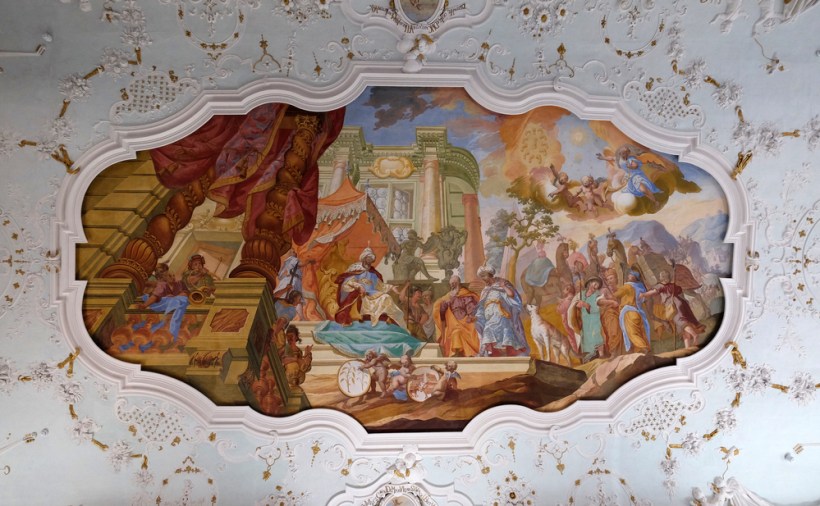
Jacob with his sons before the Pharaoh, ceiling fresco by Johann Adam Remele in Joseph Hall, Cistercian Abbey of Bronbach in Reicholzheim near Wertheim, Germany

“But Joseph said to them, “Do not fear, for am I in the place of God? As for you, you meant evil against me, but God meant it for good, to bring it about that many people should be kept alive, as they are today.'” Genesis 50:19-20 ESV

I have written recently about the verse, Genesis 50:20 (things men might mean for evil God is able to use for good). (See God in the Dark) The message that God can turn the evil that impacts our lives for good is  powerful one. Though we might despair in our circumstances, especially when the evil we experience is caused by people, maybe even people we love, God is ever at work. God is able to redeem our circumstances, and, more importantly, redeem us.

As with any verse in the Bible, though we need to read it in context to understand the fullest, and most complete meaning. Genesis 50:20 was spoken by Joseph in a very specific context, so let’s take a look at that context and mine this well-known verse for some deeper meaning.

Continue reading “God’s Purpose for Good”

The Roots of Modern Ethics in the Ancient Near East

Of the origins of monotheistic religion and ethics.

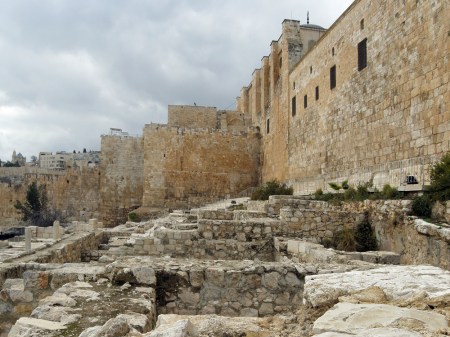
Jerusalem: The Temple Mount from the time of the Second Temple

When I was in college, the first class I took was World Religions. Though I graduated with an English Literature major, I also had enough credits to be a Religion major. I didn’t need the dual major. I only took the religion classes because they interested me.

I also became a believing Christian during my college years. It was a transition that took place between that World Religion class and the summer between Sophomore and Junior years. It’s a long story that I might tell in detail some time, but the point for now is that I did a lot of reading and thinking about these things in those years and in the decades since. It doesn’t make me a theologian, but I have more than a passing interest.

Early on I learned that the creation story and flood story in Genesis, among other things, have counterparts in other religions, including other religions in the same area of the world – the Ancient Near East. Phoenicians, Assyrians, Persians, and other people groups had similar myths that have been uncovered from that general time period.

I learned that Zoroastrianism shared attributes similar to the ancient Hebraic view of the world, including the idea a singular creator God, a dualistic cosmology of good and evil, the ultimate destruction of evil, judgment after death, etc. The scholarly understanding when I was in college was that Zoroastrianism predated Hebraic thought and influenced it.

It occurred to me at the time, not having any reason to doubt what I was taught, that Abraham may have been particularly open to his encounter with God if, indeed, he had lived in an area of the world and in a time in which there was this kind of influence. It made some sense. He was the right guy in the right place with the right influences setting the table for an encounter with God, the Creator of the world. Perhaps, Abraham brought the influence of monotheistic Zoroastrians into the pagan, polytheistic world of Canaan.

Recently I did some research on Zoroastrianism. Wikipedia acknowledges that Zoroastrianism has “possible roots dating back to the second millennium BC”, though the “recorded history” of Zoroastrianism dates back only to the 5th Century BC. (Wikipedia). The conjecture that Zoroastrianism dates back further to the second millennium BC is has no present support in the historical record.

If we date the accounts of Abraham and his descendants according the biblical chronology and references, that history goes far back into the second millennium BC, but the consensus of modern archaeologists and theologians reject that dating in favor of first millennium BC dating. (See Wikipedia, for example) Modern scholars don’t take the Bible at face value. In fact, they presumptively dismiss the Bible as historical record.

Scholarly views are not universal on this issue, of course. Not by a long shot. Modern archaeological and written evidence exists to suggest that the modern consensus is wrong about the timeline for the life of Moses, the Exodus and other things. (See for instance Patterns of Evidence: The Moses Controversy) The Patterns of Evidence theory is that historians and archaeologists who assume a particular timeline for certain events are not apt to see the evidence for those events if they occurred in a different timeline.

The Patterns of Evidence thesis is that evidence for the events described in the biblical narrative is there if we use the right timeline and look for them in the right time periods. Specifically, the biblical accounts of Moses, the Exodus, and entry into the land of Canaan are apparent in the archaeological record and historical data on the biblical timeline (second millennium BC), but they are not evident in the first millennium timeline applied by modern, skeptical scholars.

Certain archaeological finds, like the Ebla Tablets, also raise questions about the modern scholarly consensus. The importance of “looking” in the right places according to the right timelines is explored in Timing the Walls of Jericho.

Back to Abraham, though. He was reportedly from the area of Ur (in modern southwest Iraq), which is quite a distance from the area of Canaan (later Judea) where he ended up – about 1600 miles in fact. In Ur, he may have come in contact with Zoroastrians and similar influences. That idea intrigued me in college, and it still does. So I revisit that thought journey again today.

Continue reading “The Roots of Modern Ethics in the Ancient Near East”