Christians On Social Media


Peter said, “but in your hearts honor Christ the Lord as holy, always being prepared to make a defense [apologia; apologetics] to anyone who asks you for a reason for the hope that is in you; yet do it with gentleness and respect.” (1 Peter 3:15)

This is the tenor and main point of the article, CHRISTIANS ARGUING WITH CHRISTIANS ON SOCIAL MEDIA: A REAL INTEREST IN THE SALVATION OF THE LOST?…. I encourage you to read it. I put it here so people would read it, and so I would be reminded of it and read it again myself.

It’s far too easy to say things on social media that we wouldn’t think of saying face to face in conversation with someone. If we don’t respond to people with gentleness and respect, as Peter urges us, we are not responding in love. We might as well not respond at all.

We live in a reactionary world like never before, exasperated by social media that gives us the instant gratification of an immediate response for every thought that crosses our minds. Don’t do it!

Social media is designed for instant gratification. The algorithms are purposely designed to evoke an immediate response. Social media marketing is aimed at stirring up your emotions to get you to respond, good or bad (they don’t care). Our knee-jerk reactions, especially to contentious comments and posts, are often unkind, judgmental, harsh or worse.

We need to be more self controlled than that. We need to be more self-sacrificial, resisting that desire for immediate gratification for the good of the Gospel. We can pick up our crosses and follow Jesus in this social media age by dying to that desire for the instant response.

We need to be salt and light. Salt accentuates the taste of food, but it does that subtly. Too much salt overwhelms and destroys the flavor of the food. Just the right amount accents and brings out the flavor. People are much more apt to take notice of what we say and take it to heart if we say it with gentleness and respect, as Peter admonishes us.

Light illuminates. Too often we demonstrate heat without a great deal of light. It isn’t our job to convict people of their sin or even to convince them of the rightness of our positions. The Holy Spirit is well-equipped to do the convicting in peoples’ hearts. We just need to be faithful to speak the truth, but we need to do it in love – always in love.

God’s word does not go out and come back void, but our idea of how people should respond and what it means that God’s word does not come back void may not be accurate. We may want every post to be a mic-drop moment, but God doesn’t always work that way.

When Isaiah was given the commission to speak God’s word to the people, he was told they wouldn’t listen. It wasn’t Isaiah’s responsibility to make sure they listened. It was his responsibility simply to speak and to let God do His work. If nobody listened, still Isaiah was being faithful in what God called him to do.

Are we always speaking God’s word? We are finite beings. We might not always have it right. We should have the humility to realize that.

Our love for other people, on the other hand, is always “true”. How we treat people will always shine through and have an impact. Our greatest apologetic is the love of God. Love covers a multitude of sins.

“If I speak in the tongues of men and of angels, but have not love, I am a noisy gong or a clanging cymbal. And if I have prophetic powers, and understand all mysteries and all knowledge, and if I have all faith, so as to remove mountains, but have not love, I am nothing. If I give away all I have, and if I deliver up my body to be burned, but have not love, I gain nothing.” 1 Corinthians 13:1-3

The Hole In the God of the Gaps Argument

All people, including scientists, fill in the gaps in their knowledge with a model of reality they believe best fills those gaps in light of the knowledge they have. 


Most people who have entertained the question, whether God exists, are familiar with the “God of the Gaps argument” that is made against the existence of God. It goes something like this: In the past, people couldn’t explain natural phenomenon, like rain, thunder, earthquakes, etc. so they attributed those things to the activities of the gods. People use the gods (or God) to fill gaps in their knowledge and understanding of how the world works out of ignorance.

From that observation (which is factually true as a simplistic statement), they add in the equally true observation that the progression of science over the centuries has been filling in the gaps in human knowledge and understanding of the natural world. We have found natural explanations for most phenomenon without having to resort to the conclusion that “God did it”. Thus, the argument goes, we should stop invoking divine explanations.

Many people take that even further and conclude that we should stop believing in God altogether. We don’t need God to do science; thus, we don’t need God at all, they say.

Thinkers realized during the Enlightenment period that they didn’t need to invoke divine explanations at all to be able to study the natural world. From that realization, a scholarly consensus the thinking has developed that divine explanations are not only not necessary; they are not appropriate.

Divine explanations are viewed today by most scholars as anti-scientific. Some people who are concerned with the purity of science would even deem divine explanations “heretical” to the current scientific orthodoxy.

The God of the gaps argument (as an argument to prove the nonexistence of God), however, is pretty weak. The fact that we can do science (which is, by definition, the study of the natural world) without appealing to a supernatural being or explanation isn’t surprising. It also can’t tell us what caused the natural world, as any cause of the natural world would have to be independent of it.

Just as the study of a painting can never introduce us to the painter, study of the natural world could never hope to introduce us to the creator of the natural world. At best, it might tell us something about the painter/creator. In both cases, we must be willing to look elsewhere to find the painter/creator.

Frankly, the order we see in the natural world is more surprising on a naturalistic worldview that assumes no intelligence behind the universe. We see intricate design in the universe, from the micro to the macro levels. How do unguided co-locations of molecules and matter acting randomly on each other produce the exquisite fine tuning we see?

The order to the natural world that we can study and know doesn’t preclude the existence of a supernatural (other than natural) Being behind it all. The order of the natural world is actually more difficult to explain without God.

The order of the world, by itself, is not proof that God exists, but the design we see is best explained by a grand Mind. This is not a gap-filling argument. It is an argument based on the best explanation we have – that all design we see in our experience is created by a being with agency who thought of it, designed it, and created it. This is the best explanation that we have.

If we resign ourselves to nothing but the study of the natural world, how do we expect to know anything about the possibility of reality beyond it? If we limit ourselves to naturalistic explanations, we foreclose any other possibility.

Thus, refusing to allow for the possibility of a God that might fill the gaps in our knowledge is just as arbitrary and closed-minded as filling every gap with God (and refusing further inquiry).

We all fill gaps in our knowledge, and we do it on the basis of what we know and believe about what we know. Our gap fillers are our basic assumptions. The theists assumes a Creator exists. An atheist assumes that no creative mind is behind the universe.

Frankly, there is a big gap between the fact that the natural world has order that we can study and the question whether anything beyond the natural world exists. I can turn the argument around and accuse the naturalist of filling the gap with the conclusion that no God exists.

But all of this really misses the important point. Hugh Ross addresses the God of the gaps argument in a recent interview with Kahldoun Sweis. He says,

“In science, there are always gaps. We will never learn everything. We are limited human beings.”

However, when we “push back the frontiers of science”, we have to ask ourselves whether the gaps in our knowledge are getting bigger and more problematic? Or are they getting smaller and less problematic?”

Continue reading “The Hole In the God of the Gaps Argument”

An Intriguing Interview with Dr. Hugh Ross

When we try to rely on science, alone, to answer the big questions, we can’t do it without sneaking philosophy into the equation.


In this age in which fake news seems to dominate the public domain, how do we know what is really true? How can we trust any news? That is a legitimate question today, one that people in my generation didn’t ask as often as we have to ask now.

Skepticism that was once the esoteric tool of elite, fringe intellectuals is now, perhaps, as often used as a hammer in the intellectual toolkit of the common person. What years of intellectualism was not able to accomplish has been achieved in less than a generation by the constant barrage of biased and untrustworthy “news outlets” in the Internet age.

Such an atmosphere of skepticism might cause despair of ever knowing, or being able to know, what is really true. Perhaps, the only thing we can trust is skepticism itself. That is the forlorn cry of a post-modern age.

Many people have retreated to science and what can be known about the world that we observe with our five senses. Science seems like the only protector of truth in a world that can’t be trusted without concrete evidence.

Some people even hold to a position that science is the only way we can know the world: the five senses are the only way to know truth. These people discount psychology, sociology and “soft” sciences, and they largely dismiss philosophy (and theology most of all).

Some people even take the position that science is the only way of knowing truth, and philosophy, therefore, is no longer needed or even useful (because it can’t be trusted).

At that moment, however, if we are paying attention at all, we realize that the person who says this is actually asserting a philosophical position! The scientist who rejects philosophy on this basis has cut off the limb he hangs on, and he doesn’t even realize it. Not even science, then, is the safe harbor we wish it was.

Frankly, mathematics might be the only certain way of knowing things, if the truth be told, but mathematics doesn’t tell us anything about the most important questions that people ask. Why are we here? Where does life come from? Is there purpose to life?

We try to rely on science, alone, to answer these big questions, but we can’t do that without sneaking philosophy (or theology, heaven forbid) into the equation. What we observe with our five senses can’t answer those questions without the help of philosophy and theology.

That leaves us with the more difficult talk of synthesizing and harmonizing all the ways we analyze truth and reality, including science, psychology, sociology, philosophy, theology, etc. It would be more convenient and may seem like an easier task to eliminate one or more of those disciplines from the mix, but we would be missing nuances of truth and reality in the process.

In the end, the best we can do is strive for honesty, integrity, objectivity, knowledge, understanding and humility in our efforts to understand the nature of reality and truth. Humility is important because it recognizes and factors into the equation the fact that we are finite creates with limited perspective and capacity.

With that introduction, I am providing a link to an interview with Dr. Hugh Ross who has spent his life trying to synthesize and harmonize what he knows about science (which is a lot) with philosophy and theology. I like him because of his humility and commitment to science, logic and understanding.

Continue reading “An Intriguing Interview with Dr. Hugh Ross”

Though Every Man Be a Liar

The flaws of humanity that exist in the church negatively affect people and are a stumbling block for many.


In Romans 3, Paul asks whether a lack of faith nullifies God’s faithfulness. It’s a rhetorical question that Paul answers this way: “Even if everyone else is a liar, God is true.” (NLT)

Our faithlessness, of course, doesn’t make God faithless. Our actions don’t change God’s character. Though every man be a liar, still God is true.

This is the backdrop to this piece that is inspired by the interview of Lisa Gungor and Alisa Childers by Justin Brierley on the Unbelievable? podcast.

Alisa Childers and Lisa Gungor both grew up with evangelical Christianity. They were both Christian musical artists. They both went through a period of doubt and “deconstruction”. Alisa Childers emerged from that period of deconstruction with her faith intact, stronger than it was before, while Lisa Gungor has evolved into a progressive Christian – holding on to the title “Christian”, while letting go of nearly everything that distinguishes Christianity from other religions.

Of her own experience, Childers says that the flaws and errors in her construct of God, scripture and doctrine were removed in that process of deconstruction and replaced. Instead of giving up on Christianity, she doubled down in her testing of the faith. What could not stand up to the scrutiny, she let go. What remains is a solid foundation.

While the church, and people generally, seem to fear doubt, and shy away from it, the Bible actually encourages us to meet doubt head on. Paul urges us to “test everything” and “keep [or hold fast] what is good”. (1 Thessalonians 5:21) This is the route Alisa Childers took when faced with doubt and challenges to her faith.

More to the point of this article, though, Childers observes that many people who go through “deconstruction” of their faith often cite the behavior of the church, and the people in the church, as a primary reason for leaving the faith. It might be hypocrisy, judgmental attitudes, failure to live up to “Christian standards”, ignorance of modern science, an adherence to a blind faith that refuses to admit facts that are contrary to their understanding of Scripture.

Or worse – it might be experience with the ugliness of sin that we expect should not be present in the church. Church people can be cliquey and unapproachable. Church people can be greedy, petty, quick to get angry, lustful and worse – even church leaders. The evidence of sexual abuse and pedophilia that has come to light in Baptist churches recently reveals an ugly underside to quintessentially evangelical churches that hadn’t before come to light.

I would add that non-church people level similar complaints at the “the church” as former church people who have left.  The reasons they give for not going to church, or being “religious”, or having faith in God include apparent hypocrisy, negative personal experiences and bad behavior of church going Christians.

While people may give other reasons for “not believing” or not having faith, the examples of people who hold themselves out to be Christians is almost always one of the reasons given, if not the most compelling reason given by people who don’t consider themselves (or no longer consider themselves) “Christian” (at least in the sense of born again, evangelical (whatever that still means) Christianity).

To this point, I am reminded of what Paul says, “Though every man be a liar, still God is true!” Let me explain.

Continue reading “Though Every Man Be a Liar”

Questioning the Skepticism about Some of Paul’s Letters

A little skepticism of the skeptics might be in order in questioning the rejection of the authorship of some of the “questionable” Pauline epistles.

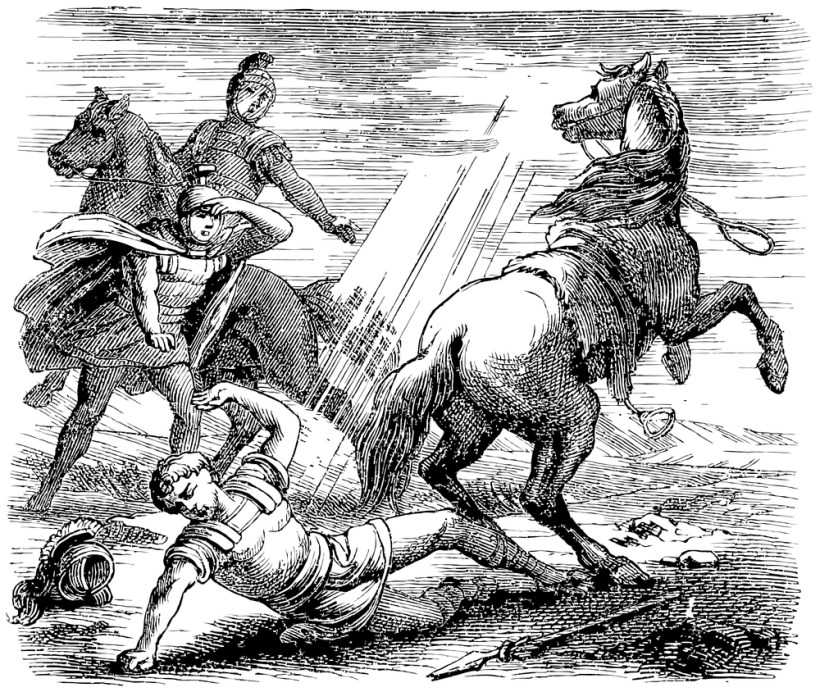
Old Engraving of the Conversion of Paul

I first learned that some of the “Pauline epistles” were not written by Paul in my religion courses in college. That was the scholarly consensus then, as it is now, among the elite New Testament scholars in colleges and universities around the world. This consensus grows out of the “school of higher criticism” that began in the 19th Century in Tubingen, Germany.

The so-called “school of higher criticism” is textual criticism with a heavy emphasis on the text. (I will explain that comment below.) Not that textual criticism, itself, should be suspect. Textual criticism is “a branch of textual scholarship, philology, and of literary criticism that is concerned with the identification of textual variants, or different versions, of either manuscripts or of printed books…. The objective of the textual critic’s work is to provide a better understanding of the creation and historical transmission of the text and its variants.” (Wikipedia)

And by the way, there are differences among the New Testament manuscripts. Many differences. That fact shouldn’t come as a shock to anyone in this information rich age. If you aren’t aware of that fact, you would do well to consider the work of Daniel Wallace on the subject. I have addressed this issue before (Can We Trust the Bible?). But, I digress….

I have no issue with textual criticism applied to the Scriptures. We have learned much about the Bible from the method of study called textual criticism. “Criticism” here doesn’t mean, necessarily, rejection or doubt, but is more of a method of study that recognizes textual differences between manuscripts and attempts to identify the text that is most true to the original text, among other things.

Because we have so many manuscripts, well over 25,000 of them in various languages, there are variants that need to be addressed and understood. Textual criticism helps us with this understanding. (I should add that we have such a high degree of certainty about what the original text says precisely because we have so many manuscripts. If you want to dig in to the topic of textual criticism as applied to the Bible, I recommend The Basics of New Testament Textual Criticism.)

Some people take the fact that there are many differences among the manuscripts as a reason to reject the New Testament as Scripture, believing it to be inherently unreliable, questing whether we even know what the original authors wrote. This is an extreme view, in my opinion, though one that skeptical intellectuals seem to like. Perhaps, their fondness of this view is that it eliminates the need to take Scripture seriously or to apply it to their lives (to apply a little skepticism to the skeptics).

The fact is that we have such a wealth of New Testament manuscripts (5800 Greek, 10,000 Latin and 9800 Syriac, Coptic, etc.) that we can know with a very high degree of accuracy precisely what the original text was (like 98.5% per Dr. Wallace). Even if we didn’t have a single manuscript left, there are some 36,000 quotations of New Testament text by the early church leaders. Wallace observes that we could assemble the entire New Testament from those quotations alone, without the need for a single manuscript of the text.

But, I digress. Only a little. The point is that we should be as skeptical of the skeptics as they are skeptical of the text. In fact, Skepticism is the hallmark of the higher school of criticism. Skepticism is their starting place. They assume a skeptical approach. They don’t just wipe the slate clean, and start from neutral; they assume that the plain meaning of the text, the authenticity of the text and the reliability of the text has the burden of proof. And for this reason, we have good reason to be skeptical.

This form of skepticism is the flip side of what some might call blind faith. There is a danger in being skeptical that will not admit a positive result. There is a commitment to skepticism that is counterfactual. We can be as “committed” to skepticism as we are to belief to the exclusion of the facts and reality. I believe this is the case with the Pauline epistles that scholars reject.

Continue reading “Questioning the Skepticism about Some of Paul’s Letters”