As I read through Scripture, I am always looking to understand it better. At the same time, I am listening for God to speak to me. In the process, I notice things. Like today. I noticed Paul’s statement to the Colossians:
I say this in order that no one may delude you with plausible arguments.
Colossians 2:4 ESV
Hmmm… the delusion of plausible arguments. That’s an interesting phrase… (So it seems to me, anyway!) I want to explore that a bit further.
Context is always important. the context for this statement is Paul’s letter to the people in Colossae, a very Greek city. He had already been to Athens where the Athenians spent significant time telling and listening to the latest ideas. (Acts 17:21)
In our modern view, we might imagine an ancient think tank in which new ideas are explored and developed toward some greater ends. We might be tempted to see Athens as an incubator of ideas for the benefit of mankind.
Luke, the writer of Acts, was not being complimentary, however, when he made this observation. The context suggests a contrast between a desire for novel ideas and a desire for truth. Ideas for the sake of ideas and novelty for the sake of novelty may be an erudite pastime for the bored elite who enjoy comfort and privilege, but they are not noble pursuits in themselves.
Unless one has a desire to know truth (and put it into practice), entertaining new ideas is only an exercise in futility, diversion and delusion. The ancient writer of Ecclesiastes, writing about a millennia before Paul set foot in Athens, recognized “there is nothing new under the sun”. (Ecc. 1:9)
Even way back then! Chasing after ideas that are new for the sake of novelty is just a distraction from the truth. It is meaningless!
Paul views the sharing of ideas for the novelty of them in the same way modern people might play video games or read a book – entertainment to pass time. He obviously thought little of such things and had no time for it.
Truth had been revealed to Paul in the form of the risen Jesus, whom his people had crucified and Paul had persecuted. Paul’s whole life was interrupted one day as he traveled with the intention of arresting and imprisoning Christ followers in Damascus, and the course and trajectory of Paul’s life was forever changed.
Paul’s life would never be the same. By the time Paul wrote the letter to the Colossians, his motto had become “to live is Christ and to die is gain”. (Phil. 1:21) Other things, including a preoccupation with novel ideas, has become mere distractions not worth his time.
If we can tell anything about the biographical and autobiographical sketches of Paul in Acts and his letters, we can see that Paul was fiercely and uncompromisingly concerned about truth. That attitude led him to persecute the followers of Christ with zeal when he thought the truth lay in that direction.
It was Paul’s commitment to truth that prompted him to turn in the opposite direction and accept the same Jesus Paul had persecuted as his Lord and Savior. Paul gave himself completely as a servant of the risen Lord to the point of sharing in his own body the sufferings of Christ (as described in Colossians 1:24).
Paul’s turn of phrase, perhaps, is what caught my eye as I read through Colossians this morning: the delusion of plausible arguments. It deserves some additional contemplation.
The story about the book has intrigued me since I heard him talk about it. I am taking my time reading through it. Holland is a historian with a particular focus on ancient, classical history. He chose dinosaurs over the Bible as a young child. He was more enamored with Pontius Pilate than Jesus Christ. The ancient, classical world and the likes of Julius Caesar captured his imagination.
His passion became both avocation and vocation. He became a historian. Holland is the best kind of historian, because he realizes that we all have basic assumptions that we bring to the table, and we need to be as candid challenging our own assumptions as we are challenging others.
We all have a perspective, right? We come to whatever we read or hear with certain assumptions that have developed in our thinking. Affirmations of those assumptions sit well, but challenges to those assumptions do not rest easy. You know what I am talking about.
Holland challenges assumptions from all sides, including his own. For that reason, it’s a challenging read, but all lasting growth of any kind comes through conflict and tension.
His worldview? Holland is an atheist and secular humanist. Holland’s basic philosophy of life is informed by the values of basic humans rights: the right to equality, fair treatment and freedoms that we might call inalienable, like the separation of church and state, the value of scientific endeavor and the social necessity of charity and good will.
When he set out to write a book tracing these values back to their sources, he was not predisposed to assume where he would find them, though he certainly had assumptions and presuppositions. Like the paleontologist sifting through layers of earth and civilization laid one on top of another, Holland did the painstaking, tedious work.
Beginning with Darius and the great Persian Empire, Holland sought to uncover the lineage of modern western thought from one empire to the next, tracing the rivulets of thinking to find the headwaters for modern secular humanism.
Holland was looking for the progression that evolved into ideas that inform the modern western mind. He did not focus on the usual events that historians dutifully catalogue, other than to look behind them for their motivation. He focused on thoughts as they developed and the people who championed them and events as they influenced those thoughts and ideas.
In the ancient world, as one might expect, many of those ideas were dressed in metaphysical garb. Holland’s focus, though, is always on the those thoughts and ideas that continue in our modern values today. The ones that died off, like the dinosaurs, are only interesting as side notes to that history.
Much of the book explores the world of discarded gods and beliefs that animated the ancient world. The beliefs of the ancients are the evolutionary precursors to our modern thought. In those layers of metaphysical and philosophical sediment lie traces of our modern values.
In sifting through the soils of history, Holland identifies the beginnings and ancestry of the ethics and values that ground his worldview as a humanist in the sedimentary layers in which they arose. As often is the case in such endeavors, Holland makes some startling discoveries.
What Holland carefully and methodically uncovers is one seismic development that diverted and defined the flow of thinking in western civilization – a metaphysical “Cambrian Explosion”. His find caught him off guard: that western thinking is founded on, permeated with and inextricably intertwined in Christian ideas.
Holland was always taught that the Church held back modern advances, like a stubborn dam that had to be blown up to let the river of progress flow. He assumed the narrative of the Enlightenment was true. Holland assumed we are Greek, and maybe a little Roman, in our modern, western values.
Holland had a nagging suspicion, however, that modern values are not so much connected to the thinking of ancient Greeks and Romans as they are connected to something else.
When Holland gets into the Enlightenment Era in his book, he finds that his suspicions were correct, and he is able to identify the disconnect – an incongruity that bears some candid analysis for its deviation from the origin and trajectory of the historical developments to that stage.
It was Christianity that changed the course of history and added the soil in which modern values took root. Holland also came to realize that Enlightenment thinking grew out of that rich soil that it sought to dig, and this is both ironic and dangerous, like the man sawing off the branch that supports him.
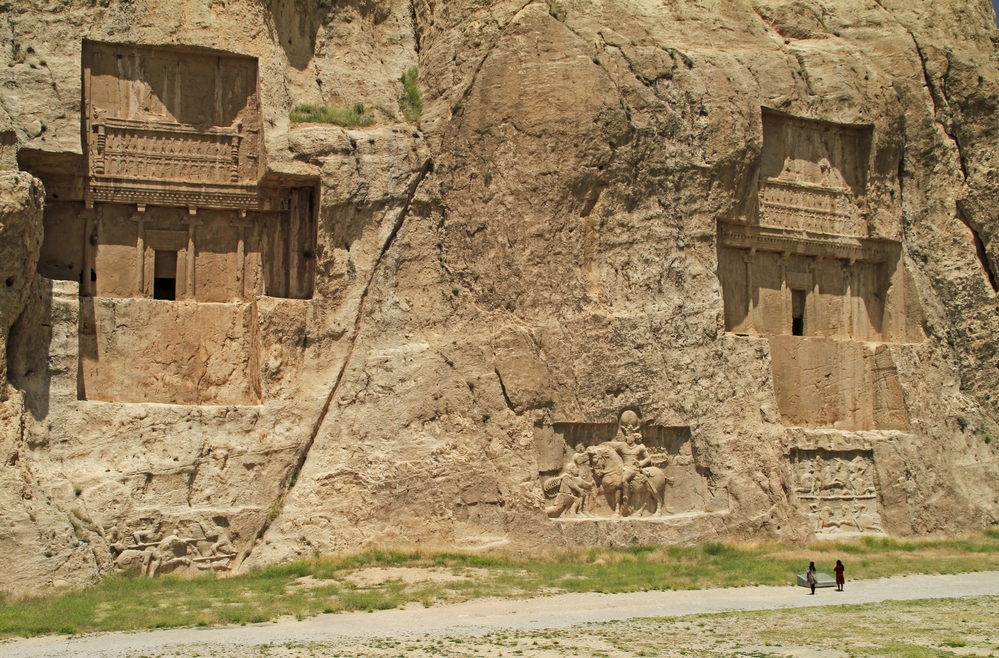
The graves of the Persian kings Darius and Xerxes near Persepolis, Iran
I am finding a wealth of subject matter in Tom Holland’s history of western civilization, Dominion: The Making of the Western Mind. Of particular interest is the place where he starts his history of the west – with Darius, the great Persian conqueror of the Assyrian and Babylonian empires in the east.
It seems that Holland’s candid explorations of history have fascinated him as much in tracing the threads of his childhood fantasies about ancient history as in busting the myths that arose as part of those childhood fantasies. Below he describes the busting of one of those myths – that the Greeks fought off the evil Persians from the east to save the west:
In Persian Fire: The First World Empire and the Battle for the West, which focuses on the Persian incursion into Greek territory, Holland realized that the Spartans were no champions for freedom, and the Persians were no moral monsters comparatively. In fact, the Persians were the ones motivated by what they believed were moral callings – something that would have been a completely foreign concept to the Greeks.
Darius and the Persians during his reign believed in Ahura Mazda, the Zoroastrian supreme, creator God. When I was in college, I learned in my World Religion class that Zoroastrianism was the first monotheistic religion. I had my doubts then about that statement, as I do now (see The Roots of Modern Ethics in the Ancient Near East), but the fact is that monotheism developed in the ancient Near East. Not in the west.
The first reference to Ahura Mazda appears in the Behistun Inscription by Darius. Darius reigned from 522 BCE until his death in 486 BCE. While Holland uses more “traditional” historical sources for Dominion, Hebrew Scripture intersects with Persian history in this time period.
Before Darius, the nation of Judah was exiled to Babylon when Nebuchadnezzar II conquered Jerusalem in 587 BC. The Prophet, Jeremiah, describes the siege of Jerusalem (Jer. 39:1-10 & 52:1-30), and Nebuchadnezzar is mentioned throughout the first four chapters of Daniel, who was one of the exiles from Jerusalem in Babylon.
Though Nabonides succeeded to the throne after Nebuchadnezzar, his son, Balshazzar, was left in charge in Babylon for ten years while Nabonides was away on an archaeological expedition. Balshazzar is mentioned in Daniel, chapters 5, 7 and 8. Daniel mentions his death, which occurred after Cyrus II (Cyrus the Great) conquered Babylon (539 BC). Nabonides was also killed on his return to Babylon that same year.
Cyrus conquered Babylon while the Hebrews were exiled there, and the Hebrews were still exiled in Babylon when Darius 1 (Darius the Great) took over as the king in 522 AD. Again, the biblical reports intersect with the more “traditional” archaeological and historical sources.
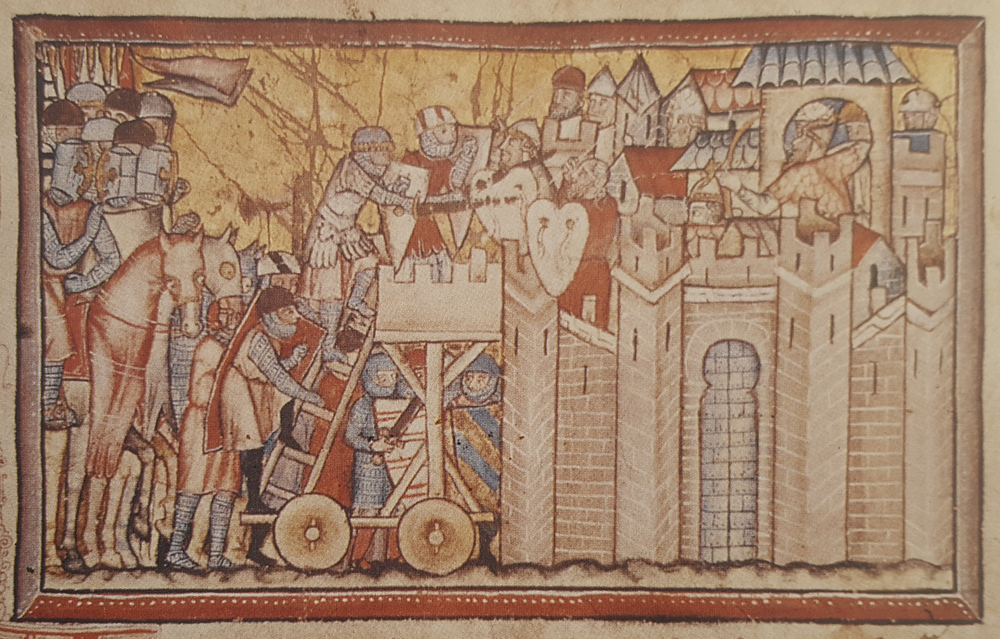
Miniature showing siege scene of conquest of Jerusalem, 1099. Nunez de Balboa House-Museum, Jerez de los Caballeros, Spain
I am working my way through Tom Holland’s book, Dominion: The Making of the Western Mind. I have just finished the segment on Pope Gregory VII and Pope Urban II at the turn of the first millennium since the birth of Jesus Christ.
Since Jesus first told an antagonistic group of religious leaders that people should “render unto Caesar that which is Caesar’s, and render unto God that which is God’s”, and for centuries afterward, the church was at the mercy of the state. Not even a generation after Jesus died, the Roman government, which controlled Judea where Jesus lived and his following sprung up, ransacked Jerusalem, scattering Jews and Christians into the countryside and beyond.
Through the first three centuries, the best the followers of Jesus could hope for was an indifferent Caesar or provincial ruler. At various times, they suffered at the hands of a Nero or more local prefects of local Roman rule in places like Lyons, Vienne or Carthage. The powerful Roman government was to be suffered and obeyed.
Christianity was illegal until Constantine decreed the prohibition lifted. Within a generation or two, Christianity was not just legal in the Roman Empire; it became the favored religion. Christian rulers became part of the governing structure of Rome, serving by the appointment and the pleasure of ruling authorities from mid-way through the 4th Century on.
Over the centuries, the Roman Church became a player in the ebbs and flows of power and influence in western and central Europe. When Gregory VII was made Pope by acclamation of the people, however, he hid himself, not having been chosen through the usual protocols. When he was affirmed, nevertheless – his affirmation having as much to do with popular will as with political protocols, it marked the beginning of a change.
Gregory and Henry IV, the Roman Emperor, had a fitful relationship. Gregory excommunicated him three times, each time undoing it, the last time on his death bed in a remote outpost to which he been banished by the powers that be. Henry IV, for his part, declared antipopes in opposition to the papacy of Gregory, but his antipopes never rose to the position of acceptance by the people. The tide was turning.
When Pope Urban II gathered and commissioned a vast army in the sacred duty of marching on Jerusalem to reclaim it from the Saracens who had overrun it a couple centuries earlier, the victory they attained in 1099 AD (the First Crusade) marked the completion of a transition. Carrying forward the efforts of Pope Gregory to divorce the church from the state, the goal was accomplished by the military victories won for Christendom – not by any Caesar or secular emperor, but by people marching under the banner of The Church.
Holland described the irony that, in obtaining freedom from the state, the church became a state. Holland calls it is “a supreme paradox” that ‘the church in freeing itself from the secular itself became a state”.
Tom Holland, in his book, Dominion: The Making of the Western Mind, published in 2019, traces western civilization from Darius, the Persian king, through the present time. Holland links the development of modern thinking to its various sources as expressed through the thread of religious views form age to age.
The mode of his analysis is, perhaps, a unique one for an atheist. It also exposes the wellspring of one predominant source for most of the fundamental assumptions of the modern western world. Holland was surprised, himself, to find how prominently one source showed through.
To his chagrin, Holland found that source flowing from the influence of an itinerant, first century carpenter of humble background. Holland’s work reveals that the source of modern western thought is decisively Judeo-Christian, and particularly Christian.
The river in which the Christian spring wells up is, first, Mesopotamian (the Persian version), then Greek, then Roman, but the source of the thinking that invigorates all our basic, western assumptions is not reducible to Persian, Greek or Roman principals – or any combination of all three. Holland’s work demonstrates how the spring of Christianity overwhelmed the river leading to modern western thought and irrevocably changed and defined its course.
Holland traces the assumptions of the modern western world forward through the evolution of religious expression. From Persian Zoroastrianism that was, perhaps[1], the beginning of monotheistic thought, through Judaism converging into the Roman world that combined Greek gods and philosophy, Holland finds from the currents of religious expression the sources of those assumptions that inform the modern western mind and sensibilities.
Holland’s history reveals that the values we take for granted, like the water that comes from a tap, find their source predominantly in Christian origins. Like a spring that swelled the river and came to define it over time, despite its headwaters and tributaries, Christianity overtook the river and ineffably changed and defined its course.
For Holland, the discovery that the values that inform his modern, humanist worldview are Christian came as a paradigm shift from the Enlightenment, modern and post-modern position. His book shows how a modernist can no more escape the spring of Christian influence than drain the water from the river.
The ways in which the theme reveals itself are myriad. Following is one example revealed through the life of Flavius Claudius Julianus. Julian, who would be known as Julian the Apostate, was the nephew of Emperor Constantine. Constantine, of course, set the course of history in his conversion to Christianity and decree to lift the prohibition against its practice. Up to that point, Christianity flourished only despite the efforts to curtail it.
Julian was also raised Christian, but he renounced Christianity to embrace the paganism of his ancestors. Tom Holland describes how Julian sought to reclaim the empire from people who had “’abandoned the ever-living gods for the corpse of the Jew’”.
Julian believed the god, Cybele, had rescued him from the darkness of Christianity. In his effort to promote the worship of Cybele, Julian wrote a letter to the priests in Galatia, blaming them for what he called a lack of faith in Cybele, the god whose temple they kept. His accusation against them? That they were getting drunk in taverns instead of devoting themselves to the poor. Julian committed the funds himself to a program of providing food and drink to the poor, travelers and beggars.
What’s the big deal?
Holland, was a noted historian of the Greco-Roman world before writing Dominion. He knowing well the values of that world. They were incongruous with Julian’s plea. He addresses the incongruity of Julian’s appeal as follows:
“The heroes of the Iliad, favourites of the gods, golden and predatory, had scorned the weak and downtrodden. So, too for all the honour that Julian paid them, had philosophers. The starving deserved no sympathy. Beggars were best rounded up and deported. Pity risked undermining a wise man’s self-control. Only fellow citizens of good character, who through no fault of their own had fallen on evil days, might conceivably merit assistance. Certainly, there was little in the character of the gods whom Julian so adored, nor in the teachings of the philosophers whom he so admired, to justify any assumption that the poor, just by virtue of their poverty, had a right to aid. The young emperor, sincere though he was in his hatred of ‘Galilean’ teachings, and in regretting their impact upon all that he held so dear, was blind to the irony of his plan for combatting them: that it was itself irredeemably Christian.”
“’How apparent to everyone it is, and how shameful, that our own people lack support from us, when no Jew has ever to beg, and the impious Galileans support not only their own poor, but ours as well.’ Julian could not but be painfully aware of this. The roots of Christianity ran deep. The apostles, obedient to Jewish tradition as well as to the teachings of their master, had laid it as a solemn charge upon new churches always ‘to remember the poor’. Generation after generation, Christians had held true to this injunction. Every week, in churches across the Roman world, collections for orphans and widows and the imprisoned, and the shipwrecked, and the sick had been raised. Over time, as congregations swelled, and ever more of the wealthy were brought to baptism, the funds available for poor relief had grown as well. Entire systems of social security had begun to emerge.”
Holland was keenly aware of the pagan world to which Julian wanted to return. It was his focus as an historian. In an interview and discussion with Justin Brierley and AC Grayling, Holland describes how he was fascinated by the extravagant decadence and pomp of the classic Greco-Roman world, but he found nowhere in it any hint of the ethic that is ingrained in modern humanism to care for the poor, save for one source alone: Christianos, the derogatory term given to the followers of Jesus by the Romans.
Throughout the book, Holland identifies the various roots of modern ethics and principals that are no longer seen as distinctly Christian, because they are simply taken for granted – like Julian’s assumption that caring for the poor was a moral obligation, though no such obligation can be traced to the gods and philosophers he embraced in rejecting Christianity.
The idea that correct thinking (belief) is more important than ritual practices, inalienable (human) rights and equality, the importance of education (not just for the elites), the separation of church and state, and many other things find their origins in spring of uniquely Christian thought. The book is well-written and provides much food for thought.